

For most athletes, IT band syndrome responds best to a progressive, clinician-guided rehab program built around hip abductor strengthening and a graded return to activity. This isn’t a single fix. It’s a layered approach, and most people who follow it see real improvement within 2 to 8 weeks.
A systematic review of conservative treatment strategies found pain reductions ranging from 27% to 100% and functional gains of 10% to 57% in runners who combined targeted exercise with manual therapy or shockwave over that same window. The plan you’re about to read walks through:
Knee or hip pain? Start with a $67 new patient visit
A chiropractor assesses the joint, the muscles around it and how you move, and treats it the same day when it is safe. See knee pain care in Calgary. Book online.
Multimodal conservative care, anchored by hip abductor strengthening and paired with clinician-guided manual therapy or shockwave when needed, resolves most IT band syndrome cases within 2 to 8 weeks.
| Point | Details |
|---|---|
| Lead with hip strength | Clamshells, bridges, and banded walks address the root weakness behind most IT band pain. |
| Progress by pain, not calendar | Advance to the next exercise only after 3 pain-free sets with clean form. |
| Combine, don’t replace | Manual therapy and shockwave add the most value when layered onto an active exercise program. |
| Set objective return-to-run criteria | Pain-free hops, matched hip strength, and stable mechanics under fatigue signal readiness, not just weeks passed. |
| Get clinician support when progress stalls | Shephard Health pairs shockwave therapy, ART, and laser therapy with personalized rehab plans to move recovery along. |
Your iliotibial band is a thick strip of connective tissue running from your hip down the outside of your thigh to just below your knee. When it becomes irritated, usually from repetitive friction against the femur near the knee, you get the hallmark symptom: sharp or burning pain on the outside of the knee, often worst around 30 degrees of knee flexion, which is roughly the position your knee is in during the middle of a running stride.
This is a runner’s problem more than anything else. It affects an estimated 7% to 14% of runners, and the usual suspects behind it are overuse, weak hip abductors, and training volume that ramped up faster than your tissue could adapt.
Diagnosis is mostly clinical. A physical therapist or chiropractor will take a history focused on your training pattern, then run a few provocative tests, including palpation over the lateral femoral condyle and Noble’s compression test, to reproduce the pain. Red flags that push toward imaging or a broader workup include:
Nonoperative care is the standard here, not a fallback. StatPearls identifies activity modification, cryotherapy, and targeted physical therapy as first-line management, with most patients returning to full activity within 6 to 8 weeks.

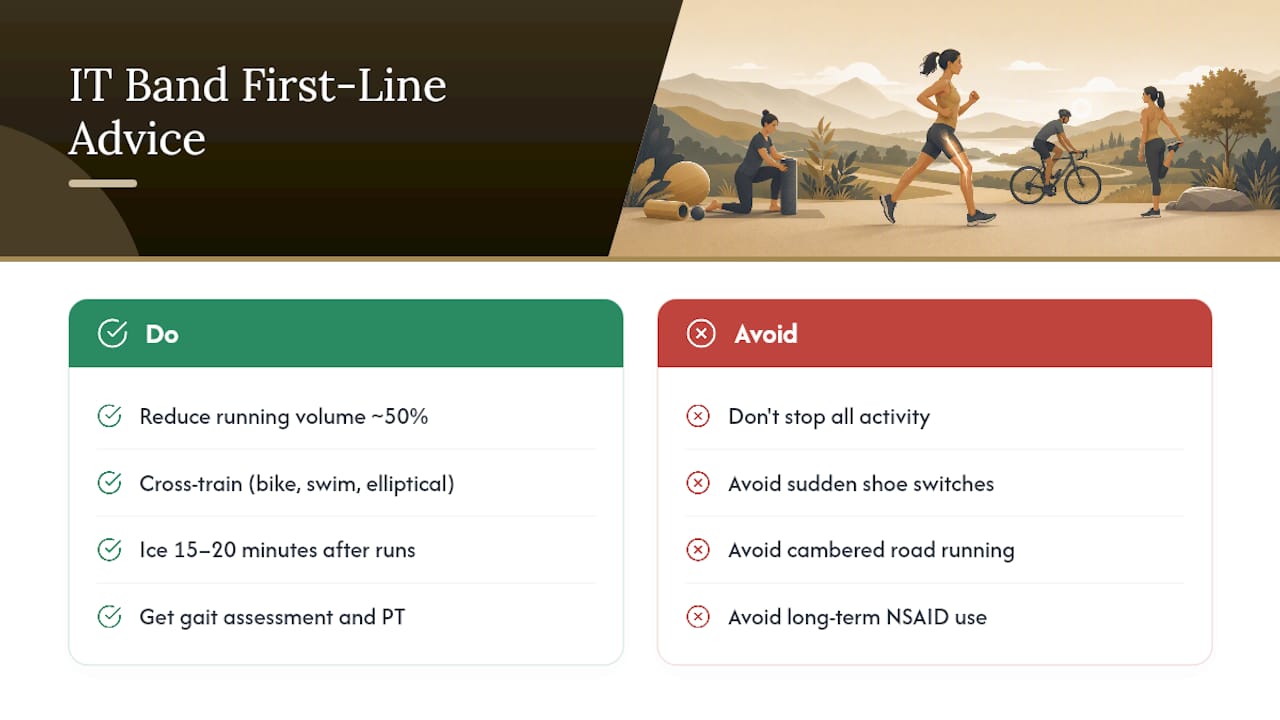
Start with activity modification, not full shutdown. Cutting your running volume by 50% while swapping in cycling, swimming, or an elliptical machine keeps your cardiovascular fitness intact without repeating the exact motion that irritates the band. Complete rest isn’t necessary for most cases and can actually slow your return, since it does nothing to address the hip weakness that likely caused this in the first place.
Ice for 15 to 20 minutes after activity helps manage acute inflammation, and short courses of over-the-counter NSAIDs like ibuprofen can take the edge off pain during the first week or two. Neither fixes the underlying mechanical problem, though, and NSAIDs used beyond a couple of weeks bring diminishing returns and real gastrointestinal risk. If your clinician recommends a corticosteroid injection for a stubborn flare, understand it’s a short-term pain bridge, not a repair. Injections calm inflammation around the lateral synovial tissue but don’t strengthen the hip muscles that are almost certainly part of the problem, and repeated injections can weaken surrounding soft tissue over time.
Equipment matters more than most runners expect. Worn-out shoes, a sudden switch to a minimalist shoe, or running exclusively on a cambered road shoulder all load the IT band asymmetrically. A gait assessment, sometimes as simple as a slow-motion video of you running on a treadmill, can reveal overstriding or excessive hip drop that a shoe change or orthotic won’t fix on its own but can meaningfully reduce.
Pro Tip: Track your pain on a simple 0 to 10 scale before and after each run for two weeks. If it’s trending down even slowly, you’re on the right path. If it’s flat or rising, that’s your signal to see a clinician before pushing further.
Exercise, not passive treatment, is what actually resolves IT band syndrome. The 2013 review of ITBS treatments in athletes found that combined therapy, rest, pain control, stretching, and strength training together produced the best return-to-sport outcomes, with hip abductor strengthening showing up again and again as the core intervention.
Phase 1 (weeks 0 to 2): Wake up the stabilizers.
Phase 2 (weeks 2 to 4): Load it standing up.
Phase 3 (weeks 4 to 8 and beyond): Make it sport-specific.
The rule that governs every step of this program is simple: progress only when the current exercise is pain-free through 3 full sets with clean form. If you can hit that mark, increase load or complexity by roughly 10 to 20%. If pain flares acutely, drop back a phase and figure out why before moving forward again. Clinicians who supervise this kind of graded loading consistently emphasize technique-first progression as the thing that separates a full recovery from a nagging recurrence.
Pro Tip: Log which specific movement triggers your pain (downhill running, stairs, prolonged sitting with crossed legs) and avoid just that trigger during rehab, rather than avoiding all activity. Precision beats total avoidance.
Manual therapy and clinical modalities work best as a booster on top of your exercise program, not a substitute for it. The evidence on shockwave and manual techniques is still developing and somewhat variable, which means these tools are most defensible when they’re paired with the structured strengthening work covered above, not used instead of it.
A few options you’ll encounter at a rehab clinic:
Most patients see 6 to 10 sessions of a given modality worked into a broader plan over several weeks. Insurance coverage for these services varies widely, so check your plan before committing to a full course, and always confirm the clinician is layering the modality onto an active exercise program rather than offering it as a standalone fix.
Time-based and criterion-based benchmarks work better together than either alone. A three-phase framework from Mass General Brigham’s rehabilitation protocol gives you both a timeline and a checklist for progressing safely.
Objective benchmarks matter more than the calendar. Clinicians increasingly stress that returning to sport should hinge on pain-free functional tasks and demonstrated strength, not simply “it’s been six weeks,” since premature return is one of the leading drivers of recurrence. If pain returns during any phase, drop back to the prior phase’s exercises and reassess your technique before trying again. Pushing through a relapse almost always extends the total recovery timeline.
Most IT band syndrome resolves with the conservative approach outlined above. See a clinician promptly if you notice:
If conservative care stalls, the next step is usually formal physical therapy supervision, sometimes paired with a diagnostic injection to confirm the pain source, and imaging to rule out other lateral knee pathology. AAOS OrthoInfo notes that surgery is rarely necessary and is typically only considered after roughly six months of failed conservative treatment. Surgical release of the IT band is the most common procedure, and while outcomes are generally favorable, recovery still involves several weeks of guided rehab before a full return to sport.
Recurrence is common when the underlying hip weakness never got fully addressed. Build these habits into your routine:
Pro Tip: If you’ve had IT band syndrome once, treat hip strength work as part of your training plan permanently, not a rehab phase you graduate from. Recurrence rates drop sharply for runners who keep doing the work after symptoms disappear.
Shephard Health builds IT band treatment plans around the same evidence base covered above, layering in-clinic modalities onto structured exercise rather than offering them as a quick fix. Services relevant to ITBS include:
A typical pathway starts with a consultation and movement assessment, moves into a combined plan of in-clinic modalities and a home exercise program, then reassesses progress against the phase benchmarks described earlier. Same-day appointments and direct insurance billing are available for active patients.
Most advice on this topic still leads with foam rolling and stretching, as if the IT band itself were the problem to be loosened up. It isn’t. The band is dense connective tissue that doesn’t lengthen much no matter how long you roll it, and the research backs that up: the outcomes worth chasing come from hip abductor strengthening, not soft tissue release. Foam rolling has a place as a short-term comfort measure before a workout, nothing more.

The bigger gap is in how recovery gets framed. Runners tend to treat IT band syndrome as a switch, painful, then fixed, rather than a strength deficit that needs ongoing maintenance. That’s why recurrence rates stay stubbornly high. The athletes who stay symptom-free are the ones who keep doing hip and core work long after the pain is gone, not the ones who stop the moment they can run again.
If you take one thing from the evidence here, let it be this: progress by pain-free performance, not by how many days have passed. A rigid six-week timeline ignores the fact that recovery speed varies enormously based on how consistently you do the strength work, not just how much you rest.
— Deane
Reading a phased exercise program is one thing. Executing it correctly, with someone checking your form, tracking your progress, and adjusting the plan when something isn’t working, is what actually gets runners back to full mileage without a relapse. Shephard Health builds exactly that kind of plan for IT band syndrome, combining hands-on treatment options like shockwave therapy and Active Release Technique with a personalized strength and return-to-run progression, so you’re not guessing whether you’re ready for the next phase.

Same-day appointments and direct insurance billing mean you can get an assessment started this week instead of waiting weeks for a referral. If your knee pain has lingered past the point where rest and stretching alone are helping, book a consultation for soft tissue injury treatment and get a plan built around where you actually are in your recovery, not a generic timeline.
Same Day Appointments Available
We Direct Bill!