

Shockwave therapy for Achilles tendinopathy is best used as an optional second-line treatment, not a first choice. Extracorporeal shockwave therapy (ESWT) helps some patients after structured loading programs have failed, but the evidence is inconsistent and effect sizes vary widely across trials. Major guidance bodies, including NICE, recommend it only under proper clinical oversight, and it works best paired with a supervised exercise program rather than used alone.
TL;DR:
- Shockwave therapy should be considered only after at least three months of proper loading exercises have failed, not as a first-line treatment.
- Evidence shows no consistent, clinically meaningful benefit of shockwave therapy beyond placebo, especially when compared to conservative exercises alone.
- Different device types and treatment protocols, such as radial versus focused shockwaves, vary widely, making standardized dosing and outcomes difficult to assess.
- Shockwave therapy carries a small risk of adverse effects, including skin bruising and rare tendon rupture, and should be administered by trained clinicians with proper screening.
- Clinics that track treatment outcomes and combine shockwave therapy with structured rehabilitation provide a more realistic hope of benefit than clinics offering it as a standalone fix.
Stubborn tendon pain? Start with a $67 new patient visit
A chiropractor assesses the problem and tells you whether shockwave therapy fits your plan. See shockwave therapy in Calgary. Book online.
If you’re weighing shockwave therapy for Achilles tendinopathy, you deserve a straight answer about what the research actually shows, not marketing language dressed up as science. The honest picture is mixed, and the most recent large-scale analysis is more cautious than a lot of clinic websites let on.
A 2026 systematic review with meta-analysis published in the Journal of Orthopaedic & Sports Physical Therapy looked at shockwave therapy across both midportion and insertional Achilles tendinopathy and found no clinically meaningful benefit overall. The authors rated evidence certainty from very low to moderate depending on the outcome measured, and they specifically advised against routine use of shockwave therapy for Achilles tendinopathy outside of carefully monitored settings. That’s a notably firmer conclusion than earlier reviews reached, and it matters because this analysis pooled more trials with tighter methodology than prior work.
Earlier reviews told a more encouraging, if muddier, story. A systematic review covering both insertional and non-insertional cases found improvements in VAS pain scores and VISA-A function scores across several individual studies, but the authors flagged substantial heterogeneity: different energy settings, different session counts, different ways of confirming the treatment actually hit the target tissue. A separate systematic review focused specifically on midportion Achilles tendinopathy found that ESWT sometimes beat wait-and-see or purely conservative care, but results were inconsistent when compared against sham treatment or eccentric loading alone.
Here’s the pattern that emerges once you line these findings up side by side:
Statistic Callout: GRADE certainty ratings across ESWT trials for Achilles tendinopathy range from very low to moderate, meaning even the studies showing benefit carry real doubt about whether that benefit would hold up in a larger, better-controlled trial.
None of this means shockwave therapy is worthless. It means the honest clinical stance is measured optimism for the right patient, not a guarantee. NICE’s own evidence summary reaches a similar conclusion: the data are inconsistent and limited in quality, which is why the agency recommends ESWT be delivered only with proper governance, informed consent, and outcome auditing or as part of ongoing research. That’s a meaningfully different message from “shockwave cures Achilles tendinopathy,” and you should expect any clinic recommending it to frame it the same way.
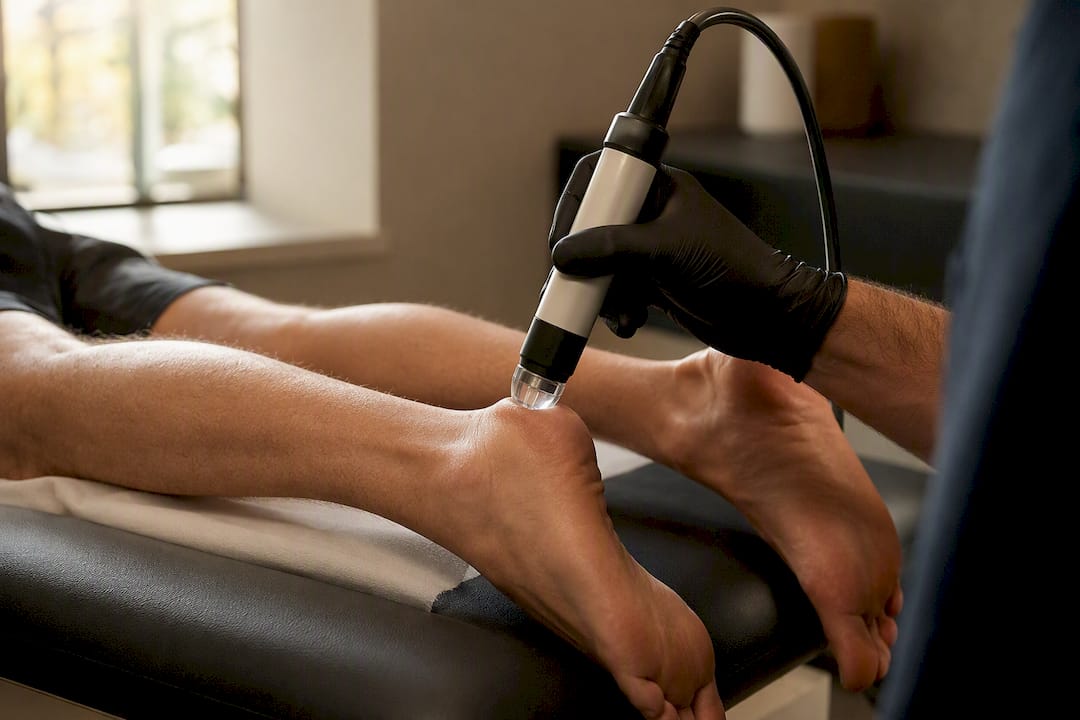
Two different technologies get lumped under the umbrella of shockwave therapy, and the distinction affects what you’ll actually feel and how many visits you’ll need.
Radial pressure wave devices generate a broader, lower-energy pulse that disperses as it travels into tissue. They’re gentler, more common in outpatient physical therapy settings, and generally require less precise targeting. Focused shockwave devices concentrate energy at a specific depth and point, delivering a higher-energy pulse directly to the tendon. Focused devices are the technology used in most of the higher-quality randomized trials, including protocols from researchers like Rompe and Furia, though radial devices remain widely used in practice.
A typical course runs somewhere between one and four sessions, spaced one to three weeks apart, though protocols vary enormously between clinics and studies. That variation is part of why systematic reviews struggle to pool results cleanly. Energy density, pulse count per session, and total number of sessions all differ from trial to trial, which makes head-to-head comparisons genuinely difficult.
One detail surprises a lot of patients: local anesthesia is often deliberately avoided during treatment. NICE’s guidance and several trial protocols note that numbing the area before high-energy shockwave treatment may actually blunt the therapeutic response and make it harder for the clinician to confirm accurate targeting, since patient feedback (where it hurts, how much) helps guide the device.
Pro Tip: If a clinic offers to numb the area before a focused, high-energy shockwave session, ask why. In many protocols, brief discomfort during treatment is actually part of confirming the device is hitting the right spot.
Shockwave therapy isn’t the right starting point for everyone, and it isn’t safe for everyone either. Here’s how to think through your own situation before booking a session.
If any of these apply to you, that’s not necessarily the end of the conversation. It’s a reason to have a direct discussion with a clinician before scheduling anything.
Set your expectations around gradual improvement, not a dramatic single-visit fix. Most patients who respond to shockwave therapy notice changes over weeks to a few months, not days. Clinicians typically track progress using validated tools like the VISA-A questionnaire (Victorian Institute of Sport Assessment, Achilles) and a simple VAS pain scale, checking in at intervals rather than judging success after one session.
Statistic Callout: Several trials report meaningful VAS and VISA-A improvements in the ESWT group by three to six months, yet the 2026 JOSPT meta-analysis concluded these gains, pooled across all available high-quality trials, didn’t consistently clear the bar for a clinically meaningful benefit. Both things are true at once, and that tension is exactly why clinicians should present ESWT as a possibility, not a promise.
Side effects tend to be minor and short-lived:
That last point deserves a plain statement: shockwave therapy carries real, if rare, risk, and it should be delivered by someone trained to screen for the tendon integrity issues that would make rupture more likely.
Progressive loading exercise remains the backbone of Achilles tendinopathy care, and no credible clinician suggests skipping straight to shockwave therapy. Reviews from Bone & Joint and the MSD Manual both point to structured, often heavy-slow-resistance or eccentric loading programs as the first-line, most evidence-backed intervention for reducing pain and restoring function.
The typical escalation pathway looks like this:
Deciding whether you’re a candidate for that second step comes down to three questions: how long you’ve had symptoms, whether you’ve genuinely completed a loading program (not just started one), and what your functional goals actually are. A recreational runner hoping to return to a specific race has a different risk tolerance than someone who just wants to walk without pain. Treatment options for soft tissue injuries generally follow this same staged logic, whether the tissue involved is a tendon, ligament, or muscle.
Walking into a shockwave appointment without knowing what to expect adds unnecessary anxiety to an already frustrating injury. Here’s the general flow you can expect at a clinic that treats Achilles tendinopathy with this technology.
Local anesthesia is usually skipped intentionally, for the same reason described in national guidance: numbing the area can interfere with both targeting accuracy and the tissue response the treatment is trying to trigger. ESWT here is layered onto an existing loading program, not offered as a replacement for it, and outcomes get checked at intervals rather than assumed.
Pro Tip: Bring your exercise log to your first shockwave consultation. Clinicians use it to confirm you’ve actually completed a loading program, which affects whether ESWT is even appropriate for your case yet.
Before committing to a course of treatment, walk through this short checklist with your clinician:
If a clinician can’t answer the outcome-tracking question, or brushes off contraindication screening as unnecessary, treat that as a signal to get a second opinion before proceeding.
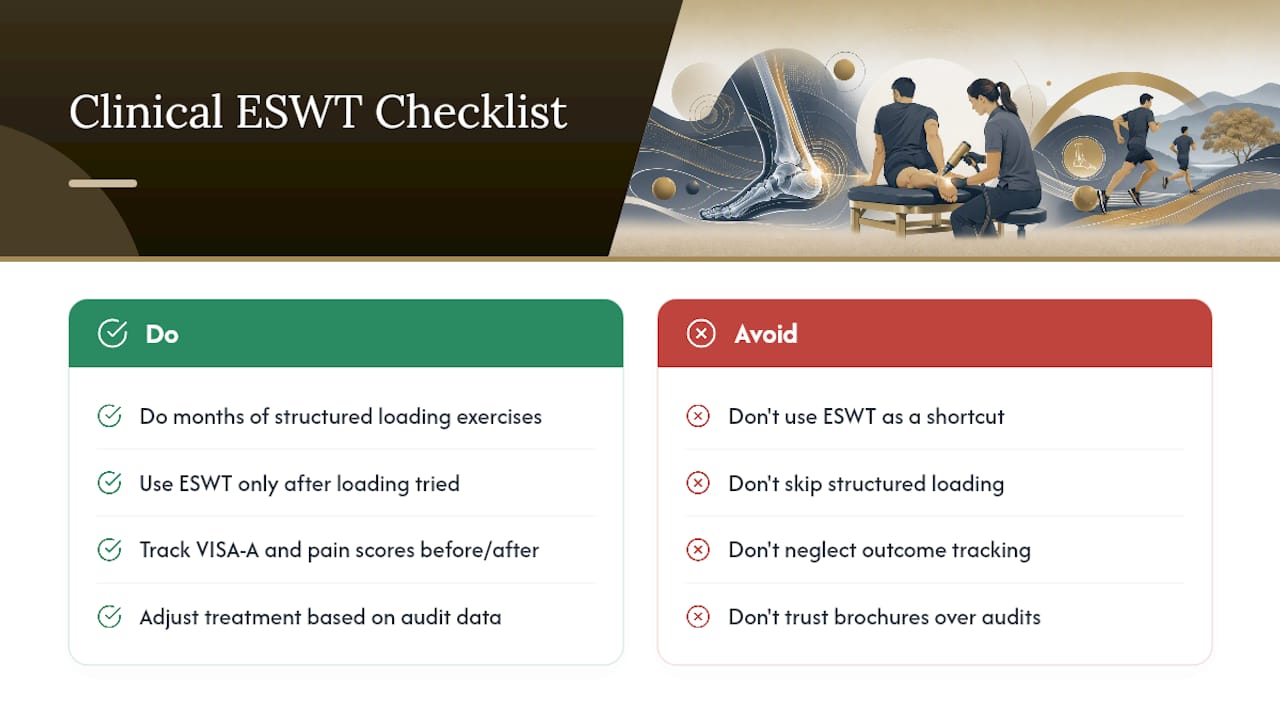
The biggest misconception about shockwave therapy for Achilles tendinopathy isn’t that it doesn’t work. It’s that patients expect it to work instead of the boring part: months of consistent loading exercises. That expectation gap causes most of the disappointment I see referenced in outcome data. ESWT is a reasonable adjunct for a patient who has genuinely put in the work on structured loading and still isn’t where they want to be, not a shortcut around that work.
What gets underrated is the audit piece. A clinic that tracks VISA-A and pain scores before and after treatment, and adjusts its approach based on that data, is practicing very differently from one that treats ESWT as a standalone product. Ask about that difference. It tells you more than any brochure will.
— Deane
Shephard Health treats shockwave therapy as one part of a coordinated recovery plan, not a standalone fix, which is the distinction that separates a clinic that audits outcomes from one that doesn’t. Every ESWT case here starts with an assessment to confirm you’ve already worked through a structured loading program, followed by a treatment plan that layers shockwave sessions on top of your existing rehab rather than replacing it.

A first visit includes a full history review, a hands-on assessment of the tendon, and a clear conversation about realistic expectations before any device touches your leg. If direct insurance billing applies to your plan, the front desk handles that conversation before treatment starts, not after. You can review what a first chiropractic or rehab visit typically involves or explore the shockwave therapy procedure in detail before booking. If you’ve been dealing with Achilles pain for more than a few months and structured exercise alone hasn’t moved the needle, request an assessment through the shockwave therapy service page to find out whether you’re a reasonable candidate.
This article is general information, not a substitute for advice from a qualified doctor. Consult a qualified healthcare professional about your own circumstances before acting on anything here.
Same Day Appointments Available
We Direct Bill!