

Yes, anterior pelvic tilt (APT) responds well to a targeted mix of stretching and strengthening for most people. The NASM corrective continuum, which inhibits tight muscles first, then activates weak ones, produces noticeable change within 4 to 8 weeks for people who stick with it. Your next move: run the Thomas Test below, then start a hip flexor stretch and a glute bridge today.
TL;DR:
- Stretching tight hip flexors and lumbar erectors should be prioritized for 4 to 8 weeks before strengthening exercises for optimal correction.
- Regular self-assessment using the Thomas Test and photos can track progress, but severe tilt, pain, or asymmetry require professional evaluation.
- Common mistakes include skipping stretching, performing crunches that worsen tilt, and rushing into deep stretches, which can cause injury or reinforce imbalances.
- Incorporating specific stretches and activation exercises into warm-ups or cooldowns enhances daily movement and maintains pelvic alignment outside workouts.
- Combining stretching, strengthening, habit modifications, and professional assessments yields the most effective, sustainable correction of anterior pelvic tilt.
Back or hip tightness the exercises have not fixed? Start with a $67 new patient visit
A chiropractor assesses your pelvis, hips and low back, treats on day one when it is safe, and gives you exercises matched to what we find. See chiropractic care in Calgary. Book online.
Stand sideways in front of a mirror or ask someone to snap a photo. If your pelvis tips forward, you’ll usually see an exaggerated lower back curve, a belly that pushes slightly forward even with a flat stomach, and your ribcage flaring up and out rather than stacking over your hips. Check your hip bones, too: your front hip points (the ASIS) sit noticeably lower than the bony points on your lower back (the PSIS) when your pelvis is tilted forward.
The Thomas Test gives you a more reliable read. Here’s how to do it at home:
A positive result on either side tells you where to focus your stretching first. Self-checks are useful for tracking trends, but they’re not a diagnosis. If the tilt looks severe, causes pain, or one side is dramatically different from the other, a professional physiotherapy assessment will catch things a mirror can’t. Take a photo every two weeks, in the same spot and clothing. It’s the easiest way to see if your pelvic alignment is actually shifting.
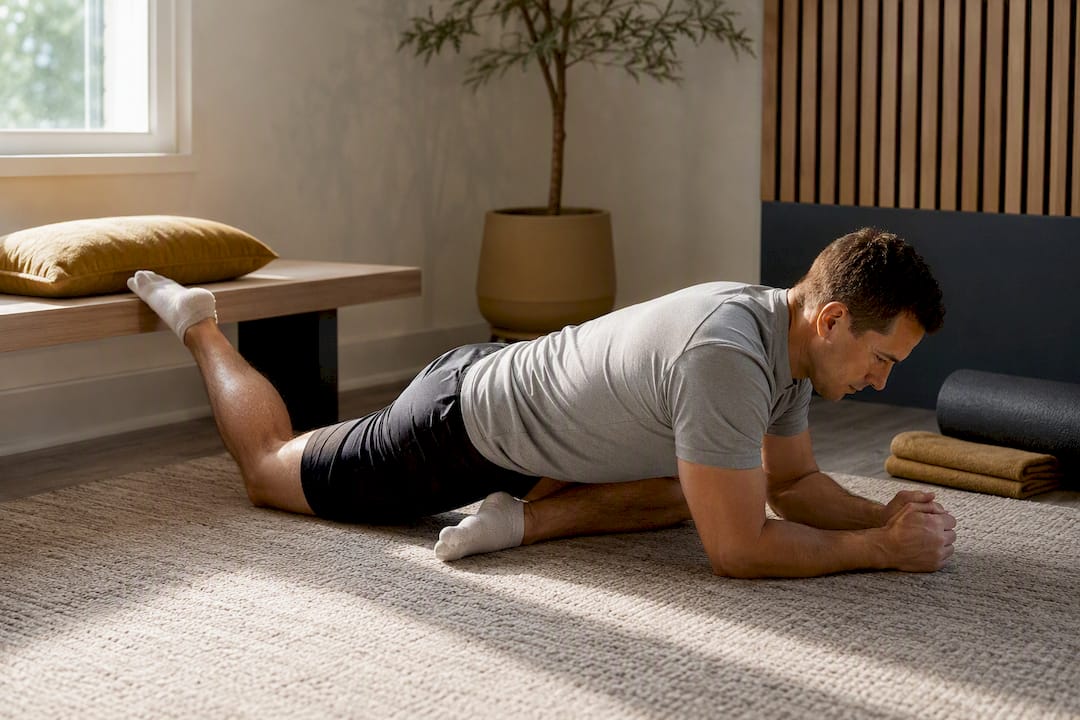
Anterior pelvic tilt is largely a tug-of-war problem. Your hip flexors, quads, and lumbar erectors get short and stiff, then they win the pull. Lengthening them is step one of the NASM model, and it has to happen before strengthening work sticks.
Pro Tip: Do your hip flexor stretch right after you’ve been sitting for an hour or more. Tight muscles respond faster to lengthening work when they’re already warm from being loaded, not cold first thing in the morning.
If you have existing low back pain, skip deep spinal flexion in cat-cow and keep the couch stretch shallow, propped on your forearms instead of upright. Sharp pain anywhere, not the pulling sensation of a stretch, means stop and reassess.
Stretching tight muscles solves half the puzzle. The other half is waking up the glutes, hamstrings, and deep core muscles that have gone quiet from disuse, then teaching them to fire in real movement. This is the “activate” and “integrate” phase of the corrective continuum.
Pro Tip: If you feel your lower back working during a glute bridge instead of your glutes, you’re likely arching instead of squeezing. Cue a slight posterior tilt at the top of every rep, and place a hand on your low back to check it isn’t lifting off the floor.
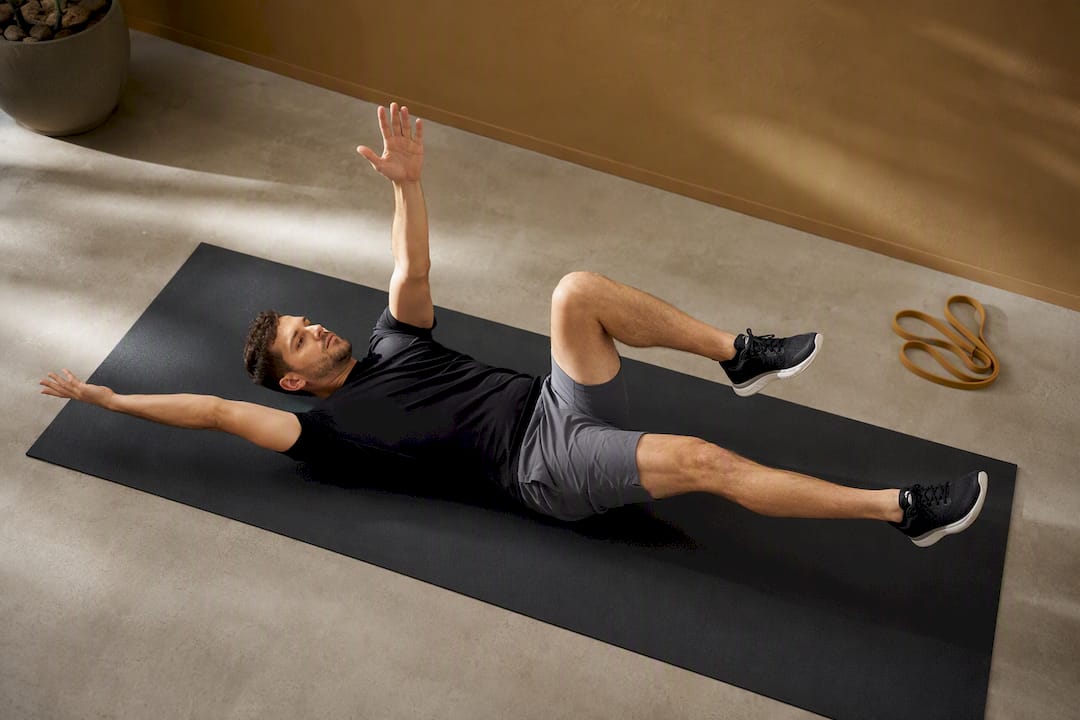
Common compensations include shrugging the shoulders during dead bugs, letting the low back arch during RDLs, and using the quads to dominate squats instead of the hips. A physiotherapy assessment can spot these patterns faster than a mirror.
Consistency beats intensity here. Multiple sessions each week, done over several weeks, is often enough for people to notice a real shift.
Weeks 1 to 2 (foundation): three sessions weekly. Each one: 5 minutes foam rolling and dynamic hip flexor swings as a warm-up, the half-kneeling hip flexor stretch (2 rounds per side), cat-cow (10 reps), then two strengthening drills, glute bridges (3 sets of 15) and dead bugs (3 sets of 8 per side).
Weeks 3 to 4 (build): add the couch stretch, progress bridges to single-leg, and add planks with posterior tilt.
Weeks 5 to 6 (load): replace bodyweight bridges with hip thrusts using a light barbell or resistance band, and add goblet squats or Romanian deadlifts once form is clean.
Improvement windows in clinical and fitness guidance typically land between four and eight weeks, though severity and adherence both move that number. Someone doing the program twice a week half-heartedly won’t see what someone doing it three times with real posterior tilt cues will.
For deeper background on the ergonomic side of this problem, Shephardhealth’s guide to desk setup covers chair height, monitor position, and break scheduling in more detail than fits here. Athletes layering this work into training should also look at a mobility restoration checklist built for exactly this kind of integration work.
Home exercise handles most cases of anterior pelvic tilt, but not all of them. Get a professional assessment promptly if you notice any of the following:
Cleveland Clinic names physical therapy the primary non-surgical treatment for pelvic tilt, and for good reason. A clinician adds hands-on assessment, sacroiliac joint stabilization when that’s part of the picture, and sensorimotor retraining that’s genuinely hard to self-cue in a mirror.
Individualized assessment and workplace ergonomics education matter most for people who sit for long stretches every day. A generic exercise sheet rarely accounts for how your specific job, old injuries, or movement habits feed into your particular tilt.
At Shephardhealth, evaluating anterior pelvic tilt starts with a hands-on assessment, not a template. Depending on what that assessment finds, your plan might include Active Release Technique for stubborn hip flexor tightness, laser therapy to calm irritated soft tissue, or shockwave therapy for chronically overactive muscle groups, paired with a home program built around your actual movement pattern. With direct insurance billing and same-day booking, getting that first assessment doesn’t have to wait weeks. Most people coordinating professional care with a home program see change within the same 4 to 8 week window, often faster because compensations get corrected early instead of practiced for a month.
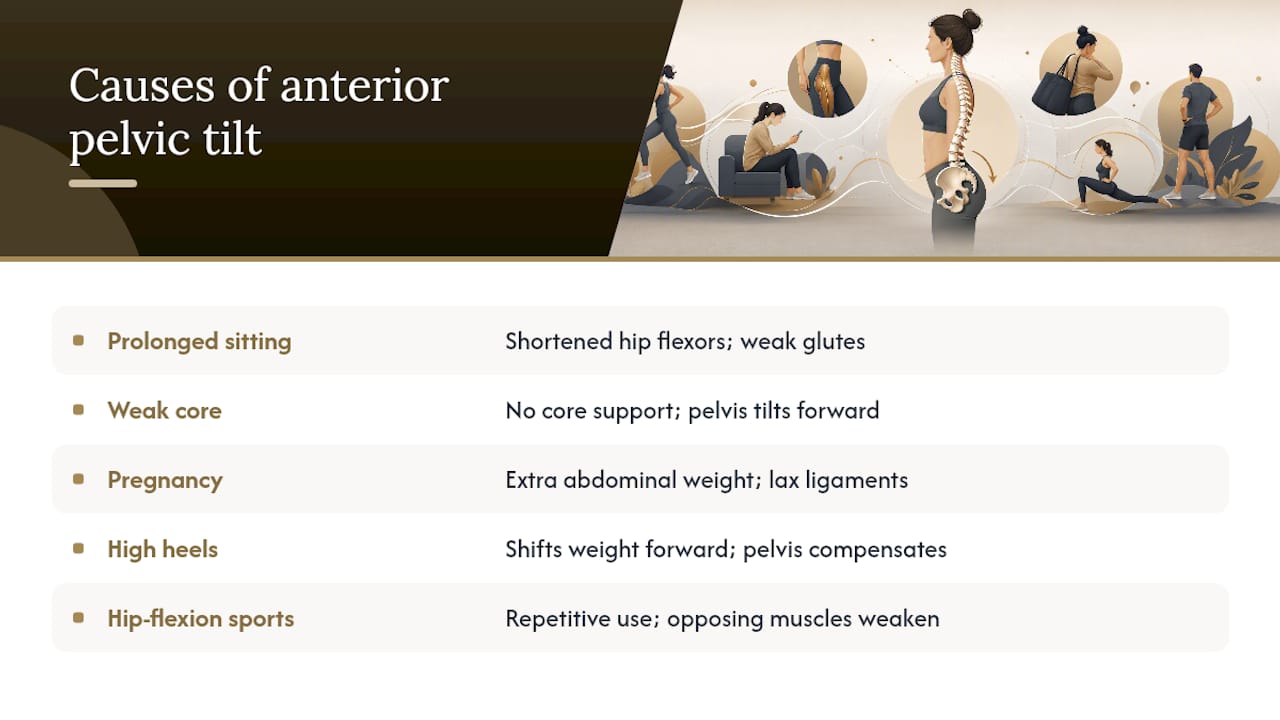
Prolonged sitting is the most common driver. Hip flexors shorten in a seated position for hours at a time, and the glutes go quiet from disuse. Do that eight hours a day, five days a week, and your body adapts to that position as its new normal, even when you stand up.
Weak deep core muscles let the pelvis drift forward because nothing is holding it level against the pull of tight hip flexors and lumbar erectors. Pregnancy is another common cause. Added abdominal weight and hormonal changes that loosen ligaments both push the pelvis into a more forward-tilted resting position, one reason postpartum patients often benefit from chiropractic care as they rebuild core stability.
High heels are a sneaky contributor. They shift your weight forward onto the balls of your feet, which your body compensates for by tilting the pelvis forward to keep balance. Athletes in sports dominated by hip flexion, cycling and sprinting among them, can develop the same imbalance simply from repetitive movement patterns that never train the opposing muscles.
Genetics and anatomy play a role too. Some people are built with a naturally deeper lumbar curve, which isn’t dysfunction on its own. The distinction matters: correction targets the muscle imbalance, not necessarily the exact curve, and a clinician can tell you which situation you’re actually in.
Left uncorrected, APT rarely stays a cosmetic posture issue. The exaggerated lower back curve increases compressive load on the lumbar spine, and that’s a common contributor to chronic low back pain over time.
Tight hip flexors that never get lengthened can also alter how your hip joint moves during walking and running, which shows up downstream as knee pain or hip impingement symptoms in some people. Your glutes, meanwhile, keep getting weaker the longer they stay underused, which feeds the same cycle that caused the tilt to begin with. It’s a loop that tends to reinforce itself rather than resolve on its own.
Some people also notice reduced core endurance and a “tired back” feeling by the end of a workday, since the lumbar erectors are working overtime to stabilize a pelvis position they weren’t designed to hold constantly. Athletic performance can take a hit too. A tilted pelvis changes the length-tension relationship of the glutes and hamstrings, which can blunt power output in movements like sprinting, jumping, and heavy lifting.
None of this means anterior pelvic tilt is an emergency. It usually develops over months or years, and it responds to correction on a similar, if shorter, timescale. But the symptoms rarely stay isolated to the pelvis, which is exactly why catching it early with a Thomas Test and a consistent routine pays off.
The single biggest mistake is strengthening the glutes and core without ever lengthening the hip flexors first. NASM’s corrective continuum puts inhibition before activation for a reason: a muscle that’s already short and tight doesn’t respond well to more loaded work stacked on top of it. Skip the stretching phase and you’ll often just build strength on top of the same imbalance.
Another frequent error is doing crunches or sit-ups to “fix” the core, which can actually reinforce a forward pelvic tilt by pulling the ribcage down and the pelvis forward. Dead bugs and planks with a posterior tilt cue train the same core muscles without that side effect.
Rushing the couch stretch is a common injury risk. Going straight to an upright torso without building tolerance first can pinch the front of the hip or strain the knee. Build up gradually, propped on your forearms before progressing.
Watch for these compensations specifically:
If a stretch or exercise produces sharp, localized pain rather than a general pulling or working sensation, stop and modify the range or scale back the load.
Anterior pelvic tilt work doesn’t need its own separate hour at the gym. The stretches fit naturally into a warm-up before any lower-body or full-body session, and the strengthening moves double as solid accessory work for glutes and core that most training programs already need.
Do the hip flexor stretch and a few dead bug reps before squats or deadlifts, since a pelvis that’s already positioned correctly makes those lifts safer and more effective. Glute bridges and single-leg progressions slot in well as an activation drill before leg day, waking up muscles that often stay dormant during heavier compound lifts otherwise.
For runners and cyclists, add the couch stretch and cat-cow to a post-training cooldown rather than skipping stretching altogether, since these sports load the hip flexors repetitively without a built-in counterbalance. Strength athletes should treat Romanian deadlifts and hip thrusts as legitimate programming, not just corrective busywork; they build real posterior chain strength while reinforcing the pelvic position you’re trying to train.
The habit changes matter just as much as the workout itself. Micro-breaks during long sitting blocks, mindful posture during standing tasks, and swapping heels for flatter shoes on high-mileage days all compound with your exercise routine rather than competing with it. Think of the gym work as the correction and the daily habits as what keeps the correction from unraveling.
Most articles on this topic hand you a list of stretches and call it done. That’s incomplete advice, and the systematic review evidence backs that up. Interventions combining stabilization work with activation consistently outperform stretching alone. Stretching a tight hip flexor without ever teaching your glutes to fire is treating half a problem.
The conventional wisdom also underplays the habit side of this. Exercise-only programs consistently show weaker carryover than programs that pair a routine with movement awareness throughout the day. If you do your 20-minute session and then sit slumped for nine more hours, you’re fighting your own gains all day long.
What I’d prioritize first: master the posterior tilt cue before adding load to anything. It’s the one skill that makes every other exercise in this program actually work, from bridges to squats to standing posture itself. Get that right, layer in the micro-breaks, and the six-week timeline stops feeling like a stretch and starts feeling conservative.
— Deane
This article is general information, not a substitute for advice from a qualified doctor. Consult a qualified healthcare professional about your own circumstances before acting on anything here.
Same Day Appointments Available
We Direct Bill!