

Cold laser therapy, also called photobiomodulation or low-level laser therapy (LLLT), is generally safe when administered by a trained clinician. Systematic reviews covering thousands of patients report no serious adverse events. Before your first session, confirm three things with your provider: screening for active cancer or infection, avoidance of the abdomen and pelvis if you’re pregnant, and consistent eye protection for you and staff. Bring your full medical history and ask how many sessions your plan calls for.
TL;DR:
- The effectiveness of laser therapy remains uncertain due to inconsistent dosing, device variability, and limited high-quality research, despite its strong safety profile.
- Patients with active cancer, pregnancy in the pelvic area, or ocular exposure risks should avoid treatment or consult their clinician beforehand to prevent complications.
- Mild side effects like tingling, redness, or temporary pain flares are common and usually resolve within 48 to 72 hours, but symptoms lasting longer warrant medical attention.
- Proper screening, individualized dosing, and clinician oversight are essential to maintaining safety and maximizing potential benefits of laser therapy.
- Most treatment protocols involve 8 to 30 sessions, with initial improvements often seen after 3 to 5 visits, and therapy works best when combined with other rehabilitation methods.
The evidence on laser therapy side effects is reassuring, with a real caveat attached. A systematic review of low-level laser therapy for nonspecific low-back pain found no serious adverse events across the trials it examined, and a broader clinical review of photobiomodulation for musculoskeletal pain control reached the same conclusion while cataloging the handful of situations where the therapy should be avoided altogether.
The caveat is effectiveness, not danger. A Cochrane review of low-level laser therapy for low-back pain found small, mixed trials with no reported side effects, but concluded the evidence base is too thin and too inconsistent in dosing to make firm claims about how well it works. Trial sizes tend to be modest, devices vary widely in wavelength and power, and some studies carry industry ties that create bias risk.
Statistic callout: A systematic review of photobiomodulation therapy in musculoskeletal rehabilitation pooling roughly 2,800 patients reported no serious adverse events, with average pain reduction on standard pain scales landing around 28 to 32 percent versus sham treatment in the conditions studied.
Put simply: the safety data is strong. The effectiveness data is promising but still maturing, which matters when you’re deciding whether laser therapy vs. ultrasound, or laser therapy alongside manual therapy, makes more sense for your specific injury.
Most people who ask about side effects of laser therapy are picturing something dramatic. In practice, the reactions clinicians see are minor and short-lived.
These post-laser treatment symptoms typically show up during the session or within a few hours afterward, and clear up on their own within 48 to 72 hours. That window matters: if a symptom is still building past day three, it’s no longer in the “expected” category.
Pro Tip: Keep a simple note on your phone tracking pain level, redness, and any new symptoms for the two days after each session. Patterns are easier to spot than memories, and your clinician will want specifics if something feels off.
Call your clinic if pain climbs above your pretreatment baseline, redness spreads beyond the treated area, or you develop a fever. Those aren’t part of the normal recovery curve and deserve a follow-up call the same day.
Laser treatment risks are low overall, but a handful of situations rule it out entirely or require real caution. Your clinician should walk through these before your first appointment, not after.
None of this is meant to scare you off the therapy. It’s meant to make sure the small number of real exceptions get caught before they become a problem.
If you feel more discomfort mid-session than expected, that’s a signal for your clinician to act, not something to push through. Standard practice is to stop or reduce the energy dose immediately, reposition the probe, and reassess tissue sensitivity before continuing. That kind of real-time adjustment is exactly why clinic-administered treatment beats an unsupervised device.
In-clinic checks typically include:
At home, recovery is mostly about patience. Rest the area, use ice briefly if a flare shows up, and ease back into normal activity rather than jumping straight into a workout. Over-the-counter pain relief is fine if your clinician has already approved it for you.
Pro Tip: Set a two-day mental checkpoint after each session. If swelling, redness, or pain is trending down by then, you’re on the expected curve. If it’s trending up, call the clinic instead of waiting it out.
Seek urgent care for vision changes, spreading infection, or pain that keeps worsening well past the 72-hour mark. Those are outside the range of normal laser therapy recovery effects.
Nobody feels dramatically better after one session, and that’s normal. Most protocols run somewhere between 8 and 30 sessions, typically scheduled 2 to 4 times per week depending on the condition and how your tissue responds.
A randomized, sham-controlled trial of the Erchonia FX 635 device illustrates the range: 72.4% of participants receiving active treatment reported clinically significant improvement in chronic low-back pain, compared with 27.6% in the sham group, over eight 20-minute sessions, with no safety concerns identified during the trial.
Outcomes depend heavily on wavelength, energy dose, and the specific condition being treated. That’s part of why “how many sessions will I need” doesn’t have a one-size answer, and why a personalized plan matters more than a generic protocol.
At Shephard Health, laser therapy is built into a broader assessment, not handed out as a default add-on. Every plan starts with an individualized evaluation, and cold laser gets paired with other modalities, like manual therapy or targeted exercise, when that combination fits your diagnosis better than laser alone.
Safety steps built into the process include a full medical-history screen for cancer, infection, and pregnancy status, documented eye protection for both patient and staff, and dosimetry that’s tracked and adjusted session to session rather than applied on autopilot. Clinic experience with conditions like diabetic nerve pain has shown that 10 to 12 sessions can ease symptoms for some patients, though your own timeline depends on your specific condition.
You’ll also talk through expected benefits, session counts, and insurance coverage before committing to a plan. That conversation is where questions about laser therapy complications or cost belong, not after you’ve already started.
Here’s what gets lost in most consumer explanations of laser therapy: when a study shows no benefit, the laser itself is rarely the reason. It’s usually the dose.
Wavelength and energy density vary enormously across devices on the market, commonly ranging from 630 to 904 nanometers, with wildly different joule-per-square-centimeter settings from one study to the next. Consensus guidance on clinical study design for LLLT, shaped by standards from the World Association for Laser Therapy (WALT), exists specifically because inconsistent dosing has muddied the research for years. A trial using too little energy will show no effect, not because photobiomodulation doesn’t work, but because the dose given wasn’t enough to trigger a cellular response.
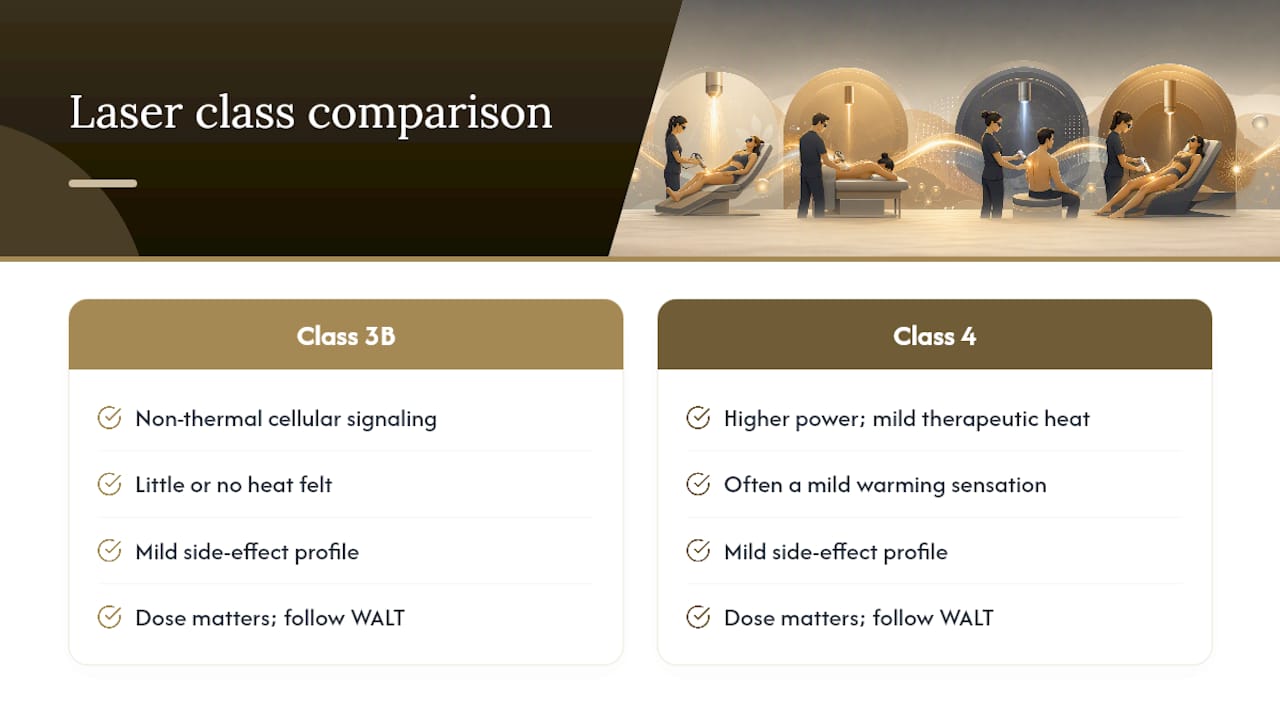
This is also where the PBMT versus high-intensity laser distinction actually matters. Class 3B cold lasers, the kind used in most rehab and chiropractic settings, work through non-thermal cellular signaling. Class 4 lasers deliver more power and can produce a mild therapeutic heating effect, which changes both the treatment protocol and what a patient should expect to feel during a session. Neither approach produces the kind of thermal tissue destruction associated with surgical or ablative lasers, which explains why the side effect profile across both stays mild.
If your clinician follows WALT-informed dosing standards, you’re getting a treatment that’s more likely to match what the strongest trials actually tested, rather than a protocol invented on the fly.
The honest answer is that long-term data is limited, mostly because photobiomodulation doesn’t damage tissue the way high-intensity or ablative lasers can. The mechanism itself works at the cellular level, stimulating mitochondrial activity rather than generating the heat that causes lasting tissue change.
No systematic review or trial in the current literature has flagged cumulative or delayed harm from repeated cold laser sessions administered within standard protocols. That’s consistent across the reviews cited earlier: the risk profile at session 30 looks the same as it does at session one, assuming dosing and screening stay consistent throughout.
The real long-term risk isn’t physiological. It’s the opportunity cost of relying on laser therapy alone for a condition that needs a combined approach. Photobiomodulation is best used as one piece of a rehab plan; treating it as a standalone cure for a structural problem, a torn tendon that needs mechanical loading, for example, can delay the treatment that actually addresses the root cause. That’s a planning risk, not a safety one, but it’s worth naming plainly.
Photosensitizing medications are the main interaction concern. Certain antibiotics, some acne medications, and specific herbal supplements can make skin more reactive to light exposure, including laser wavelengths. Disclosing your full medication list before your first session, not just what feels relevant, lets your clinician adjust the dose or skip a treatment area if needed.
Laser therapy generally combines well with other rehab treatments rather than conflicting with them. It’s commonly used alongside chiropractic adjustments, Active Release Technique, and exercise-based rehab, and clinicians often sequence it deliberately, using laser to calm inflammation before manual therapy addresses joint or soft-tissue restriction.
Recent surgery is a separate disclosure item, not strictly a medication interaction, but it belongs in the same conversation. Laser applied too close to a fresh surgical site or unhealed wound needs clinician judgment about timing and placement. If you’re on blood thinners, this is also worth flagging, since it can influence how your clinician reads any localized redness or sensitivity after treatment.
None of these interactions are common causes of serious problems. They’re the reason a proper intake conversation exists in the first place.
Yes, and this is where a lot of consumer confusion starts. Not all lasers used in rehab settings are the same, even when they’re grouped under one umbrella term.
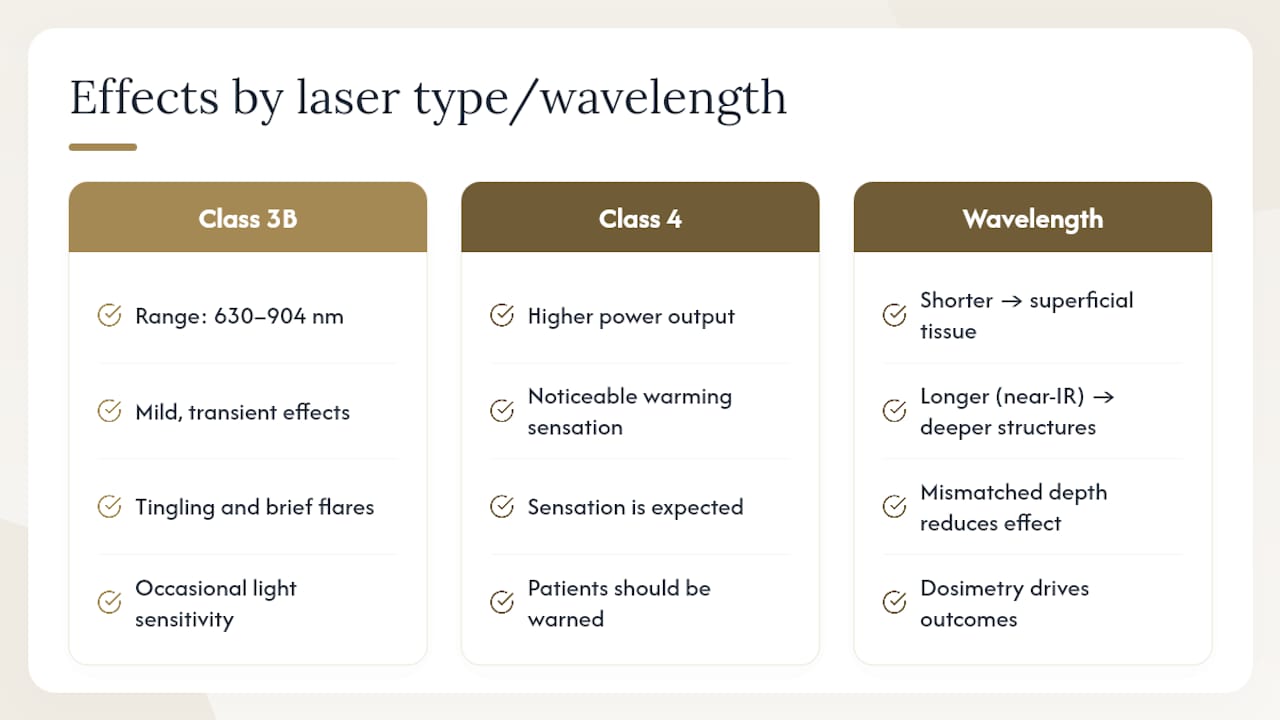
Class 3B cold lasers, typically operating in the 630 to 904 nanometer range, produce the mild, transient effects covered earlier: tingling, brief flares, occasional light sensitivity. Class 4 lasers deliver higher power output and can generate a noticeable warming sensation during treatment, which is expected rather than a sign of malfunction, but does mean patients should be told in advance what they’ll feel.
Wavelength also affects how deep the energy penetrates. Shorter wavelengths tend to affect more superficial tissue, while longer near-infrared wavelengths reach deeper structures, which is part of why a clinician chooses a specific device and setting based on whether they’re treating a shallow tendon or a deeper muscle layer. Mismatched wavelength-to-depth targeting doesn’t typically cause harm, it just reduces how effective the session is, another example of why dosimetry drives outcomes more than the general category of “laser therapy” does.
Across every wavelength and class used in musculoskeletal rehab, the one universal rule stays constant: eye protection specific to that wavelength is required for patient and staff, since retinal risk applies to the whole spectrum, not just higher-powered devices.
Side effect risk isn’t distributed evenly. A few patient factors shift the odds, and a good clinician screens for them before treatment starts rather than reacting after the fact.
Darker skin types can absorb light energy differently than lighter skin, which sometimes calls for a dosage adjustment to avoid overtreating the area. People with diabetes or peripheral neuropathy have reduced sensation in the treatment zone, making it harder to self-report discomfort during a session, which is part of why clinicians rely more on visual skin checks for these patients. Anyone with a known autoimmune condition affecting skin or connective tissue should flag it during intake, since flare patterns can look similar to expected post-laser redness and are worth distinguishing early.
Age plays a role too, though less dramatically than most people assume. Older adults with thinner skin or slower healing may take slightly longer to clear mild redness, without it signaling anything more serious. And patients already on photosensitizing medications, covered in the interactions section above, carry a higher chance of a light-related skin reaction regardless of their baseline skin type.
None of these factors make laser therapy unsafe for these groups. They just mean the standard protocol sometimes needs adjusting, which is exactly what an individualized assessment is for.
The safety data on cold laser therapy is about as reassuring as musculoskeletal treatments get. What gets overlooked in most consumer guides is that the safety numbers hold specifically because trained clinicians are screening patients and controlling dosage. Strip out that screening step, and the risk profile changes.
The conventional advice online tends to either overstate the danger (treating any laser as high risk because of the word “laser”) or understate the importance of dosing (treating every device and protocol as interchangeable). Neither is accurate. The mixed effectiveness findings in the research trace back almost entirely to inconsistent dosimetry, not to any inherent flaw in photobiomodulation as a mechanism.
If you’re weighing this treatment, prioritize the intake conversation over the marketing claims. Ask what wavelength and dose your clinic uses, whether it follows WALT-informed protocols, and how they’ll adjust if you’re in a higher-risk category. A clinic that answers those questions specifically, rather than generically, is one that’s actually paying attention to the evidence.
— Deane
If you’ve read this far, you already know the real safety work happens before the laser ever turns on: a thorough screen for contraindications, a clear plan for how many sessions you’ll need, and a conversation about how laser fits with the rest of your care. That’s exactly how Shephard Health’s laser therapy program is built, as part of an individualized plan rather than a one-size treatment handed out on autopilot.

Appointments may be available to accommodate your schedule, and the clinic handles insurance billing where applicable to provide cost information before treatment begins. Bring your full medical history and current medication list to your first visit. If you’re not sure whether laser is the right fit or whether another approach like Active Release Technique or shockwave therapy makes more sense for your injury, that’s exactly what the consultation is for. Book a consultation to get a plan built around your specific condition.
This article is general information, not a substitute for advice from a qualified doctor. Consult a qualified healthcare professional about your own circumstances before acting on anything here.
No. Most patients feel warmth or mild tingling during treatment, and any brief increase in pain afterward typically resolves within 48 to 72 hours.
Treatment over the abdomen or pelvis should be avoided during pregnancy, but other body areas may still be treatable. Discuss your specific situation with your clinician before booking.
Mild effects like tingling, redness, or a short-term pain increase typically clear up within hours to a few days, usually no more than 48 to 72 hours.
Photosensitizing medications, including certain antibiotics and acne treatments, can increase skin reactivity to laser wavelengths, so disclose your full medication list before your first session.
Yes, without exception. Both patient and staff must wear wavelength-appropriate eyewear, since direct laser exposure to the eyes can cause permanent retinal damage.
Session counts vary by condition, but clinic experience shows plans often run 8 to 30 sessions, with some patients noticing initial relief after 3 to 5 visits. Your provider will confirm an individualized plan during your consultation.
Same Day Appointments Available
We Direct Bill!