
Most people with TMJ (temporomandibular joint) pain get better without surgery. Conservative measures like jaw rest, soft diet, guided exercises, and stress management reduce symptoms in 50–90% of patients, which makes them the right starting point for nearly everyone. Your treatment roadmap, in order: self-care and behavior changes first, then targeted exercises and hands-on physical therapy, then dental appliances if grinding or bite issues are confirmed, then minimally invasive procedures like injections or arthrocentesis only after conservative care has genuinely failed, and surgery reserved as a last resort for structural disease that doesn’t respond to anything else.
Here is what that looks like in practice:
Shephardhealth offers same-day appointments for jaw pain assessment and follows exactly this conservative-first pathway, with Active Release Technique, Graston, laser therapy, and licensed massage on-site.
A thorough evaluation shapes everything that follows. Clinicians typically open with a focused history: where the pain is, whether it’s worse with chewing or talking, whether the jaw locks or catches, any history of trauma or bruxism, and whether headaches, ear fullness, or tinnitus accompany the jaw symptoms. Stress and clenching habits often surface here too, and they matter because muscle-driven TMJ disorders respond differently than structural joint disease.
The physical exam covers several areas:
When imaging is actually useful:
| Indication | Preferred Imaging | Notes |
|---|---|---|
| Suspected disc displacement or soft-tissue pathology | MRI | Best for disc position, joint effusion, and soft tissue |
| Suspected bony changes, fracture, or degenerative joint disease | CT | Best for cortical bone detail |
| Routine TMJ pain without mechanical symptoms | Usually not needed | Start conservative care first |
| Progressive jaw limitation not responding to care | MRI or CT | Guides surgical planning if needed |
| Suspected condylar fracture after trauma | CT | Urgent referral warranted |
Plain X-rays have limited value for most TMJ presentations. For the majority of patients with pain and clicking but no progressive limitation or trauma, imaging adds little to the initial plan. Reserve it for cases where mechanical dysfunction persists after a fair trial of conservative care, or when surgery is being considered.
Conservative care is not a placeholder while you wait for “real” treatment. For most people, it is the treatment.
Self-care checklist:
Medications: Over-the-counter NSAIDs like ibuprofen or naproxen sodium are appropriate for short-term pain and inflammation control. Acetaminophen is a reasonable substitute if NSAIDs are contraindicated due to gastrointestinal issues, kidney concerns, or blood-thinning medications. Do not use NSAIDs continuously for more than 10 days without checking with your physician. Short-term muscle relaxants (cyclobenzaprine, for example) can reduce nighttime clenching and acute muscle spasm, but they require a prescription and are not appropriate for long-term use. Topical diclofenac gel applied over the masseter is an option for localized muscle pain with fewer systemic effects.
Behavioral changes: Teeth-contact awareness is one of the highest-yield habits you can build. Most people unconsciously hold their upper and lower teeth together throughout the day, which keeps the masseter and temporalis under constant low-grade load. The goal is lips together, teeth apart, tongue resting lightly on the palate. Reducing gum chewing, pen chewing, and nail biting removes repetitive jaw loading. Diaphragmatic breathing practiced for five minutes before bed lowers overall muscle tone and reduces nighttime clenching.

Pro Tip: Set a phone reminder every hour with the cue “lips together, teeth apart.” Patients who practice this awareness habit consistently report faster symptom reduction than those who rely on medication alone.
Physical therapy for temporomandibular disorders (TMD) uses a combination of home exercises, hands-on mobilization, postural training, and adjunct modalities as explained in this Reactive Neuromuscular Training guide. The research supports it: physiotherapy modalities including passive stretching, resistance exercises, postural training, and thermotherapy are standard components of TMD management.
Using a mirror with a vertical reference line drawn on it helps you confirm your jaw is opening straight rather than deviating to one side. Deviation reinforces faulty movement patterns that perpetuate clicking. A vertical line of tape on a bathroom mirror works well.
Expect some transient muscle soreness in the first 1–2 weeks. Clinicians note this is a normal adaptation response, not a sign that exercises are harmful, and consistent practice for 2–3 weeks is typically needed before you notice meaningful improvement.
Beyond home exercises, a physical therapist may use soft-tissue mobilization, joint mobilization of the TMJ and cervical spine, postural retraining, and adjunct modalities. Ultrasound and TENS can reduce acute muscle pain and improve tissue extensibility before manual work. Laser therapy is another adjunct that some clinics use to reduce inflammation and promote tissue healing in the joint area.
Cervical spine work is often overlooked in TMJ care. The upper cervical joints share neural pathways with the trigeminal nerve, and forward head posture increases the compressive load on the jaw joints. Addressing neck mobility and deep cervical flexor strength frequently reduces jaw pain even when the neck itself is not the primary complaint.
Cleveland Clinic guidance highlights that targeted massage releases trigger points and restores muscle balance rather than simply masking pain, making it a high-value addition to exercise. External massage of the masseter (along the cheek and angle of the jaw), temporalis (at the temple), and suboccipital muscles (at the base of the skull) can be performed by a therapist or carefully self-applied.
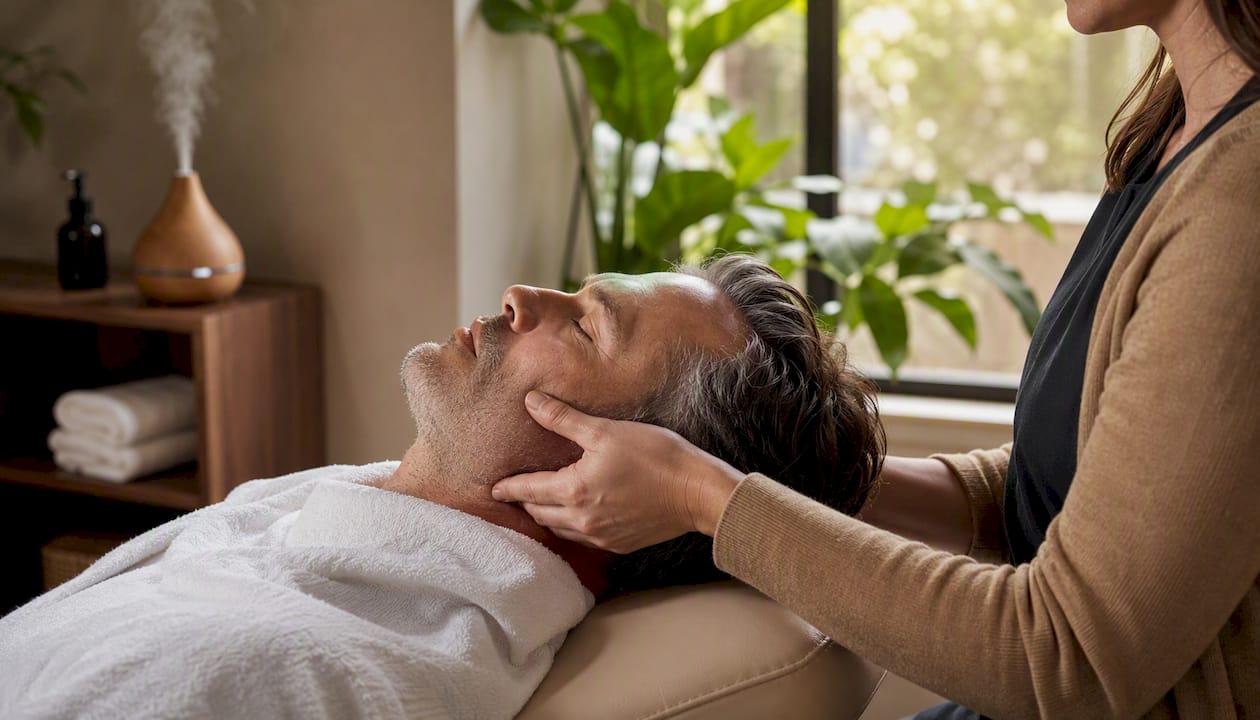
Intraoral massage directly accesses the medial and lateral pterygoid muscles and is often the missing element for chronic clicking or locking that external work alone does not resolve. A gloved finger is inserted inside the cheek to apply direct pressure to the pterygoid attachment points. The technique can be intense but produces rapid functional gains. It requires a trained, consenting clinician and is not a self-treatment. For patients with significant clicking or locking that hasn’t responded to external massage and exercises, intraoral work is worth requesting specifically.
Pro Tip: Pair diaphragmatic breathing with every manual therapy session. Registered Massage Therapist Hannah Etlin-Stein notes that nervous-system downregulation significantly enhances manual therapy outcomes because the jaw muscles respond to sympathetic tone. Breathing slowly and deeply before and during treatment lets the therapist work more effectively and reduces post-treatment soreness.
For more on how massage therapy addresses trigger points in adjacent muscle groups, Shephardhealth’s resources on neck and soft-tissue work are directly applicable to TMJ care.
Night guards and occlusal splints are among the most commonly prescribed TMJ interventions, and they are also among the most misunderstood.
A splint is a custom-fitted acrylic device worn over the upper or lower teeth, typically at night. Its primary job is to protect tooth surfaces from grinding wear and to reduce the compressive forces transmitted to the joint during bruxism. Some patients also report reduced morning jaw pain and headaches. What splints do not reliably do is correct the underlying cause of TMJ pain, particularly when that cause is muscular or stress-related.
What the evidence shows:
When dental correction is considered: Orthodontic treatment or occlusal adjustment (reshaping tooth surfaces) is occasionally discussed for TMJ patients. This should only happen after a multidisciplinary evaluation confirms a clear, demonstrable bite-related cause. Irreversible dental procedures, including grinding down teeth or permanent bite changes, should never be the first-line response to TMJ pain. The evidence for occlusal adjustment as a primary TMJ treatment is not strong enough to justify permanent changes without a clear indication.
Pro Tip: If you are prescribed a splint, ask your dentist whether it is a flat-plane stabilization design. Repositioning splints worn continuously can shift your bite permanently. Clarify the intended wear schedule and the plan for reassessment.
Invasive interventions are reserved for patients who have not improved after a consistent, adequate course of conservative therapy. That threshold matters. Procedures carry real risks and should not be offered as shortcuts around physical therapy and behavioral change.
Procedural options:
| Procedure | Primary Use | Key Limitation |
|---|---|---|
| Arthrocentesis | Disc displacement, adhesions, inflammatory flare | Requires specialist; not for structural disease |
| Corticosteroid injection | Acute osteoarthritic pain | Cartilage risk with repeated use |
| Hyaluronic acid injection | Degenerative joint changes | Mixed evidence; patient selection matters |
| Botulinum toxin | Myofascial muscle overactivity | Not for structural joint disease; evidence still developing |
Combining any of these procedures with ongoing rehabilitation produces better outcomes than procedures alone. A joint injection that reduces pain is most valuable when you use that window of reduced pain to progress your exercises and manual therapy.
Surgery is appropriate for a small subset of patients: those with structural joint disease that has not responded to comprehensive conservative and procedural care, severe degenerative changes confirmed on imaging, or irreducible mechanical locking that prevents normal function.
Checklist for surgical appropriateness:
Surgical options, in order of invasiveness:
Surgery does not eliminate the need for rehabilitation. Post-operative physical therapy and jaw exercises are required to restore range of motion and prevent scar tissue formation.
Setting realistic expectations prevents both premature abandonment of conservative care and unnecessary escalation.
Timeline:
Conservative care reduces symptoms in most patients, but relapses can occur, particularly during high-stress periods. Maintenance exercises and ongoing stress management are the most reliable way to prevent recurrence.
Cost considerations:
| Treatment Stage | Typical Cost Range (US) | Insurance Notes |
|---|---|---|
| Self-care and OTC medications | $10–$50 | Not typically covered; low barrier |
| Physical therapy / manual therapy | — | Often covered with referral; verify benefits |
| Custom dental splint | — | Coverage varies; dental vs. medical billing matters |
| Corticosteroid or HA injection | — | May require preauthorization |
| Arthrocentesis | — | Specialist referral usually required |
| Arthroscopy or open joint surgery | — | Requires preauthorization and specialist |
Insurance tip: TMJ treatment often falls in a gray zone between medical and dental coverage. Before scheduling PT or a splint fitting, call both your medical and dental insurers to ask specifically about temporomandibular disorder coverage. Request preauthorization in writing for any procedure above the injection level. Keep records of all conservative treatments attempted, as insurers typically require documented failure of conservative care before approving procedures.
Most jaw pain is manageable with the self-care steps above. These signs, however, warrant prompt evaluation rather than continued home management:
What to do:
Shephardhealth follows a conservative-first, evidence-informed pathway for every TMJ patient. The goal is to identify the primary driver of your symptoms, whether that is muscle hyperactivity, disc displacement, postural loading, or a combination, and address it with the least invasive approach that produces durable results.
What the assessment and treatment plan includes:
Therapies available at Shephardhealth for TMJ:
Shephardhealth offers same-day appointments and direct insurance billing. Progress is tracked with objective measures (mouth opening in millimeters, pain scores, functional questionnaires) so you and your clinician can see clearly whether the plan is working and when to adjust it.
Pro Tip: At your first visit, ask your clinician to measure your mouth opening in millimeters and record it. This single objective number is the clearest way to track whether treatment is working over the following weeks.
Conservative, evidence-backed care relieves TMJ symptoms for most patients: start with self-care and exercises, add hands-on therapy if needed, and reserve dental appliances, injections, and surgery for cases that genuinely require them.
| Point | Details |
|---|---|
| Conservative care works for most | 50–90% of patients improve with jaw rest, soft diet, exercises, and behavioral changes. |
| Exercise consistency matters | Commit to 2–3 weeks of daily jaw exercises before judging results; early soreness is normal adaptation. |
| Manual therapy over medication | Soft tissue manipulation improved mouth opening and reduced disability more than short-term pharmacotherapy in a randomized controlled trial. |
| Escalate carefully | Injections and surgery are appropriate only after documented failure of multidisciplinary conservative care. |
| Shephardhealth’s approach | Shephardhealth provides same-day TMJ assessment using ART, Graston, massage, and laser therapy, with direct insurance billing and specialist referral when needed. |
The conventional framing of TMJ treatment puts the night guard at the center of the story. You see a dentist, you get a splint, you wear it, and presumably things improve. That narrative is incomplete in a way that leaves a lot of patients stuck.
The majority of TMJ cases are primarily muscle-driven, not joint-driven. The disc and the condyle are often fine on imaging. What is actually happening is that the masseter, temporalis, and pterygoids are chronically overloaded, usually by a combination of stress, postural habits, and teeth-contact behavior that most patients don’t even realize they have. A splint protects your teeth from that load. It does not address the load itself.
What actually moves the needle for most patients is the combination of hands-on manual therapy to release the accumulated trigger points, progressive jaw exercises to retrain movement patterns, and behavioral change to reduce the daily muscle load. The randomized trial evidence supports manual therapy over pharmacotherapy for functional outcomes. The clinical reality, seen repeatedly in practice, is that patients who do the exercises consistently and address their stress and clenching habits get better. Those who rely on a splint alone often plateau.
The other thing worth saying plainly: TMJ pain has a strong psychological component in many cases. Cognitive-behavioral therapy and stress management are not soft add-ons. They are legitimate, evidence-supported parts of the treatment plan, particularly for patients whose symptoms flare with life stress. Treating the jaw without addressing what is driving the muscle tension is like treating a blister without changing the shoe.
If your jaw pain has persisted beyond a week or two of self-care, or if clicking, limited opening, or morning stiffness is affecting your daily life, hands-on assessment makes a real difference. Shephardhealth’s clinicians assess the full picture: jaw mechanics, cervical posture, muscle tension patterns, and contributing habits, then build a plan specific to what your exam reveals.
Same-day appointments are available, and the clinic offers direct insurance billing so you are not navigating paperwork on your own. Your first visit includes a focused history, hands-on examination, initial manual therapy where appropriate, and a clear at-home plan to start that day. To understand what the visit involves before you arrive, see what to expect on your first visit. For a broader look at the conservative care options available, the soft tissue injury treatment overview covers the full range of hands-on therapies Shephardhealth provides.
Book online or call the clinic directly to schedule your assessment.
This article provides general health information and is not a substitute for professional medical or dental advice. Confirm current treatment guidelines and your specific situation with a qualified clinician.
The following sources informed this article and are worth sharing with your treating clinician, particularly if you are asking about imaging, advanced procedures, or exercise protocols.
Same Day Appointments Available
We Direct Bill!