

Modify your activity, control your symptoms with ice and compression, and start a progressive hip-and-quad strengthening program within about a week — that is the proven path to lasting relief from runner’s knee (patellofemoral pain syndrome, or PFPS).
Here is what to do in the first few days after pain starts:
Your clear next step: once pain has settled to a consistent 2/10 or below, begin the progressive strengthening program outlined in Section 5. Most athletes can start within 5–7 days.
Patellofemoral pain syndrome is pain that originates around or directly behind the kneecap (patella) when the knee is loaded in a flexed position. The kneecap sits in a groove at the end of the femur, and when it tracks improperly through that groove — due to muscle imbalances, poor mechanics, or training overload — the cartilage underneath experiences abnormal stress. That stress produces the characteristic aching pain most athletes describe as “deep” or “diffuse” around the front of the knee.
Early signs include a dull ache at the front of the knee during activities that bend the knee, such as climbing stairs, squatting, or sitting for extended periods. Use this checklist to self-assess:
Red flags that require urgent evaluation: severe swelling that develops rapidly, a sensation of the knee locking or giving way, sharp pain at rest, or visible deformity. These symptoms suggest a different diagnosis — a meniscal tear, ligament injury, or fracture — and need prompt clinical assessment rather than home rehab.
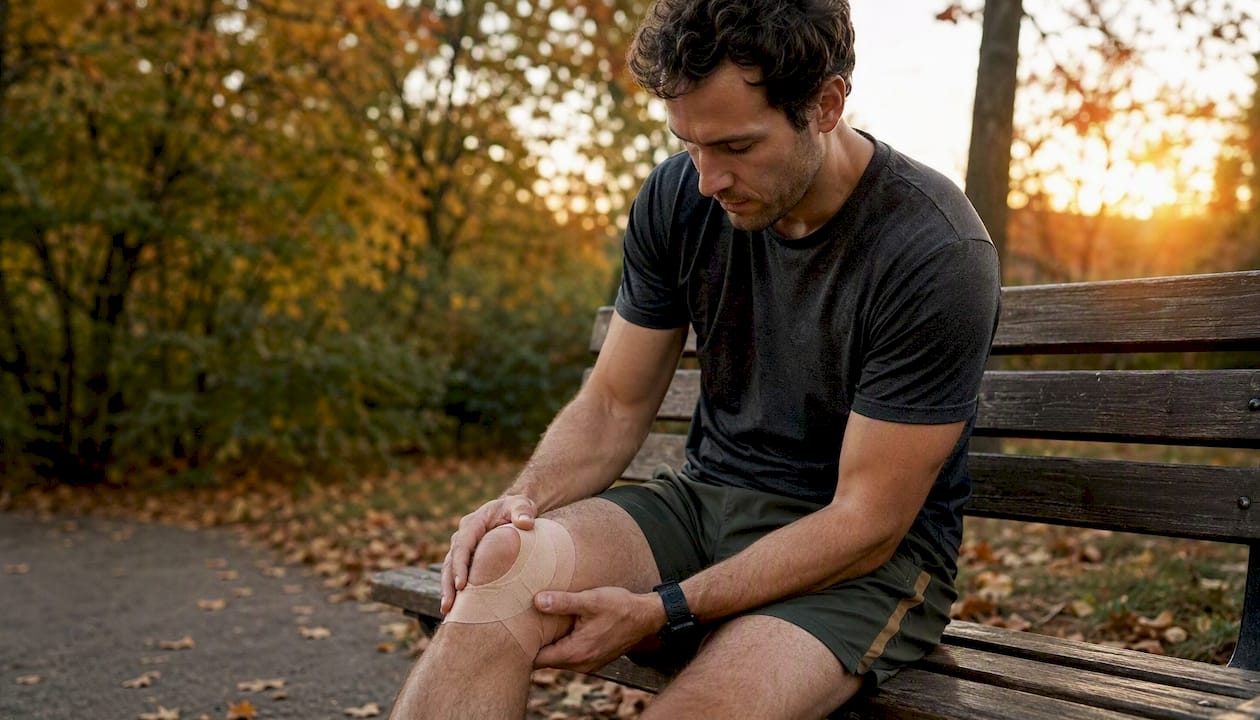
PFPS is rarely caused by a single event. It develops when cumulative mechanical stress on the patellofemoral joint exceeds the tissue’s capacity to adapt. Correcting the underlying muscle imbalances — particularly hip abductor and glute weakness — is what separates lasting recovery from repeated flare-ups.
Mechanical drivers:
Training contributors:
Who is at higher risk: Female athletes experience PFPS at roughly twice the rate of male athletes, likely due to a wider pelvis increasing the Q-angle at the knee. Prior knee injury, high weekly training volume, and a pattern of inward knee collapse (valgus) during single-leg loading are also consistent risk factors across clinical populations.
The goal in the first 48–72 hours is symptom control without creating deconditioning. Complete rest is rarely the right answer; controlled movement keeps the joint healthy and prevents the muscle inhibition that makes rehab harder later.
Activity modification rules:
Symptom control:
What to avoid:
Structured strengthening of the knee, thigh, and hip muscles is the most effective intervention for PFPS and the only approach proven to give long-term relief. The program below moves through four phases, each with a clear progression criterion before advancing.
Phase 1: Low-load activation (Days 1–7). Start with quad sets (tighten the quad while the leg is straight), glute isometrics (squeeze the glutes while lying or seated), and prone hip extensions. These activate the target muscles without loading the patellofemoral joint. Aim for 2–3 sets of 15–20 reps, twice daily.
Phase 2: Isolated strengthening (Weeks 2–3). Add clamshells (hip abductor activation with a resistance band), straight leg raises, and side-lying hip abduction. These directly address the glute and hip weakness that drives poor patellar tracking. Progress when you can complete all sets with no pain and no compensatory movement (no pelvic tilt, no hip hiking).
Phase 3: Loaded compound movements (Weeks 3–6). Introduce wall sits (start at 30 seconds, progress to 60), step-downs from a low step, and terminal knee extensions with a band. Single-leg squats to a shallow depth are the benchmark exercise for this phase — they load the quad and glute together while demanding patellar control. Keep knee pain at or below 2/10 throughout.
Phase 4: Return-to-run drills (Weeks 6–8+). Begin with a run-walk protocol: 1 minute running, 2 minutes walking, for 20 minutes. Progress the running interval by no more than 10% per session. Add lateral band walks and single-leg Romanian deadlifts to maintain hip strength under fatigue.
A 10–15 minute daily activation routine targeting hip and quad engagement is a practical and effective starting point before progressing to heavier loading.
| Exercise | Phase | Primary Target | Pain Limit |
|---|---|---|---|
| Quad sets | 1 | VMO activation | 0/10 |
| Glute isometrics | 1 | Glute activation | 0/10 |
| Clamshells (banded) | 2 | Hip abductors | 2/10 |
| Straight leg raises | 2 | Quad, hip flexor | 2/10 |
| Wall sit | 3 | Quad endurance | 2/10 |
| Step-downs | 3 | Quad, glute control | 2/10 |
| Single-leg squat | 3 | Full chain control | 2/10 |
| Run-walk intervals | 4 | Return to load | 2/10 |
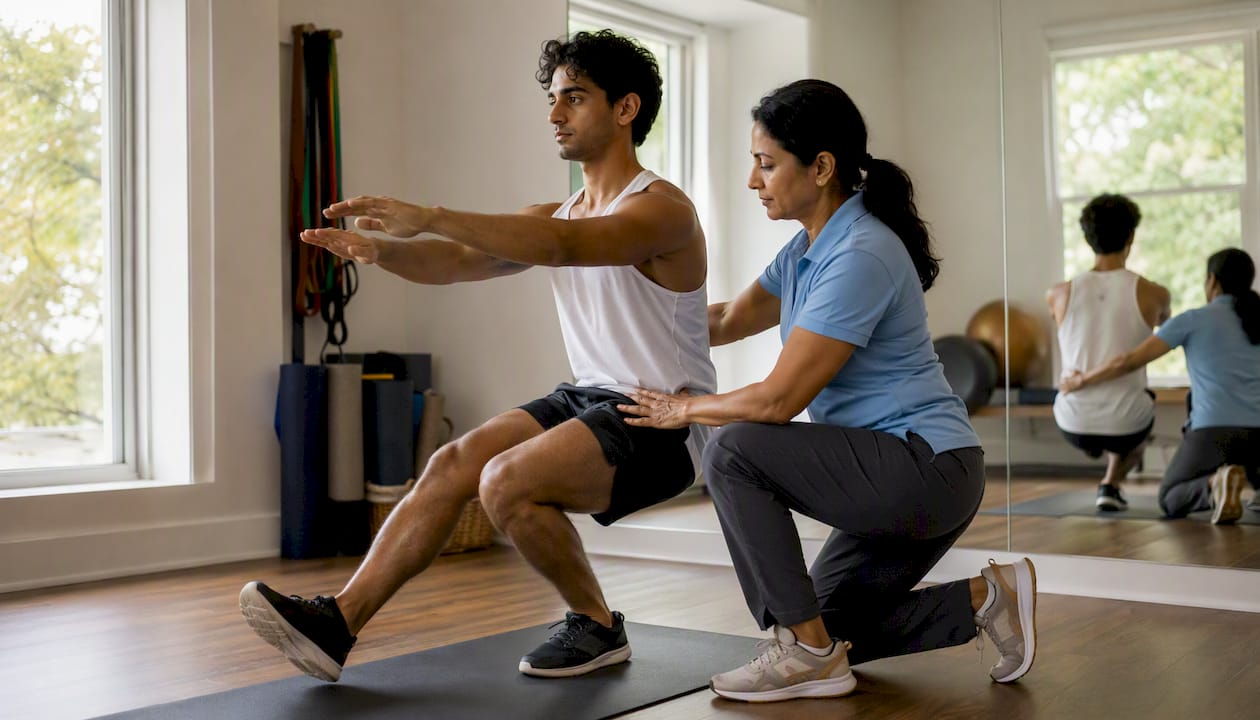
Pro Tip: Get your movement assessed by a clinician or physical therapist before or early in Phase 2. Patients who start strengthening without technique guidance often develop compensatory patterns — inward knee collapse, pelvic tilt — that reinforce the problem rather than correct it.
The evidence here is clear and consistent. Systematic clinical reviews conclude that structured strengthening of the hip, thigh, and knee muscles is the only intervention proven to produce lasting relief from PFPS. Passive modalities — ultrasound, TENS, acupuncture, and even laser therapy — may offer transient comfort, but multiple reviews find no evidence they produce durable improvement on their own.
Taping and foot orthotics occupy a middle ground. They can reduce pain enough to allow effective exercise, which is genuinely useful in the early phases. But clinical guidance frames them as facilitators of movement retraining, not as treatments in themselves. An athlete who relies on taping without progressing their strengthening program will likely see symptoms return.
Conservative nonoperative therapy is the standard of care, and surgery is reserved for rare cases that fail to respond after up to 24 months of structured rehab. That timeline underscores how strongly the evidence favors exercise over procedural intervention. For most athletes, the question is not whether to do the strengthening work — it is how to do it correctly and consistently.
Most PFPS cases can be managed with home rehab, but there are clear situations where professional evaluation changes the outcome. The diagnostic process is straightforward: a clinician takes a focused history, performs physical tests for patellar tracking and load-provoked pain, and reserves imaging for atypical presentations. X-rays and MRI are rarely needed for a straightforward PFPS diagnosis.
See a clinician if:
What clinicians can offer beyond home exercise:
The key word is adjunct. Every one of these clinic tools works best alongside a structured exercise program, not instead of one.
Once you are pain-free and back to full training, the work is not over. PFPS has a high recurrence rate among athletes who return to their previous training habits without addressing the underlying weaknesses. Prevention is largely about maintaining the strength you built during rehab and managing training load intelligently.
Maintenance strength schedule:
Training modifications:
Footwear and orthotics:
Recovery from PFPS varies, but most athletes see meaningful improvement within 4–8 weeks with a structured, consistent rehab program. Severity at onset, how quickly you modify activity, and adherence to the exercise program are the three biggest factors that determine where in that range you land.
Milestone checklist before returning to full running:
| Recovery Stage | Typical Timeframe | Key Marker |
|---|---|---|
| Symptom control | Days 1–7 | Pain settles to 2/10 at rest |
| Isolated strengthening | Weeks 2–3 | No pain with Phase 2 exercises |
| Loaded compound work | Weeks 3–6 | Single-leg squat with good control |
| Return to easy running | Weeks 6–8 | Run-walk protocol completed pain-free |
| Full training return | Weeks 8–12+ | No symptom flare at previous volume |
Prolonged recovery is often linked to returning to activity too soon, neglecting hip-strengthening, or uncorrected biomechanical problems requiring clinical evaluation.
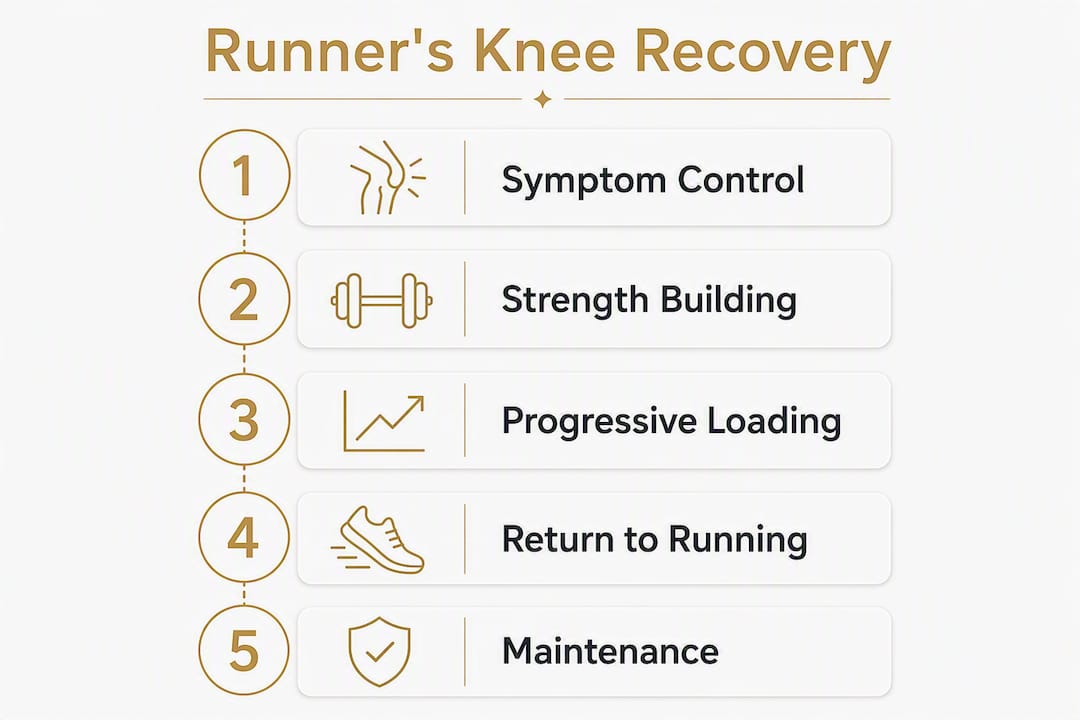
Exercise-based hip and quad strengthening is the only proven long-term treatment for runner’s knee, and many athletes can expect meaningful improvement with consistent, progressive rehab over several weeks.
| Point | Details |
|---|---|
| Modify activity first | Keep pain at or below 2/10 during any activity and avoid full rest. |
| Strengthening is the fix | Hip, glute, and quad exercises are the only interventions proven to give lasting relief. |
| Taping and orthotics are adjuncts | Use them to enable exercise, not as standalone treatments. |
| Recovery takes 4–8 weeks | Adherence to progressive phases determines where in that range you land. |
| Shephardhealth for clinical care | Shephardhealth offers individualized PT, ART, shockwave, laser, and taping for athletes who need guided rehab. |
The athletes who recover fastest from PFPS are rarely the ones who rest the most or tape the most. They are the ones who get their movement assessed early and commit to the strengthening work before returning to full training.
In practice, the assessment process at a clinic like Shephardhealth starts with understanding your training history and identifying the specific mechanical pattern driving your symptoms. Inward knee collapse during a single-leg squat, limited hip abductor strength, or restricted ankle dorsiflexion each point to a different emphasis in the rehab program. A generic exercise list does not account for those differences.
What I find most underappreciated is the role of the hip in a knee problem. Most athletes focus on the knee itself — taping it, icing it, bracing it — while the actual driver of the problem sits one joint up. Strengthening the glutes and hip abductors changes the mechanics of every step you take, which is why the research consistently shows that hip-focused programs outperform quad-only programs for long-term outcomes.
The other thing worth saying plainly: passive therapies like shockwave and laser have a legitimate role as adjuncts, particularly when pain is high enough to prevent effective exercise. But they are tools to get you into the work, not substitutes for it. Any clinic that leads with passive modalities and treats exercise as optional is not giving you the evidence-based care you deserve.
Knee pain that does not respond to home care within 4–6 weeks, or that keeps returning every training cycle, is a signal that the underlying mechanics need a closer look.

Shephardhealth offers a full range of evidence-based services for athletes managing PFPS: individualized physical rehabilitation, Active Release Technique for soft-tissue restrictions around the knee, shockwave therapy as an adjunct for persistent cases, laser therapy, Kinesio taping, and custom orthotics. Every treatment plan is built around exercise-centered rehab, with adjunct therapies used only where the evidence supports them. Direct insurance billing is available, and same-day appointments mean you do not have to wait weeks to get started.
Book your first visit to get a clear picture of what is driving your knee pain and a structured plan to fix it.
This article provides general information for educational purposes and is not a substitute for professional medical advice. Confirm your diagnosis and treatment plan with a qualified clinician.
Same Day Appointments Available
We Direct Bill!