

A staged, least-to-most invasive pathway gives most people with frozen shoulder (clinically called adhesive capsulitis) the best balance of early pain relief and long-term range-of-motion recovery. The evidence is consistent: start with home measures and patient education, add supervised physical therapy, consider an intra-articular corticosteroid injection early when symptoms are under a year old, and escalate to hydrodilatation or surgical procedures only when conservative care has genuinely failed.
A JAMA Network Open systematic review and meta-analysis of 65 randomized trials confirmed that intra-articular corticosteroid produces statistically and clinically meaningful short-term improvements in pain and function, especially when paired with a home exercise program. A comprehensive NIH/PMC review lists the full treatment spectrum, from medication and physiotherapy through hydrodistension, manipulation under anesthesia (MUA), and arthroscopic capsular release (ACR), and emphasizes that stage-based selection drives outcomes more than any single intervention.
The practical starting point for most patients:
A staged, least-to-most-invasive approach, starting with home exercise and education and escalating only when conservative care has genuinely failed, gives most patients the best long-term outcome for frozen shoulder.
| Point | Details |
|---|---|
| Stage determines treatment | Freezing stage prioritizes pain control; frozen stage targets ROM; thawing stage focuses on progressive loading. |
| Early injection is evidence-backed | Intra-articular corticosteroid paired with home exercise produces meaningful short-term pain and function gains, especially in the first year of symptoms. |
| No invasive option is clearly superior | Large RCTs show MUA and ACR do not outperform well-managed conservative care in long-term outcomes; patient selection drives the decision. |
| Diabetes changes the timeline | Patients with diabetes face a longer, more treatment-resistant course and may need earlier specialist involvement and blood glucose monitoring around steroid use. |
| Shephardhealth’s staged care | Shephardhealth evaluates your stage, coordinates injection referrals, and delivers ART, shockwave, and laser therapy as part of a structured recovery plan. |
Frozen shoulder is a clinical diagnosis. Your clinician will not need an MRI to confirm it in most cases. The defining feature is a progressive loss of both active and passive range of motion in the glenohumeral joint, typically with pain that precedes or accompanies the stiffness. The key distinction from a rotator cuff tear, for example, is that passive motion is also restricted. With a rotator cuff tear, passive range of motion is usually preserved even when active movement is painful or weak.
At your appointment, expect the clinician to measure external rotation with your elbow at your side, compare both shoulders, and assess global ROM in multiple planes. The StatPearls clinical review notes that risk factors including diabetes and thyroid disease should be identified early, since they affect both prognosis and treatment intensity.
Imaging is used selectively. X-rays help rule out glenohumeral arthritis or calcific tendinopathy. An MRI or ultrasound is ordered when the clinician suspects a concurrent rotator cuff tear, significant bony pathology, or when the diagnosis is genuinely uncertain. For a straightforward presentation, imaging adds cost without changing the initial treatment plan.
Red flags that warrant urgent evaluation rather than a standard appointment:
Pro Tip: If your shoulder pain is significantly worse at night and you also notice tingling or numbness radiating down your arm, mention both symptoms together at your appointment. That combination can point toward cervical spine involvement rather than pure adhesive capsulitis, and the treatment pathway differs considerably. Shephard Health’s shoulder and rotator cuff assessment includes a differential screening to sort this out at your first visit.
Understanding which stage you are in is not just academic. It directly determines whether your priority is pain control, mobility restoration, or progressive loading, and it tells your clinician which interventions are appropriate right now versus premature.
| Stage | Common Name | Primary Feature | Typical Duration | Treatment Priority |
|---|---|---|---|---|
| Stage 1 | Freezing | Pain-dominant, ROM begins to decrease | 2 months | Pain control, gentle ROM, education |
| Stage 2 | Frozen | Stiffness-dominant, pain often less severe | 4–12 months | ROM restoration, targeted stretching, PT |
| Stage 3 | Thawing | Gradual spontaneous improvement in ROM | 5 months | Progressive loading, strength, return to activity |
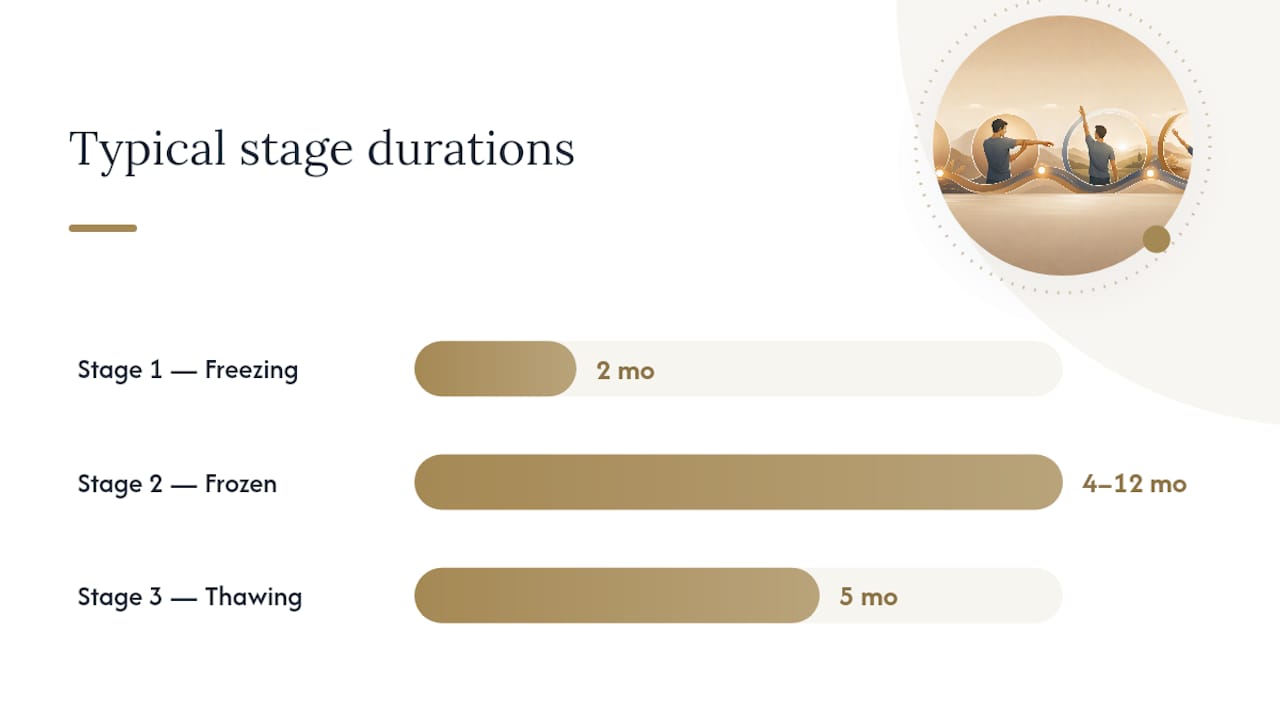
The freezing stage is the most painful phase. Aggressive stretching here tends to worsen inflammation rather than restore mobility, which is why pain-limited, gentle movement is the clinical standard during this period. The frozen stage shifts the goal toward reclaiming range of motion as pain often plateaus. The thawing stage is when structured progressive exercise can foster functional gains for most patients.
Stage also affects procedural timing. A corticosteroid injection is most effective when offered during the freezing or early frozen stage, when inflammation is the dominant driver. By the thawing stage, the inflammatory component has largely resolved, and the benefit of injection diminishes. Knowing your stage helps you and your clinician make that call at the right time.
Conservative care is the foundation of any frozen shoulder treatment plan, regardless of stage. The goal in the early weeks is to manage pain, maintain whatever range of motion you have, and avoid the trap of complete rest, which accelerates stiffness.
Home measures that make a practical difference:
Medications play a supporting role. Acetaminophen is a reasonable first choice for mild-to-moderate pain, particularly for older adults or those with gastrointestinal sensitivity. NSAIDs such as ibuprofen or naproxen reduce both pain and inflammation and are appropriate for short-term use, but carry cautions for patients with elevated blood pressure, kidney disease, or a history of GI ulcers. If you have diabetes, NSAIDs can interact with blood sugar regulation and some diabetes medications, so discuss the choice with your prescriber before starting a regular course.
Supervised physical therapy becomes the right next step when home exercise alone is not producing progress after 4–6 weeks, when pain is severe enough to limit your ability to self-direct a program, or when you are uncertain about technique. A PT program for frozen shoulder typically includes manual therapy, guided stretching, neuromuscular re-education, and a progressive home program tailored to your stage. The JAMA Network Open meta-analysis confirms that home exercise programs provide clinically meaningful benefits and add measurable short-term benefit when combined with other treatments like corticosteroid injection.
Pro Tip: On high-pain days, do not skip movement entirely. Instead, use heat for 10–15 minutes, then perform only the gentlest pendulum exercise for 2–3 minutes. Keeping the joint moving, even minimally, prevents the rapid stiffening that follows complete rest. Save ice for after movement, not before.
Intra-articular corticosteroid injection is one of the most evidence-supported tools in frozen shoulder treatment, particularly in the first year of symptoms. The JAMA Network Open systematic review found that corticosteroid injection produced statistically significant short-term improvements in both pain and function, with benefits that can extend up to six months and are meaningfully enhanced when paired with a home exercise program.
What to expect from a corticosteroid injection:
If you have diabetes, the blood glucose spike after a corticosteroid injection can be significant and may last several days. This does not mean injection is off the table, but it does mean your blood sugar should be monitored closely in the days following the procedure, and your prescribing clinician should be aware of your diabetes management plan before proceeding.
The injection is most useful in the freezing and early frozen stages, when inflammation is driving your symptoms. Offering it early, before the capsule becomes densely fibrotic, gives the anti-inflammatory effect the best chance to reduce pain enough for you to engage meaningfully in exercise and PT.
Hydrodilatation, also called hydrodistension, involves injecting a volume of fluid (typically saline, often combined with corticosteroid and local anesthetic) into the glenohumeral joint under imaging guidance. The goal is to stretch the contracted joint capsule mechanically while delivering anti-inflammatory medication directly to the site.
Key points about hydrodilatation:
The honest summary: hydrodilatation is used with anecdotal success in many clinics, and it carries a reasonable short-term safety profile, but the evidence base is not yet strong enough to position it as a clearly superior step over optimized conservative care. Discuss the current evidence with your clinician so your decision is based on your specific stage, symptom duration, and response to prior treatment.
Both MUA and ACR are reserved for patients who have completed an adequate trial of conservative care, typically 6–12 months of structured PT and at least one corticosteroid injection, without achieving acceptable function. The PMC systematic review is direct on this point: large randomized trials, including the UK FROST trial, have not shown a clear long-term clinical superiority of any invasive option over well-managed conservative care. Patient selection, recovery tolerance, and individual functional goals drive the decision more than a single evidence hierarchy.
| Feature | Manipulation Under Anesthesia (MUA) | Arthroscopic Capsular Release (ACR) |
|---|---|---|
| Stage suitability | Late frozen, early thawing | Late frozen, thawing; failed MUA |
| Invasiveness | Minimally invasive (no incision) | Surgical (small incisions, general anesthesia) |
| Typical time to improvement | Days to weeks post-procedure | Weeks to months post-surgery |
| Short-term effectiveness | Rapid ROM gain; pain relief variable | Consistent ROM and pain improvement |
| Long-term effectiveness | Comparable to ACR in most trials | Comparable to MUA in most trials |
| Key risks | Fracture, nerve injury, rotator cuff tear | Infection, nerve injury, anesthesia risks |
| Rehab requirement | Immediate post-procedure PT essential | Structured post-surgical PT program required |
MUA involves a clinician forcibly moving the shoulder through its range while you are under general or regional anesthesia, breaking down the adhesions without surgical incision. ACR uses arthroscopic instruments to cut the contracted capsule directly. Both require a committed post-procedure rehabilitation program; without it, stiffness can return.
Neither procedure is a shortcut. The evidence does not support pursuing either option before a genuine, well-supervised conservative trial has been completed.
The five exercises below form the backbone of a home exercise program for frozen shoulder, as supported by Harvard Health’s clinician-reviewed guidance. Progress through them in order, and always stay within a pain range that settles within 30 minutes of finishing.
1. Pendulum exercise
Lean forward with your unaffected arm resting on a table. Let the affected arm hang freely and use gentle body momentum to swing it in small circles, forward-back, and side-to-side. Keep the shoulder relaxed, not actively moving. Freezing stage: small circles only, 1–2 minutes. Frozen stage: larger arcs, 3–5 minutes, twice daily.

2. Towel stretch
Hold a towel behind your back with both hands, affected arm below. Use the unaffected arm to gently pull the affected arm upward. Freezing stage: pull only to the point of mild tension, hold 15 seconds. Frozen stage: increase the pull range gradually, hold 30 seconds, repeat 3–5 times.
3. Finger walk
Stand facing a wall at arm’s length. Walk your fingers up the wall as high as comfortable, hold briefly, then walk back down. Freezing stage: stop well below the pain threshold. Frozen stage: aim to increase height by a finger-width each week.
4. Cross-body stretch
Use your unaffected arm to bring the affected arm across your chest, just below chin height. Apply gentle pressure at the elbow. Hold 15–30 seconds. This targets the posterior capsule and is most productive in the frozen and thawing stages.
5. Assisted external rotation
Hold a cane or stick horizontally with both hands, elbows bent at 90 degrees. Use the unaffected arm to gently push the affected forearm outward. Hold 15–30 seconds. External rotation is often the last movement to return and the most important for overhead function.
When to advance: increase repetitions or hold duration only when an exercise produces no more than mild, transient discomfort that resolves within 30 minutes. If soreness persists into the next day, reduce intensity rather than pushing through.
For a structured mobility progression framework, the mobility restoration checklist for athletes from HTK Training offers a useful staged return-to-activity reference alongside your shoulder program.
Pro Tip: Post-exercise soreness that resolves within 30 minutes is acceptable and expected. Pain that lingers for hours or wakes you that night is a signal to reduce the range or repetitions at your next session, not to stop entirely. Consistency at a lower intensity beats sporadic high-effort sessions every time.
Night pain is one of the most disruptive features of frozen shoulder, particularly in the freezing stage. Lying on the affected shoulder compresses the joint capsule directly, and even lying on the opposite side can create traction discomfort if the arm falls forward unsupported.
Positioning and pillow strategies:
For short-term medication support at night, acetaminophen taken 30–60 minutes before bed is a reasonable option for most adults. Older adults should use NSAIDs cautiously at night due to cardiovascular and renal considerations; discuss timing and dose with your clinician. Topical NSAIDs (such as diclofenac gel) applied to the shoulder before bed offer localized relief with lower systemic absorption. TENS (transcutaneous electrical nerve stimulation) is a nonpharmacologic option that some patients find helpful for short-term pain modulation; the TENS vs EMS guide at Shephardhealth explains how these devices differ and when each is appropriate.
When night pain should prompt a clinician reassessment:
A few well-intentioned but counterproductive habits can significantly extend your recovery timeline. Knowing what to avoid is as important as knowing what to do.
What not to do:
Red flags requiring urgent clinician review:
On alternative therapies: acupuncture and massage therapy have limited, low-quality evidence for frozen shoulder specifically. They are not replacements for a staged, evidence-based care plan, but they can serve as adjuncts for symptom management, particularly for pain relief and relaxation during the freezing stage, when patients are looking for any relief that does not worsen inflammation. If you use them, treat them as additions to your structured program, not substitutes for it.
Frozen shoulder is broadly self-limiting, meaning most people do recover without surgery. But “self-limiting” does not mean “quick.” The full cycle from onset to resolution commonly spans 1–3 years, and a meaningful minority of patients retain some degree of permanent restriction.
| Factor | Typical Timeline or Outcome | Clinical Implication |
|---|---|---|
| Full natural course | 1–3 years from onset | Set early expectations to prevent treatment fatigue |
| Majority of patients | Near-normal function regained | Reassurance is part of the treatment plan |
| Minority with persistent symptoms | Some degree of restriction remains long-term | Earlier escalation may be warranted for high-demand patients |
| Diabetes | Longer, more treatment-resistant course | Earlier multidisciplinary involvement recommended |
| Thyroid disease | Associated with higher prevalence and slower recovery | Monitor closely; adjust PT intensity accordingly |
| Prolonged immobilization | Accelerates capsular fibrosis | Avoid complete rest at any stage |
The StatPearls review confirms that diabetes and thyroid disease are among the most significant comorbid factors affecting prognosis. Patients with diabetes tend to have a more prolonged and treatment-resistant course, which is why earlier multidisciplinary involvement, closer blood glucose monitoring around any steroid use, and potentially earlier escalation to specialist care are all clinically appropriate for this group.
Setting realistic timeline expectations early is itself a therapeutic intervention. Patients who understand that slow progress over months is normal are far more likely to stay consistent with their exercise program and avoid the frustration-driven decisions, like demanding surgery prematurely, that can complicate recovery.
The staged approach below reflects how evidence-based clinicians sequence frozen shoulder care. It is not rigid, and individual factors, particularly diabetes, functional demands, and symptom severity, can shift the timeline at any step.
Step-by-step clinical algorithm:
Time and progress thresholds for escalation:
Referral checklist:
At Shephardhealth, the evaluation process begins with a thorough clinical assessment: stage identification, active and passive ROM measurement, differential screening to rule out rotator cuff pathology or cervical involvement, and a review of relevant comorbidities including diabetes and thyroid conditions. Imaging is ordered when clinically indicated, not as a default.
Treatment decisions are made collaboratively, weighing the evidence, your stage, your functional goals, and any comorbid factors that affect how aggressively or conservatively to proceed. The clinic’s soft tissue treatment approach applies directly to frozen shoulder, with services that map onto each stage of the pathway:
Same-day appointments are available, and the clinic offers direct insurance billing to reduce administrative friction. The first visit includes a full assessment and a clear explanation of your stage, your options, and what a realistic recovery timeline looks like for your specific situation.
The most common mistake I see in frozen shoulder management is not under-treatment. It is premature escalation driven by understandable frustration with a slow-moving condition. Patients who push for MUA or ACR after two months of inconsistent home exercise are not getting a better outcome. They are trading a predictable, evidence-supported recovery pathway for a procedural risk profile that the evidence does not justify at that stage.
The staged, conservative-first model is not a passive “wait and see” approach. It is an active, structured program that requires consistency, appropriate exercise intensity, and honest reassessment at defined intervals. The evidence from large randomized trials, including the UK FROST trial reviewed in the PMC systematic review, shows that invasive procedures do not outperform well-managed conservative care in long-term outcomes for most patients. That finding should be reassuring, not discouraging. It means that doing the right conservative things, at the right stage, with the right guidance, gives you the same long-term result as surgery, without the surgical risk.
The one group where I would push for earlier escalation: patients with diabetes who are seeing rapid functional decline. For them, the standard conservative trial timeline may need to compress, and multidisciplinary involvement should come sooner rather than later.
Frozen shoulder responds best to care that matches your stage, not a one-size-fits-all protocol. Shephardhealth provides exactly that: a structured, evidence-based evaluation that identifies where you are in the freezing-frozen-thawing cycle and builds a treatment plan around your current needs.

From your first visit, you receive a clear stage assessment, a personalized home exercise program, and access to hands-on therapies including Active Release Technique, shockwave therapy, and laser therapy, all coordinated under one roof. When corticosteroid injection is appropriate, the clinic integrates that step into your active rehab plan so the pain-relief window translates into real ROM gains. Direct insurance billing and same-day appointment availability mean you can get started without delay.
Book your evaluation at Shephardhealth and get a clear picture of your stage, your options, and your realistic recovery timeline at your very first visit.
The sources below are the highest-quality references used in this article. Each is appropriate to bring to a clinician appointment for discussion.
This article is general information, not a substitute for advice from a qualified doctor. Consult a qualified healthcare professional about your own circumstances before acting on anything here.
Same Day Appointments Available
We Direct Bill!