

A structured corrective exercise program, delivered inside a multimodal care plan, is the most effective approach for upper cross syndrome treatment. The clinical term is upper crossed syndrome (UCS), and the research is consistent: therapeutic exercise improves forward head posture, rounded shoulders, and thoracic kyphosis when applied in the right sequence. You do not need to wait for a clinic appointment to start. Here are your immediate next steps.
Today, at home:
When to book a clinician: If you have numbness, tingling, arm weakness, or pain that does not ease with rest, schedule a professional assessment this week rather than starting a home program on your own.
Pro Tip: Set a phone alarm labeled “chin tuck” for mid-morning and mid-afternoon. Two 30-second sessions daily, done consistently, outperform a 20-minute routine you do once a week.
A structured corrective exercise program, sequenced through the inhibit-lengthen-activate-integrate continuum and combined with ergonomic changes and supervised care, is the most effective approach for treating upper crossed syndrome.
| Point | Details |
|---|---|
| Sequence the exercise correctly | Inhibit and lengthen overactive muscles before strengthening weak ones to avoid compensation. |
| Expect measurable postural change by weeks 6–12 | Early symptom relief often appears in weeks 2–6; objective angle improvements take longer with consistent practice. |
| Combine exercise with ergonomics | Raising your monitor and taking movement breaks every 20–30 minutes are high-impact, low-cost recovery accelerators. |
| Seek professional care for red flags | Progressive numbness, arm weakness, or neurological signs require same-week clinical evaluation, not a home program. |
| Shephardhealth provides supervised multimodal care | Chiropractic, ART, Graston, corrective exercise, and laser therapy are combined into a structured, re-assessed program. |
The evidence base for UCS is growing, and the direction is clear even where the quality is uneven. A systematic review and meta-analysis confirmed that therapeutic exercise produces significant improvements in forward head angle, rounded shoulder position, and thoracic kyphosis compared to control conditions. The authors noted high heterogeneity across included studies and variable methodological quality, which means the effect sizes are real but the precise magnitude varies depending on the program design and population studied.
Manual therapy tells a similar story. Narrative reviews of physiotherapy and manual approaches report that techniques such as myofascial release, instrument-assisted soft-tissue mobilization, and muscle energy technique produce short-term improvements in pain and mobility. Those gains are meaningful for getting a patient comfortable enough to exercise, but they do not substitute for the exercise itself when it comes to lasting postural change.
The most recent clinical evidence sharpens that point. A 2026 Springer clinical study found that corrective exercise addresses biomechanical deficits but achieves better and more consistent functional and pain-related outcomes when combined with supervised stabilization and dynamic neuromuscular training. Home exercise alone can move the needle; supervised progressive training moves it further and more reliably.
A 2026 MDPI review reinforces this, identifying stretching, strengthening, scapular stabilization, and NASM-based corrective sequences as effective components for improving postural alignment and scapular muscle balance in UCS.
| Intervention | Outcome Measured | Direction of Effect | Evidence Quality |
|---|---|---|---|
| Therapeutic exercise | Forward head angle, rounded shoulders, thoracic kyphosis | Significant improvement vs. control | Moderate (high heterogeneity) |
| Manual therapy (MFR, IASTM, MET) | Short-term pain and mobility | Short-term benefit | Low-to-moderate |
| Corrective exercise + supervised dynamic training | Functional outcomes and pain | Better and more consistent than exercise alone | Moderate (2026 clinical research) |
| Scapular stabilization programs | Scapular muscle balance and alignment | Positive postural changes | Moderate (MDPI 2026 review) |
The honest summary: exercise works, manual therapy helps in the short term, and combining both inside a supervised program produces the best outcomes. No single modality is sufficient on its own.
Upper crossed syndrome describes a specific pattern of muscle imbalance across the neck, shoulders, and upper back. Two groups of muscles are involved, and they form an “X” when you map them on the body.
The overactive and tight muscles are the upper trapezius, levator scapulae, and pectoralis major and minor. These muscles shorten and pull the head forward and the shoulders inward. The underactive and weak muscles are the deep cervical flexors (the small muscles at the front of your neck), the rhomboids, lower trapezius, and serratus anterior. These muscles lengthen and lose their ability to hold the shoulder blades and head in a neutral position. Healthline’s clinical overview describes this crossed pattern clearly and is a useful reference to share with a clinician.
The visual signs are recognizable once you know what to look for: the head sits forward of the shoulders, the shoulders round inward, the thoracic spine (mid-back) develops an exaggerated curve, and the shoulder blades may wing or tilt. Common associated symptoms include neck and shoulder pain, reduced range of motion in the cervical spine, tension headaches, and scapular dysfunction that can affect overhead movement. For a deeper look at how posture patterns develop and what good alignment actually looks like, this posture guide is worth reading.
Upper crossed syndrome is not a structural diagnosis — it is a functional pattern. That distinction matters because it means the pattern is correctable with the right exercise and habit changes, provided there is no underlying structural pathology driving it.
Pro Tip: Take a photo from directly to your side with your arms relaxed. Draw an imaginary vertical line from your ear downward. In neutral alignment, that line passes through the shoulder, hip, knee, and ankle. If your ear is more than an inch forward of your shoulder, UCS posture is likely present.
A thorough assessment separates UCS from other causes of neck and shoulder pain and gives you a measurable baseline to track progress against. Clinicians use a combination of objective angle measurements, movement screens, and strength tests. You can replicate several of these at home with reasonable accuracy.
Practitioners typically measure the craniovertebral angle (CVA) using a side-view photograph: a line from the tragus of the ear to the C7 spinous process is compared to horizontal. Angles below 50 degrees are associated with forward head posture. Thoracic kyphosis is measured with an inclinometer or a flexible ruler. Scapular position is assessed visually and with the scapular dyskinesis test, and strength tests for the deep neck flexors (the craniocervical flexion test) and lower/mid-trapezius round out the picture. Physical therapy and supervised programs consistently outperform unstructured self-exercise in clinical trials, partly because this baseline assessment guides the program design.
Document your results. Re-assess at 4–6 weeks to track progress objectively.
Pro Tip: If the wall angel test causes sharp pain in your shoulder or neck, or if you notice progressive numbness or tingling during any self-check, stop and book a professional assessment before continuing. Self-checks are screening tools, not diagnostic tests.
The NASM Corrective Exercise Continuum structures UCS treatment into four sequential phases: inhibit, lengthen, activate, and integrate. Skipping ahead to strengthening before you have addressed the overactive tissues is one of the most common reasons UCS programs fail. The sequence exists for a reason.
The goal is to reduce tone in the overactive muscles before you stretch or strengthen anything. Use a foam roller or lacrosse ball on the pectoralis major (rolling along the chest wall near the armpit), the upper trapezius (a ball against a wall at the top of the shoulder), and the thoracic spine (foam roller perpendicular to the spine, mid-back). Spend 30–60 seconds on each tender area. This is not aggressive rolling; you are looking for mild, tolerable pressure.

Once tissue tone is reduced, static and dynamic stretching becomes more effective.
This phase targets the underactive muscles: deep cervical flexors, lower trapezius, rhomboids, and serratus anterior. Scapular stabilization and NASM-based corrective sequences are specifically supported by the 2026 MDPI review for improving postural alignment.
Pro Tip: During prone Y/T/W, if your upper traps fire and your shoulders shrug toward your ears, reduce the range of motion or drop to a lighter load. Compensation defeats the purpose of the exercise.
Integration means applying the motor patterns you have trained to real movements. Loaded rows and presses performed with a deliberate scapular set (shoulder blades down and back before initiating the movement) are the primary tools. A posture-focused warm-up before any strength training session, including 5–10 chin tucks and a set of band pull-aparts, reinforces the pattern under load.

For active adults and tactical athletes, reactive neuromuscular training adds a dynamic layer to integration, training the nervous system to maintain scapular position during unpredictable movements rather than only controlled exercises.
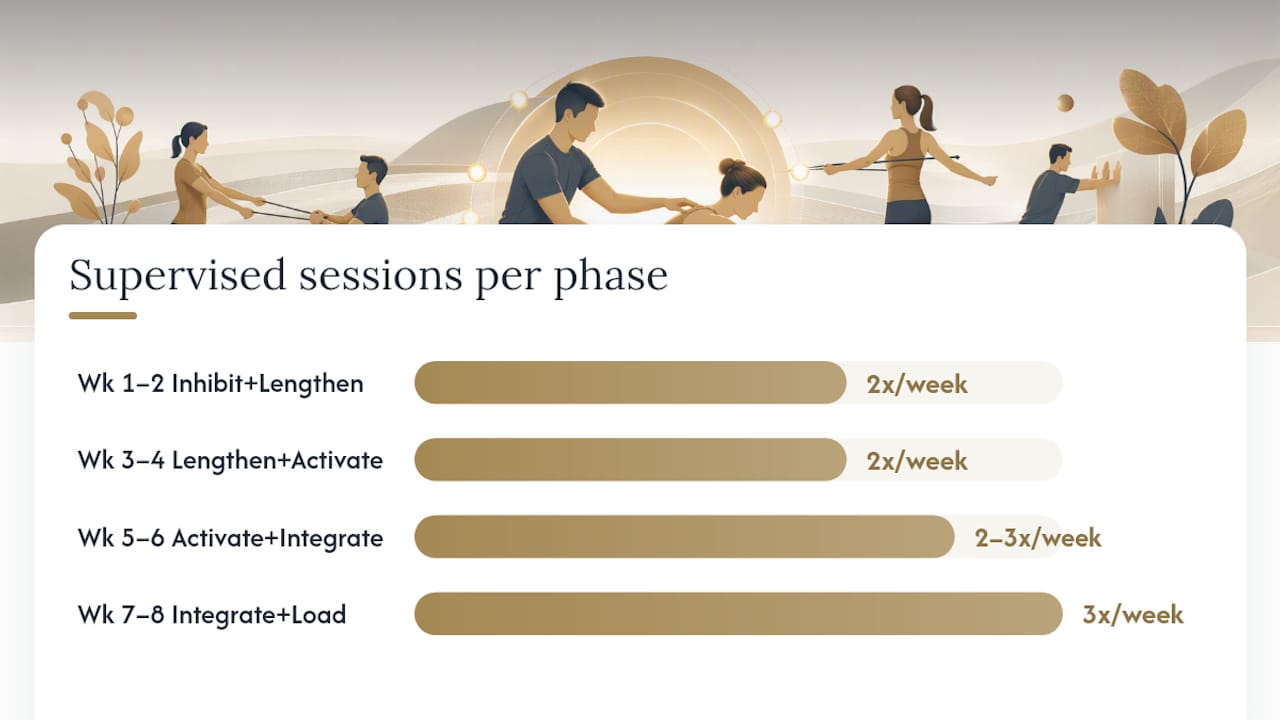
| Week | Primary Focus | Daily Practice (10 min) | Supervised Sessions |
|---|---|---|---|
| 1–2 | Inhibit + Lengthen | SMR + pec/trap stretches | 2x/week |
| 3–4 | Lengthen + Activate | Stretches + chin tucks + prone Y/T | 2x/week |
| 5–6 | Activate + Integrate | Full activation circuit + band work | 2–3x/week |
| 7–8 | Integrate + Load | Loaded rows/presses + posture warm-up | 3x/week |
Pro Tip: Advance to the next phase only when you can complete the current phase’s exercises with good form and no compensation for two consecutive sessions. Rushing the progression is the most common self-treatment mistake.
Pro Tip: Pain is a signal to regress. Discomfort from muscle fatigue or a mild stretch is expected. Sharp, shooting, or radiating pain means stop and reassess.
Manual therapy does not fix UCS on its own, but it plays a meaningful supporting role, particularly in the early stages when pain and tissue tension limit your ability to exercise effectively. The key is understanding what it does well and where its limits are.
Techniques with short-term evidence:
A narrative review of physiotherapy and manual approaches confirms that these techniques provide short-term improvements in pain and mobility and are best used as part of multimodal protocols rather than as standalone treatments.
Adjunct modalities clinicians may add include kinesio taping for proprioceptive cueing of scapular position, TENS for short-term pain modulation, and laser therapy for tissue-level support in cases with significant soft-tissue involvement.
Pro Tip: Think of manual therapy as preparation for exercise, not a replacement for it. A session that reduces pec minor tension before your activation exercises will make those exercises more effective. The lasting postural change comes from the exercise.
No corrective exercise program will hold if you spend eight hours a day reinforcing the same posture that caused the problem. Ergonomic adjustments and regular movement breaks are non-negotiable components of UCS recovery and prevention. The good news is that a few high-impact changes cover most of the risk.
Priority ergonomic adjustments:
Movement strategies:
For a detailed workstation setup checklist, the ergonomic desk setup guide covers monitor, chair, and peripheral positioning step by step. If you work from home, this resource on soft-tissue injuries in remote workers addresses the specific risk factors that come with home office setups.
Pro Tip: Pick one ergonomic change and one daily exercise, and do them for two weeks before adding more. A single habit that sticks beats five that don’t. Screen height plus daily chin tucks is the highest-return starting point.
Recovery from upper crossed syndrome follows a predictable arc, though the timeline depends on how long the pattern has been present and how consistently you apply the program.
Short-term goals to track: improved chin-tuck control (holding 10 seconds without compensation), reduced morning stiffness, and the ability to complete wall angels with wrists touching the wall throughout the range. Medium-term markers include a measurable improvement in your CVA photograph and reduced thoracic kyphosis on reassessment.
Structural changes, such as long-standing thoracic stiffness or significant pec minor shortening, respond more slowly than pain does. Symptom relief and postural correction are related but not identical timelines. Physical therapy and tailored programs consistently show that supervised programs outperform unstructured self-exercise, particularly for patients with chronic presentations.
Self-management with corrective exercise is appropriate for most adults with typical UCS posture and mild-to-moderate symptoms. There are situations, however, where professional assessment should come first.
Seek evaluation this week if you experience:
Which clinician to see first:
For most people, a physical therapist, chiropractor, or sports medicine physician is the right first stop. They can confirm the UCS diagnosis, rule out structural causes, and design a supervised program. If neurological signs are present, a primary care physician or orthopedist should be involved early. For workplace-related presentations, workplace injury prevention strategies may also be relevant to your recovery plan.
A routine appointment within 1–2 weeks is appropriate for persistent pain without red flags. Same-week evaluation is warranted when neurological symptoms are present.
Supervised care at a clinic like Shephardhealth follows a structured workflow that goes well beyond what a home program can replicate. The process starts with a thorough intake: a detailed history of your symptoms, posture photographs, movement screening, and objective measurements of your craniovertebral angle and thoracic kyphosis. This baseline is what makes re-assessment meaningful at 4–6 weeks.
Typical multimodal services used in clinic:
The clinical flow typically looks like this: early sessions focus on manual therapy to reduce pain and tissue tension, making the corrective exercise more effective. As pain settles, the emphasis shifts to supervised activation and integration work. A home program runs in parallel from the first visit. Re-assessment at 4–6 weeks determines whether the program needs to be progressed, modified, or escalated.
The most consistent predictor of a good outcome in UCS is not the specific technique used in the clinic. It is whether the patient leaves each session with a clear, manageable home task and actually does it between appointments.
Pro Tip: At your first appointment, ask your clinician to photograph your posture and measure your craniovertebral angle. Having a documented baseline makes your progress visible and keeps the program accountable to objective markers rather than just how you feel on a given day.
The research on upper crossed syndrome is consistent enough to act on, but it also reveals something that gets underemphasized in most online guides: the exercise sequence matters as much as the exercise selection. Patients who start with strengthening before addressing overactive tissues often plateau early or develop compensatory patterns that make the problem harder to treat later. The inhibit-lengthen-activate-integrate sequence is not a theoretical framework; it reflects what actually happens in tissue when you try to strengthen a muscle that is being actively inhibited by its overactive antagonist.
The other underappreciated factor is adherence. Short, daily corrective practice paired with a single ergonomic change outperforms elaborate programs that require 45 minutes and a gym. The patients who improve most reliably are the ones who do 10 minutes every day, not the ones who do an hour twice a week. Objective re-assessments at 4–6 week intervals keep both the patient and the clinician honest about whether the program is working or needs to change. When progress stalls, that is the signal to escalate to supervised care or investigate whether a structural issue is limiting the response, not to simply add more exercises.
If your symptoms include persistent neck pain, shoulder tension, or postural changes that have not responded to home exercise, Shephardhealth provides the supervised, multimodal care that the evidence supports. The clinic combines chiropractic adjustments, Active Release Technique, Graston Technique, guided corrective exercise, and laser therapy into a structured program tailored to your specific muscle imbalance pattern and functional goals.

Your first visit includes a full postural assessment with objective measurements, so you leave with a clear picture of where you are and a realistic plan for where you are going. Direct insurance billing and same-day appointments mean you can get started without the usual delays. Learn what to expect on your first visit or explore the soft-tissue treatment options most relevant to UCS. Book your assessment at Shephardhealth and get a measurable baseline within the week.
These sources represent the strongest available evidence and practical guidance on upper crossed syndrome. Bring them to your clinician if you are seeking supervised care.
This article is general information, not a substitute for advice from a qualified doctor. Consult a qualified healthcare professional about your own circumstances before acting on anything here.
Same Day Appointments Available
We Direct Bill!