

The right ankle sprain rehab exercises follow a specific order: range-of-motion work first, then stretching, then strengthening, then balance training. Most people can start gentle movement within a few days of injury, and full rehab typically runs several weeks depending on severity. Skip the balance and strength phases and you raise your risk of re-spraining the same ankle. If you have severe pain, significant swelling, or suspect a fracture, see a clinician before starting any of this.
TL;DR:
- Starting gentle range-of-motion exercises within a week of injury helps prevent long-term instability, especially if pain and swelling are manageable.
- Progressing to stretches targeting the calf and Achilles early in rehab improves dorsiflexion and gait, but overstretching increases swelling or pain.
- Strengthening should begin with isometric holds, then resistance bands, and eventually focus on heel raises and functional stability exercises over several weeks.
- Balance and proprioception training using stable and unstable surfaces significantly lowers the risk of re-injury when integrated after initial strength gains.
- Persistent joint looseness or instability beyond two weeks of home rehab warrants professional assessment for hidden soft-tissue or joint issues.
Begin as soon as weight-bearing is tolerable, which for most Grade I and Grade II sprains means somewhere between day 3 and day 7. Early movement, guided by pain, beats complete immobilization for preventing the kind of proprioceptive deconditioning that leaves an ankle feeling unstable months later. During the first 48 to 72 hours, RICE (rest, ice, compression, elevation) still applies, but that does not mean staying still entirely.
Here is a simple weekly rhythm to follow once you get the green light to move:
Stop and seek care if: you have severe or worsening pain, numbness, an inability to bear any weight, or visible deformity. A clinician or emergency department visit is warranted, not a home program.
Ankle pumps come first. Point your toes down (plantarflexion), then pull them up toward your shin (dorsiflexion), moving slowly through the full available range. Start with two sets of multiple repetitions several times a day.
Ankle circles and the “ankle alphabet” build on that foundation:
You are progressing correctly when your range of motion increases without a corresponding rise in pain or swelling over the following 24 to 48 hours. That window matters more than how you feel in the moment during the exercise itself.
Pro Tip: Do ankle alphabet reps while seated with your heel on a rolled towel. It isolates the ankle joint and keeps your knee and hip from doing the work your ankle needs to relearn.
Calf and Achilles tightness develop fast when you’ve been favoring an injured ankle, and tight calves limit the dorsiflexion range you need for a normal walking gait. The seated towel stretch is the gentlest entry point: loop a towel around the ball of your foot, keep your knee straight, and pull gently until you feel a stretch through the calf. Hold for 30 seconds, repeat three to five times, two to three times a day.
Once you’re standing comfortably, add these two variations:
Back off any stretch that increases swelling or sharpens pain rather than producing a mild pulling sensation. If you’re also managing tightness further up the leg, the same loading logic applies to calf strain recovery.
Strength work rebuilds the muscles that stabilize your ankle joint, and it should follow a clear sequence rather than jumping straight to resistance bands.
This same principle, load progressively and let pain guide the dosage, shows up in other tendon and joint rehab protocols, including the VAS 3/10 rule used for patellar tendon issues.
Pro Tip: Rushing to single-leg heel raises before your calf can handle double-leg work is one of the most common setbacks. Master 15 clean double-leg reps first.

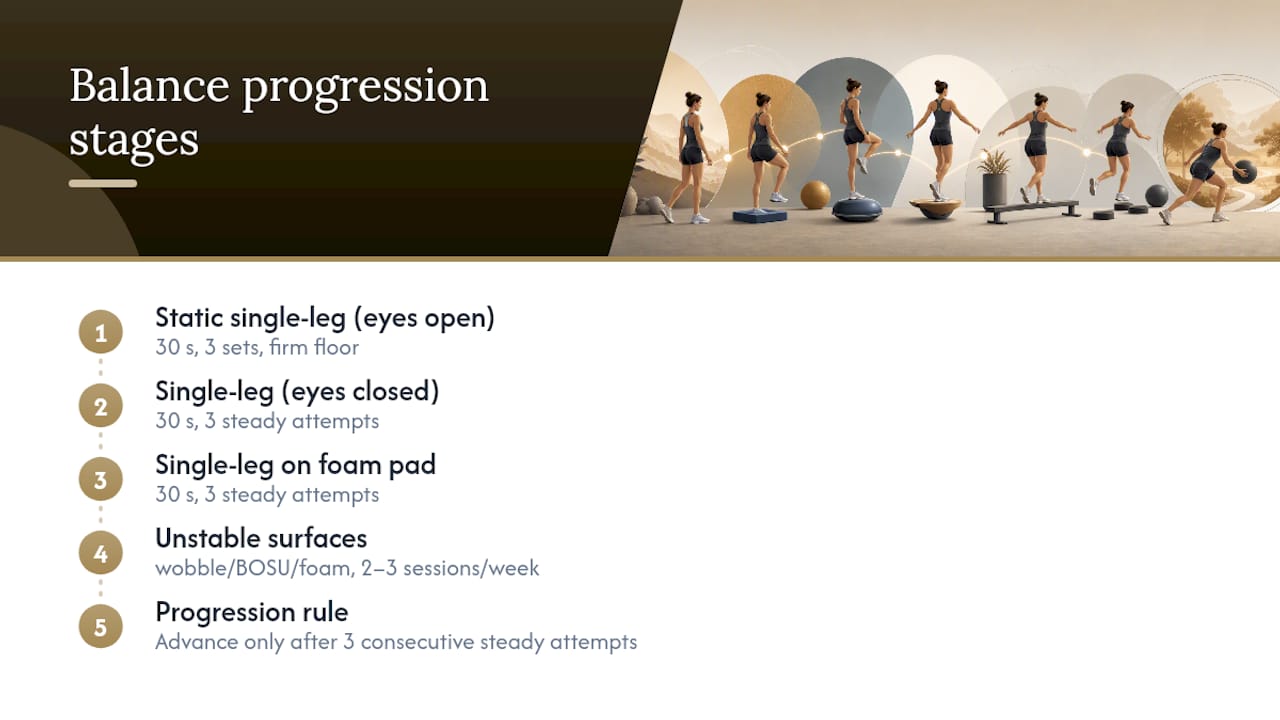
Balance training is what separates a rehab plan that prevents re-injury from one that only restores motion. Start with static single-leg standing: 30 seconds, 3 sets, eyes open on a firm floor. Once that’s easy, close your eyes, and once that’s easy, move to a foam pad. Progress only when you can hold each level steady for three consecutive attempts.
The Star Excursion Balance Test (SEBT), or its simplified Y-Balance version, doubles as both an assessment and an exercise. Reach your free leg out in each of the test directions while balancing on the injured side, 3 reaches per direction, twice a day.
A meta-analysis of 9 studies covering 308 participants found that unstable-surface training, using wobble boards, BOSU trainers, or foam pads, produced measurable improvements in multiple SEBT reach directions and time-in-balance scores among people with chronic ankle instability. Hop-test performance didn’t move as consistently, which is a useful reminder that unstable-surface work supports balance specifically, not every athletic outcome.
Introduce this training once basic strength and pain-free standing balance are established, not in the first week. Start with low-dose perturbations near a wall or chair for support, and aim for two to three sessions a week over four to six weeks once you’re ready for that level.
A structured timeline keeps you from either rushing back too soon or staying overly cautious long after your ankle is ready for more.
Objective checkpoints matter more than the calendar. You’re ready to advance when you can hold single-leg balance on a foam pad for 30 seconds, symmetrically on both sides, and progress into single-leg hops without pain. Ongoing balance training, maintained for a sustained period even after pain resolves, is what most reliably lowers your recurrence risk.
Pro Tip: Log your pain level right after each session and again the next morning. A pattern of next-day soreness that fades by afternoon is normal progression; soreness that lingers or worsens means you advanced too fast.
Your pain and swelling response over the next 24 to 48 hours is the best guide for whether to increase difficulty or pull back. If pain rises above a mild, tolerable level during or after exercise, or if swelling worsens, drop back to the previous stage rather than pushing through.
Common modifications include:
See a clinician promptly if you have severe pain, cannot bear weight at all, notice numbness or spreading bruising, or see no improvement after 10 to 14 days of consistent home exercise. Persistent symptoms at that point usually mean something beyond a straightforward soft-tissue sprain needs a closer look, a pattern we cover in more detail in our guide to soft tissue injury treatment.
Home exercises handle most ankle sprains well, but not every ankle responds the same way to the same program. At Shephard Health, we see patients whose ankles plateau: motion returns, strength improves, yet the joint still feels loose or “gives way” on uneven ground. That pattern often points to soft-tissue restriction or lingering joint dysfunction that exercise alone won’t resolve, where manual approaches like Active Release Technique or targeted Kinesio taping can support the same rehab program you’re already doing. If your progress stalls for more than two weeks, that’s usually the signal to get an assessment rather than keep guessing.
— Deane
Home exercises get most sprained ankles back to normal, but a stubborn one, still swelling weeks later, still buckling on stairs, needs hands-on assessment to find out why. Shephard Health treats that gap directly: our team combines physical rehabilitation with adjuncts like Kinesio taping, Active Release Technique, and custom foot orthotics to address the mechanical causes home exercises can’t reach on their own.

When you come in, bring a list of what you’ve already tried and when your pain flares, since that history shapes the assessment more than a single snapshot exam would. We’ll check joint mobility, muscle activation patterns, and gait mechanics to figure out whether the issue is soft-tissue, structural, or a balance deficit that needs more targeted loading than a home program provides. Appointments and insurance billing options can facilitate timely access to assessment without a long wait. If your ankle still isn’t cooperating after two weeks of consistent home rehab, book a visit through our services page and let’s find out what’s actually holding your recovery back.
This article is general information, not a substitute for advice from a qualified doctor. Consult a qualified healthcare professional about your own circumstances before acting on anything here.
There’s no shortcut that skips phases safely, but you can speed things along by starting gentle ROM exercises as soon as weight-bearing is tolerable, often within 3 to 7 days, rather than resting completely. Consistent daily ROM and stretching work, followed by strength and balance training, gets most people back to normal activity faster than waiting for pain to disappear before moving.
For most Grade I and Grade II sprains, gentle rehab exercises can start around day 3 to day 7, once you can bear some weight without sharp pain. Waiting much longer than that risks stiffness and muscle deconditioning that slow overall recovery.
Yes, range-of-motion exercises work best done several times daily, while strengthening exercises typically run three times a week before advancing toward daily as your ankle tolerates more load. Balance training should continue consistently for 8 to 12 weeks even after pain resolves, since that duration is linked to lower re-sprain rates.
Early movement within pain limits, combined with progressive strengthening and balance work, heals ankles faster than immobilization or rest alone. Full recovery for most sprains runs six to twelve weeks, and skipping the balance phase is the most common reason ankles stay unstable long after the swelling is gone.
Persistent instability after two or more weeks of consistent home exercise usually signals soft-tissue restriction or a mechanical issue that needs hands-on evaluation. A clinic assessment, like the ones offered through Shephard Health’s foot and ankle services, can identify what home exercises alone aren’t addressing.
Same Day Appointments Available
We Direct Bill!