

Gentle, regular jaw exercises and self-massage are among the best-supported things you can do for jaw pain, and they work best when they are matched to what your jaw is actually doing. The temporomandibular joint (TMJ) is the hinge on each side of your face that connects your lower jaw to your skull. When people say “TMJ” they usually mean a temporomandibular disorder (TMD): pain or restricted movement in that joint or the chewing muscles around it. Below you will find the exercises, the evidence behind them, how often to do them, and the point where a hands-on assessment gets you further than repeating the same routine on your own. If your jaw is stuck, painful and not improving, our team at Shephard Health in Calgary can assess it and build a plan around your goals.
The jaw is a joint surrounded by some of the strongest muscles in your body for their size. When those muscles stay tense, because of clenching, stress, posture or a recent injury, the joint moves less freely and hurts more. Exercises aim to do three things: relax the muscles, restore smooth movement, and teach the jaw to open and close in a coordinated way.
The Canadian Chiropractic Guidelines describe supervised jaw exercise and stretching for persistent TMD as a supported option. That includes coordination, relaxation, range-of-motion, stretching, endurance and graded chewing practice, with the type, amount and progression chosen to reflect your presentation, irritability and goals. That last point matters. There is no single routine that suits everyone, which is why two people with “jaw pain” can need quite different programs.
The evidence is encouraging, and it is worth knowing how strong it is so your expectations are realistic.
A 2023 systematic review found that pooled exercise data showed reduced masticatory (chewing) muscle pain and improved mouth-opening range. The pain result came from five trials with 209 participants, and the mouth-opening result from four trials with 145 participants. Coordination exercise, which trains the jaw to move in a controlled, symmetrical pattern, performed best for muscle and joint pain in that review.
A 2020 randomized trial of 97 people with chewing-muscle pain found that therapeutic jaw exercises reduced pain during jaw movement, headache frequency and pain medication use compared with no treatment. The exercises were also more cost-effective than a stabilization appliance in that study.
A broader 2023 umbrella review (a review of reviews) concluded that manual therapy and therapeutic exercise had moderate effects on pain and maximum mouth opening, and low-level laser therapy had large effects, with limited to moderate evidence quality. A 2026 network meta-analysis also found that exercise and manual therapy both reduced pain, with manual therapy ranking higher.
What this means for you: exercises are a sound first step, and combining them with hands-on care is a well-supported route when pain is stubborn.
The routine below follows the instructions in a patient guide from Roswell Park, written for people with limited jaw opening. It is a starting point for general jaw stiffness, not a replacement for an assessment.
Step 1: Set up. Sit or stand in front of a mirror so you can see whether your jaw moves straight. Breathe normally throughout. Holding your breath tightens the neck and shoulders and works against the goal.
Step 2: Open to a stretch, not to pain. Open your mouth slowly until you feel a good stretch, then hold for 10 seconds. Use a timer so you are not guessing. The common mistake is pushing for a bigger opening on a good day, which can flare the joint the next morning. Stretch is the target; pain is the signal to stop.
Step 3: Side-to-side glides. Move your lower jaw gently to the left and hold for 3 seconds, then to the right and hold for 3 seconds. Keep the movement small and smooth. If your jaw deviates or catches, note which side, because that detail is useful in an assessment.
Step 4: Repeat three times a day. The same guide recommends doing the exercises three times a day. Short, regular sessions are easier to keep up than one long one.
Step 5: Know when to stop. Stop and get in touch with a healthcare provider if you feel pain, numbness or tingling during the exercises. Those are not normal stretching sensations.
Your jaw does not work alone. The neck muscles and the muscles that hold your head over your shoulders share workload with the chewing muscles. The Canadian Chiropractic Guidelines note that for persistent TMD, supervised postural exercise can accompany jaw-focused care when neck symptoms, movement findings or daily activity demands are relevant. A Canadian Dental Association journal article on jaw restriction also lists neck stretching and chin tucks among the exercises used to restore normal function.
To do a chin tuck, sit tall and glide your chin straight back, as if making a gentle double chin, without tipping your head down. Hold briefly, release, and repeat a few times. If you spend long hours at a desk or on a phone, how your head sits can load the jaw. We explain that link in our guide to tech neck and TMJ.
Self-massage is a simple way to ease the chewing muscles, especially the masseter, the thick muscle at the angle of your cheek and jaw that does most of the work when you bite down.
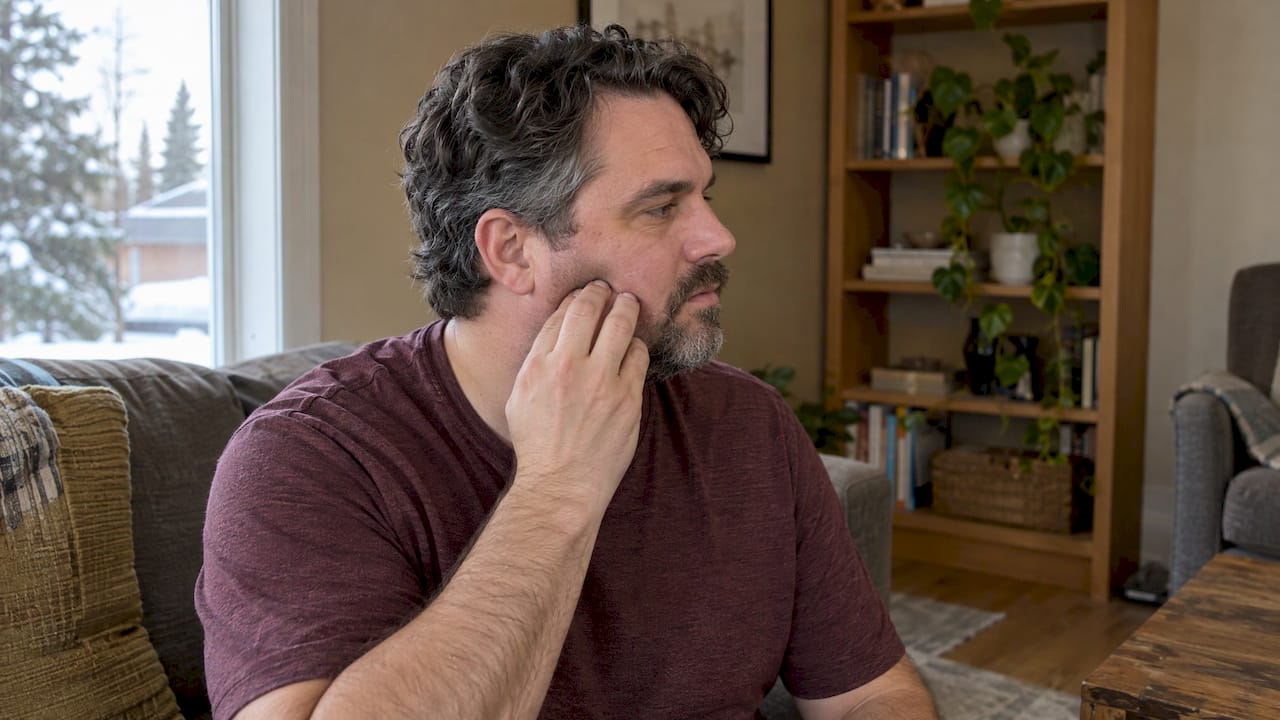
The Roswell Park guide describes the method this way: place your index and middle fingers on your cheekbone, slide them down over the masseter toward the bottom of the jaw, and find any tender or tight spots. Then massage those areas in small circles for 30 seconds, two to three times every day.
A few practical points make it work better:
Alberta Health Services’ TMJ pathway on myhealth.alberta.ca recommends asking a healthcare provider to show you how to do a gentle self-massage. That makes sense: where to press and how hard depends on which muscles are tight in your case. At our clinic, massage therapy is part of what we offer, and our team can also work with you on the techniques that suit your jaw.
The three-finger test is a quick way to track your own progress. Stack three fingers, held vertically, and see whether they fit between your upper and lower front teeth. The Canadian Dental Association journal states that normal mouth opening is 35 to 55 mm, averaging about 40 mm, roughly three fingers wide.
Use it as a baseline rather than a diagnosis. Check once a week at about the same time of day, since the jaw is often stiffer in the morning. If your opening is clearly shrinking over days despite gentle exercise, or you cannot fit three fingers at all, that is a reason to be assessed rather than to push harder.
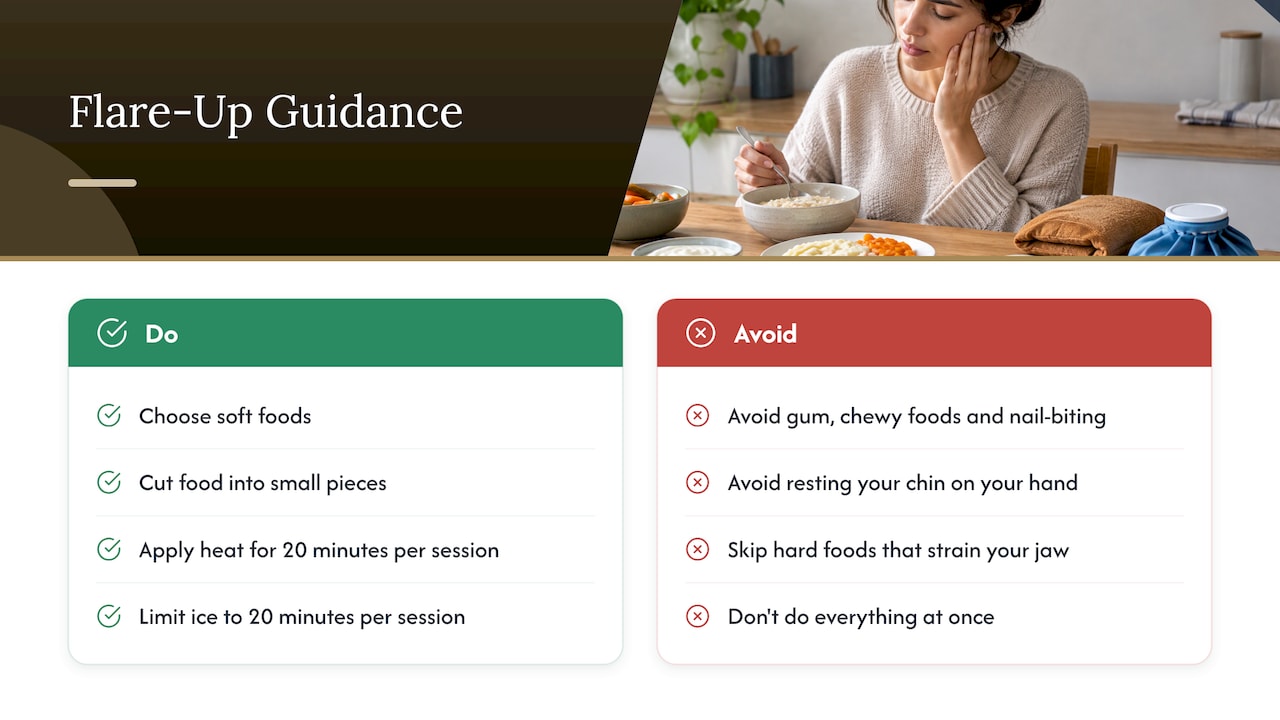
A flare-up is a period when your jaw pain spikes. It is the time to calm the joint down, not to test its limits. The Alberta Health Services pathway gives clear, practical guidance:
Avoid gum, chewy foods, nail-biting and resting your chin on your hand, and skip hard foods that make the jaw work very hard. Choose soft foods such as eggs, yogurt or soup, or cut food into small pieces. Apply heat, such as a warm cloth or heat pack, for 20 minutes at a time, a few times a day, to relax jaw muscles. Ice or a cold pack for up to 20 minutes at a time, a few times a day, can help reduce swelling and pain. All of this is on the myhealth.alberta.ca page.
The Canadian Chiropractic Guidelines list the same family of strategies, plus awareness of clenching or repetitive jaw activity, sleep support, pacing and a written flare plan. Pick the ones that fit your situation instead of doing everything at once. A written flare plan is worth making when things are calm: note your triggers, which foods you will switch to, which exercises you will drop to gentle movement, and who you will call.
If you notice yourself clenching during the day, that habit matters. Our page on teeth grinding and jaw pain covers what helps.
Many people worry about a clicking jaw. The Canadian Chiropractic Guidelines say that painless clicking or popping does not by itself require treatment, and that bite or imaging findings alone do not establish the cause or severity of TMD. If your jaw clicks but moves freely and does not hurt, you do not need an elaborate routine. If the click comes with pain, catching or locking, an assessment is worthwhile. See our guide to jaw clicking and popping for more.
Self-care suits mild to moderate jaw pain. Get assessed sooner when:
A dislocated jaw, where it is stuck wide open or out of position, needs emergency care at an emergency department, not exercises. The Canadian Dental Association journal also stresses that restricted opening can have an underlying cause, such as an infected or impacted tooth, which should be treated directly.
The guidelines also note that therapist-assisted jaw mobilization and manual trigger-point therapy can accompany active care for persistent TMD when a short-term change in pain or movement helps you take part in your exercises. They advise avoiding forceful techniques with an acute lock, marked irritability or suspected serious pathology. That is why a careful assessment comes before any hands-on work.
Exercises are most effective when they match your jaw, your neck and your daily demands. Our approach starts with a comprehensive biomechanical assessment and an individualized, evidence-based treatment plan. Our chiropractic care covers joint and soft tissue problems, and we use non-invasive options such as laser therapy and Active Release Technique, a hands-on soft tissue method. If you want to see how a chiropractor approaches jaw pain, read can a chiropractor help with TMJ, or our overview of TMJ pain treatment options.
We offer same-day appointments and direct insurance billing, so you do not need to wait out a flare-up.
If your jaw is stiff, painful or keeps coming back, book an assessment at Shephard Health in Calgary and we will build the exercise plan around you.

We see jaw pain as part of a bigger picture. The jaw, neck, upper back and the way you load your body each day all influence one another, so we assess the whole system before we prescribe a single exercise.
The research supports this. Exercise helps, and the strongest results in the literature come from programs that are tailored and, where appropriate, paired with hands-on care. That is why we combine an individualized plan with techniques such as chiropractic care, Active Release Technique and laser therapy, always matched to what your assessment shows.
Our advice is simple: start gently, stay below pain, keep the routine short and regular, and let us help you refine it. You should not have to guess whether the stretch you are doing is the right one.
Deane
Yes, they can. A 2023 systematic review found that exercise therapy reduced muscle pain and improved mouth opening in painful TMD, although the certainty of the evidence was low. Results are best when the exercises fit your presentation.
You fit three stacked fingers between your upper and lower front teeth. Normal mouth opening is about 35 to 55 mm, roughly three fingers wide. It is a useful way to track your own progress, not a diagnosis.
A commonly given routine is three times a day: open to a stretch and hold for 10 seconds, then move the jaw left and right, holding 3 seconds each. Stay below pain, and stop if you feel numbness or tingling.
Avoid gum, chewy and hard foods, nail-biting and resting your chin on your hand. Choose soft foods and use heat or cold for up to 20 minutes at a time, as outlined by Alberta Health Services.
Same Day Appointments Available
We Direct Bill!