

Yes, targeted soft-tissue massage, including gluteal myofascial work, gentle hip-flexor release, and trigger-point pressure, commonly reduces hip pain in the short term and can make movement easier when paired with exercise. Evidence certainty is limited, so expect meaningful short-term relief rather than a lasting fix on its own. Massage works best as a bridge into rehabilitation, not a replacement for it. If you notice numbness, tingling, or weakness, stop and get assessed.
TL;DR:
- Self-massage techniques, such as gluteal release or hip-flexor work, provide short-term relief but are less effective if symptoms persist or worsen over time.
- Targeted pressure on specific tender points, held for 60 to 90 seconds, can relieve localized pain, especially when accurately located by a professional.
- Massage is contraindicated if symptoms include swelling, numbness, weakness, or rapid worsening, requiring prompt medical assessment instead.
- Combining massage with gradual exercise focusing on hip strength and mobility yields longer-lasting improvements, especially for osteoarthritis-related pain.
- Inconsistent or no improvement after a few weeks of self-care suggests the need for professional assessment to address possible referred pain or underlying issues.
Different hip pain patterns respond to different techniques, so matching the method to your symptom location matters more than picking the “best” one in general. Lateral hip pain that radiates toward the buttock often responds to gluteal myofascial release, which eases tension in the gluteus medius and minimus. A focal, reproducible “knot” that recreates your familiar pain usually calls for sustained trigger-point pressure rather than broad strokes.
Pain centered at the front of the hip or groin tends to respond better to gentle hip-flexor and iliacus release, applied with light, patient pressure rather than force. If your hip feels generally tight from overuse or long periods of sitting, deeper tissue work on the larger hip and thigh muscles can help; if the joint is acutely inflamed or recently injured, gentle stroking is safer than deep pressure.
A few guidelines help you decide where to start:
If self-massage does not change your symptoms after a few sessions, or if you are unsure how to locate the right muscle group, a therapist trained in hands-on techniques can apply more precise, graded pressure and check for findings you might miss on your own.
Before starting, warm up with a few minutes of walking or gentle hip circles, and settle into slow, steady breathing. Pressure should sit in a tolerable range: firm enough to feel a release in the tissue, never sharp or breath-holding. Reassess after each technique by standing, walking a few steps, or climbing a stair to see whether the movement feels easier.
After each technique, check a functional movement: walking, climbing a stair, or rising from a chair. If it feels easier or less restricted, you are on the right track. If pain sharpens, or you notice numbness or tingling down the leg, stop the technique and avoid repeating it until you have had it assessed. Our guide to self-massage for sciatica covers similar pressure and symptom cues if your hip pain radiates down the leg.
Pro Tip: Work one technique at a time and reassess before moving to the next; stacking several intense techniques in one session makes it hard to tell what actually helped.
A therapist brings precision and feedback that self-massage cannot fully replicate, particularly for pain that has not improved with home techniques. Clinical sessions commonly draw on a handful of approaches, each suited to a different tissue problem:
A typical session starts with an assessment of your movement, posture, and pain pattern, followed by targeted soft-tissue work on the muscles contributing to your symptoms. The therapist then reassesses your movement before finishing with mobility guidance or exercises to carry the improvement forward.
Consider booking a session if self-massage has not meaningfully changed your symptoms after a couple of weeks, if your pain persists or worsens, or if you suspect your hip pain is actually referred from your lower back or sacroiliac joint rather than originating locally.
Massage is not appropriate for every kind of hip pain, and some symptoms call for medical attention rather than soft-tissue work. HealthLink BC advises gentle rubbing to encourage blood flow but is clear that you should not massage if it causes pain, and that certain signs warrant prompt evaluation.
Stop and seek assessment if you notice:
One practical safety test matters more than any technique: if massage worsens your pain, causes new numbness, or triggers weakness, stop immediately and arrange an assessment rather than pushing through it.
When acute inflammation is present, gentle stroking, heat or cold application, and rest followed by a graded return to activity are safer starting points than deep pressure.
Massage eases tension and can make movement feel possible again, but exercise is what tends to drive lasting improvement in hip pain, particularly when osteoarthritis is involved. Arthritis Society Canada recommends targeting the hip abductors, extensors, and quadriceps, holding stretches for 30 to 45 seconds, and gradually progressing aerobic activity toward 150 minutes a week if your symptoms allow it.
A practical sequence looks like this:
If stairs or longer walks aggravate your hip, a patellofemoral-style gradual loading routine applies the same principle of building tolerance slowly rather than pushing through pain.
Pro Tip: Track walking distance, stair tolerance, sleep quality, and range of motion rather than how sore you feel right after a session; function tells you more than momentary comfort.
A 2019 trial on hip pain used weekly, moderate-pressure massage sessions of about 20 minutes for 4 weeks, which produced immediate pain decreases and improved hip-related measures that were still present at one-month follow-up, though the evidence base behind this protocol remains limited.
A reasonable plan to discuss with a therapist or try at home:
The right tool depends on how much pressure and control you need. A foam roller covers larger areas with moderate, adjustable pressure, while a lacrosse or therapy ball concentrates pressure on a smaller point, useful for the glutes and piriformis. A massage stick gives you more control for rolling along the thigh, and your hands remain the most precise option for sensitive areas like the hip flexor and groin.
A few notes on position and safety:
At Shephard Health, massage therapy is one piece of a broader assessment that looks at how your hip pain connects to posture, movement patterns, and surrounding structures like the lower back and sacroiliac joint. A typical visit starts with an assessment of your pain and movement, followed by targeted soft-tissue work suited to what the assessment finds, whether that means gluteal release, trigger-point work, or Active Release Technique. The session closes with mobility and exercise guidance so the benefit of the hands-on work carries into your daily activity rather than fading once you leave the clinic.
This structured flow, assessment, treatment, reassessment, and a rehab plan, reflects the individualized, evidence-based approach the clinic is built around, with advanced non-invasive technologies available when soft-tissue work alone is not enough. The goal at each step is a measurable change in how you move, not just how you feel on the table.
Hip pain rarely comes from one single source, which is why matching the right massage technique to the right cause matters. Muscle strain, often from overuse, sudden activity increases, or poor movement mechanics, tends to cause localized tightness and tenderness that responds well to gluteal or hip-flexor release. Bursitis, an irritation of the fluid-filled sacs that cushion the hip joint, typically causes pain on the outer hip that worsens with direct pressure or lying on that side.
Osteoarthritis involves gradual wear of the joint cartilage and commonly causes stiffness and deep aching, especially with weight-bearing activity or after periods of rest. This is the pattern where pairing massage with progressive exercise matters most, since the joint itself needs strength and mobility support beyond soft-tissue work alone.
Referred pain is easy to miss. The lumbar spine and sacroiliac joint sit close enough to the hip that irritation in either can mimic hip pain, and clinicians commonly assess and treat the hip alongside these adjacent structures rather than treating the hip in isolation. If your hip pain does not respond to targeted hip work, the source may sit higher up the chain.
Mild soreness after a massage session, particularly deeper tissue work or trigger-point pressure, is a normal response and usually settles within a day or two. It tends to feel similar to the ache after a new workout rather than the sharp or radiating pain that signals a problem.
Light movement, walking, and gentle stretching help more than complete rest in most cases, since they encourage blood flow to the worked tissue. Applying heat can ease residual tightness, while a brief period of cold may help if the area feels inflamed rather than simply worked.
Soreness that lingers beyond two or three days, sharpens rather than fades, or comes with new numbness or weakness is different from typical post-massage discomfort and is worth mentioning to a therapist before your next session. Adjusting pressure, technique, or session frequency usually resolves this without needing to stop massage altogether.
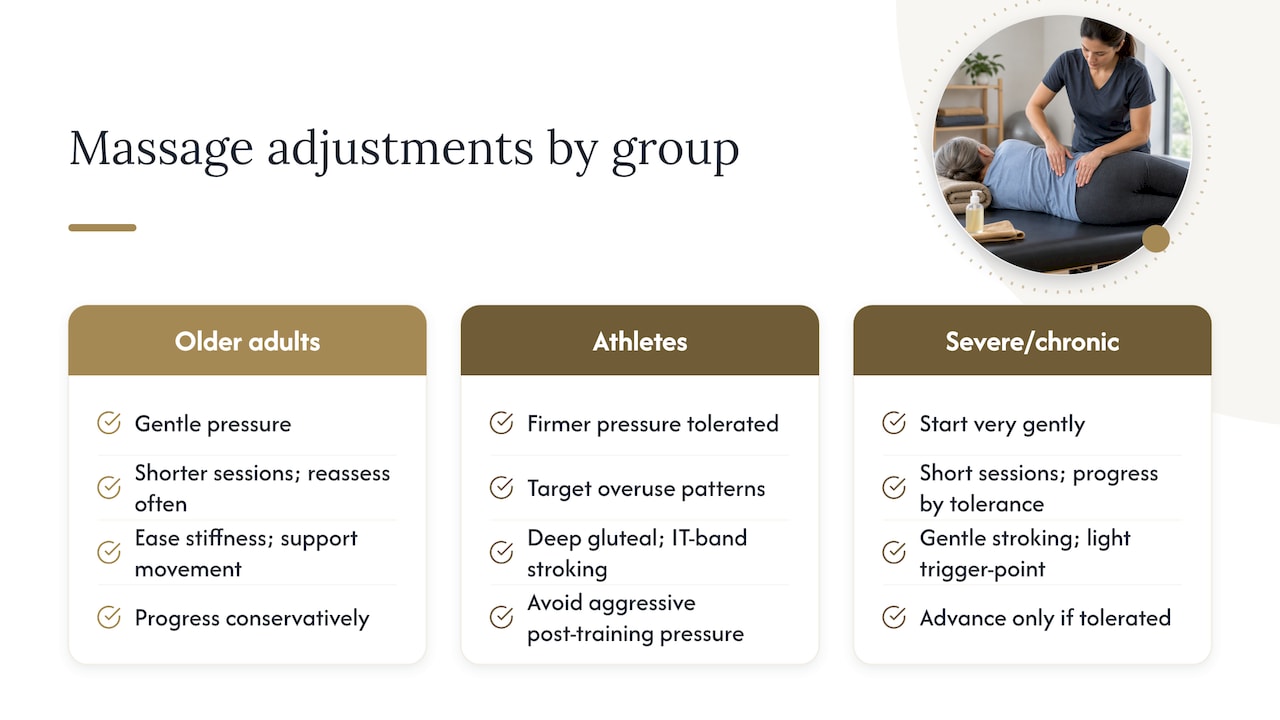
Hip pain looks different depending on who is experiencing it, and technique intensity should shift accordingly. Older adults, particularly those with osteoarthritis or more fragile tissue, generally do better with gentler pressure, shorter session lengths, and more frequent reassessment, since the goal is easing stiffness and supporting movement rather than breaking down deep tissue restriction.
Athletes and highly active individuals often tolerate firmer pressure and benefit from techniques aimed at specific overuse patterns, such as deep gluteal work after high training volumes or IT band stroking following repetitive running. Even so, aggressive pressure immediately after an intense training session can increase soreness rather than help, so timing matters as much as technique choice.
For anyone with more severe or long-standing hip pain, starting conservatively, gentle stroking and light trigger-point pressure, and progressing only as tolerance allows, is safer than jumping straight to deep tissue work. A therapist can tailor pressure and technique choice more precisely than self-massage allows, which matters most for populations where tissue tolerance is harder to judge from home.
Massage earns its place in hip pain care as a tool for easing tension and making movement more comfortable, not as a cure for the underlying problem. The evidence supporting it leans toward short-term relief, and the honest position is to treat that relief as an opening to move better and strengthen the hip, not as the end goal itself.
What matters most is whether a technique changes your function, a longer walk, an easier stair, better sleep, rather than how good a session feels in the moment. Red flags deserve immediate respect: numbness, weakness, or worsening pain are signals to stop and get assessed, not symptoms to massage through.
— Deane

If self-massage has eased your symptoms but plateaued, or if you are unsure which technique fits your specific pain pattern, an assessment at Shephard Health gives you a clearer answer than continuing to guess at home. Massage Therapy is one option among a broader set of hands-on approaches, including Active Release Technique and Graston Technique, chosen based on what your assessment actually shows rather than a one-size-fits-all routine.
A typical visit starts with an assessment of your hip pain and movement pattern, followed by an individualized treatment plan, so there is no added hassle on top of managing the pain itself. You can review the full range of options on our services page or book directly through our Massage Therapy page to get an assessment scheduled.
Massage can help many types of hip pain by easing muscle tension and making movement feel more comfortable in the short term. It works best alongside exercise rather than as a stand-alone fix, and it is not appropriate if massage itself increases your pain or triggers numbness or weakness.
There is no single universal pressure point, since the right spot depends on where your pain originates. Common targets include the gluteus medius just below the hip bone for lateral pain, a deeper point in the buttock for piriformis-related pain, and the area just inside the front hip bone for hip-flexor tightness.
Gluteal myofascial release works well for lateral or buttock-related soreness, while gentle hip-flexor and iliacus release suits pain at the front of the hip or groin. Deep tissue work suits general tightness without acute inflammation, while gentle stroking is safer when the area feels recently injured or inflamed.
Gentle self-massage combined with light movement often brings faster relief than rest alone, since it helps ease muscle guarding around the joint. If pain is severe, worsening, or comes with numbness or weakness, seek assessment promptly rather than relying on self-massage alone.
Same Day Appointments Available
We Direct Bill!