

Soft tissue damage refers to injury of muscles, tendons, ligaments, or bursae, usually from a sudden trauma like a fall or twist or from repetitive overuse that wears down tissue over time. The right first move is to protect the area and limit aggravating movement, then watch for red flags such as deformity, numbness, or a limb that looks pale or feels cold, which call for urgent medical assessment.
TL;DR:
- Most soft tissue injuries heal with staged, pain-guided rehabilitation, but complete ruptures may require months of structured treatment.
- Imaging like ultrasound and MRI are reserved for complex cases or those not improving as expected, while initial diagnosis relies on clinical examination.
- The first three days involve protecting the area, minimizing aggravation, and gradually starting gentle movement based on pain levels.
- Red flags such as limb deformity, numbness, or increasing pain require urgent medical assessment for potential serious complications like compartment syndrome.
- Recovery time varies widely from two weeks for mild sprains to several months for severe tears or post-surgical cases, depending on injury severity and treatment adherence.
Soft tissue covers muscles, tendons, ligaments, bursae, cartilage, nerves, and blood vessels, not just skin and fat as the term sometimes implies to patients. That distinction matters because a ligament tear and a nerve injury need very different care, even when both start with a twisted ankle. The Merck Manual describes these injuries as either acute, from a single traumatic event like a blow or fall, or cumulative, from repetitive loading without enough recovery time between sessions. Clinicians also grade severity on a simple scale: a stretched tissue, a partial tear, or a complete rupture. That grading shapes everything that follows, from how long you rest to whether surgery becomes part of the conversation.
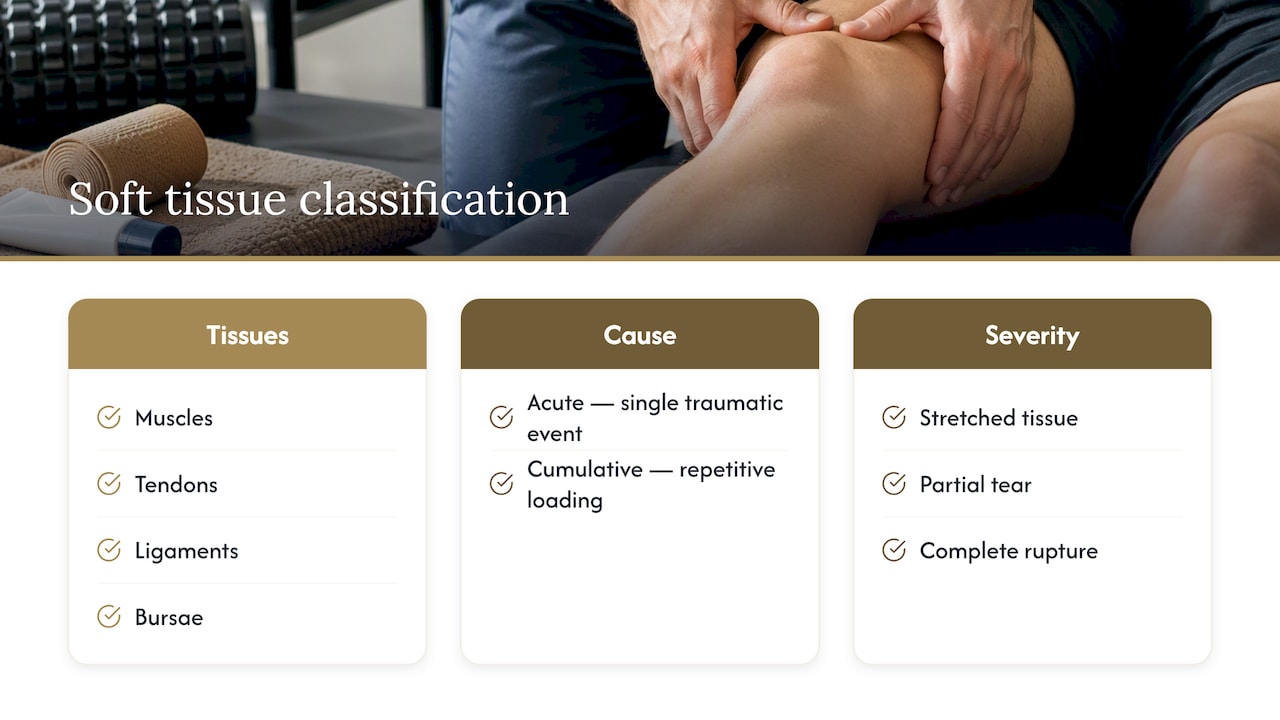
Most soft tissue injuries fall into a handful of recognizable categories, each with its own typical cause and location.
Mild sprains and strains usually respond well to conservative care, while complete ruptures, especially of weight-bearing tendons, more often need a surgical opinion.
Pain, swelling, bruising, stiffness, and weakness make up the typical symptom cluster for soft tissue damage, according to the Cleveland Clinic. How these symptoms appear, and when, often tells you more about severity than the symptoms themselves.
Severity on this spectrum ranges from a stretched tissue that still functions to a complete rupture that cannot bear load, and that range is exactly why the same word, “sprain,” can mean a two-day recovery for one person and a six-week rehab program for another.
Diagnosis starts with a conversation and a hands-on exam, not a scan. A clinician will ask how the injury happened, then check the area for tenderness, swelling, range of motion, strength, joint stability, and circulation and sensation in the limb, a process the BJSM PEACE & LOVE framework outlines as the starting point for every soft tissue assessment.
Routine repeat imaging is not generally supported once a diagnosis is clear. Scans are most useful when they answer a specific question the exam could not, and ongoing assessment of your response to early treatment often tells a clinician more than a second picture would.
The acute phase runs roughly the first one to three days, and the goal is to calm the tissue down without shutting it down completely. The BJSM PEACE & LOVE framework and NHS Inform both frame this as a staged process rather than a single rule like “rest it.”
Pro Tip: Pain does not need to hit zero before you start moving again. A little discomfort during gentle activity is normal; sharp or worsening pain is the signal to pull back.
Recovery follows a staged path: protect, then mobilize, then strengthen, then retrain balance and coordination, then return to full activity. Pain should guide how fast you move through each stage, not a fixed calendar.
A 6 to 8 week ankle sprain rehab plan illustrates how this staged approach plays out for one of the most common injuries treated in clinics.
Pro Tip: Track a functional goal, like walking a set distance without a limp, instead of just counting days. It gives you a clearer sense of progress than the calendar does.
Most soft tissue injuries heal without drama, but a small number signal something more serious. The AAOS rapid update is direct about this: acute compartment syndrome is a surgical emergency, and diagnosis depends on clinical judgment rather than a single pressure reading.
Any of these warrants an emergency department visit, where staff will check circulation and nerve function, consider imaging, and assess whether surgery is needed.
Most soft tissue injuries heal cleanly, but a subset leads to lasting problems. Chronic tendinopathy can develop when overuse injuries are not properly rehabilitated. Joint instability sometimes follows ligament injuries that heal with excess laxity. Scarring and, less commonly, heterotopic ossification (bone forming in soft tissue) can follow severe trauma. Risk factors that slow healing and raise complication risk include older age, diabetes, vascular disease, and smoking. Surgical referral becomes more likely with complete tendon ruptures, significant joint instability, or any case involving suspected nerve or vascular injury.
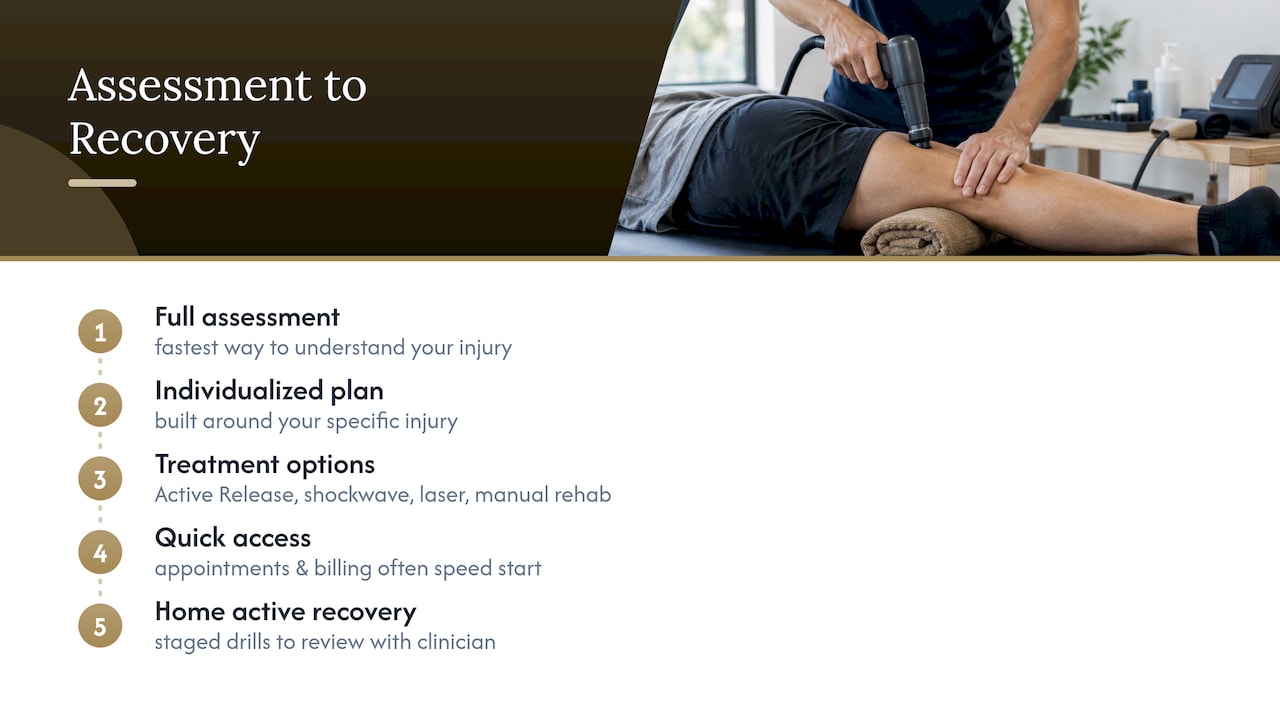
Shephard Health builds treatment plans around a full biomechanical assessment, then matches the approach to the injury and its stage of healing. Depending on what the assessment shows, that might include Active Release Technique, shockwave therapy, laser therapy, manual therapy, and guided exercise progression. The clinic offers same-day appointments and bills most insurance providers directly, which removes some of the friction that keeps people from starting rehab early.
Quick-fix thinking is the most common obstacle I see in soft tissue recovery. Staged, pain-guided progress beats shortcuts every time. If you hit a red flag, get seen urgently. Otherwise, ask questions at every appointment and track function, not just how you feel that day.
— Deane
If you are dealing with a sprain, strain, or stubborn overuse injury that is not improving on its own, a full assessment is the fastest way to understand what you are actually working with. Shephard Health builds an individualized plan around your specific injury, drawing on treatments for soft tissue injuries such as Active Release Technique, shockwave therapy, laser therapy, and manual rehabilitation.

Appointments and insurance billing processes mean you can often get assessed and started on a plan relatively quickly, rather than waiting weeks for a referral. For home-based recovery ideas between sessions, active recovery techniques for athletes offer practical, staged drills worth reviewing with your clinician. Book an assessment through the services page to get a clear plan for your injury.
This article is general information, not a substitute for advice from a qualified doctor. Consult a qualified healthcare professional about your own circumstances before acting on anything here.
Most soft tissue damage is mild to moderate and heals well with staged, guided rehabilitation. Severity ranges widely, from a stretched tissue that keeps functioning to a complete rupture that may need surgery, so the Cleveland Clinic frames severity as a spectrum rather than a single outcome.
Treatment follows a staged approach: protect the area early, then introduce graded, pain-guided movement and strengthening as healing allows. The BJSM PEACE & LOVE framework emphasizes active rehabilitation over passive treatments for the best long-term function.
A mild strain often improves within two to four weeks, while moderate injuries can take six to twelve weeks, and severe tears may take several months. Healing time depends on which tissue is involved and how closely rehab follows a graded loading plan.
Not necessarily. Many soft tissue injuries heal faster and with fewer complications than a fracture, though a complete tendon or ligament rupture can involve a longer, more complex recovery than a simple, non-displaced fracture. Severity depends on the specific tissue and grade of injury, not on whether bone was involved.
Same Day Appointments Available
We Direct Bill!