

Most mild ulnar nerve entrapment is treated first without surgery. That means changing the elbow and wrist positions that irritate the nerve, protecting it at night, and working with a clinician on gentle movement and strength. Numbness in your pinky and ring finger deserves a proper assessment before you pick a treatment, because the compression can sit at the elbow, at the wrist, or the symptoms can come from somewhere else entirely. This guide walks you through the options in the order most people meet them, and explains where they help and where they don’t.
The ulnar nerve runs from your neck down the inner arm, passes behind the bony point of the elbow (the “funny bone”) and continues into the hand. It can be squeezed at the elbow, in a passage called the cubital tunnel, or at the wrist, in a space called Guyon’s canal. Johns Hopkins Medicine lists cubital tunnel syndrome, Guyon’s canal syndrome and handlebar palsy among the names for this problem. A 2025 Cochrane update describes ulnar neuropathy at the elbow as the second most common entrapment neuropathy after carpal tunnel syndrome.
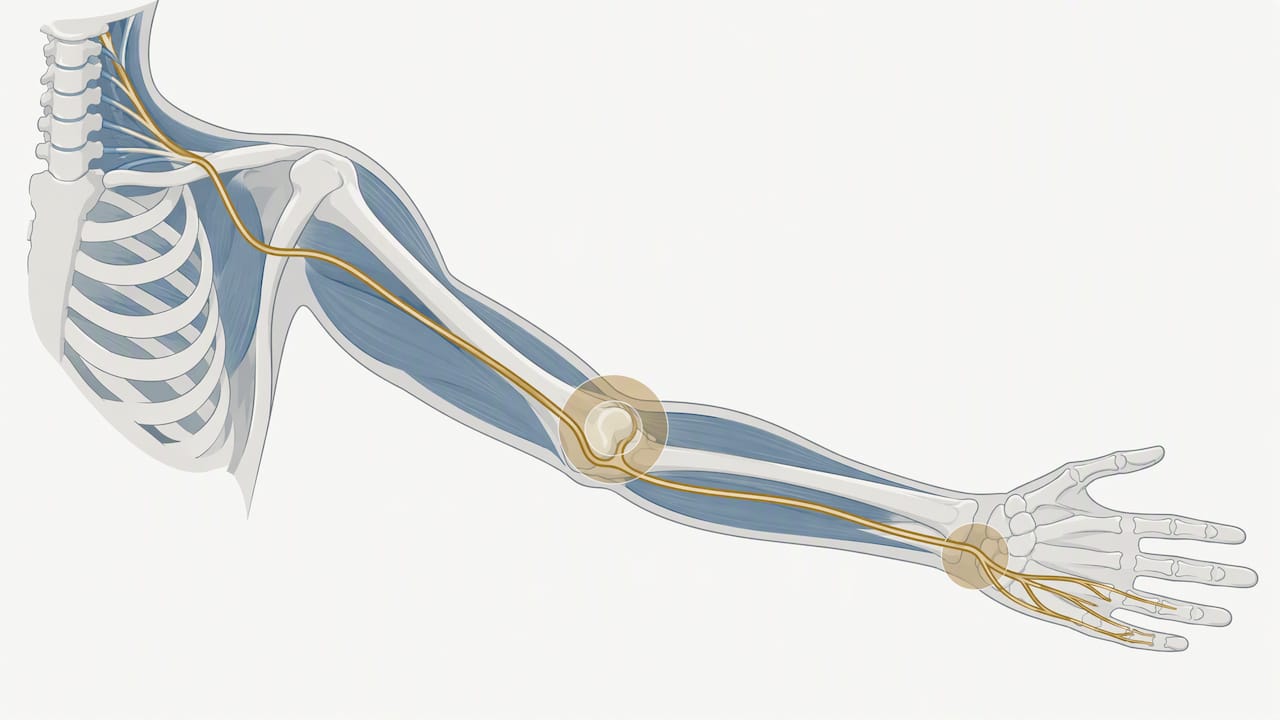
Where the nerve is compressed shapes everything that follows. Elbow entrapment tends to flare with a bent elbow, such as holding a phone, sleeping with your arms curled up, or long drives. Wrist entrapment is more often tied to pressure on the heel of the hand, as in cycling or gripping tools.
It also helps to know that not every pinky symptom is an ulnar nerve problem. Numbness in the little finger and half of the ring finger can come from a nerve root in the neck, the brachial plexus, an injury, diabetes-related neuropathy or another condition. Canadian musculoskeletal guidance lists tingling and weakness among findings that need careful differential diagnosis rather than an assumption of a local muscle problem. A good assessment therefore looks at your neck, shoulder, elbow, wrist and hand together.
See a family physician, sports-medicine physician, physiotherapist or hand specialist soon if you notice any of the following:
Constant numbness, loss of pinch or grip, and hand wasting suggest the nerve’s motor fibres are involved. The Cochrane-linked evidence review frames management around severity for this reason, and these findings should not be managed indefinitely with massage or exercises. If you are in Alberta and unsure where to start, a family doctor, or a physiotherapist or chiropractor who can examine you in person, is a sensible first call. In an urgent situation, such as sudden weakness after trauma, go to urgent care or an emergency department.
For mild or intermittent entrapment without muscle wasting or progressive weakness, conservative care comes first. StatPearls lists nonsurgical measures for ulnar neuropathy without atrophy: anti-inflammatory medication, external padding of the nerve and night splinting.
In practice, this usually looks like four things.
Reduce prolonged elbow flexion. A hand therapy leaflet from an NHS trust advises avoiding long periods with your elbows bent. Holding a phone against your ear, sleeping with your elbows tucked tightly, and long stretches of typing with elbows at a sharp angle are the usual culprits. Switch to speaker or earbuds, and alternate hands.
Take pressure off the inner elbow. Resting on your elbows at a desk, leaning on a car armrest or propping on a counter all load the nerve. The same leaflet suggests avoiding resting on your elbows when using a computer. A padded sleeve or a small elbow pad can help in daily life.
Protect the nerve at night. Many people sleep with the elbow fully bent without knowing it. A soft splint, or a towel loosely wrapped around the elbow, keeps it straighter. Ask your clinician which option suits you and how long to wear it.
Get a supervised plan. Occupational therapy and physiotherapy are standard parts of non-surgical care, and Johns Hopkins notes that this problem can be treated non-operatively with therapy, medication and splints.
Honestly, less certain than people expect. The 2025 Cochrane review pooled 15 randomized or quasi-randomized trials with 970 participants, and the certainty of the evidence for many conservative treatments was low or very low. That doesn’t mean they don’t work for you. It means that no splint, injection or exercise has a guaranteed result, so your plan should be reviewed. If your sensation, strength or function isn’t improving after a fair trial, the plan should change rather than repeat.
People search for ulnar nerve glides, nerve flossing and cubital tunnel exercises because movement feels like something you can control. Used correctly, nerve gliding may help the nerve slide more freely through the tissues around it. Used aggressively, it can make things worse.
The difference matters. A glide moves the nerve gently through its path. A forceful stretch pulls on it. A small 2025 clinical study reported improvement in selected mild-to-moderate patients, but cautioned that aggressive mobilization in severe entrapment may worsen symptoms.
We suggest the following rules, which match patient guidance from hospital therapy teams:
For the upper-body positions and how glides differ from stretching, see our guide to upper-body nerve flossing exercises, and read when to avoid nerve flossing before you begin.
Once symptoms are settling, the aim shifts to rebuilding tolerance for load. Forearm and hand strength, shoulder-blade control and a neutral neck posture all reduce the strain reaching the nerve. If you climb, lift or train grip, a measured approach matters: this guide to tendon-safe grip training covers four grip types in two to three sessions per week, which is a useful framework for returning to hanging and gripping without flaring symptoms. Keep to light loads while any tingling is active, and confirm timing with your clinician.
Soft-tissue treatment can ease muscle tension around the neck, shoulder, forearm and hand, and improve how those areas move. It does not reliably remove a fixed compression of the nerve itself. Work should be light and directed around the nerve pathway, not repeated pressure on the funny bone.
A 2024 Cleveland Clinic case study of an esports athlete used soft-tissue mobilization as one part of a broader program that also included ergonomic changes, targeted strengthening, taping and a cervical assessment. It is a single case, not proof that massage alone treats entrapment, but it shows what good care looks like: several pieces working together.
At Shephard Health in Calgary, hands-on options include Active Release Technique, Graston Technique and massage therapy. We use them to address tight, restricted tissue that may be contributing to your symptoms, alongside movement and positioning advice, never as a stand-alone cure. We also offer laser therapy and shockwave therapy for soft-tissue pain, and whether either belongs in your plan depends on your assessment.
For athletes and active adults, the trigger is rarely one exercise. It is cumulative positioning: a long time with the elbow flexed, pressure from armrests or handlebars, wrist posture, forward-head posture, grip demands and training errors can add up along the same nerve. The Cleveland Clinic case illustrates this, with an evaluation that included the athlete’s playing position.
That is why a return-to-sport plan needs two parts: symptom control now, and graded restoration of load tolerance after. In practice, think about:
General soft-tissue recovery principles also apply while you rebuild. Our guide to soft tissue damage recovery timelines explains how to stage load safely after an injury.
Surgery is considered when symptoms are severe, weakness or muscle atrophy is present, or an appropriate trial of conservative care has failed. The options include simple decompression (releasing the tissue over the nerve), anterior transposition (moving the nerve to the front of the elbow) and, in selected cases, decompression at the wrist.
It is reassuring to know the choice between techniques is less clear-cut than marketing suggests. The Cochrane review found little to no difference between simple decompression and transposition, and little to no difference between open and endoscopic decompression, with evidence certainty ranging from moderate to low. The decision should rest on the site of compression, the stability of the nerve, your anatomy, prior injury or surgery, severity and your surgeon’s assessment.
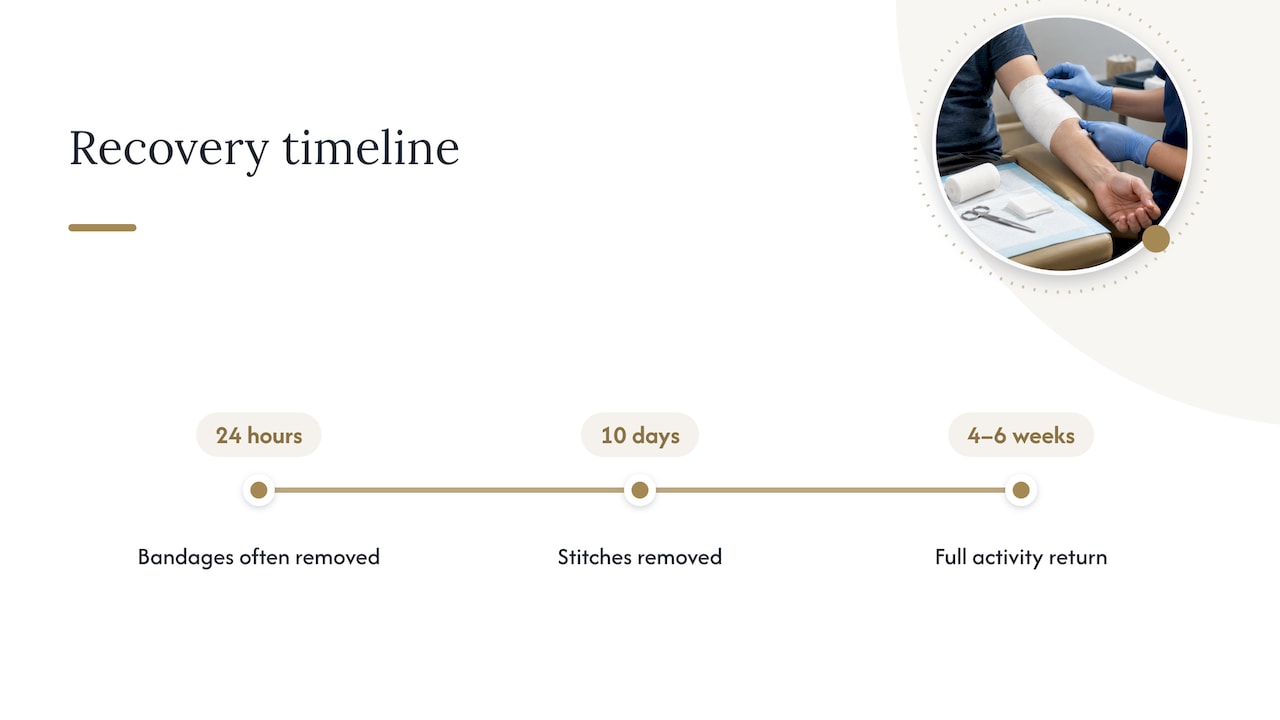
Recovery varies. Johns Hopkins reports that bandages are often removed within 24 hours, stitches come out at about 10 days, and a return to full activity may take 4 to 6 weeks. Those are general estimates, not a promise, and your surgeon decides when you can return to your sport or job.
We see this pattern often: someone has weeks of pinky tingling, tries a few stretches from a video, and either gets no change or feels worse. The usual reason is that the stretch was aimed at the wrong place, or was too aggressive for an irritated nerve.
Our approach starts with a thorough biomechanical assessment. We look at the neck, shoulder, elbow, wrist and hand, because the problem is often a chain, not a single spot. Then we build a plan around you: what you do all day, what your sport demands and what is reproducing the symptoms. Hands-on care, gentle nerve mobility, strengthening and positioning advice work together, and we reassess often. If your findings suggest motor involvement or a problem that needs a physician or surgeon, we say so and help you get there. Care that keeps repeating without improvement is not care we want to give you.
— Deane
If you are dealing with elbow, forearm or hand symptoms, our team offers same-day appointments and direct insurance billing where applicable. Learn about our chiropractic care in Calgary and physical rehabilitation, or see all treatments on our services page. If your hand symptoms involve the thumb, index and middle fingers instead, that pattern points to a different nerve, and our carpal tunnel treatment page is a better place to start.
Some mild cases settle once the pressure or position that irritates the nerve is removed, which is why first-line care focuses on activity changes and night positioning. Persistent or worsening numbness, weakness or hand wasting should not be left to resolve by itself. Have it assessed.
There is no universal dose. One NHS program begins with 5 to 10 slow repetitions, and others differ, so your clinician should set the number based on your symptoms. If tingling or pain persists after a session, stop and get it reviewed.
Light soft-tissue work around the neck, forearm and hand can ease contributing tension, but it does not reliably release a fixed compression. Avoid repeatedly pressing on the funny bone itself. It works best as one part of a plan that includes positioning changes and exercises.
Surgery is usually considered when symptoms are severe, weakness or atrophy is present, or a proper conservative trial has not worked. A surgeon chooses the technique based on where the nerve is compressed and your anatomy, since current evidence shows little difference between common methods.
Same Day Appointments Available
We Direct Bill!