

Spondylolysis, also called a pars defect or pars stress fracture, is usually treated without surgery. The core of care is a period of reduced activity, a progressive core-strengthening program and a gradual return to sport, with a brace added in some cases. Most people, especially young athletes, can expect a recovery measured in months, not years, when the problem is caught early and the plan is followed. Surgery is reserved for the minority whose symptoms and imaging do not improve after a long, well-run conservative trial (Orthopedic Reviews, 2022).
This guide explains what the treatment involves, how long healing takes, how to return to your sport in stages, and what to ask when you book an assessment.
The pars interarticularis is a small bridge of bone in the back of a vertebra, most often in the lower lumbar spine. A pars defect is a stress fracture in that bridge. It can occur on one side (unilateral) or both sides (bilateral).
The usual cause is repetition. Repeated spinal hyperextension and axial loading, the kind of movement seen in gymnastics, football, diving, weightlifting and cricket bowling, can contribute to pars fractures in young athletes (Spondylolysis in Young Athletes, 2020). Think of it as a bone that is asked to absorb more arching and twisting load than it can recover from between sessions.
Typical signs include low back pain that builds with activity, is worse when you arch backward, and eases with rest. Pain does not always match the finding on a scan, which is why the next point matters.
Pars lesions can be incidental findings. Clinicians are advised to consider other causes of pain instead of assuming the lesion is responsible (Journal of the American Board of Family Medicine, 2022). If your back pain has a muscular, joint or nerve component as well, a plan that only focuses on the fracture can miss part of the problem. A thorough assessment sorts out which structures are actually driving your symptoms.
Treatment starts with identifying what you have. Your clinician takes a history of your sport, training volume and when the pain began. They then assess how your spine and hips move, how your trunk muscles control load, and whether extension reproduces the pain.
Where a pars defect is suspected, imaging is usually arranged through your physician. The stage of the lesion matters. Early lesions with partial or complete fracture lines may heal after 4 months of activity restriction (Treatment of pediatric spondylolysis and spondylolisthesis, 2025). Older, established defects are less likely to knit back together, and the goal shifts toward relieving symptoms and restoring function.
Two more points shape the plan:
Unilateral or bilateral. Bony union is more common with unilateral defects than bilateral ones. In one review, 25% of patients with bilateral spondylolysis developed low-grade spondylolisthesis (a forward slip of one vertebra) during 2 years of follow-up (same review). That is a reason to follow up properly, not a reason to panic.
Your sport and life demands. Assessing the athlete’s sport demands, training volume and the pressures around them helps tailor management to the individual (Current concepts: approach to spondylolysis, 2024).
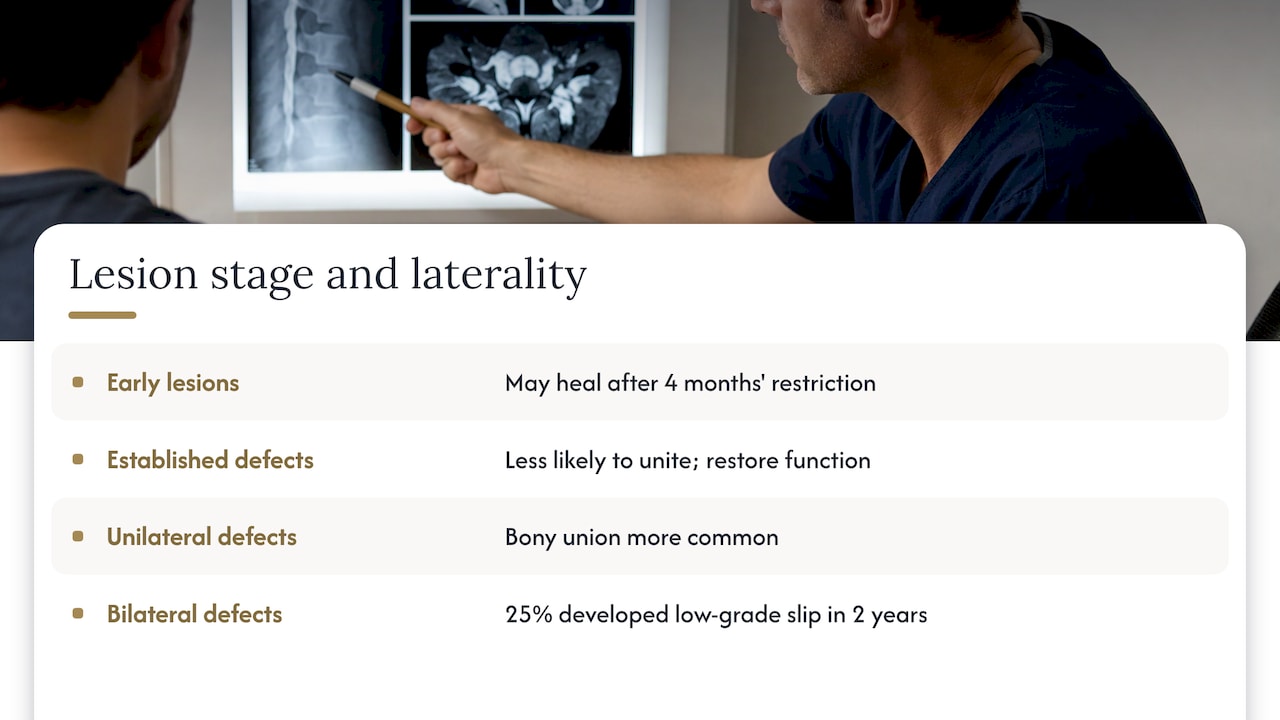
Conservative management is the first-line therapy. Its aims are to heal the lesion where possible, prevent further progression and relieve symptoms (Orthopedic Reviews, 2022).
In practice, “rest” does not mean lying on the couch for months. It means removing the specific loads that stress the pars: repeated arching, heavy axial loading, high-volume sport-specific drills. Daily walking and pain-free movement usually continue.
The degree of restriction varies. Management may involve avoiding aggravating sports entirely or limiting training volume. One published example restricts cricket bowling to 30 overs per week (Current concepts: approach to spondylolysis, 2024). Your own limit depends on your sport, your pain and your lesion stage, which is why it should be set by a clinician who has examined you.
For younger athletes, the stakes of getting this right are real. Early identification of an acute pediatric spondylolysis and 4 months of activity restriction can improve functional outcomes by promoting bony union (Treatment of pediatric spondylolysis and spondylolisthesis, 2025). Parents and coaches can help most by taking back pain in a young athlete seriously instead of asking the athlete to push through it.
Rehabilitation is where most of your recovery happens. Physiotherapy for spondylolysis includes core-strengthening exercises that activate and isolate the transverse abdominis, internal oblique and multifidus muscles (Spondylolysis in Young Athletes, 2020). These are the deep trunk muscles that stabilize the spine and share load that would otherwise land on the pars.
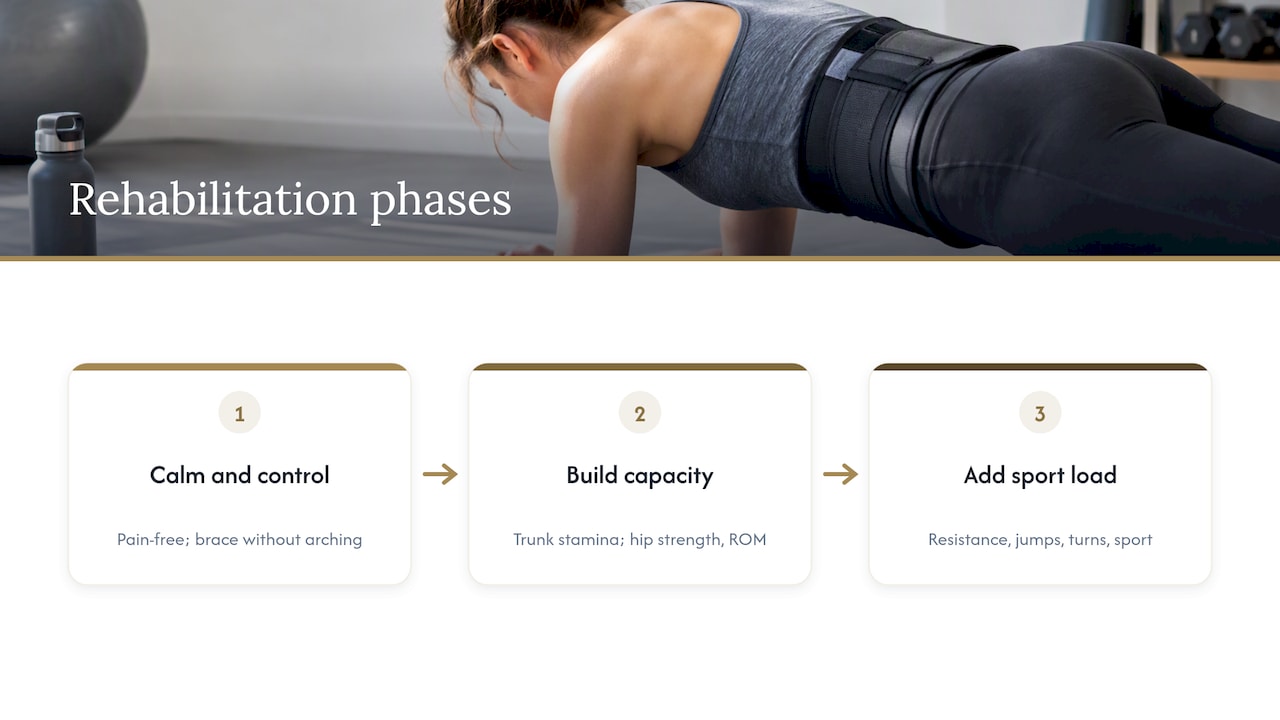
A well-designed program usually moves through phases.
Phase 1: calm and control. The aim is pain-free movement and learning to brace the trunk without arching. Exercises are low-load, such as gentle pelvic control work and abdominal bracing on your back.
Phase 2: build endurance and strength. Trunk endurance work, hip strengthening and mobility for tight hip flexors and hamstrings are added. Tight hips can push the lower back into more extension, so they matter. Our article on spondylolisthesis exercises for neutral spine control shows the type of positions used to train this control, and our guide to anterior pelvic tilt exercises covers hip and pelvis work that often overlaps.
Phase 3: load and sport-specific work. Once daily activity is comfortable, you add resistance, jumping, rotation and the movements of your sport in measured steps.
The Public Health Agency of Canada notes that rehabilitation for musculoskeletal conditions must be personalized to the individual’s needs, functional status and condition (Public Health Agency of Canada). That principle applies directly here: two people with the same scan can need very different programs.
Stop an exercise and tell your clinician if it brings on sharp back pain, pain that radiates down a leg, numbness or tingling.
While you are limiting sport, surrounding muscles often become tight and guarded. Soft tissue work can help you stay comfortable and keep moving well. At Shephard Health we use techniques such as Active Release Technique and Graston Technique for muscle and fascial restrictions around the hips and lower back, where your assessment shows they are relevant. They support the rehab program; they are not a replacement for it. If you want to understand the soft tissue side of recovery in more detail, our piece on soft tissue recovery timelines explains how healing stages guide what you do and when.
Bracing is one of the most debated parts of spondylolysis care. The evidence summary is nuanced.
Routine external bracing is not advocated for everyone, but it may be considered if symptoms persist (Spondylolysis in Young Athletes, 2020). Where a brace is used, a thoracolumbar-sacral orthosis is often worn for 6 to 12 weeks in young athletes, particularly for unilateral spondylolysis (Orthopedic Reviews, 2022).
So bracing is a tool for specific situations: a young athlete with a unilateral lesion, or pain that does not settle with activity modification and rehab alone. Whether it fits you is a decision to make with the clinician managing your case, ideally together with your physician if imaging is involved.
Plan in months. In one review, healing of the defect was noted at a mean of 14 weeks of follow-up. In a prospective study, 67% of patients with early or progressive pars lesions showed healing on CT after 4 months of activity restriction (Treatment of pediatric spondylolysis and spondylolisthesis, 2025).
That means roughly two out of three early lesions healed in that study, and some did not. Healing depends on how early the lesion was caught, whether it is on one side or both, and how well the restrictions were followed. A lesion that does not fully unite can still become pain-free and function well, because pain relief and bony healing are related but separate outcomes.
| Factor | What the research suggests |
|---|---|
| Early or progressive lesion | May heal after about 4 months of activity restriction |
| Mean healing in one review | About 14 weeks of follow-up |
| Unilateral vs. bilateral | Bony union is more common with unilateral defects |
| Brace, when used in young athletes | Often 6 to 12 weeks |
| Surgery considered | After more than 6 months of conservative therapy without substantial improvement |
A good return plan is built on criteria, not on the calendar alone. Before you resume full training, you should generally be able to do daily activity without pain, move through your back and hips comfortably, hold trunk control through your rehab exercises, and tolerate loaded and sport-specific drills without symptoms returning. Your clinician will decide the exact tests for your case, and may coordinate with your physician on imaging.
A typical staged approach looks like this:
If you want to see how a staged progression is laid out for another back-loading sport, this four-stage return plan for lower back pain shows the same logic of adding load only as the back tolerates it.
If pain returns at any stage, step back one phase and tell your clinician. A flare is information, not failure.
Most people never need it. Surgery may be considered when more than 6 months of conservative therapy has not substantially improved symptoms and imaging shows a persistent fracture. The options include direct repair and spinal fusion, and the choice depends largely on lesion severity and the patient’s clinical goals and outlook (Orthopedic Reviews, 2022).
This decision belongs with a spine surgeon or your physician, after a proper trial of conservative care. If you have progressive leg weakness, numbness in the groin or saddle area, or changes in bladder or bowel control, seek emergency medical care right away instead of waiting for a clinic appointment.
You cannot remove all risk, but you can lower the load on the pars. Build trunk and hip strength before increasing training volume, avoid sudden jumps in repetitive arching or loading work, vary sport-specific drills, and treat persistent back pain in a young athlete as a reason for assessment. Coaches and parents play a large part here, because many athletes hide pain to keep playing.
For active adults, the same principles apply: strengthen the trunk, keep the hips mobile and respect pain that keeps returning at the same point in a movement.
Many people arrive at our clinic after being told to “just rest” with no plan for what comes next. We think that is where recovery stalls. Rest protects the bone, but it does not rebuild the trunk control, hip mobility and movement habits that put load on the pars in the first place.
Our approach starts with a comprehensive biomechanical assessment, so the plan reflects your sport, your training load and the other structures that may be contributing to pain. From there we build an individualized, evidence-based program that combines exercise-based rehabilitation with hands-on and technology-supported therapies where they fit, such as Active Release Technique, Graston Technique, laser therapy and shockwave therapy. Our goal is to eliminate pain, restore function and help prevent the problem coming back.
We also see the family side of this. When a young athlete is sidelined, parents and coaches need clear guidance on what is safe, what is not and what progress looks like. We aim to give you that clarity at each stage.
Deane
If you have back pain that worsens with arching or sport, or you have been told you have a pars defect, a hands-on assessment is the right next step. At Shephard Health in Calgary, our team offers physical rehabilitation and chiropractic care, with same-day appointments and direct insurance billing where applicable.
We will assess how you move, build a plan around your sport and your goals, and guide you through each stage of return. You can also see our full list of services.
Often it improves with conservative care, and some lesions heal. Early lesions may unite after about 4 months of activity restriction, and in one prospective study 67% of early or progressive lesions showed healing on CT (2025 review). Older lesions may not unite but can still become pain-free with rehabilitation.
Not always. Routine bracing is not advocated, but it may be considered if symptoms persist, and a brace is often worn for 6 to 12 weeks in young athletes with unilateral lesions (Orthopedic Reviews, 2022). Ask your clinician whether your lesion and symptoms fit that picture.
Core-strengthening exercises that activate the transverse abdominis, internal oblique and multifidus are central (2020 overview). These are supplemented by hip mobility and strength work. Start only under guidance, since the right exercises depend on your lesion stage and symptoms.
Surgery may be considered after more than 6 months of conservative therapy without substantial improvement, when imaging shows a persistent fracture. Direct repair and spinal fusion are the options discussed in the literature (Orthopedic Reviews, 2022).
No. Pars lesions can be incidental findings, so other causes of pain should be considered (JABFM, 2022). A full assessment helps separate what is causing your symptoms from what simply shows up on a scan.
Spondylolysis, Orthopedic Reviews (2022)
Treatment of pediatric spondylolysis and spondylolisthesis (2025)
Spondylolysis in Young Athletes: An Overview (2020)
Current concepts: approach to spondylolysis (2024)
Journal of the American Board of Family Medicine (2022)
Public Health Agency of Canada: prevention and management
Same Day Appointments Available
We Direct Bill!