

Gluteal tendinopathy, the most common cause of pain on the outer side of the hip, responds best to a plan with three parts. You learn what is irritating the tendon, you temporarily reduce the positions that squeeze it, and you rebuild its strength with progressive exercise. Canadian chiropractic guidelines describe treatment as education, a temporary reduction in provocative compression, and progressive strengthening and task practice. Rest alone rarely finishes the job, and neither does a single hands-on session. This guide walks you through each stage so you know what to do this week and what to expect over the coming months.
The gluteus medius and gluteus minimus muscles attach by tendons to the bony point on the outer hip, the greater trochanter. When those tendons are repeatedly compressed or overloaded, they become painful and lose some of their capacity to tolerate load. You may hear it called greater trochanteric pain syndrome, lateral hip pain, or trochanteric bursitis.
The naming shift is more than semantics. Researchers led by Alison Grimaldi argue that the condition is mainly managed by reducing excessive tendon compression while progressively rebuilding load tolerance, rather than treating it as an inflammatory bursitis. That is why the old advice of ice, rest and anti-inflammatory pills often brings only brief relief.
Typical signs include pain over the outer hip that is worse when you lie on that side at night, climb stairs, stand on one leg, or walk uphill. It is most common in active adults, runners and people who sit or stand for long stretches. Pain that spreads down the leg, or that follows a fall, a sudden loss of strength, fever, or an unexplained night-time ache that does not change with position, needs an assessment first. Those patterns can point to a different problem.
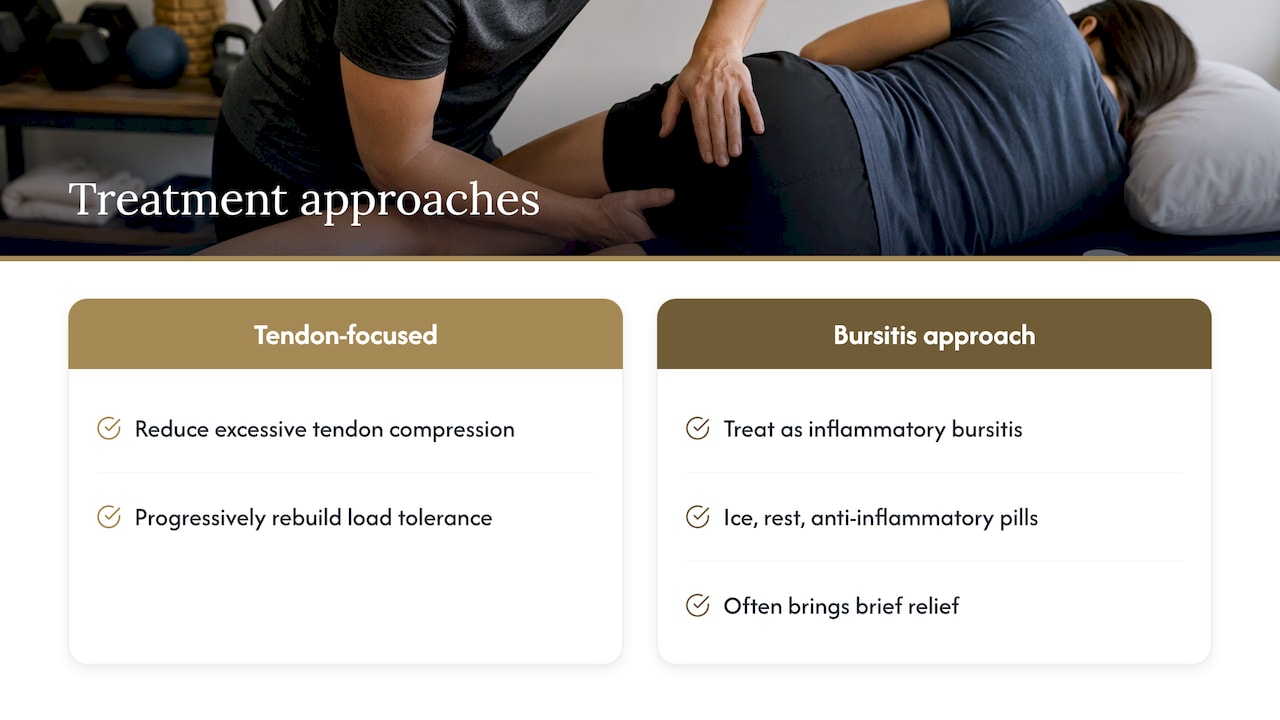
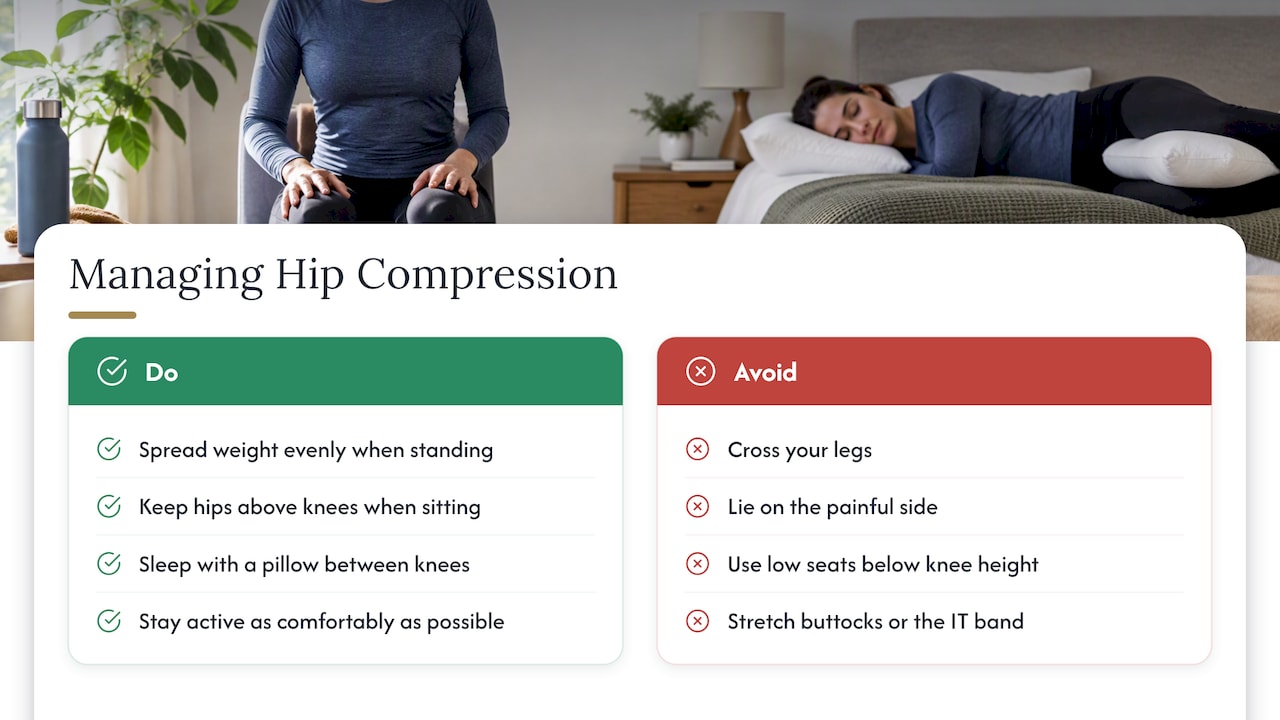
Tendons dislike being squeezed against bone, and the hip tendons are squeezed most when the thigh angles across the midline of your body. This is called hip adduction. The guidelines advise temporarily reducing sustained or repeated adduction, such as lying directly on the painful side, standing with the hip pushed outward, or crossing the legs, then restoring load gradually according to your symptoms, capacity and goals.
In practice, that looks like this:
Standing. Spread your weight evenly across both feet instead of resting on one hip. The Royal National Orthopaedic Hospital advises keeping weight evenly distributed when standing.
Sitting. Avoid crossing your legs, and avoid low chairs and sofas that leave your knees higher than your hips. The same hospital recommends sitting with your hips higher than your knees. A firmer, higher seat or a wedge cushion can help, and it is worth testing a few options in your own car and at your own desk.
Sleeping. Avoid lying on the painful side. On your back, or on the unaffected side with a pillow between your knees, keeps the top leg from falling across your body. Night pain often improves quickly once this changes, which is a useful early win.
Stretching. It feels natural to stretch a tight, aching buttock or the iliotibial band, but a stretch that pulls the leg across the body adds compression. Cambridge University Hospitals advises avoiding buttock and IT-band stretching, hip-hanging, crossed legs and low chairs, and limiting prolonged walking, hills and stairs where you can.
Notice the word temporarily. The goal is not to wrap the hip in cotton wool. You stay as active as is comfortable, and you keep feasible movement in your day, while you remove the positions that keep re-irritating the tendon.
Once compression is under control, the tendon needs graded loading to regain capacity. The review by Grimaldi and colleagues notes that exercise commonly includes isometric hip abduction, exercises for frontal-plane control of the pelvis and thigh, heavy slow abductor loading, and conditioning of the whole lower limb.
A useful way to think about it is in stages.
Isometric exercises ask the muscle to hold tension without moving the joint. A common example is standing beside a wall and pressing the outside of your leg or ankle gently into it, or pressing the knee out against a band or your own hand while lying on your back. The hip stays in a neutral or slightly out-to-the-side position, so the tendon is not compressed. The authors of a rehabilitation review on the gluteus medius and minimus explain that isometrics may help pain, whereas higher tensile loading is needed to improve muscle size and tendon load-bearing capacity.
That sentence tells you what isometrics are for and what they are not. They are a good starting point and a pain-settling tool. They are not the finish line.
The same review describes rehabilitation as beginning with gradually progressive tensile loading in minimally adducted hip positions, then adding strengthening and graded functional movement. It suggests starting with moderate effort and few repetitions, raising the load slowly, and watching your symptoms, including night-time pain.
Examples a clinician might use include side-lying or standing hip abduction against resistance, bridging variations, and step-ups where the pelvis stays level. The exact choice depends on how irritable your hip is. If you have no equipment and no guidance, start with the isometrics above and book an assessment rather than guessing at loads.
The last stage rebuilds the things you actually want to do: single-leg stance, stairs, walking on hills, then running or jumping if that is your sport. The Canadian guidelines frame recovery around participation, capacity, symptoms and goals. A runner and an office worker with the same diagnosis will finish at different places.
The gluteus medius and minimus review advises that high-tensile loading generally be performed about three times a week, which gives the tendon time to recover and adapt between sessions. More is not better here. If you feel more pain the next morning, or your night pain gets worse, drop back a step in load or repetitions and hold there for a few sessions.
A tendon that is loading well may ache mildly during exercise, but it should settle within a reasonable time afterward. A simple monitoring routine keeps you honest.
Check your pain during the exercise, then again that evening, then the next morning on waking, and note how you slept. If pain has not climbed beyond a mild, tolerable level and is back to baseline by morning, you can usually progress slowly. If it spikes or lingers, reduce the load. Our own rehab articles use the same logic, for example the pain-monitoring rule in our guide to patellar tendinopathy exercises, and our soft tissue recovery timelines page explains how to phase load across any tendon or muscle injury.
Two more habits help. Keep a short log of what you did and how the hip felt, because patterns show up quickly on paper. And change one thing at a time. If you add a new exercise, a new cushion and a new running route in the same week, you cannot tell which one helped or hurt.
Plan in months. The Royal Orthopaedic Hospital states that exercise therapy may take 6 to 12 months for symptoms to resolve, and it explains that tendons have a relatively limited blood supply and adapt slowly to exercise. Kingston and Richmond NHS reports that symptoms usually improve within 3 to 6 months with reduced activity and gradual strengthening.
Those figures are not in conflict. Many people notice better sleep and easier stairs within weeks of changing positions and starting a program, while full tolerance for hills, long runs or heavy training takes longer. Your timeline depends on how long the problem has been there, how much load your life demands, and how consistently you progress.
Exercise and education are the base. Several other options can sit alongside them for the right person.
Corticosteroid injection. The Canadian guidelines note that an injection can provide short-term relief in selected adults but does not replace load management and exercise. The Grimaldi review reports that education plus exercise produced higher success rates than corticosteroid injection or wait-and-see at 8 and 52 weeks. If you are considering an injection, ask your physician how it would fit with your exercise plan.
Shockwave therapy. The guidelines describe shockwave as a shared-care option for persistent symptoms, to be discussed with attention to cost, time commitment and the fact that protocols vary. A 2025 systematic review found focused shockwave therapy superior for long-term pain compared with corticosteroid injection plus exercise. The same review found platelet-rich plasma superior to corticosteroid injection for short-term function, and it notes that varied study methods limit certainty, so results should be weighed with clinical reasoning and your preferences. Education and exercise stay first-line, with shockwave added when progress stalls.
Manual therapy. Hands-on work can make the early phase more comfortable and help you tolerate exercise. Soft tissue techniques around the hip, glutes and lower back should avoid deep pressure or stretching directly across the sore tendon attachment, and your clinician should tailor it to your pain. Our guide to massage for hip pain explains how we approach this, and if your pain turns out to be inside the joint instead, our hip impingement exercises article covers that pattern.
We see gluteal tendinopathy most often in people who are doing everything “right”: they run, they stretch, they rest when it hurts. Then the pain keeps coming back, because the stretch or the crossed-leg rest position was compressing the tendon all along.
Our approach starts with a biomechanical assessment, so we can tell whether your pain is really coming from the gluteal tendons, the hip joint, the low back or a nearby nerve. From there we build a plan around your goals: what you need to change in daily positions now, which loading exercises suit your current irritability, and how to progress them.
Hands-on care and technology have a role when they serve that plan. Soft tissue work such as Active Release Technique or massage can keep you moving comfortably while you rebuild strength, and shockwave or laser therapy can be considered for stubborn cases, alongside exercise and never in place of it. We would rather you understand your hip than depend on us.
Deane
If your hip has hurt for more than a couple of weeks, or night pain is affecting your sleep, an assessment saves months of trial and error. At Shephard Health, our team assesses the hip, pelvis and low back, explains what is driving your pain, and builds an individual plan that can combine exercise-based physical rehabilitation with hands-on care. Same-day appointments and direct insurance billing are available where applicable.

If your plan calls for more than exercise, we offer shockwave therapy, Active Release Technique and laser therapy. You can see what the first appointment involves in our guide to what to expect on your first chiropractic visit, or read about our chiropractic care in Calgary.
If you want a simple starting point before you are seen, this order works for most people.
Days one to three: change only your positions. Stop crossing your legs, spread your weight evenly when standing, sleep on your back or the other side with a pillow between the knees, and raise your seat height. Skip the buttock and IT-band stretches.
Days four to seven: if the hip is calmer, add gentle isometric hip abduction, held at a moderate effort, a few repetitions at a time. Keep the leg in a neutral position. Record how the hip feels that evening and the next morning.
After that, progress slowly or get a clinician to set your loading. Keep walking in flat, comfortable stretches, and reduce hills, stairs and long distances only as far as your symptoms require. Runners can often keep some running, but the amount and surface should follow your symptoms, and it is worth having this agreed with your clinician instead of guessing. For the first few weeks, avoid running on a sloped surface, which tilts the pelvis into more adduction.
The first is resting completely. A tendon that is never loaded does not get stronger, and the guidelines stress keeping feasible movement in your day. The second is stretching the sore spot. It feels logical and often feels briefly good, but it adds the compression you are trying to remove. The third is jumping straight to heavy loading because the pain eased for a few days. Progress in small steps, using the response of the next morning as your signal. The fourth is treating the scan as the problem. The Canadian guidelines advise that imaging findings should not be presented as damage that necessarily requires correction, and many hips with scan changes feel fine once the tendon is loaded well. The fifth is quitting at the three-month mark when the timeline may legitimately be longer.
For now, avoid the positions that compress the tendon: crossing your legs, standing with your weight hung on one hip, lying on the painful side, and sitting in low chairs. Cambridge University Hospitals also lists prolonged walking, hills and stairs as things to limit where possible. These are temporary changes while you rebuild strength, not permanent bans.
Many people start with gentle isometrics at home, held at moderate effort with the hip in a neutral position. Heavier loading is easier to get right when someone sets the load for your hip. If an exercise increases your night pain or leaves you sorer the next day, reduce it and have it reviewed.
Usually not at first. Stretches that pull the thigh across your body add compression to the tendon, and hospital guidance for this condition advises avoiding them. Your clinician can show you better ways to ease tightness that do not provoke the tendon.
Symptoms can improve with activity changes and gradual strengthening, with NHS guidance giving 3 to 6 months as a common range. Without addressing compression and load, pain often lingers or returns, so a structured plan tends to shorten the road.
Book an assessment if the pain has lasted more than a couple of weeks, disturbs your sleep, or limits walking and training. See a clinician promptly if pain followed a fall, spreads down the leg, comes with new weakness or numbness, or is accompanied by fever or feeling unwell.
Same Day Appointments Available
We Direct Bill!