

Biceps tendinopathy usually responds to conservative care: relative rest from the movements that hurt, a progressive strengthening program, and a proper assessment to confirm the front of your shoulder pain is coming from the biceps tendon. Most people improve over weeks to a few months, and surgery is rarely needed. This guide explains what treatment involves, how exercise should progress, how long recovery tends to take, and when it is time to have someone examine your shoulder.
The long head of the biceps tendon runs through the front of the shoulder joint before attaching inside it. When that tendon is overloaded, it becomes sore, especially when you lift, pull, reach overhead or throw. UpToDate’s patient education page lists repetitive lifting, pulling, reaching and throwing as the usual causes, and notes that risk rises with age and with repetitive work or sport.
You will see both tendonitis and tendinopathy. The same source explains that tendinopathy is the more accurate term, because most people do not have true inflammation in the tendon, although rapid overuse can cause sudden swelling and tendinitis. StatPearls describes this as a continuum from acute inflammatory tendinitis to degenerative tendinopathy. In practice the label changes less than you might expect: the treatment approach is built around loading the tendon sensibly and fixing what overloaded it.
Pain at the front of the shoulder is not always the biceps. A peer-reviewed review of biceps pain stresses that proximal biceps problems can be inflammatory, instability-related or traumatic, and that several conditions often coexist. The Alberta primary-care consensus adds that rotator cuff, labral, instability and arthritic problems can mimic biceps pain, so persistent or atypical symptoms need assessment.
This is why we start with a thorough biomechanical assessment rather than a standard routine. We look at how your shoulder blade, upper back and rotator cuff move together, which movements reproduce your pain, and whether anything points to a different source. If your pain sits more in the top or outer shoulder, our guide to rotator cuff tendinopathy treatment may describe your situation better.
See a clinician promptly, rather than waiting out a program, if you notice any of the following:
The first move is relative rest. The NHS MSK Bexley guidance recommends cutting back on heavy lifting, repetitive overhead reaching and other painful tasks while continuing comfortable daily movement, so the shoulder does not stiffen and weaken. CCOHS likewise frames activity modification as avoiding the activities that caused or aggravated symptoms, and notes that tendon disorders are usually treated conservatively.
Usually yes, in a modified form. Think of it as turning the dial down, not switching the shoulder off. Practical changes that tend to help:
If you cannot find a version that stays tolerable, that is a good moment to book an assessment so we can tell you which movements are safe to keep.
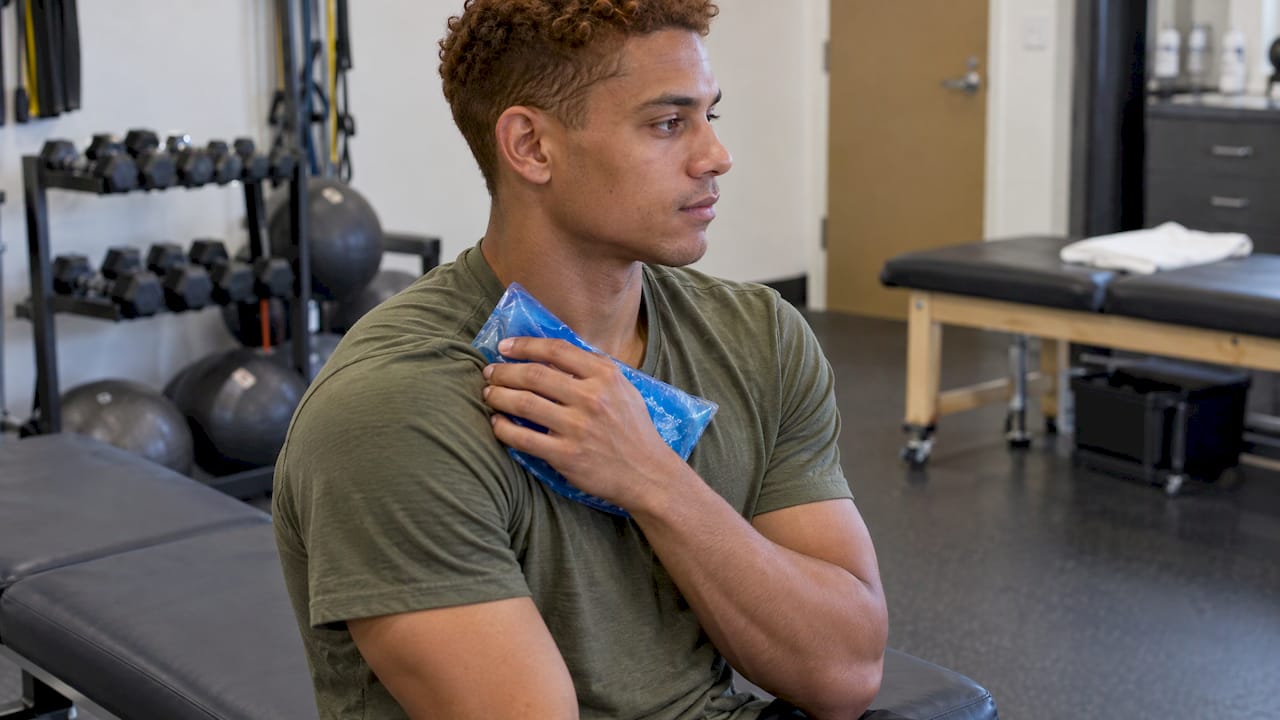
AAOS OrthoInfo lists cold packs for 20 minutes several times a day and NSAIDs such as ibuprofen, aspirin or naproxen among nonsurgical options. The Alberta consensus notes that NSAIDs help some people but depend on clinician or pharmacist advice and your own contraindications, so check with your pharmacist or doctor first, particularly if you have stomach, kidney or heart concerns or take blood thinners. The same consensus says a clinician may consider an injection when pain prevents you from exercising at all.
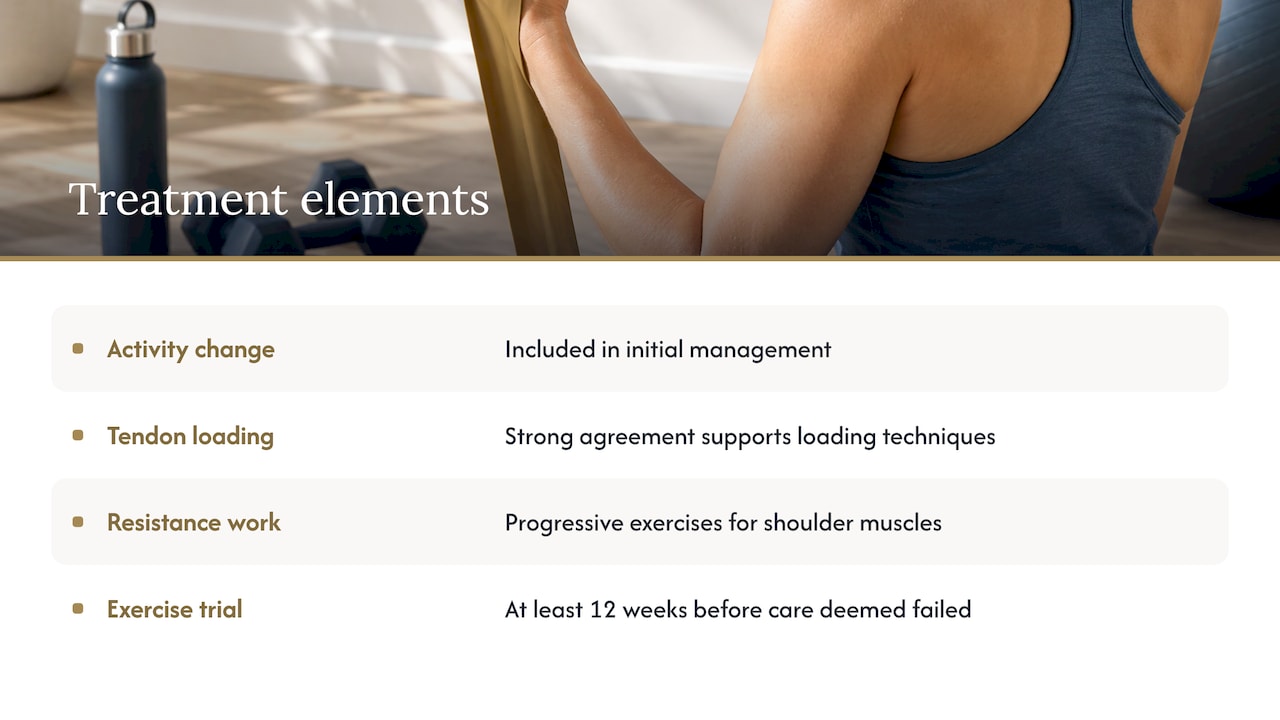
The Alberta consensus identifies active, strength-based exercise as the primary treatment for shoulder pain, recommending at least 12 weeks of home or supervised exercise before conservative care is judged to have failed. An international Delphi study of physical therapists found strong agreement that tendon-loading techniques and progressive resistance exercises for most shoulder muscle groups belong in the management of long-head biceps tendinopathy. A sports physical therapy review describes initial management as activity modification, anti-inflammatory treatment and rehabilitation that emphasizes scapular, postural and rotator cuff strengthening.
The NHS resource gives three starting examples, which show the general pattern of a program:
The same page suggests starting rows and curls at roughly 0.5 to 2.0 kg for 6 to 10 repetitions, and exercising 4 to 6 days a week. It allows a small increase in pain as long as it settles within 30 minutes. Those are published starting points, not a prescription for you. Your starting weight, how often you train and which movements you avoid depend on what we find in your assessment.
Though every plan differs, the logic is consistent:
If you would like to see how a staged shoulder program looks in practice, our rotator cuff rehab exercises and shoulder impingement exercises guides cover closely related shoulder loading work.
The Alberta consensus reports strong evidence that manual therapy, including joint mobilization, manipulation and soft-tissue techniques, is a useful adjunct to exercise. That matches how we use it. Manual work can ease tightness around the shoulder, upper back and neck so that you can perform your strengthening program more comfortably and with better movement.
At Shephard Health, depending on what your assessment shows, your plan may include Active Release Technique for soft-tissue restrictions, Graston Technique for tissue mobilization, laser therapy, or chiropractic care for the neck and upper back. Each is chosen for your findings and goals and sits alongside your exercise, never in place of it. For a wider look at how we approach tendon and muscle problems, see our overview of treatments for soft tissue injuries and our PEACE and LOVE recovery timelines.
Our perspective on biceps tendon pain
Most people come to us after weeks of either pushing through the pain or avoiding the arm altogether. Neither tends to settle a tendon. What we see work is a clear diagnosis first, then a plan you can follow on your own between visits.
We build that plan around loading: the right exercises at the right weight, progressed as your shoulder allows. Our hands-on techniques and technology are there to make that loading easier, helping you move better and stay consistent. Athletes especially need that combination, because they want to keep training while they recover.
We also reassess at every visit. If your shoulder is not responding the way it should, we adjust the plan or help you get to the right next step, instead of repeating what is not working.
Deane
The NHS resource says mild to moderate cases usually settle in 6 weeks to 3 months, and persistent cases can take up to 6 months. Improvement from exercise may take up to 6 weeks to show. That is slower than most people hope, which is why consistency matters more than intensity in the early weeks.
A reasonable way to track progress is to ask yourself every two weeks:
If the answer to all three is no after 6 to 12 weeks, the NHS guidance advises consulting a doctor. We would add that this is the point to have your diagnosis rechecked, since another shoulder condition may be contributing.
Shoulder pain that lingers for months can affect sleep, mood and your willingness to keep exercising. If that sounds familiar, support for coping with long-lasting pain, such as online therapy for chronic pain, can help you stay engaged with your rehab alongside your physical care.
Surgery is not the usual route. AAOS says it may be considered when nonsurgical treatment fails, when symptoms return after improvement, or when other shoulder problems are present, and that it is usually done arthroscopically. The Alberta consensus similarly reserves referral for surgical screening for people whose conservative care has failed, which is why a documented, well-run rehab trial matters. If you reach that point, we can share what we have found and help you take the next step with your physician.
We offer same-day appointments where available and direct insurance billing where applicable, so you do not have to wait weeks to start. Your first visit involves a conversation about your pain, your training or work, and your goals, followed by a hands-on assessment of your shoulder, neck, upper back and movement. You leave with an explanation of what we found and a plan you can start at home. If you have never visited a chiropractor, our guide on what to expect on your first visit walks through it.
If you are in Calgary and front-of-shoulder pain is limiting your training, work or sleep, our team can assess the cause and build a rehabilitation plan around your goals. Explore our chiropractic care and rehabilitation services, or start from our main site to book.

We treat athletes, active adults and families, and we explain every step so you know what you are working toward.
There is no single best treatment, but progressive strengthening is the foundation. An Alberta primary-care consensus recommends at least 12 weeks of active, strength-based exercise for shoulder pain, with manual therapy as an adjunct. Activity changes and, where appropriate, pain relief support that work.
Usually, with changes. Reduce heavy lifting and overhead or repetitive painful movements, and keep comfortable movement going. Choose variations that do not reproduce your pain, and ask a clinician to guide your return to heavier lifts.
You cannot be sure on your own. Rotator cuff, labral, instability and arthritic problems can feel similar, so a hands-on assessment is the reliable way to find the source. Persistent or unusual symptoms especially deserve an examination.
Mild to moderate cases usually settle within 6 weeks to 3 months, and stubborn ones can take up to 6 months, according to NHS guidance. If you have not improved after 6 to 12 weeks, get your shoulder reassessed.
They overlap. Tendinopathy is the more accurate term because most tendon pain involves degenerative change rather than inflammation, while true tendinitis can follow rapid overuse. Treatment centers on gradual loading either way.
Same Day Appointments Available
We Direct Bill!