

Most patellar tracking problems are treated without surgery. The usual plan combines load management, hip and knee strengthening, flexibility work, and sometimes taping, bracing or foot support. Many people feel better after a few months, and the plan works best when it is matched to your knee, your sport and your daily demands. This guide explains each step in plain language, so you know what to do at home and when a hands-on assessment makes sense.
The kneecap (patella) normally glides in a groove at the end of your thigh bone as you bend and straighten your leg. Alberta Health Services describes patellar tracking disorder as the kneecap shifting out of place during that movement. You might notice pain around or behind the kneecap, a feeling of catching, or stiffness after sitting.
Diagnosis usually starts with a conversation: your health history, your activities and when the symptoms began. Then the knee is examined while you sit, stand and walk. The same Alberta Health Services page notes that X-rays may be used to look at the knee bones, and an MRI may be added if more information is needed.
On imaging, a 2019 review of patellar maltracking lists the main structural features associated with it: a shallow trochlear groove (trochlear dysplasia), a tibial tuberosity positioned too far to the outside, a high-riding patella (patella alta) and lateral patellar tilt. It also describes MRI as the imaging choice for assessing maltracking.
One point can reassure you. A 2020 review of patellofemoral pain in runners reports that measurements such as the quadriceps angle, patellar tilt angle and sulcus angle were no different in people with knee pain than in those without it, and that healthy knees vary a lot. In practice, your knee shape is not your destiny. How your knee is loaded and how your hips, thighs and feet control it matter a great deal, and those are things you can change.
Early on, the aim is to settle irritation without letting the leg go weak. The HealthLink BC guidance on patellar tracking disorder says non-surgical care may include rest, stretching and strengthening exercises, taping or bracing, ice, and short-term anti-inflammatory medicine.
In practical terms, this often looks like:
A Montreal rehabilitation hospital protocol, the HMR conservative treatment protocol for femoropatellar syndrome, also advises avoiding painful activities early in the acute phase. Notice the word early. The plan is to return to those activities as your strength and control improve.
If there is one thing to do, it is this. The 2019 clinical practice guideline for patellofemoral pain gives a Grade A recommendation for exercise therapy that combines hip-targeted and knee-targeted exercises to reduce pain and improve function. It says the hip work should focus on the muscles at the back and side of the hip.
The consensus summary in Annals of Translational Medicine points the same way: exercise should address both hip and knee rather than the knee alone.
The HMR protocol describes strengthening for the gluteus maximus, gluteus medius, quadriceps (with emphasis on the vastus medialis obliquus) and hamstrings. It adds control exercises such as squats, single-leg squats, step-downs and jumps, single-leg balance work with progressions, and stretches as needed for the quadriceps, hip flexors, hip abductors and iliotibial band, and hamstrings.
That is a long list, so here is how it tends to fit together:
If you want a ready-to-use sequence, our patellofemoral pain exercises routine takes about 10 to 15 minutes.
A 2017 review of patellofemoral pain in athletes found that the most effective programs targeted the hip external rotators and abductors along with the knee extensors. It reports that programs most often ran for 6 weeks. It also suggests starting with the more proximal (hip) exercises when both are recommended, because they may bring more benefit and cause fewer side effects.
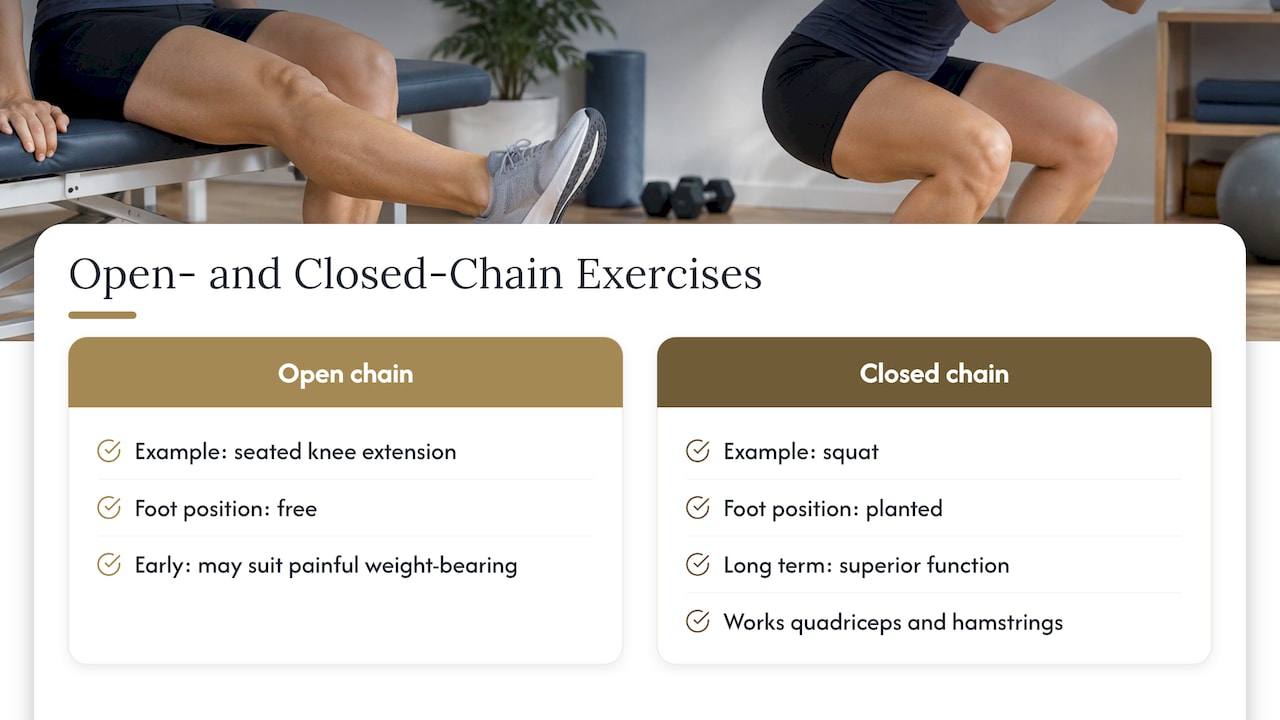
Open chain means your foot is free, as in a seated knee extension. Closed chain means your foot is planted, as in a squat. According to a 2014 rehabilitation review, open chain work may be better tolerated early on if weight-bearing is painful or the leg is very weak. Over the longer term, closed chain exercises that work the quadriceps and hamstrings together have proven superior for function. A sensible progression moves from comfortable early work toward closed chain strengthening as pain allows.
The HMR protocol gives a clear guide. Pain during exercise should be minimal, it should settle within 30 minutes to 1 hour afterward, and there should be no pain the next morning. If the knee is sore the next day, you did too much, so reduce the load or repetitions at the next session and build up again more gradually.
If you are also dealing with pain just below the kneecap that builds with jumping or running, that may be a different problem. Our patellar tendinopathy exercises guide explains that pattern.
Lateral patellar tilt means the outer edge of the kneecap sits tilted or pulled toward the outside. Orthobullets describes lateral patellar compression syndrome as improper tracking in the groove, generally caused by a tight lateral retinaculum, the band of tissue on the outer side of the knee. It is diagnosed clinically, with pain when the patella is compressed and tenderness on the outer edge of the kneecap. Sunrise-view X-rays often show the tilt.
The approach for most people is the same as above, with extra attention to flexibility. Orthobullets lists physical therapy focused on quadriceps stretching and strengthening as the nonoperative treatment. A procedure to release the lateral retinaculum is reserved for cases that do not respond.
The clinical practice guideline also notes that a clinician may use the patellar tilt test, with the presence of limited mobility, to support a diagnosis of patellofemoral pain. This is a hands-on test, so it is a good reason to have your knee assessed by someone who can feel how the kneecap moves rather than guessing from a picture.
The guideline gives a Grade B recommendation for patellar taping combined with exercise for short-term pain reduction (about 4 weeks). The consensus summary adds that combined approaches, including taping, orthotic management and manual therapy, should be used alongside prescribed exercise, and that foot orthoses are recommended to reduce pain in the short term.
What does that mean for you?
The same consensus summary does not recommend kneecap, knee or lumbar mobilizations in isolation. Hands-on treatment belongs with exercise, not in place of it.
Support tools such as compression therapy are also discussed in relation to the causes and management of kneecap maltracking, and may be something to raise with your clinician if swelling is part of your picture.
A good plan is built from an assessment of how your whole leg, hip and foot move. At Shephard Health, our chiropractic care and physical rehabilitation are built around biomechanical assessment, so your plan reflects your goals, your sport and your history. Depending on what we find, your visits can include:
The HMR protocol notes that if progress plateaus, it may be worth evaluating lumbar deficits and the neural mobility of the lower limb. That is a good example of why we look beyond the kneecap itself.
Alberta Health Services says most people feel better after a few months of treatment, and the longer the problem has been present, the longer recovery may take. Surgery usually is not needed.
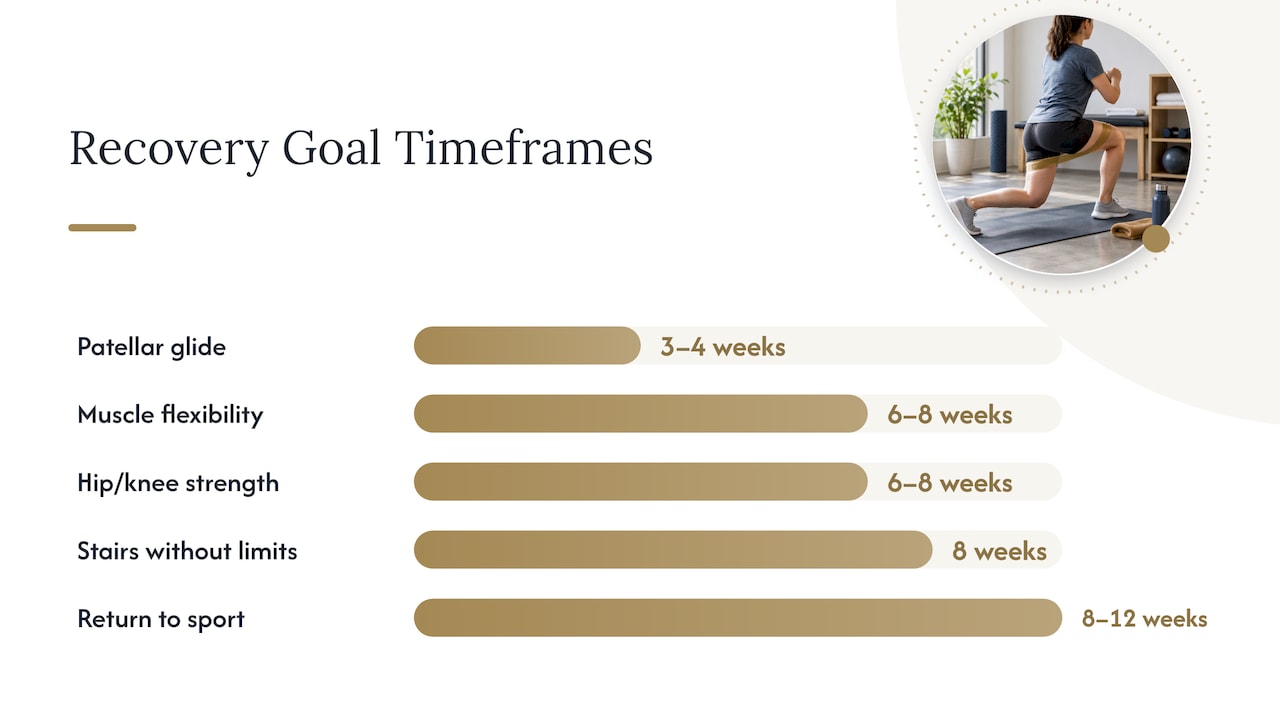
The HMR protocol lays out typical long-term goals for femoropatellar syndrome, which give you a useful map:
| Goal | Target timeframe |
|---|---|
| Normal medial patellar glide | 3 to 4 weeks |
| Normalized muscle flexibility | 6 to 8 weeks |
| Full (5/5) hip and knee muscle strength | 6 to 8 weeks |
| No limitation with stairs | 8 weeks |
| Return to sport | 8 to 12 weeks |
The same protocol suggests treatment once a week for 4 weeks, then once every two weeks, with total follow-up of 8 to 12 weeks. Treat these numbers as a guide, not a promise. Your timeline depends on how long the knee has been bothering you, how consistent you are with exercise and how demanding your sport or work is.
Recovery is not only about the knee. Sleep, nutrition and how you space out hard training days all shape how well tissue adapts, and we have more on this in a practical guide on how to recover after exercise. For injuries more generally, our soft tissue recovery timelines article explains how to pace the return to activity.
We see patellar tracking problems in runners, hockey and soccer players, cyclists and people whose knees started hurting after a new gym routine. The pattern we see most is that people look for one fix for the kneecap itself, when the knee is usually responding to what is happening above and below it.
That is why we begin with a biomechanical assessment rather than a standard handout. We look at hip strength, foot mechanics, how your spine and pelvis move, and how you load the leg in your sport. Then we build a plan around your goals. Our approach is designed to combine exercise guidance with hands-on care, taping, and technologies like laser and shockwave therapy when they fit your case.
We would rather you start sooner than wait. The research is clear that early assessment matters, and a knee that has had months of irritation takes longer to settle. Same-day appointments are often available, and we bill many insurers directly, so getting started should not be a hurdle.
Deane
Some situations should not wait for a home program. Alberta Health Services explains that a completely dislocated kneecap can cause severe pain and swelling, make the knee look out of place and prevent you from bending or straightening it. A doctor needs to put a dislocated kneecap back in place right away, so go to an emergency department or urgent care.
Book an assessment soon if your knee repeatedly gives way, locks, swells noticeably, or has not improved after several weeks of consistent exercise. The 2019 review also emphasizes early diagnosis, because chronic maltracking can lead to cartilage damage and osteoarthritis, and treatment aims to stabilize the joint to slow or halt that cartilage loss. After a first dislocation, the same review describes a trial of non-operative care: anti-inflammatory medication, a short period of immobilization (3 to 6 weeks) and then progressive physiotherapy for range of motion, closed chain exercises and vastus medialis obliquus strengthening. That plan is set by your doctor, based on your imaging.
If your kneecap pain is limiting your running, training or daily stairs, we can assess how your hip, knee and foot are working together and explain what we find in plain language. You can see the full list of what we offer on our services page, learn more about chiropractic care in Calgary, or start with our physical rehabilitation and nerve flossing services.

New to chiropractic care? Read what to expect on your first visit before you come in.
No single exercise wins. The best-supported approach combines hip strengthening, especially the muscles at the back and side of the hip, with quadriceps strengthening. The 2019 guideline gives this combination a Grade A recommendation. Start with comfortable movements and progress as pain allows.
Yes, for most people. Alberta Health Services says surgery usually is not needed and most people feel better after a few months of treatment. Surgery such as a lateral retinaculum release is typically considered only in refractory cases after non-surgical care has been tried.
Yes, in a modified way. Use the 30 minute rule: pain during exercise should be minimal, should settle within 30 minutes to 1 hour, and should be gone by the next morning. If it is not, reduce the load and build back gradually.
Tape is not a cure. The guideline supports using taping with exercise for short-term pain relief, around 4 weeks. It can help you tolerate the exercises that do the real work.
Not always. Diagnosis often starts with your history and a physical exam, and Alberta Health Services notes X-rays may be used, with MRI added if more information is needed. Your clinician will tell you whether imaging adds anything for your situation.
Same Day Appointments Available
We Direct Bill!