

The exercises that help most for hip bursitis (now often called greater trochanteric pain syndrome, or GTPS) are gradual strengthening exercises for the gluteal muscles on the outside of your hip. Gentle stretching and a few changes to how you sit, stand and sleep support them. You start with light holds, build to heavier work as pain settles, and keep pain at a low, manageable level throughout. If your pain is not settling, a hands-on assessment shows which muscles are weak and which movements keep irritating the area. At Shephard Health in Calgary, that assessment is where a plan like this starts.
This guide covers a staged plan, the stretches that are safe to use, what to avoid, how long recovery usually takes and when to get checked.
A bursa is a small fluid-filled cushion that reduces friction between tendon and bone. On the outside of the hip, the bursae sit beside the gluteal tendons. Pain there was long labelled “trochanteric bursitis”, but the current thinking is broader. A 2022 international consensus describes GTPS as being associated with weak hip abductors, poor pelvic control and a tight or thickened iliotibial band. Together these raise the compression on the bursae and the gluteal tendons.
The practical meaning is that the tendon is irritated by load it is not strong enough to handle. That is why the exercise answer is strength, and why simply resting or stretching hard usually does not fix the problem.
Typical signs are pain on the outside of the hip that is worse lying on that side, climbing stairs, getting up from a low chair or after a long walk or run. Runners, walkers and people who have recently increased their activity are common patients.
Before you add exercise, reduce what keeps provoking the area. MyHealth Alberta advises you stop activities that cause pain and return to them slowly with less effort, until you can do them without pain or swelling. It also suggests warming up before activity and stretching after it.
For short-term relief, the same page suggests a cold pack for 10 to 20 minutes at a time with a thin cloth between the ice and your skin. After three days of ice, you can switch to heat. If you want an over-the-counter pain medicine such as acetaminophen, ibuprofen or naproxen, ask your doctor or pharmacist whether it suits you.
Walking does not need to stop altogether. Shorten the distance, avoid hills and uneven ground for a while, and build back up. Do not walk through sharp or worsening pain.
The research agrees on the order: start gently, then load the muscle more as irritation falls. One 2022 clinical paper recommends starting with isometric contractions in gravity-eliminated positions when the hip is highly irritable. An isometric exercise means you tighten the muscle without moving the joint. You then move to isotonic, concentric and eccentric work (muscle shortening and lengthening under control) once irritability is low.
Side-lying or standing hip push-out. Lie on your back with knees bent and a belt or resistance band just above your knees. Press your knees outward against it without letting your pelvis move. A hospital leaflet from the UK suggests holding for 15 seconds, 5 to 10 times, twice a day, with some discomfort acceptable.
Standing wall press. Stand beside a wall with the sore hip toward it. Press the outside of your knee or thigh gently into the wall for a 10 to 15 second hold. Keep your trunk upright and do not lean into the sore hip.
Do these daily while your pain is high. Stay at a level you can repeat without a flare-up the next morning.
When the holds feel easy, add movement.
Bridge. Lie on your back, knees bent, feet flat. Squeeze your glutes and lift your hips until your body forms a straight line from shoulders to knees. Lower slowly. The same leaflet suggests 8 to 15 repetitions once a day.
Sit-to-stand squat. Stand in front of a chair, lower yourself until you touch the seat, then stand again. Keep your knees tracking over your second toe rather than collapsing inward. Use a higher seat if a low one provokes pain, since low chairs put the hip in a more compressed position.
Side stepping. With a light band above the knees and knees slightly bent, take 8 to 15 steps in one direction, then back. Keep your toes forward and your pelvis level.
Side-lying hip abduction. This is the one non-weight-bearing exercise that the clinical paper found produces similar muscle activity to weight-bearing work. If lying on the sore side hurts, do it on the pain-free side to work the sore hip’s partner, or skip it and favour standing work.
The consensus says strengthening should progress from submaximal isometrics to heavy-load and eccentric exercises based on how you tolerate them. The same clinical paper notes that weight-bearing abductor exercises create more muscle activity than non-weight-bearing ones, and that heavy slow resistance gives outcomes similar to eccentric exercise.
In practice this means exercises such as step-ups, single-leg sit-to-stands to a chair, banded side steps with a heavier band, and slow lowering phases of three to four seconds. Add load slowly.
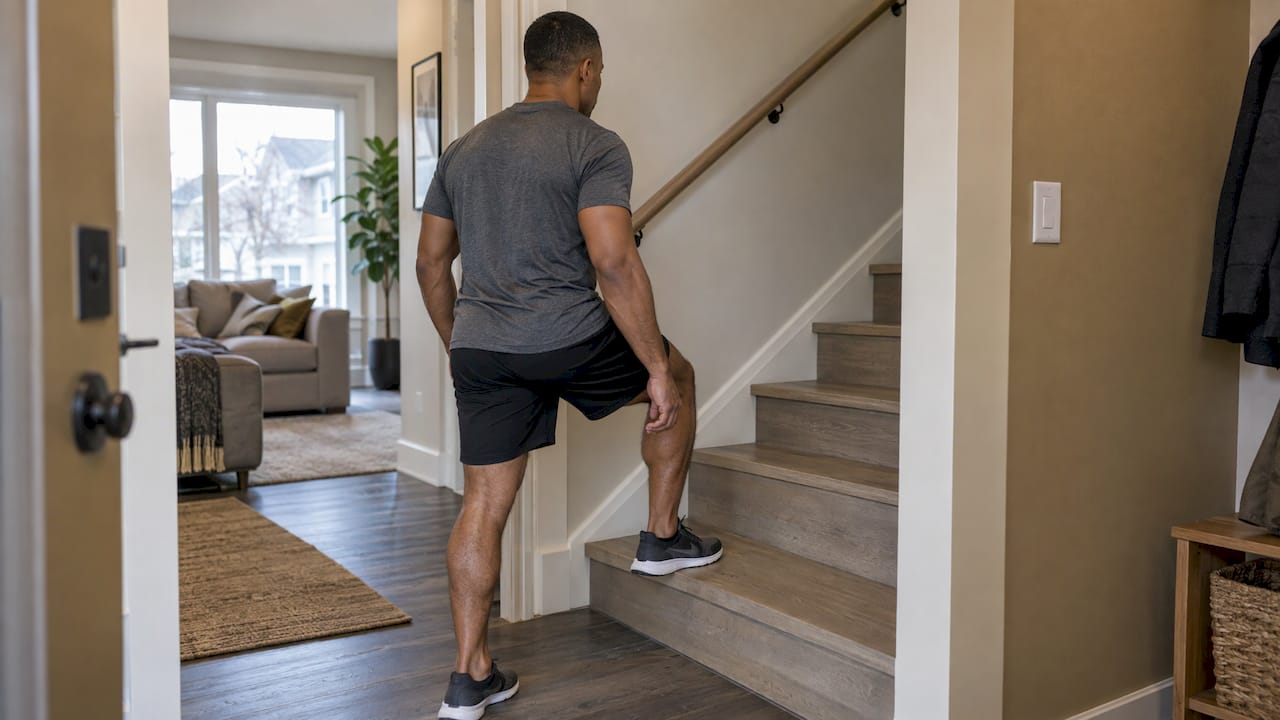
The NHS DynamicHealth guidance recommends exercising every other day, choosing 3 to 4 challenging but manageable exercises, with 3 to 5 repetitions per set and up to 1 to 2 minutes of rest. Progress by adding 2 to 5 repetitions every two weeks or by holding positions longer. It reports that gluteal strengthening combined with avoiding provocative postures has proven effective within 8 to 10 weeks.
Here is a simple weekly rhythm built from that guidance:
| Weeks | Focus | Example exercises | Frequency |
|---|---|---|---|
| 1 to 2 | Calm irritation, isometrics | Band push-out holds, wall press | Daily or every other day |
| 3 to 4 | Basic strength | Bridge, sit-to-stand, side steps | Every other day |
| 5 to 8 | Add load and tempo | Step-ups, slow lowering, heavier band | Every other day |
| 8 to 10+ | Return to activity | Walking or running build-up | As tolerated |
Treat the table as a guide, not a schedule you must hit. Your own pain response sets the pace.
The same NHS page allows pain up to 4 out of 10 during exercise, provided it eases within 45 minutes and does not disturb sleep or next-day activity. If it goes beyond that, simplify the exercise by reducing the range of motion or the repetitions.
Stretching has a smaller role than strengthening, and the wrong stretch can pinch an irritated tendon. MyHealth Alberta describes a hip external rotator stretch in which you pull the knee across your body toward the opposite shoulder, hold 15 to 30 seconds and repeat 2 to 4 times.
Note, though, that NHS DynamicHealth explicitly says to avoid a cross-body hip stretch until symptoms have fully resolved. Because the two sources differ, use a rule: if a stretch pulls on the outside of the hip or reproduces your pain, leave it for now. Choose stretches that feel like a pull in the buttock or front of the thigh, not at the bony point of the hip. The ISHA consensus recommends pain-free stretching that avoids compressive forces through the lateral gluteal tendons.
If the outside of the hip feels tight, hands-on soft tissue work can be a better choice than a hard stretch. One clinical paper advises directing it at the gluteal muscle bellies, tensor fasciae latae and IT band, not the bursa or tendon attachments, to avoid more irritation. Our guide to massage for hip pain explains what this looks like.
Exercise only works if you stop feeding the irritation the rest of the day. The ISHA consensus advises avoiding hip adduction (the knee crossing toward the midline) when sitting, standing and sleeping. It also suggests minimizing single-leg time, such as balancing on one leg to put on trousers.
A Kingston and Richmond NHS leaflet adds practical examples: place your feet wider apart on stairs, sleep on your back or non-painful side with a pillow between your knees, and avoid crossed legs, low chairs and lying on the sore side. Also avoid standing with your weight shifted onto one hip.
If you stand at work, alternate your weight evenly and shift your feet rather than hanging on one side. If you run or train, reduce volume first and keep your stride narrow, not crossing one foot over the midline.
Expect weeks, not days. The Kingston and Richmond leaflet (updated December 2024) says symptoms usually improve within 3 to 6 months. Noticeable gains from a well-run strengthening program can come earlier, as the NHS DynamicHealth 8 to 10 week window above shows. Progress is rarely a straight line, so a flat week or a mild flare after an increase is a signal to step back one level, not to stop.
MyHealth Alberta advises you contact a doctor or the nurse advice line if hip pain lasts 2 weeks or longer despite home treatment. Seek immediate care for fever, increased swelling or redness around the hip, being unable to use the hip, or pain that is getting worse. These can point to infection or another problem that exercise cannot fix.
Once those are ruled out, an assessment from a clinician who examines how you move helps. Lateral hip pain can also come from the lower back, the hip joint itself or a tendon tear, and the best exercises differ for each. Our article on gluteal tendinopathy treatment goes deeper into the tendon side of the problem.
The ISHA consensus says physiotherapy should follow corticosteroid or PRP injections, because injections do not address weak hip abductors or other modifiable factors. After a corticosteroid injection, you can resume rehab when tolerated. After PRP, a longer rest is advised before starting with gentle isometrics. Whether you need an injection is a decision for your physician.
The US-based AAFP notes that treatment usually involves strengthening, stretching and avoiding painful activities, with physical therapy if function is affected, especially in long-standing cases.
If your hip has not settled with home exercise, our chiropractic care team in Calgary can assess how your hip, pelvis and lower back move and build an individualized plan around your goals. Our approach is built on a comprehensive biomechanical assessment, and our clinic offers physical rehabilitation, Active Release Technique, shockwave therapy and massage therapy. We offer same-day appointments and direct insurance billing where applicable.

If you train or play sport, tell us what you do each week so your plan fits your return to activity.
When someone arrives with outer hip pain, the first thing we want to know is why the tendon is overloaded. Often the answer is a combination of weak hip stabilizers, a pelvis that drops on one side when walking or running, and a day full of crossed legs and one-sided standing.
That is why we pair exercise with assessment. A list of moves from the internet cannot tell you whether you are ready for step-ups or still need isometric holds. Our clinic combines hands-on care with rehabilitation so that treatment settles the irritation while the strengthening work addresses the cause.
Our aim is simple: help you move without pain and stay that way, whether your goal is a walk with your family or a return to competition.
Deane
There is no single best move, but glute-strengthening exercises are the foundation. Start with band push-out holds, then progress to bridges, sit-to-stands and side steps as pain allows. The consensus statement recommends progressing from light isometrics to heavier loading based on tolerance.
It can if you walk too far or on hills while the hip is irritable. Cut back to a distance that does not leave you sore afterward, then build up slowly. MyHealth Alberta advises returning to activities with less effort until they are pain-free.
Mild cases may ease in a few weeks, but a UK hospital leaflet says improvement usually takes 3 to 6 months. Steady strengthening and posture changes shorten the process.
Avoid crossing your legs, lying on the sore side, sitting in low chairs and standing with your weight on one hip. Skip any stretch that pinches or pulls at the outside of the hip. Stop and get assessed if pain is worsening or you have fever or swelling.
Same Day Appointments Available
We Direct Bill!