

A high ankle sprain is an injury to the ligaments that hold the two lower leg bones together just above the ankle joint, and it needs a more careful, slower plan than the ordinary rolled ankle. Most stable cases heal without surgery. The recovery depends on three things: protecting the joint early, rebuilding strength and balance in stages, and returning to sport only after you pass functional tests. At Shephard Health in Calgary, our physical rehabilitation and chiropractic team builds that plan around your assessment and your goals.
Most ankle sprains involve the ligaments on the outside of the ankle. A high ankle sprain involves the syndesmosis, the group of ligaments binding the shin bone (tibia) to the smaller outer bone (fibula). According to UpToDate, it causes pain more proximally, just above the ankle joint, and carries more morbidity than lateral sprains.
The reason is mechanical. The National Athletic Trainers’ Association position statement explains that the syndesmosis is stressed throughout the ankle’s range of motion, and especially at the extremes of dorsiflexion (toes pulled toward the shin) and plantar flexion (toes pointed) under body weight. Every step loads it. That is why a high ankle sprain feels worse when you push off, twist or climb stairs, and why it lingers.
Typical stories include a foot planted while the body rotates (football, hockey, skiing, basketball), a collision that forces the foot outward, or a hard landing. Pain above the ankle bone, pain when you squeeze the lower leg, and pain when the foot is rotated outward are the red flags that point to the syndesmosis rather than a standard sprain.
Diagnosis rests on the injury pattern, a physical exam and X-rays. A review of syndesmosis injuries describes tenderness over the front of the syndesmosis and positive squeeze and external rotation tests. These tests are quite specific but not very sensitive, so a negative result does not rule an injury out, and MRI is the gold standard when doubt remains.
Grading decides the path:
Grade I is stable, with mild tenderness and normal X-rays.
Grade II involves complete disruption of the front ligament (AITFL) and the membrane between the bones, with normal X-rays but positive tests.
Grade III is a complete rupture of the main ligaments with the joint unstable on imaging, which requires surgical stabilization.
An international panel summarized in a 2017 review stressed that the key question is whether an acute isolated injury is stable or unstable. Some unstable injuries only show up on stress X-rays, standing CT, MRI or arthroscopy, which is why persistent pain after a “simple sprain” deserves a second look.
Before any treatment plan, a fracture has to be ruled out. The British Journal of Sports Medicine guideline says severe sprains should be screened with the Ottawa ankle rules (a set of bedside checks on bone tenderness and the ability to take four steps), and that MRI, with 93 to 96% sensitivity and 100% specificity, is appropriate when syndesmotic injury is suspected. A 2025 sideline management review adds full-length tibia and fibula films to rule out a Maisonneuve fracture, a break high in the fibula that can accompany a syndesmosis injury.
See a physician or go to urgent care or an emergency department if you cannot take four steps, the ankle is deformed, the pain is severe or you have numbness. Imaging orders come from a medical doctor, and that step comes first.
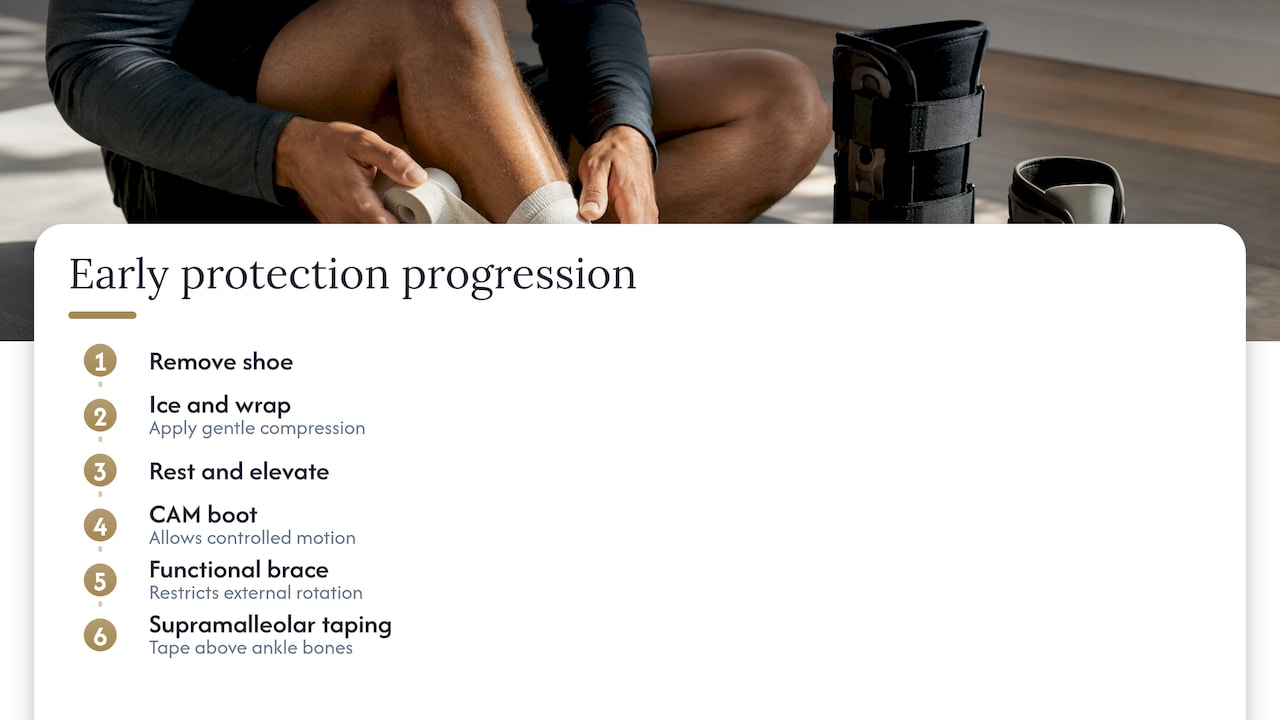
For a stable injury, the early priority is protection, not movement. The 2025 sideline review describes the first steps: remove the shoe, apply ice with a gentle compressive wrap, rest and elevate. It prefers a CAM boot (a removable walking boot) because it allows periods of non-weight-bearing and controlled motion while guarding against outward rotation. After that, the athlete transitions to a functional brace that restricts external rotation, then eventually to supramalleolar taping (tape applied just above the ankle bones).
The rehabilitation review by Williams and Allen lists the protection options: a walking cast, boot, custom orthosis, lace-up brace or stirrup. It advises avoiding external rotation and end-range dorsiflexion, with weight-bearing guided by your assessment and symptoms. The same review describes compression, elevation, cryotherapy, electrical stimulation and manual therapy for pain and swelling, and notes that pain and anti-inflammatory medications are often prescribed. Ask your doctor or pharmacist which medication suits you, particularly if you have stomach, kidney or heart conditions or take blood thinners.
NATA’s statement says syndesmotic sprains should be managed more conservatively than lateral sprains, with enough immobilization (non-weight-bearing, boot, cast or brace) to allow healing. In practice this means resisting the urge to walk it off. Walking on an unprotected syndesmosis early is one of the most common reasons a four-week injury turns into a four-month one.
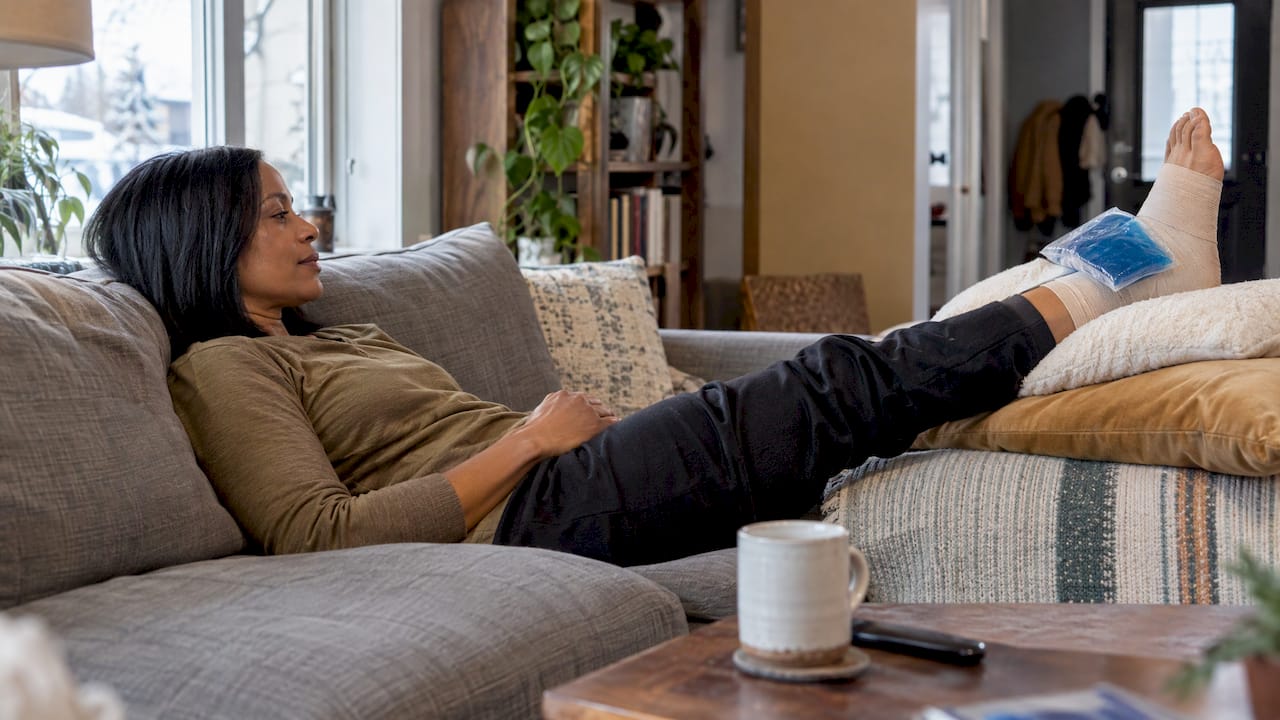
Swelling is not just uncomfortable, it limits motion and slows the first stage of rehab. A snug but not tight wrap, elevation above heart level and short cold applications are the basics. Numbness, color change or throbbing under the wrap means it is too tight and should be loosened.
No universal protocol exists, as NATA acknowledges, but the published programs share the same logic: protect, restore motion, build strength, retrain balance, then add running and sport. Williams and Allen describe three phases.
Goals are joint protection and gentle motion. Typical work includes pain-free ankle movement, a stationary cycle and progressive resistance with bands or light ankle weights. You progress when you can walk fully weight-bearing and manage stairs comfortably. A case report on syndesmosis rehabilitation used active range of motion (30 repetitions, four times a day) with the PRICE principles in the first four days.
Here the work adds low-load stretching, joint mobilization, pool exercise, heel raises, step-ups and step-downs, and calf presses. Balance training on rocker boards, wobble boards and mini-trampolines starts to retrain the nervous system’s control of the ankle. The case report describes contrast baths, rocker board work and tubing exercises in days 4 to 14, then full weight-bearing, mini-trampoline and single-leg stance work from days 14 to 28. You progress when you can jog and hop with minimal discomfort.
This phase brings running, skipping rope, hopping, shuffling, carioca (crossover stepping), figure-8 running, plyometrics and sport-specific drills, usually with taping or a lace-up brace. The case report places squats, lunges, step-ups and agility drills at days 28 to 56 for a mild injury.
The Aspetar Sports Medicine Journal adds practical markers: start basic running drills once your walking gait is normal and keep pain below 2 out of 10, use video or sensor analysis of your running motion, train the small intrinsic foot muscles with eccentric work, and use balance exercises on uneven surfaces with a second task (like catching a ball). It also advises watching for pain or swelling flare-ups after sessions, because those mean you should hold the current level instead of progressing.
These are timelines from a case report and a review, not promises. Your pace depends on the grade, your sport and how the ankle reacts. For a general ankle plan, our 6 to 8 week ankle sprain rehab plan lays out exercises step by step, and a broader look at sports injury rehabilitation phases shows how the stages fit together. Because the syndesmosis is more sensitive to rotation and end-range stretch, a high ankle sprain generally needs a more cautious pace than those general plans suggest, so the guidance of a clinician matters.
Expect longer than for a regular sprain. The 2025 sideline review reports an average return to play of 13.4 weeks for syndesmotic injuries in athletes, about twice the time for lateral sprains. A 2024 orthopedic review reports that non-surgical care succeeded in 90% of NFL athletes with acute syndesmotic injuries, with a mean recovery of 11 weeks. The case report suggests four to eight weeks for grade I and II injuries, if jump and hop tests reach more than 80% of the uninjured side.
Those ranges are wide on purpose. The case report’s authors call return-to-sport decisions “always a tenuous decision” and name pain with push-off in late stance as the most common limiting factor. Two people with the same grade can recover very differently depending on weight, sport, footwear, previous sprains and how well the first weeks were protected.
| Stage | What it looks like | What moves you forward |
|---|---|---|
| Protection | Boot or brace, ice, elevation, gentle motion | Walking comfortably, stairs without sharp pain |
| Strength and balance | Heel raises, step-ups, rocker board, single-leg stance | Jogging and hopping with minimal discomfort |
| Return to sport | Running, cutting, plyometrics, sport drills | Hop tests above 80% of the other side, game-speed tasks with good movement |
Williams and Allen say return to sport is appropriate when you can perform sport-specific tasks at game speed with minimal discomfort and good movement quality, and NATA recommends functional testing first. The case report suggests taping or bracing for the first year after returning. If running is your goal, our guide to five tests to pass before running again gives you concrete checkpoints, and the week-by-week running protocol shows how to rebuild volume.
A high ankle sprain that is never properly protected can become chronic. A 2024 review of chronic syndesmotic instability links neglected injuries to persistent pain, stiffness, instability, degenerative changes and abnormal bone formation around the joint. A 2023 review notes that syndesmosis injury makes up 1% to 18% of ankle sprains, that untreated chronic cases remain symptomatic for more than six months, and that widening of the joint by more than 1 mm can reduce the contact surface in the ankle by about 42%.
Timing matters for the unstable injuries that need surgery. A 2020 study found that stabilization delayed beyond six months was linked to significantly worse function and quality of life at a mean of 4.3 years. A consensus review states that a stable grade I injury can be managed with a period without weight-bearing, protected weight-bearing in a boot and rehabilitation, while an unstable grade III injury should be surgical to avoid long-term disability.
The practical message: if pain above the ankle is not clearly improving after a few weeks, or the ankle feels like it gives way, get it re-assessed. A StatPearls summary cited in the 2025 review says MRI is indicated when pain persists beyond six weeks despite conservative treatment. Diabetes with nerve damage and obesity are named as risk factors for chronic instability in the 2024 review, so if either applies to you, ask your doctor for closer monitoring.
Once a doctor has ruled out a fracture or an unstable injury, your recovery becomes a rehabilitation project, and that is where we work. Our physical rehabilitation starts with an assessment of how your ankle, foot, knee and hip move, so the plan matches your sport and your goals instead of a generic sheet of exercises.
Several of our therapies suit the soft-tissue side of an ankle recovery. Active Release Technique and the Graston Technique are hands-on methods for muscles, tendons and scar tissue around the lower leg. Laser therapy and shockwave therapy are non-invasive technologies we offer for soft-tissue pain. Kinesio taping can support the ankle during the later stages, and custom foot orthotics address how the foot loads the ankle with every step. Our guide on PEACE and LOVE soft-tissue recovery timelines explains how healing phases overlap.
Planning matters most at the start and at the end: at the start so the joint is protected correctly, at the end so you pass real tests before returning to play. Having one team follow you across both makes the hand-offs smoother.
Our perspective
When someone walks in with a high ankle sprain, the first thing we want to understand is how the injury happened and what they need the ankle to do again: stand through a shift, run a half marathon, cut on a field. The same diagnosis can mean very different plans.
We build treatment plans from a biomechanical assessment, because an ankle rarely recovers in isolation. The foot, calf, knee and hip all share the load, and a gap in any of them can quietly send stress back to the healing ligaments. Our multidisciplinary approach lets hands-on soft-tissue work, rehabilitation exercise, taping and orthotics support one another.
The research agrees that rehab should follow the individual, with progress guided by symptoms, task performance and repeated assessment. That is how we try to work: you move forward when your ankle shows it is ready, not when a date on the calendar says so.
Deane
If you are past the first medical check and want a plan for rehab, we can see you at Shephard Health in Calgary. We offer same-day appointments and direct insurance billing where applicable, and our team has experience with athletes and active families. You can see our full range of physical rehabilitation and therapies on our site, or read about chiropractic care in Calgary.

There is no shortcut, but you can avoid delays. Protect the joint early with a boot or brace, control swelling, and progress rehab only when you meet each stage’s markers. Pushing back to running too early is the most common cause of setbacks.
The published reviews describe a CAM boot early on, then a functional brace or lace-up stirrup that limits outward rotation, and later taping above the ankle. The right choice depends on your grade and activity, so have it fitted after assessment.
Reviews link missed injuries to chronic pain, stiffness, instability and early arthritis in the ankle. A study of delayed surgery in unstable injuries found worse function and quality of life when stabilization came more than six months after injury. Early assessment is the safest route.
Gentle motion and balance work can be part of your plan once your clinician confirms the injury is stable. Start with pain-free movement, and avoid forceful outward twisting and end-range stretching of the ankle early on, as the reviews advise. Increase only when swelling and pain stay settled afterward.
Syndesmotic ankle injury (high ankle sprain), UpToDate
Sideline Management of Syndesmotic Injuries in the Athlete, 2025
Current trends in the diagnosis and management of syndesmotic injury, 2017
Diagnosis, treatment and prevention of ankle sprains, British Journal of Sports Medicine, 2018
National Athletic Trainers’ Association Position Statement, 2013
Rehabilitation of Syndesmotic (High) Ankle Sprains, 2010
Rehabilitation of distal tibiofibular syndesmosis sprains, 2007
Aspetar Sports Medicine Journal, Syndesmosis injuries in athletes
JAAOS 2024 review of syndesmotic injury
Chronic syndesmotic instability, current evidence, 2024
Delayed stabilisation of dynamically unstable syndesmotic injuries, 2020
Ankle and syndesmosis instability: consensus, 2021
Sports injury rehabilitation phases
Same Day Appointments Available
We Direct Bill!