

Most meniscus tears can be treated without surgery, and for many of them a structured rehabilitation program gives results similar to an operation. Conservative treatment means a managed program of activity changes, pain control and progressive strengthening exercise, with surgery kept in reserve. It works best when the program is built around your tear, your knee mechanics and your sport. At Shephard Health in Calgary, our physical rehabilitation starts with a comprehensive biomechanical assessment and an individualized plan, with same-day appointments and direct insurance billing.
The meniscus is a pair of C-shaped cartilage pads in each knee. They cushion the joint and help keep it stable. A tear can come from a sudden twist, such as pivoting in soccer, hockey or pickleball, or from gradual wear that makes the tissue more fragile over the years.
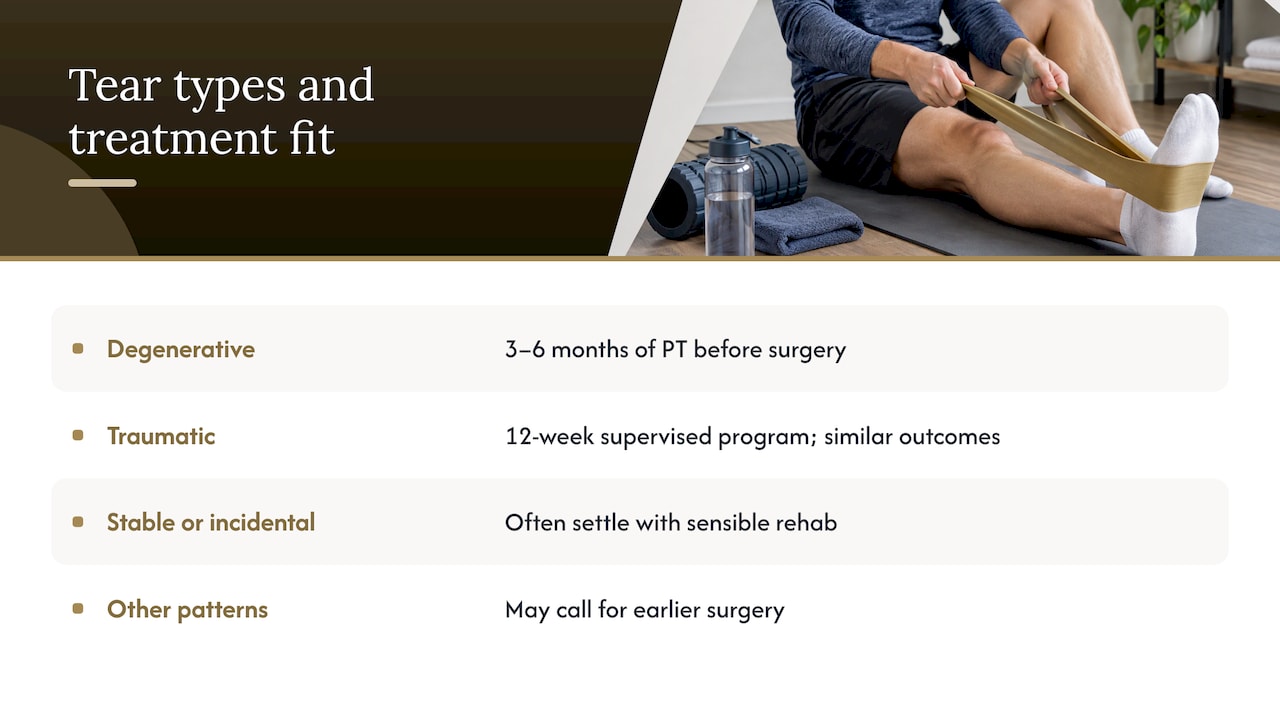
That difference matters for your treatment. Acute (traumatic) tears usually happen in younger, active people. Degenerative tears appear with age and are very common: Choosing Wisely Canada notes that they are found in 33 to 50% of people aged 50 to 60 and are most often painless. A tear seen on an image is therefore not automatically the cause of your pain, which is one reason treatment is guided by how your knee behaves and not by the scan alone.
The location also matters. The outer edge of the meniscus has a good blood supply, and a 2023 review of non-operative knee injury care lists small stable tears (10 mm or less), tears at that well-supplied outer edge, and incidental tears that cause no symptoms as ones that often do not need surgery. The same review cites a study of young active adults in which 74% of people with meniscal tears did not have surgery within a year.
Alberta Health Services explains that the choice between non-surgical and surgical treatment depends on the tear’s pattern and size, along with your age, general health and activity level. In practice, three groups tend to be good candidates for starting without surgery.
Degenerative tears. The 2024 EU-US Meniscus Rehabilitation Consensus names non-operative treatment, including physical therapy, as the first-line approach. For symptomatic degenerative lesions it reports results comparable to arthroscopic partial meniscectomy (a procedure that trims away the damaged part), and it recommends an initial period of 3 to 6 months of physical therapy before surgery is considered.
Many traumatic tears in people without locking. The same consensus group, in the companion document, notes that for traumatic tears both surgery and exercise therapy are viable options, and that a 12-week supervised neuromuscular exercise program produced outcomes similar to surgery. Evidence here is thinner than for degenerative tears, which is why the decision should be shared between you and your clinicians rather than automatic.
Small, stable or incidental tears. As above, these often settle with a sensible rehab plan.
Some tears are different. The same consensus says bucket-handle tears (where a flap flips into the joint), complete radial tears, root tears and certain other patterns in younger patients may call for earlier surgery. A knee that is physically blocked is a medical matter, covered in section 7.
A conservative plan is more than rest. It has four parts that work together.
In the first days, Alberta Health Services describes rest, ice, compression and elevation, plus over-the-counter pain medicine, as part of non-surgical care. A 2025 review in athletes notes that a short course of anti-inflammatory medication, 7 to 14 days, can take the edge off acute pain. If you have stomach, kidney, heart or blood-pressure conditions, or take blood thinners, check with your doctor or pharmacist before using anti-inflammatories.
Activity modification means swapping the movements that provoke pain (deep squatting, twisting on a planted foot, pivoting) for ones your knee tolerates, such as walking, cycling or swimming. The aim is to keep the joint moving and the muscles working while the tissue settles, not to stop everything.
This is the part that changes outcomes. The Alberta Health Services knee pathway calls for an exercise and strength-based rehabilitation program, delivered at home or supervised, as the core of a trial of non-operative management. The EU-US consensus lists the ingredients: manual therapy, joint mobilization, range-of-motion work, progressive knee and hip strengthening, neuromuscular training, and home exercises added to supervised sessions.
The pathway also lists taping or bracing and weight management as options. A 2023 review of meniscus tear treatment adds that knee alignment and functional overload drive changes in the meniscus, which is why gait and movement analysis belong in a good plan.
The exact plan is individual, which is why we assess before we prescribe. A typical structure, based on the criterion-based approach in the consensus, moves through stages.
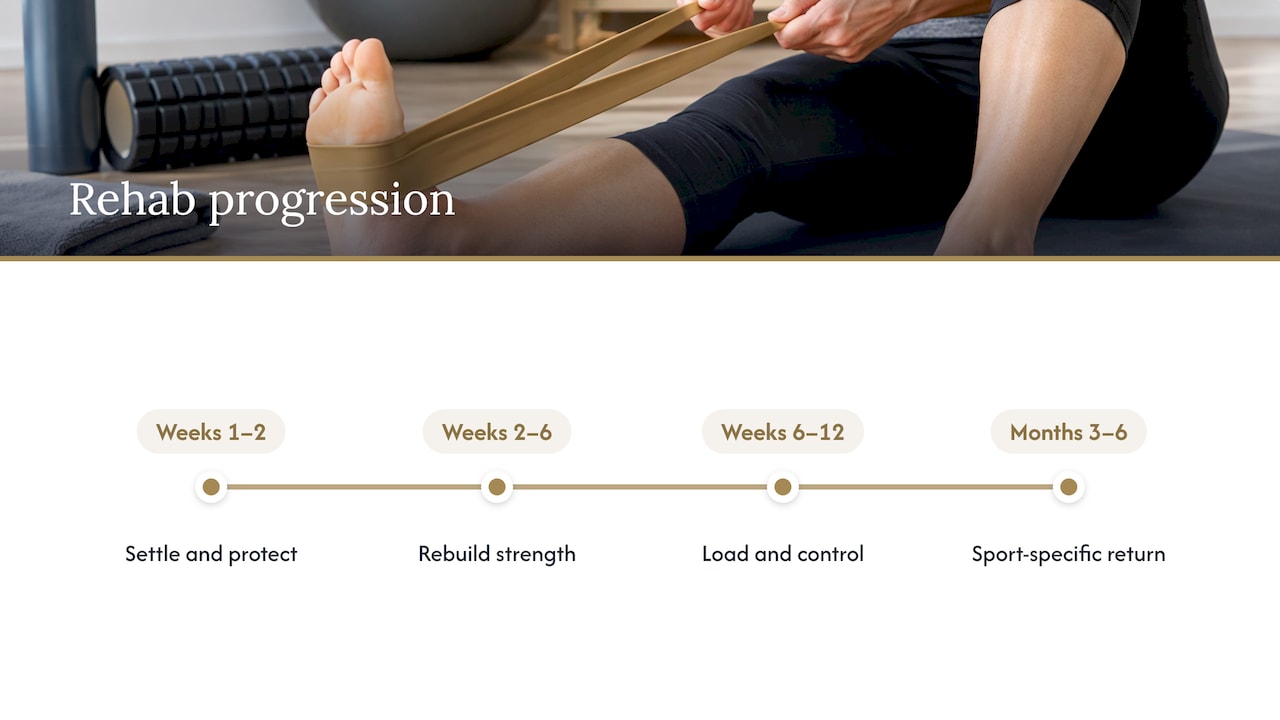
Weeks 1 to 2: settle and protect. Reduce swelling, restore full straightening of the knee, and walk normally. Gentle range-of-motion work and light activation of the thigh muscles begin.
Weeks 2 to 6: rebuild. Strength work progresses: leg press or squats in a pain-free range, hip strengthening, calf and hamstring work, and balance drills on one leg. The 2023 JAMA review of knee pain, available as a published PDF, says exercise therapy for 4 to 6 weeks is appropriate for most meniscal tears.
Weeks 6 to 12: load and control. Single-leg strength, landing and deceleration drills, and core and hip stability work. For traumatic tears, the consensus describes a 12-week supervised neuromuscular program as the version that matched surgery.
Months 3 to 6: sport-specific return. Running, cutting and jumping are added step by step. For degenerative tears, this is also the window in which the 3 to 6 month trial is judged.
Two features make a program more likely to succeed: it is supervised, so technique and progression are corrected, and it is supported by a home routine so the work continues between visits.
Exercise is the foundation. Alongside it, the consensus lists manual therapy and joint mobilization as part of rehabilitation for non-operated tears, and several of the therapies we offer are used to help the surrounding tissues keep up with the load you are putting on them.
Active Release Technique and Graston Technique are hands-on soft tissue methods we use for the muscles and fascia around the knee, such as the quadriceps, hamstrings, calf and iliotibial band, which often tighten when a knee is painful. Massage therapy helps with the general muscle tension that builds up from favoring one leg. Laser therapy and shockwave therapy are non-invasive technologies we offer for soft tissue pain, and Kinesio taping and custom foot orthotics are available when taping or foot mechanics are part of your plan. You can see the full list on our services page.
Which of these suits you depends on your assessment. Our guide to soft tissue damage recovery explains the phased logic we apply to injuries in general.
Expect weeks, not days. Research gives three useful reference points:
The consensus recommends that return to sport, whether you had surgery or not, be both criterion-based and time-based. The criteria include full range of motion, no joint swelling, good quadriceps and hamstring strength, coordination and stability on functional tasks, and your own confidence in the knee. A simple self-check before you go back to a sport: can you squat, hop and land on the injured leg without pain, swelling the next day or a feeling that the knee will give way? If not, you are not at the end of the program yet.
Conservative care is for tears without signs of a mechanical block. See a doctor promptly, or go to urgent care or an emergency department, if:
The NHS Tayside referral guide treats a locked knee (possible displaced bucket-handle tear) and a recent acute tear in people under 30 as reasons for urgent referral. It adds that bucket-handle tears and unstable large peripheral tears are typically treated surgically.
Imaging has a place too. Choosing Wisely Canada advises that MRI is not recommended for degenerative tears unless there are mechanical symptoms such as locking or you have not improved with conservative care. Weight-bearing X-rays are suggested instead, which also helps rule out arthritis as the main source of pain. Your physician decides on imaging referrals.
Choosing a rehab program first does not close the door on surgery. It tests whether surgery is needed at all, and the evidence supports that order.
A 2014 CMAJ meta-analysis of seven randomized trials with 805 patients found no important long-term difference in function or pain between arthroscopic debridement and non-operative or sham treatment for degenerative tears in middle-aged patients. It concluded that a trial of non-operative management should be first-line. Choosing Wisely Canada likewise recommends against arthroscopic debridement as the primary treatment for degenerative meniscal tears.
Surgery is worth discussing when:
Timing matters for acute tears. AAOS guidance states that people with an acute tear who fail conservative care may do better with surgery within 6 months of injury, with limited-strength evidence. So a rehab trial should be tracked against a clear checkpoint, not left open-ended. The consensus also notes that in one seven-center trial, about 30% of people in the conservative group eventually needed surgery, so a plan that includes a review point is part of good care.
Factors that shape that decision include your age, the tear pattern, your sport and how much your job or play loads the knee. Movement demands matter: for example, this overview of pickleball-related meniscus tears describes the twisting and sudden-stop patterns that stress the knee in a fast-growing racquet sport.
If you are in Calgary and want to start with a rehab-first plan, our physical rehabilitation service begins with a comprehensive biomechanical assessment, and your treatment plan is built from it. Our team works across chiropractic care, rehabilitation and soft tissue therapies, and we have experience treating high-performance athletes and families. We offer same-day appointments and direct insurance billing where applicable.

If you are not sure what to expect, our guide to your first visit walks through the consultation. When you are ready, book through our site and tell us about your knee, your sport and any locking or giving way you have noticed.
A torn meniscus is frightening because the word “tear” sounds final. The research tells a more hopeful story: for many people, the knee responds to the right loading, the right progression and some patience.
What we value in a rehab-first approach is that it treats the whole leg, not the tear alone. A knee that hurts is rarely an isolated knee. Hip weakness, a stiff ankle, tight calf muscles or a foot that collapses inward can all change how the meniscus is loaded. That is why we start with a biomechanical assessment and build an individualized plan around it, using exercise as the foundation and our hands-on and technology-based therapies to support it.
For athletes and active families, we also care about how you come back. The consensus is clear that readiness is judged by criteria, not by a date. We would rather see you return confident and strong than early and hesitant.
Deane
Some do, especially small tears and tears at the outer, well-supplied edge of the meniscus. Others do not fully heal but stop hurting once the muscles around the knee are strong and the knee is well loaded. Pain-free function is the main goal of conservative care.
Use a plan built on four parts: short-term pain and swelling control, sensible activity changes, a progressive strengthening and movement program, and attention to the load on your knee such as footwear, taping or bracing. A supervised program, with exercises you also do at home, is what the research describes.
Avoid the movements that provoke pain, such as deep squats and twisting on a planted foot, but do not stop moving. Targeted, graded exercise is the main treatment. If your knee locks or will not fully straighten, stop and see a doctor before exercising.
Usually not. Choosing Wisely Canada advises against routine MRI for degenerative tears unless you have locking or catching, or you have not improved with conservative care. Your doctor decides when imaging is useful.
For degenerative tears, trials and meta-analyses show similar results, so rehab comes first. For traumatic tears in younger people, evidence shows exercise can match surgery in suitable cases, but some patterns, such as bucket-handle tears, are usually repaired surgically.
Same Day Appointments Available
We Direct Bill!