

Most people with tennis elbow recover fully with conservative care. Start with activity modification, ice, and a structured rehab plan today, and expect meaningful improvement within a few months. If pain persists beyond six weeks without progress, a clinician can guide you through targeted options.
What to do right now:
See a clinician promptly if you notice:
If none of those red flags apply, a few weeks of consistent home care is a reasonable starting point before scheduling a clinic visit.
Most tennis elbow cases resolve with conservative care, but recovery requires consistent progressive loading, honest activity modification, and realistic timelines of three to twelve months.
| Point | Details |
|---|---|
| Conservative care first | Activity modification, bracing, NSAIDs, and eccentric exercise resolve most cases within 3–18 months. |
| Injections have limits | Corticosteroid injections offer short-term relief only; PRP and autologous blood show no consistent long-term superiority over no treatment in trials. |
| Exercise is the core treatment | Eccentric and heavy slow resistance wrist extensor loading drives tendon remodeling; passive modalities alone are insufficient. |
| Surgery is rarely needed | Consider surgical referral only after 6–12 months of appropriate conservative care with confirmed structural pathology. |
| Shephardhealth offers a full pathway | ART, shockwave, laser therapy, and supervised rehab are available as a coordinated clinic plan for persistent or complex cases. |
Tennis elbow, formally called lateral epicondylitis, is an overuse tendinopathy affecting the wrist extensor muscles where they attach at the lateral epicondyle of the humerus. The extensor carpi radialis brevis (ECRB) tendon is most commonly involved.
Despite the name “epicondylitis,” the condition is not primarily inflammatory. Research and clinical guidance consistently describe it as a tendinosis, meaning the tendon undergoes degenerative changes from repetitive mechanical load rather than acute inflammation. Microscopic examination typically shows disorganized collagen, increased ground substance, and new blood vessel formation, not the classic white cell infiltration of true inflammation. That distinction matters for treatment: suppressing inflammation alone rarely resolves the problem, which is why rehabilitation that restores load capacity tends to produce more durable results than pain medication alone.
According to Cleveland Clinic, tennis elbow is an overuse injury that affects people across a wide range of activities, not just racquet sports. It is most common between the ages of 30 and 50 and frequently affects manual workers, musicians, and anyone whose job or hobby involves repetitive forearm and wrist movements.
The hallmark symptom is pain and tenderness localized to the outer elbow, specifically over or just below the lateral epicondyle. The pain typically worsens with:
Pain can radiate down the forearm toward the wrist, and grip strength often feels noticeably reduced. Morning stiffness is common in more established cases.
Common triggers and risk factors include:
A few conditions can mimic or coexist with tennis elbow and are worth keeping in mind. Radial tunnel syndrome produces pain slightly further down the forearm and is often confused with tennis elbow because the locations overlap. Posterior interosseous nerve entrapment, cervical radiculopathy at C6–C7, and referred pain from the shoulder can all produce lateral elbow symptoms. If your pain does not follow the typical pattern or does not respond to standard care, a clinician should evaluate for these alternatives.
Diagnosis is primarily clinical, meaning it relies on your history and a physical examination rather than imaging. A clinician will ask about the onset, the specific activities that provoke pain, how long symptoms have been present, and what treatments you have already tried.
| Test | What it assesses | When it is used |
|---|---|---|
| Cozen’s test | Resisted wrist extension with elbow extended; pain at lateral epicondyle is positive | First-line bedside screen |
| Mill’s test | Passive wrist flexion with elbow extended and forearm pronated; reproduces lateral pain | Confirms ECRB involvement |
| Maudsley’s test | Resisted extension of the middle finger; isolates ECRB | Differentiates from radial tunnel |
| Grip strength comparison | Dynamometer or manual comparison side-to-side | Quantifies functional deficit |
A positive Cozen’s or Mill’s test, combined with point tenderness over the lateral epicondyle, is typically sufficient to confirm the diagnosis in a straightforward case.
Imaging is not routinely needed, but a clinician may order it in specific circumstances:
If neurological symptoms such as numbness or hand weakness are present, nerve conduction studies may be appropriate to rule out radial tunnel syndrome or cervical nerve root involvement.
The first priority is reducing the load on the irritated tendon without stopping all movement entirely. Complete rest tends to weaken the tendon further; the goal is relative rest, meaning you modify activities rather than eliminate them.
Practical first-line steps:
StatPearls confirms that rest from the offending activity, ice after activity, NSAIDs, and counterforce strapping are all recognized first-line measures, and that most patients improve within 3–18 months with this approach.
Schedule a clinic visit if:
Seek same-day or urgent evaluation for any of the red flags listed at the top of this guide: rapid swelling, neurological symptoms, fever, or suspected fracture.
Conservative care resolves the majority of tennis elbow cases. The key is sequencing treatments appropriately and giving each enough time to work before escalating.
Reducing the offending load is the single most important early step. This does not mean stopping all forearm activity; it means identifying the specific movements that provoke pain (sustained gripping, repetitive wrist extension) and reducing their volume or intensity by roughly 50% initially. Gradual reintroduction over weeks, guided by pain response, allows the tendon to adapt without re-irritation.
A counterforce strap is most useful during activity, not at rest. A wrist extension splint is more appropriate for nighttime or during tasks that require sustained wrist position. Neither brace heals the tendon; they reduce symptomatic load while rehab does the structural work.

Topical diclofenac gel is a reasonable first choice for localized pain because it delivers anti-inflammatory effect directly to the tissue with minimal systemic absorption. Oral NSAIDs provide broader pain relief but should be limited to the shortest effective duration. Short-term corticosteroid injections can reduce pain quickly, but the BMJ review is clear that steroid injections do not offer long-term benefit and that symptoms typically resolve within one year with activity modification alone.
A structured physiotherapy program is the backbone of lateral epicondylitis treatment. The most evidence-supported approach centers on eccentric and heavy slow resistance (HSR) loading of the wrist extensors, which targets tendon remodeling rather than simply stretching or resting the tissue. Manual therapy, including joint mobilization of the elbow and wrist, can complement the exercise program by restoring movement and reducing pain acutely.
Neuromobilization techniques, which address neural tension in the radial nerve, are sometimes added when nerve sensitivity contributes to symptoms. A detailed exercise progression is covered in the rehabilitation section below.
Several clinic-based modalities are used alongside exercise, though the evidence for each varies:
An older but comprehensive review documented the wide range of treatments in clinical use, including strapping, shockwave, and strengthening programs, reflecting how practice has evolved over decades of trial and refinement. Tennis elbow no more (PMC) provides useful historical context for why so many approaches have been tried.
Pro Tip: Start with exercise and activity modification for at least four to six weeks before adding clinic modalities. Modalities work best as an adjunct to loading, not a replacement for it. If pain is limiting your ability to exercise, a short course of a clinic modality can reduce the barrier to entry.
When conservative care has not produced sufficient improvement after six to twelve weeks, injection-based and minimally invasive procedures become worth discussing with your clinician.
A corticosteroid injection into the area around the lateral epicondyle can reduce pain noticeably within one to two weeks. That short-term relief is real and can be useful when pain is severe enough to prevent participation in rehab. However, the BMJ review reports that longer-term outcomes after steroid injection are not better than placebo, and repeated injections carry risks including tendon weakening and skin atrophy at the injection site. Most clinicians limit injections to one or two, spaced at least six weeks apart.
PRP involves drawing a small amount of your own blood, concentrating the platelets, and injecting the resulting solution into the tendon to stimulate repair. Autologous blood injection follows a similar rationale but uses whole blood rather than a concentrated fraction. The proposed mechanism is that growth factors in the platelets promote collagen synthesis and tendon remodeling.
The evidence for PRP and autologous blood injection remains limited. A 2021 position statement (PMC) found that these therapies produced similar pain and function outcomes to no active treatment in many randomized trials. They may still be appropriate for selected patients who have not responded to other measures, but they should not be presented as a reliable cure.
Percutaneous tenotomy involves using a needle (or ultrasound-guided instrument) to create small perforations in the degenerated tendon tissue, stimulating a healing response. It is typically considered for patients with confirmed tendon pathology on imaging who have not responded to conservative care. Recovery involves a period of relative rest followed by progressive loading.
ESWT delivers focused acoustic waves to the tendon, promoting neovascularization and tissue repair. It is non-invasive and generally well tolerated, though sessions can be uncomfortable. Shockwave therapy is most commonly used for chronic tendinopathies that have persisted beyond three to six months despite exercise-based care.
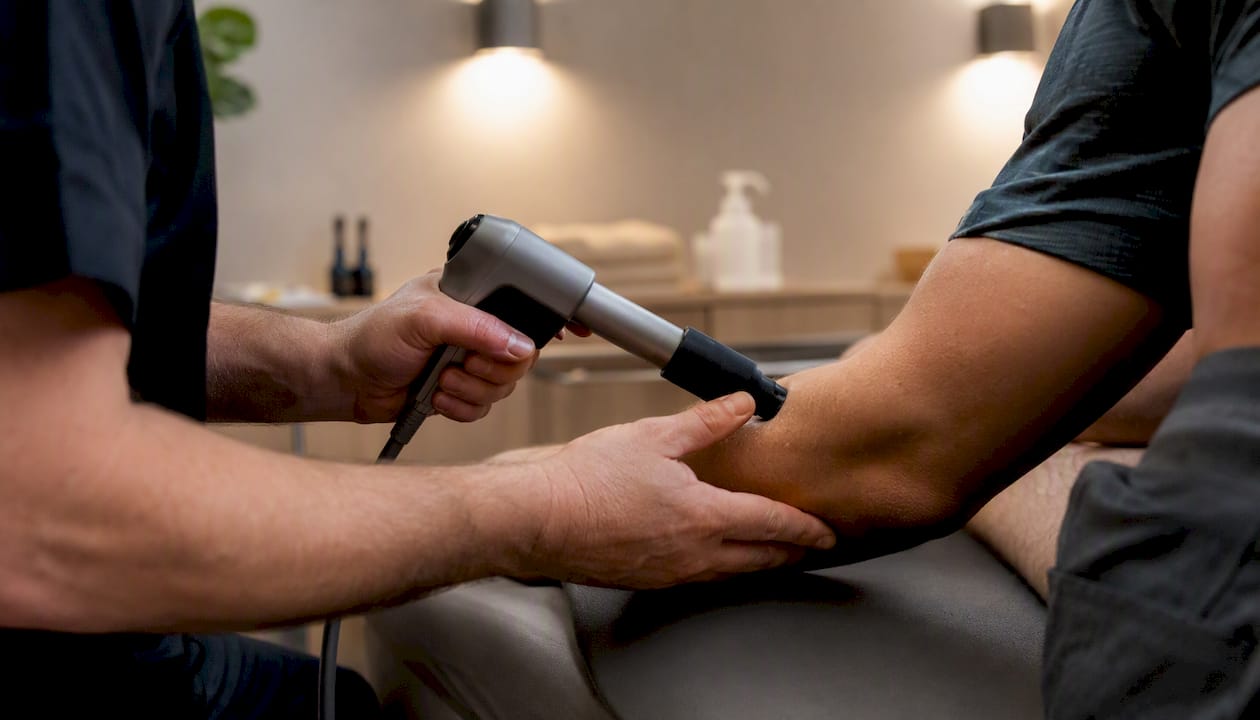
Patient selection guidance: Clinicians typically consider moving from conservative care to these options when a patient has completed a structured six-to-twelve-week exercise program, has tried bracing and activity modification, and continues to have functionally limiting pain. Imaging confirmation of tendon pathology strengthens the case for injection or tenotomy.
Surgery is genuinely a last resort. NHS guidance recommends considering it only when symptoms persist beyond six to twelve months of appropriate conservative care. The StatPearls summary notes that surgery is rarely required.
The two most common procedures are open debridement and arthroscopic release. Both aim to remove the degenerated portion of the ECRB tendon and, in some techniques, to create a small bleeding bone bed at the lateral epicondyle to stimulate fresh healing tissue. The arthroscopic approach allows the surgeon to inspect the joint for coexisting pathology (loose bodies, synovitis) that may not have been apparent preoperatively.
Typical recovery after surgery:
Realistic outcome expectations: Surgery helps a meaningful proportion of patients with truly refractory tennis elbow, but it is not guaranteed. Complication risks include infection, nerve injury (particularly to the posterior interosseous nerve), incomplete pain relief, and prolonged recovery. Patients should enter the surgical discussion with a clear understanding that outcomes vary and that post-surgical rehab is just as important as the procedure itself.
A well-structured exercise program is the most reliable path to lasting recovery. The goal is to progressively increase the load the tendon can tolerate, not simply to stretch or rest it.
This phase is the core of the program. Eccentric loading, where the muscle lengthens under tension, specifically targets tendon remodeling.
Pro Tip: Some soreness during and for up to 24 hours after exercise is acceptable. Pain that exceeds 4/10 during the session or that has not settled by the next morning means the load was too high. Drop back one progression step and rebuild more gradually.
For a broader framework on mobility and progression that complements this tendon loading plan, the mobility restoration checklist for athletes offers practical guidance on sequencing movement work alongside strength.
Most people with tennis elbow improve meaningfully over several months with consistent conservative care. The BMJ review reports that symptoms usually resolve within one year with activity modification, and StatPearls places the improvement window at three to eighteen months depending on severity and adherence.
Recovery timeline context: The PMC position statement found that lateral epicondylitis affects approximately 1%–3% of the population and that nonoperative management is the mainstay of care, with most patients recovering without surgery or injections.
Several factors tend to prolong recovery:
After surgical intervention, most patients return to full activity within three to six months, though some take up to a year. Outcomes after minimally invasive procedures such as tenotomy or ESWT are variable; improvement, when it occurs, typically becomes apparent over eight to twelve weeks post-procedure.
Prevention centers on keeping your tendon’s load capacity consistently higher than the demands you place on it. That means progressive training, not avoidance.
Load management:
Technique and equipment:
Maintenance strength work:
Return-to-sport or return-to-work checklist:
For athletes returning from injury, injury prevention habits for tactical athletes outlines load management and recovery principles that translate directly to tendon rehab.
The honest picture from high-quality reviews is that tennis elbow is often self-limiting, and many treatments perform similarly to watchful waiting in randomized trials. That does not mean treatment is pointless; it means the type and sequencing of treatment matters more than any single intervention.
What the evidence supports:
What the evidence does not clearly support:
“Nonoperative management is the mainstay of treatment for lateral epicondylitis. Exercise-based physiotherapy, corticosteroid injections, PRP, and autologous blood produced similar pain and function outcomes to no active treatment in many randomized trials.” PMC position statement
Suggested clinic workflow:
Shared decision-making is particularly important here. Given that many interventions carry uncertain benefit, your preferences, your functional goals, and your tolerance for procedures should all factor into the plan.
A well-prepared visit saves time and helps your clinician make faster, more accurate decisions about your care.
Bring with you:
Track before your visit:
High-yield questions to ask your clinician:
The patients who recover fastest from tennis elbow are almost never the ones who found the best injection or the most advanced modality. They are the ones who committed to the exercise program consistently, modified their activities honestly, and gave the tendon enough time to adapt.
Clinically, the most common mistake is treating this condition as purely a pain problem rather than a load-capacity problem. Pain relief is a means to an end: it allows you to participate in the rehab that actually rebuilds the tendon. A corticosteroid injection that reduces pain but is not followed by a structured loading program tends to produce a temporary improvement followed by recurrence, often within a few months.
The other pattern worth naming is premature return to full activity. When pain settles, it is tempting to resume normal demands immediately. The tendon’s structural recovery lags behind the pain reduction by weeks to months. Returning too early, at full load, is one of the most reliable ways to restart the cycle.
A typical patient who follows a structured plan, including six to eight weeks of progressive eccentric loading and honest activity modification, will usually notice meaningful functional improvement by weeks eight to twelve. Full resolution, including return to sport or demanding work, often takes four to six months. That timeline is not a failure; it reflects how tendons heal.
Persistent tennis elbow responds best to a structured, clinic-guided plan that combines hands-on therapy with a progressive loading program. At Shephardhealth, the approach to elbow pain integrates several evidence-informed modalities under one roof, so your care adapts as your recovery progresses.

Relevant services for tennis elbow patients include Active Release Technique to address soft tissue restrictions in the forearm and wrist extensors, extracorporeal shockwave therapy for chronic tendinopathy, Class 4 laser therapy to support tissue repair, Graston Technique for instrument-assisted soft tissue mobilization, and a supervised exercise rehabilitation program tailored to your specific functional goals. Bracing guidance and activity modification coaching are included from the first visit.
Your first appointment includes a thorough assessment of your movement patterns, strength, and pain triggers, followed by a clear treatment plan with realistic timelines. Direct insurance billing is available, and same-day appointments are often accessible. If you have had pain for more than six weeks without consistent improvement, or if home care has not been enough, book your assessment and get a plan built around your recovery.
The following sources informed this guide and are worth reading directly for primary guidance:
This article is general information, not a substitute for advice from a qualified doctor. Consult a qualified healthcare professional about your own circumstances before acting on anything here.
Same Day Appointments Available
We Direct Bill!