

Most people recover from whiplash within 2–3 months, but about 50% may have some ongoing symptoms at one year, so your recovery timeline depends heavily on injury severity, your age, and how quickly you start the right care. Get a medical evaluation soon after any crash or significant impact, even if you feel fine right now.
What to expect in the short term:
Seek emergency care immediately if you experience any of these red flags:
If any of these apply to you, call 911 or go to your nearest emergency department now. Do not wait to see if they improve on their own.
Neck pain or headaches? Start with a $67 new patient visit
A chiropractor assesses your neck, upper back and posture, and treats on day one when it is safe. See neck pain and headache care in Calgary. Book online.
Whiplash, clinically referred to as whiplash-associated disorder (WAD), is a soft-tissue injury to the cervical spine caused by a rapid, forceful back-and-forth movement of the neck. The sudden acceleration-deceleration forces strain the muscles, ligaments, tendons, and intervertebral discs of the cervical region, often without producing visible damage on standard imaging.
The most common cause is a rear-end motor vehicle collision, but whiplash can also result from sports impacts, falls, physical assault, or any sudden deceleration event. Contact sports like football and hockey carry real risk, as do horseback riding falls and diving accidents.
One detail many people miss: symptoms may not appear for several hours or even a day or two after the injury. Feeling okay immediately after a crash does not mean you are uninjured. Early assessment is recommended regardless of how you feel in the first moments.
Neck pain and stiffness are the most common early signs, but the full picture of whiplash symptoms is broader than most people expect. Recognizing the range helps you track your own healing process accurately.
Common symptoms include:
Cognitive complaints, sometimes called “whiplash brain fog,” including difficulty with memory and concentration, are less common but recognized in moderate-to-severe cases. These tend to appear in the days following the injury rather than immediately.
Nerve-related warning signs require prompt attention. If you notice numbness or tingling radiating down one or both arms, weakness in your hands or grip, or sharp electric-like pain shooting into your shoulder or arm, these may indicate nerve root involvement. That warrants a same-day or next-day clinical evaluation, not a wait-and-see approach.
Knowing what to expect at your first appointment removes uncertainty and helps you prepare. A thorough clinical assessment follows a clear sequence.
Detailed history. Your clinician will ask about the mechanism of injury (direction of impact, speed, head position at time of collision), when symptoms began, prior neck or back problems, and your current pain level and functional limitations. Be specific about symptom timing, since delayed onset is clinically relevant.
Physical examination. This includes assessing your cervical range of motion, palpating for muscle tenderness and spasm, and testing your neurological status (reflexes, sensation, and muscle strength in your arms and hands).
Red-flag screening. Your provider will check for signs that suggest a more serious structural injury, such as fracture or spinal cord involvement. High-energy mechanisms, focal neurological deficits, or midline cervical tenderness on palpation raise the index of suspicion.
Imaging decisions. WAD is frequently a diagnosis of exclusion because structural damage is often not visible on standard X-rays. X-ray or CT is indicated when red flags are present, when the mechanism was high-energy, or when there is focal neurological involvement. MRI is reserved for persistent or progressive neurological signs, or when soft-tissue or disc pathology is suspected and not resolving as expected.
Functional and psychological screening. Because pain beliefs, stress responses, and prior psychological history influence recovery, a thorough assessment often includes brief screening for anxiety, depression, or catastrophizing, particularly in patients with moderate-to-severe presentations.
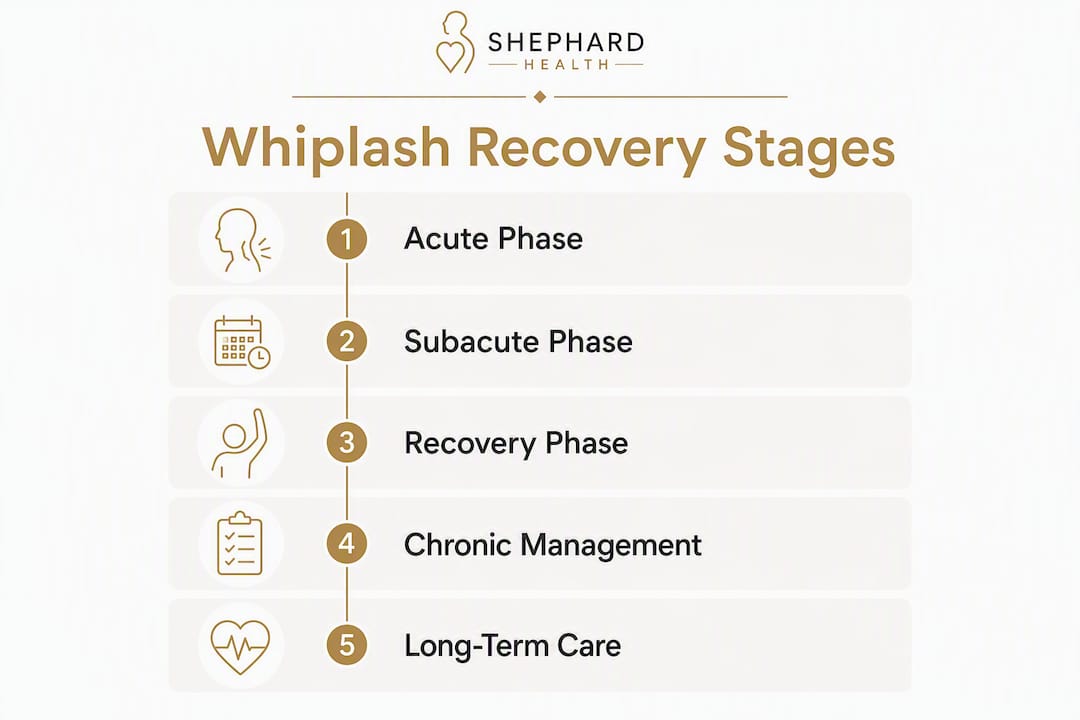
Recovery does not follow a perfectly straight line, but there are reliable patterns. The table below maps the typical whiplash healing process from the first hours through six months and beyond.

| Stage | Timeframe | What typically happens | Key action |
|---|---|---|---|
| Acute | Hours–48 hours | Pain and stiffness develop; swelling and muscle guarding begin | Seek evaluation; brief rest; ice/heat for comfort |
| Early recovery | Days 3–14 | Gradual reduction in acute pain; some stiffness persists | Begin gentle movement; avoid prolonged immobilization |
| Active rehab | Weeks 2–6 | Most mild cases improve significantly; moderate cases still symptomatic | Structured exercise, manual therapy, graded return to activity |
| Prognostic pivot | 2–3 months | Recovery often plateaus here; persistent symptoms signal higher risk | Reassess care plan; consider referral if not improving |
| Chronic risk | 3–6+ months | A minority develop chronic WAD; symptoms may persist without imaging correlates | Pain management referral, multimodal rehab, psychological support |
Milestone checkpoints to guide your expectations:
Not everyone follows the typical path, and understanding why helps you and your care team respond early. Established predictors of prolonged recovery include older age, female sex, high initial pain intensity, pre-existing neck or low back pain, and headaches or arm pain at the time of injury. These are not reasons to feel discouraged. They are clinical signals that tell your provider to increase monitoring frequency and adjust the treatment plan sooner.
Psychological and social factors carry real weight in recovery outcomes. Stress, anxiety, depression, and pain catastrophizing (the tendency to expect the worst from pain) are all associated with longer recovery. This is not a character flaw; it reflects how the nervous system processes threat and pain signals. Addressing these factors directly, through counseling, stress management, or targeted psychological support, is part of evidence-based whiplash care, not an optional add-on.
Compensation and litigation context also appears in the research. Studies note that in regions with minimal litigation, prognoses tend to be more favorable, suggesting that the broader context of a claim can influence reported outcomes. This does not mean symptoms are fabricated; it means the psychosocial environment around an injury shapes recovery in measurable ways.
If your symptoms persist past the 3-month mark, the probability of full recovery decreases. A patient who is still significantly disabled at 6–12 weeks is not simply healing slowly. That person is at elevated risk for prolonged symptoms and should be managed with greater intensity, not a continued wait-and-see approach.
The most important shift in whiplash care over the past two decades is the move away from prolonged rest toward early, supervised movement. Here is what the evidence supports.
Brief rest, then early mobilization. Rest for approximately 48 hours to manage acute pain, then begin gentle neck movement. Early mobilization and movement-based exercise is the recommended approach, supported by clinical guidelines.
Analgesics and anti-inflammatories. Over-the-counter NSAIDs (ibuprofen, naproxen) and acetaminophen help manage pain in the acute phase. Short-term muscle relaxants may be appropriate for significant muscle spasm; discuss with your prescribing clinician.
Manual therapy and physical therapy. Structured physical therapy, chiropractic care, and soft tissue treatments including Active Release Technique (ART) and Graston Technique aim to restore cervical range of motion, reduce muscle guarding, and retrain movement patterns. Massage therapy for neck pain can reduce muscle tension and support early recovery as an adjunct to active rehab.
Heat and cold therapy. Ice in the first 48–72 hours reduces local inflammation. Heat applied to the neck and upper trapezius after the acute phase helps relax muscle guarding and improve circulation.
Graded return to activity. Resume normal daily activities as tolerated, increasing intensity gradually. For athletes and physically active patients, a structured mobility restoration approach helps guide the progression from basic movement to full training load.
Advanced modalities for persistent cases. Laser therapy, shockwave therapy, and spinal decompression are options when standard conservative care has not produced adequate improvement by 6–12 weeks. These are not first-line treatments but can be valuable for moderate-to-severe or non-resolving cases.
Psychological support. When stress, anxiety, or catastrophizing are identified, cognitive behavioral therapy (CBT) or other psychological interventions are evidence-backed additions to the physical rehab plan.
Collar use guidance:
What to avoid at home:
Pro Tip: Pacing matters as much as the exercises themselves. Doing too much too soon after a few good days is one of the most common setbacks in whiplash recovery. Increase activity by roughly 10–15% per week, and back off immediately if pain spikes rather than pushing through it.
Some symptoms after a neck injury require immediate medical attention, not a scheduled appointment. Go to the emergency department or call 911 if you experience any of the following.
When you arrive at the ED, tell the team the exact mechanism of injury, the speed and direction of impact if applicable, when symptoms began, and any neurological symptoms you have noticed. This information directly guides urgent imaging and triage decisions.
The guidance in this article is grounded in peer-reviewed research and clinical guidelines. Here is a concise summary of the key evidence.
The honest picture of whiplash prognosis is more varied than most people expect. For mild WAD, full recovery within weeks to 3 months is realistic and common. Moderate cases often follow a longer arc, with meaningful improvement continuing through 3–6 months. Severe cases involving higher-grade WAD, significant neurological involvement, or multiple risk factors carry a greater chance of persistent symptoms.
What makes whiplash particularly challenging is that chronic symptoms frequently occur without correlating changes on MRI. Persistent pain does not mean something was missed on imaging. It reflects the complex interplay of soft-tissue sensitization, nervous system changes, and psychosocial factors that characterize chronic WAD. This is why long-term management focuses on multimodal rehabilitation rather than searching for a structural fix.
For patients whose symptoms continue past 6 months, the care model typically expands to include pain management consultation, psychological support, and ongoing supervised rehabilitation. The goal shifts from “full resolution” to “maximum function and quality of life.” Many people with chronic WAD achieve substantial improvement with the right combination of physical therapy, manual care, and psychological strategies, even when complete resolution is not achievable.
Most people recover from whiplash within a few months with early, active care, but many report some ongoing symptoms at one year, making prompt evaluation and the right treatment plan critical from the start.
| Point | Details |
|---|---|
| Typical recovery window | Most mild-to-moderate cases resolve within a few months, but approximately 50% of patients report some ongoing symptoms at one year; severe or high-risk cases may take longer. |
| The 3-month pivot | Symptoms persisting beyond 3 months carry a lower probability of full recovery and need a reassessed, more intensive care plan. |
| Early mobilization is key | Brief rest (about 48 hours) followed by supervised movement and exercise outperforms prolonged rest or collar use. |
| Red flags need immediate care | Neurological deficits, altered consciousness, or inability to walk after a neck injury require emergency evaluation, not a scheduled appointment. |
| Shephardhealth for whiplash care | Shephardhealth offers chiropractic care, physical therapy, ART, and advanced modalities tailored to your recovery stage and risk profile. |
The research on whiplash recovery is clear, but what it sometimes undersells is how much the first two weeks set the tone for everything that follows. Patients who come in early, commit to gentle movement despite discomfort, and address the psychological side of recovery alongside the physical tend to move through the stages faster and with less setback.
What I see most often in clinic is not a failure of treatment. It is a delay in starting it. People wait to see if the pain goes away on its own, sometimes for weeks, and by the time they come in, muscle guarding has become entrenched, movement patterns have compensated, and the nervous system has started to amplify pain signals. That delay does not make recovery impossible, but it does make it longer and harder.
The other pattern worth naming: patients who are told “your imaging is normal, so you’re fine.” Normal imaging does not mean no injury. WAD is frequently a soft-tissue diagnosis with no radiographic correlate, and dismissing symptoms because a scan looks clear is one of the most common ways moderate cases become chronic ones. If you are still in pain and your imaging is normal, that is not a reason to stop seeking care. It is a reason to seek care from someone who understands soft-tissue injury.
Recovering from a neck injury is faster and more predictable when you have a structured, personalized plan from the start. Shephardhealth specializes in exactly this: evidence-based assessment and hands-on rehabilitation for whiplash and motor vehicle accident injuries, with same-day appointments and direct insurance billing so you can start care without delays.

The clinic offers chiropractic care, physical therapy, Active Release Technique, Graston Technique, laser therapy, shockwave therapy, and Kinesio Taping, all matched to your specific recovery stage. Whether you are in the acute phase or managing symptoms that have persisted past the 3-month mark, the team builds a care plan around your goals and your timeline, not a generic protocol.
To understand what your first visit will look like and what to bring, visit the first chiropractic visit guide and book your evaluation. The sooner you start, the more of your recovery window you protect.
This article is for general informational purposes only and is not a substitute for professional medical advice. Please consult a qualified clinician or your primary care provider for guidance specific to your situation.
The following resources were used to support the clinical claims in this article and are recommended for deeper reading.
Same Day Appointments Available
We Direct Bill!