

Peroneal tendonitis, more accurately called peroneal tendinopathy, is treated without surgery in the large majority of cases. The core of treatment is managing how much load the outer ankle takes, then rebuilding the tendons’ capacity with progressive exercise. Pain-relieving hands-on care and bracing can help along the way, but they support the exercise. They do not replace it. One clinical review reports that 80 to 90% of cases resolve with early, systematic conservative management, with recovery typically taking 3 to 12 months depending on severity and how consistently you follow the plan.
Below, we walk through the stages in order, so you can see where you are and what comes next.
The peroneus longus and peroneus brevis tendons run down the outer side of the lower leg, behind the outer ankle bone, and into the foot. They help you push off, stabilize the ankle and stop it from rolling outward. According to Foot Heuristics, the problem is common in runners, dancers and basketball players, and in anyone whose training or daily activity has recently changed.
The cause is usually overuse or repetitive strain. A sudden jump in mileage, a new surface, a new sport season, or a high-arched foot that keeps the ankle tilting outward can all overload the tendons. An NHS physiotherapy handout notes that tendon pain can also follow doing less than usual, for example after illness, because the tendon loses tolerance to normal activity.
Typical symptoms are an ache along the outer ankle that builds with activity, stiffness first thing in the morning, tenderness when you press behind the outer ankle bone, and sometimes mild swelling. Pain that appears after a twist or a sudden pop is a different story, and we cover it in the red flags section below.
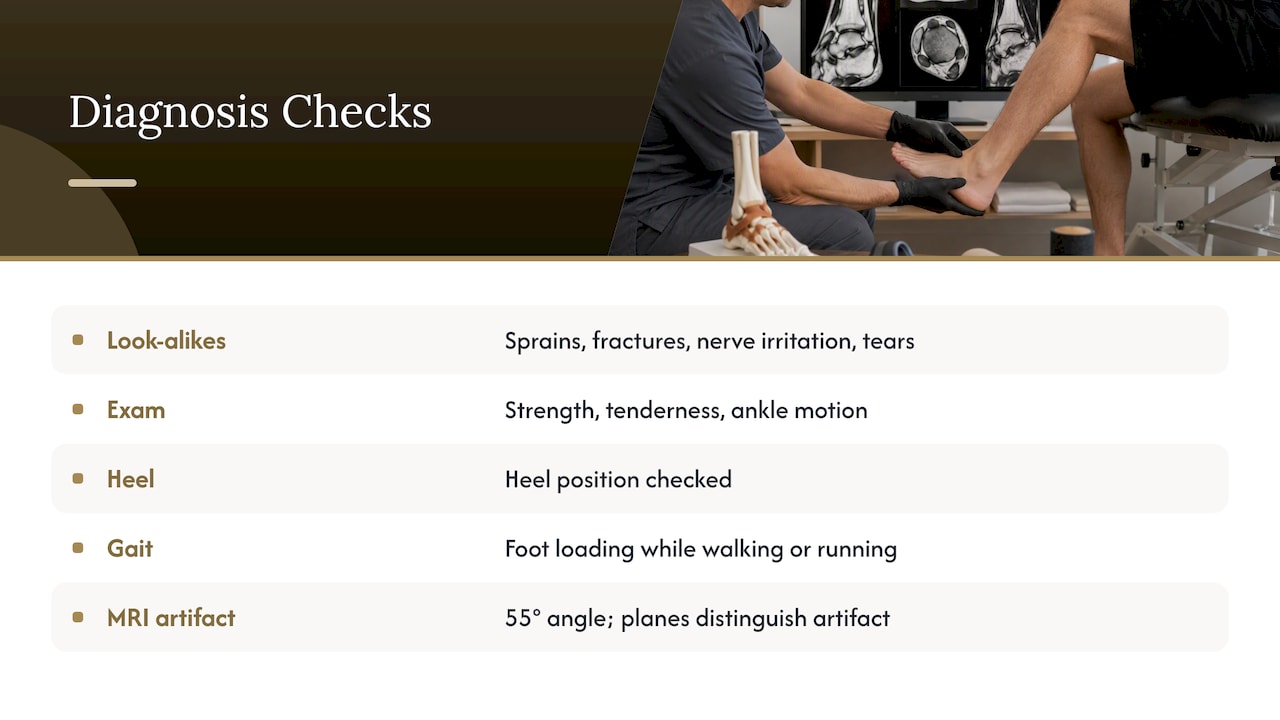
Lateral ankle pain has several look-alikes: ligament sprains, stress fractures, nerve irritation and tendon tears. A review of peroneal tendon disorders describes the condition as an under-appreciated source of outer-ankle pain that can be hard to tell apart from ligament injury. That is why a hands-on assessment matters. A clinician should check your tendon strength and tenderness, how your foot and ankle move, how your heel sits, and how you load the foot when you walk or run.
Imaging is not always the answer either. Some MRI scans show an “abnormal” signal in the peroneal tendons that is actually an artifact. The magic angle effect occurs when the tendon runs at about 55° to the magnetic field, and the same paper explains that experienced readers can use specific imaging planes or foot positions to tell it from a true tear. If a scan result does not match how your ankle feels, ask your clinician to interpret it alongside the physical exam.
In the early, painful stage, the aim is to settle symptoms while keeping the tendon moving within what it tolerates. A short period of relative rest, and sometimes brief immobilization, can help. A current concepts review in the Journal of the American Academy of Orthopaedic Surgeons states that nonsurgical treatment should always be the first step.
A practical tool from NHS Forth Valley physiotherapy is to sort your activities into three zones:
The point is to stay mostly in the green zone while you build capacity with targeted exercises. Walking on flat ground might be green, while running on a cambered trail might be red. As the tendon adapts, activities move up the ladder.
If you run or play sport, your weekly volume matters as much as any single session. The same Foot Heuristics review suggests keeping your recent load in a sensible ratio to what you have been doing over the past weeks, and avoiding increases of more than about 10% per week. Many people get into trouble by feeling better, then doubling their mileage.
Ice, compression and elevation can take the edge off a flare-up, but they are for symptom relief, not for long-term healing. Over-relying on rest or anti-inflammatory medication can also be counterproductive, since tendons need controlled mechanical loading to remodel. If you use compression devices for the leg, such as pneumatic boots, check who should not use compression boots first, and ask your doctor if you have circulation problems, a clotting history or any other medical condition.
One point deserves emphasis: injecting corticosteroid into the peroneal tendon sheath is generally discouraged because of the risk of tendon rupture, per the review above. If someone suggests it, ask about the evidence and the alternatives.
A lateral heel wedge can offload the peroneal tendons, and it tends to work best in the early, painful phase. It is not a permanent fix. The long-term goal is a tendon strong enough to tolerate load without a mechanical aid. When the foot alignment is flexible, the JAAOS review mentions that a corrective orthotic can be considered. Whether you need one depends on your foot posture and gait, which is something a biomechanical assessment can answer. Choose supportive shoes with a stable heel, and avoid worn-out trainers, which are an easy cause to overlook.
The exercise progression is the part of peroneal tendinopathy rehab that rebuilds the tendon. The structure described by Foot Heuristics moves from isometric work to isotonic resistance to plyometric, sport-specific loading. The exercises below illustrate each phase. Your clinician will adjust the choice, load and timing to your ankle.
Isometric exercises load the tendon without moving the joint, and they are often the most comfortable place to start. A common example is pressing the outside of your foot gently into a wall or a resistance band anchor and holding the effort steady for 30 to 45 seconds, repeated a few times. Add gentle ankle range of motion work, such as pointing and flexing the foot, within a comfortable range. One UK physiotherapy practice’s early programme keeps range-of-motion work at or under 4/10 on the pain scale, a useful conservative cap at this stage.
Once holds are comfortable, you add resistance through movement. Typical examples are slow resistance-band eversion (turning the sole outward), double-leg and then single-leg heel raises with a slow lowering phase, and balance work on a firm surface. Go slowly, aim for control rather than speed, and increase the resistance gradually. This phase builds the load capacity that manual therapy and rest cannot.
The final phase prepares the tendon for the demands of your sport: skipping, hopping, jumping, lateral shuffles, cutting and then graded return to running. The tendon stores and releases energy in these movements, so it needs to be trained for them. If you are coming back from an ankle injury more generally, our guide to the tests to pass before running after an ankle sprain shows how a staged return can be checked.
A simple guide from the research: avoid pushing through pain above about 5/10 during exercise, and avoid pain that lingers beyond 24 hours afterward (see the source). If your ankle is more sore the next morning, scale the load back a step rather than stopping altogether. If you want to see how a similar staged approach works for another tendon, read our pages on Achilles tendinopathy exercises and patellar tendinopathy exercises.
Manual therapy and soft-tissue techniques can reduce local tenderness and improve how tissues glide. Experts describe this as a bridge: it can open a short window of less pain so you can do your exercises well, but it does not fix the underlying load capacity problem. That distinction matters when you choose a clinic. A good plan has exercise at the center and hands-on care in support.
The options a clinician may use alongside rehab include:
Because this evidence is mostly indirect for the peroneal tendons specifically, treat these as supports and ask your clinician what they expect each one to add. For a broader view of how soft-tissue injuries are managed, see our guide to soft tissue injury treatment.
The 3 to 12 month range in the research is wide for good reason. A recently irritated tendon in a recreational walker can settle much faster than a long-standing problem in a competitive runner. Some outlets cite two to four weeks of symptom relief as typical for early cases, but symptom relief and a tendon ready for full sport are different milestones. Pain often eases well before the tendon can tolerate hard training, which is why people relapse when they stop their exercises too early.
Things that slow recovery: continuing to train through red-zone pain, skipping the strengthening phase, staying in worn shoes, and returning to full volume in one jump. Things that speed it up: consistent practice, gradual progression, and an accurate early diagnosis.
See a clinician promptly, in person, if you notice any of the following:
Peroneal tears are a common but under-recognized cause of ankle pain, so prompt assessment of these signs is worthwhile. According to the ESSKA-AFAS international consensus, conservative management is the treatment of choice in the vast majority of acute cases. As summarized in the Foot Heuristics review, surgery is reserved for cases where at least 6 to 12 months of structured conservative care has failed, or for severe tears (more than 50% damage) or recurrent subluxation. Even then, outcomes depend heavily on a tailored rehab program afterward. Your family doctor or an orthopedic or sports medicine physician is the right person to discuss surgery.
At Shephard Health, we see outer-ankle pain most often in active people who have changed something: a new training block, new shoes, a return to sport after time off. In our experience, the people who recover well are the ones who understand the plan, not just the ones who receive treatment. We build care around an individualized, evidence-based plan that starts with a comprehensive biomechanical assessment, so we know whether the problem is the tendon, the foot, the hip, or how you train.
We use hands-on techniques and technologies such as A.R.T., Graston, shockwave and laser therapy where they suit you, and we are clear that they are the bridge, not the destination. The destination is a tendon that tolerates the load of your life and your sport. We would rather give you a progressive exercise plan and a realistic timeline than promise a quick fix.
— Deane
If your outer ankle pain has lasted more than a couple of weeks, keeps returning, or limits your training, a hands-on assessment is the most useful next step. Our team offers same-day appointments and direct insurance billing where applicable. You can read about chiropractic care at our Calgary clinic, see what we offer for physical rehabilitation, or find out what to expect on your first visit.
Most cases resolve with conservative care. The clinical review we cited puts the figure at 80 to 90%, with recovery over 3 to 12 months. Neglected cases can progress to degeneration or tears, which is why early, consistent rehab matters.
Often you can keep some activity, but it depends on your pain. Use the green, amber and red zones, and keep exercise pain at or below 5/10 and settled within 24 hours. If running sits in the red zone, swap in lower-load cross-training and have the ankle assessed.
Gentle soft-tissue work on the muscles along the outer lower leg may ease tenderness. Do not dig into a sharply painful tendon, and do not rely on massage alone. It works best as a bridge into your strengthening program.
Not always. Diagnosis often rests on a physical exam, and imaging is used when a tear or instability is suspected or progress stalls. Scan findings should be read alongside your symptoms, since some signals are imaging artifacts.
The Comprehensive Treatment of Peroneal Tendonitis, Foot Heuristics
Diagnosis and Operative Treatment of Peroneal Tendon Tears, PMC
ESSKA-AFAS international consensus statement on peroneal tendon pathologies
Peroneal Tendon Syndromes, StatPearls
Peroneal Tendinopathy first line management, East Lancashire NHS
Peroneal tendon disorders, PMC
Chronic Disorders of the Peroneal Tendons, JAAOS
Peroneal Tendinopathy, NHS Forth Valley
Peroneal Tendinopathy Early Exercise Programme, Pure Physiotherapy
Same Day Appointments Available
We Direct Bill!