

Shockwave therapy can be a reasonable option for patellar tendinopathy (jumper’s knee), but only as a second step. Current guidelines put a structured loading program first and consider shockwave for knees that have not improved after about 12 weeks of that work. The research on shockwave for this particular tendon is also weaker than many clinic websites suggest. This guide explains what the evidence shows, who may benefit, what a course of treatment involves, and how to decide whether it is right for your knee.
The patellar tendon connects your kneecap to your shinbone. When it is overloaded by repeated jumping, landing, sprinting or deep squatting, the tendon’s structure changes and the area just below the kneecap becomes painful. That is why it is nicknamed jumper’s knee, and why it is common in volleyball, basketball, soccer and running sports. The ISMST shockwave guidelines describe it as functional overload of the tendon’s origin from repetitive strain.
The typical story is pain at the start of activity that eases once you warm up, then returns afterward or the next morning. Left alone and loaded the same way, it can become a long-running problem. Tendons adapt slowly, so recovery is measured in months, not days. That slow timeline is the main reason people look for something that feels like a shortcut.
Extracorporeal shockwave therapy (ESWT) delivers acoustic pulses through the skin to the painful tendon area. The aim is to reduce pain sensitivity in the tissue and encourage a biological repair response. It is non-invasive: there are no needles and no incision. A session over a single tendon is short, and the sensation is a strong tapping that can be uncomfortable over a tender spot.
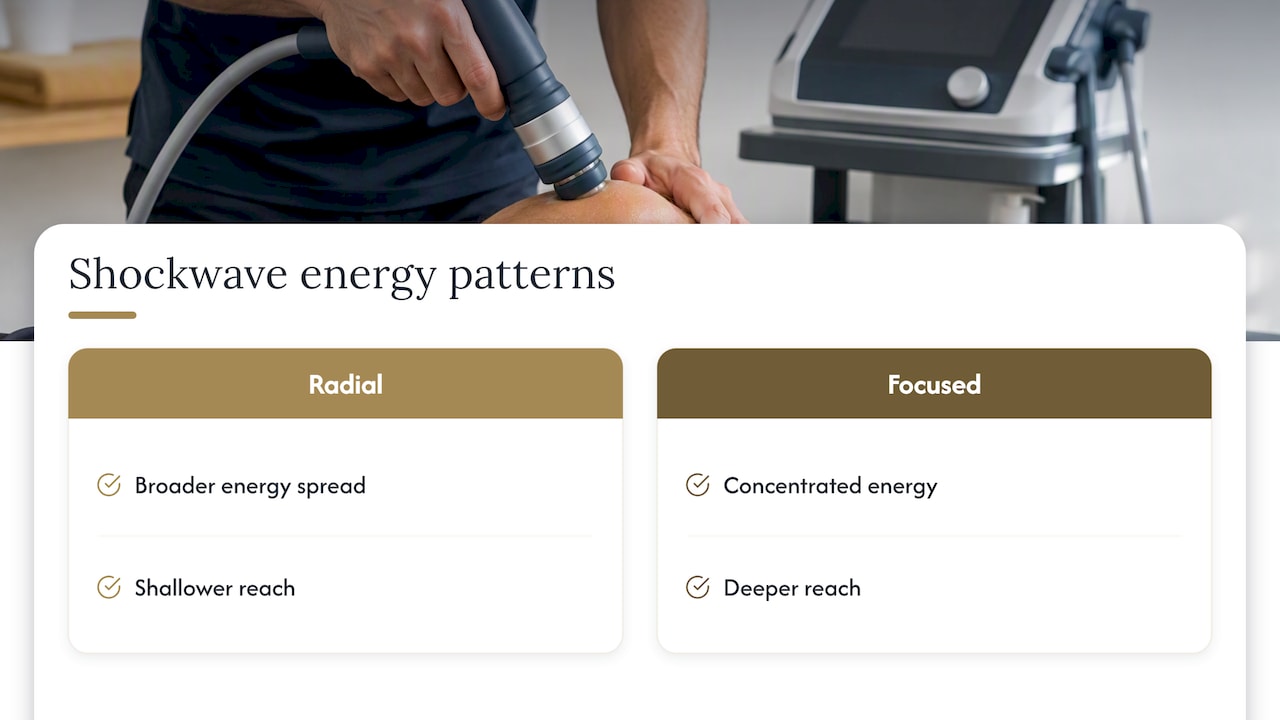
There are two common forms. Radial devices spread energy over a broader, shallower area. Focused devices concentrate energy deeper. Which one is used depends on the clinic’s equipment and on where your tendon is sore. You can read how we describe the technology on our shockwave therapy service page.
This is the part many treatment pages skip, so here it is plainly.
A 2023 systematic review and meta-analysis found low-to-moderate evidence that ESWT has a negligible effect on pain and function in patellar tendinopathy in the short term, compared with placebo. The same review found a much clearer benefit for plantar fasciitis, which shows that results differ a lot from one tendon to another. A network meta-analysis in BMJ Open Sport & Exercise Medicine reached a similar view, noting that pairwise analysis of two randomized trials did not show a convincing advantage for shockwave.
A living systematic review of lower limb tendinopathies adds a note of caution about the whole field: the comparisons that reached statistical and clinical significance were based on low or very low strength of evidence. In other words, we are working with uncertain data, and anyone promising a guaranteed result is going beyond it.
Specialists also point out that shockwave’s evidence is stronger in some conditions, such as resistant gluteal tendinopathy, than in patellar tendinopathy, where it often serves as a fallback when exercise programs are not tolerated or not effective.
What does this mean for you? It does not mean shockwave never helps. Some people with stubborn jumper’s knee do report improvement, and the technique carries a low risk when you are properly screened. It means the honest framing is: a reasonable adjunct for a knee that has not responded to good rehab, with modest and variable expected benefit.
The 2024 Dutch multidisciplinary guideline on anterior knee pain covers patellofemoral pain and patellar tendinopathy. For patellar tendinopathy it prioritizes exercise therapy and load management with patient education. It treats additional conservative options, shockwave among them, as a later consideration. The guideline advises thinking about shockwave when a structured, progressive program of about 12 weeks (with heavy slow resistance training as the key approach) has not produced a clinically relevant change in pain and function.
It also moves away from a one-size-fits-all approach. The guideline’s stepwise thinking, with the early stages built on education and managing how much load the tendon sees, means your treatment should match your stage, sport and goals.
This fits how a clinic should work. If you arrive asking only for shockwave, a good clinician will first ask what you have already tried, how you load the knee, and whether the exercise program was done consistently and at the right intensity.
Shockwave is worth discussing if several of these apply:
A hospital patient leaflet from the Wrightington, Wigan and Leigh NHS trust describes radial shockwave as usually offered when chronic symptoms have lasted at least 3 to 6 months and have not responded to conservative treatment. That lines up with the guideline thinking above.
If your knee pain began recently, if it is behind or around the kneecap rather than just below it, or if it came with a fall or twist, shockwave is probably not the right place to start. Those pictures call for a different assessment.
Clinicians generally see shockwave as an adjunct to a rigorous 12-week progressive loading program, not a substitute. The Dutch guideline frames it that way, and patients who expect the device to do the work often do worse over the long term than those who keep loading the tendon.
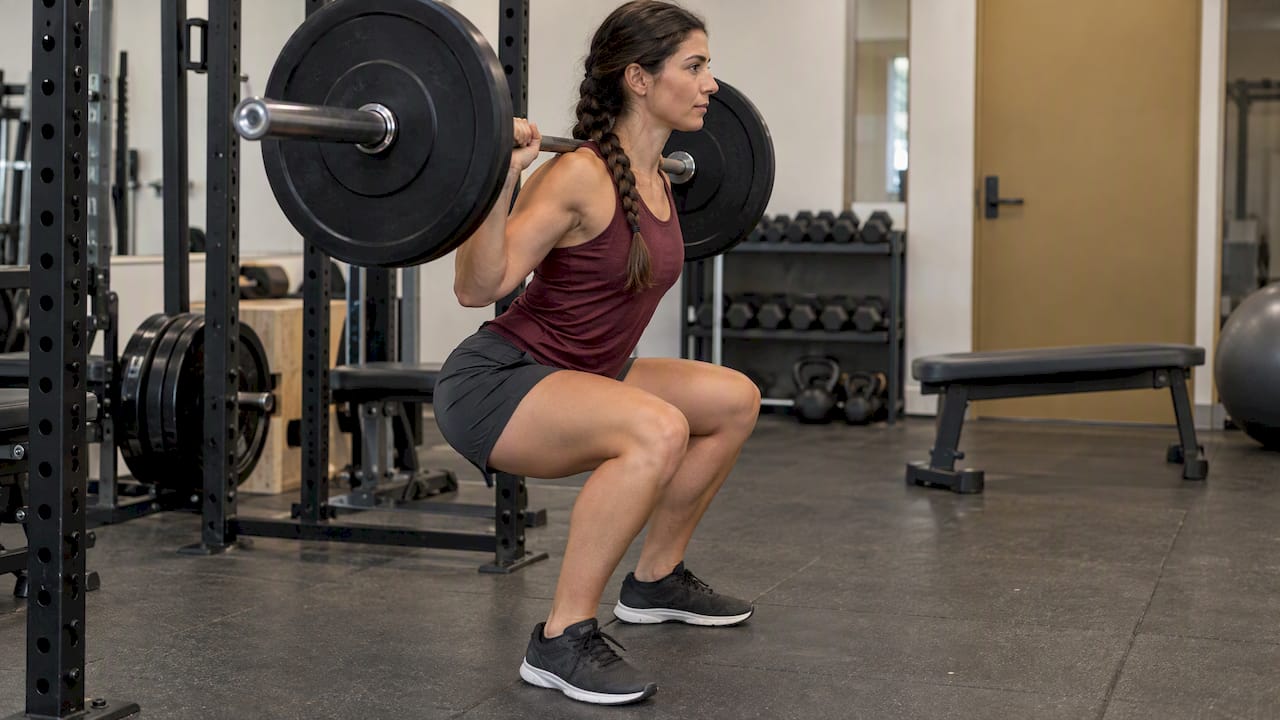
Tendons respond to graded, repeated load: heavy, slow lifts that are progressed gradually while pain stays within an acceptable range. We cover the stages, and the pain-rating rule we use to progress, in our guide to patellar tendinopathy exercises.
Support for the rest of the knee also helps in the early, sore weeks. Many people find a reusable cold wrap useful after activity, and these runner’s knee relief tips cover simple ways to manage flare-ups while you rebuild strength. Comfort measures do not replace loading, but they can make the program easier to stick to.
Shockwave is non-invasive, but it is not suitable for everyone. Screening matters, and it should happen before the first session. The NHS patient information lists the following as reasons to avoid or delay treatment:
The same source notes that some medications, including common anti-inflammatory or blood-thinning drugs, may need to be avoided around the time of treatment, and that certain cardiac devices need to be considered. Tell your clinician about everything you take, including over-the-counter products. If you are unsure about a medication, ask your pharmacist or family doctor before booking, and do not stop prescribed medicine on your own.
Assessment. Treatment starts with a conversation and a physical exam: where the pain sits, which movements provoke it, how your training has changed, and what you have already tried. We check the hip, ankle and foot mechanics too, because the knee tendon often takes the load that other joints are not sharing.
The sessions. Each shockwave session is brief, and the applicator is moved over the tender area of the tendon. Courses are usually spread over several weekly visits, though the exact number and intensity depend on your tendon’s response and the device. Our shockwave pain procedure page walks through what happens in the room.
Right after. Some people feel more soreness or local irritation for a few days, since the treatment is meant to stimulate the tendon’s biological response. This is expected, but severe or worsening pain, new swelling, heat or fever deserve a call to your clinician.
The wait. The ISMST guidelines stress that pain reduction is not immediate and that clinical success can take 8 to 12 weeks after a treatment course ends. That is long enough that many people give up early. Plan your training around that timeline and keep your exercises going through it.
This is a general outline, not a prescription. Your clinician will adjust it to you.
If you want a plain explanation of how shockwave helps with joint pain more broadly, see our overview on how shockwave therapy can treat knee pain.
We use shockwave in our Calgary clinic, and we also tell patients where the evidence is thin. For patellar tendinopathy it is a tool for resistant cases, not a headline treatment. Our approach is to assess the whole chain, from foot to hip, build a loading plan around your sport and schedule, and bring in shockwave, laser therapy, Active Release Technique or Graston Technique where they support that plan rather than stand in for it.
We would rather you spend your first weeks building tendon capacity than paying for sessions that cannot work without it. If you have already done the work and your knee has stalled, shockwave is a sensible next conversation. When something is outside what we can safely treat, we will say so and point you to the right professional.
— Deane
If your knee has hurt for months, or you are not sure whether it is the patellar tendon at all, start with an assessment. We offer same-day appointments, direct insurance billing where applicable, and a team that treats athletes and active families. You can see our shockwave therapy service or our physical rehabilitation and treatment options and book from there.
The evidence is mixed and modest. A 2023 meta-analysis found a negligible short-term effect compared with placebo for this tendon. It may still help some people whose knees have not responded to exercise, which is why guidelines treat it as a later option.
There is no quick fix. The best-supported route is a progressive loading program, with training load adjusted to keep pain manageable, over roughly 12 weeks or more. Shockwave or other adjuncts are added only if progress stalls.
That depends on your tendon, the device and your response, and a clinician has to set it after assessment. Courses typically run over several visits. Improvement can take 8 to 12 weeks after the final session to show.
It can be uncomfortable during treatment, and soreness for a few days afterward is common. Risks rise if you skip screening, so tell your clinician about pregnancy, recent steroid injections, infections, cardiac devices and medications beforehand.
Same Day Appointments Available
We Direct Bill!