

If a rib feels out of place, the usual path is to rule out serious causes first, calm the irritated area with short-term rest and symptom control, and then restore movement with hands-on care and graded rehab. Most people who say a rib has “slipped” or “gone out” describe sharp, catching pain in the lower ribs or mid-back that flares with twisting, coughing or lifting. Below, we explain what is probably happening, what conservative treatment looks like, where chiropractic care fits, and which symptoms mean you should skip the clinic and get urgent medical help.
The phrases “rib subluxation,” “slipped rib” and “rib out of place” are used loosely, and they describe a feeling more than a single diagnosis. Patients tell us about a sharp stab under the ribs, a pop or click when they roll over, or a deep ache that grabs when they reach overhead.
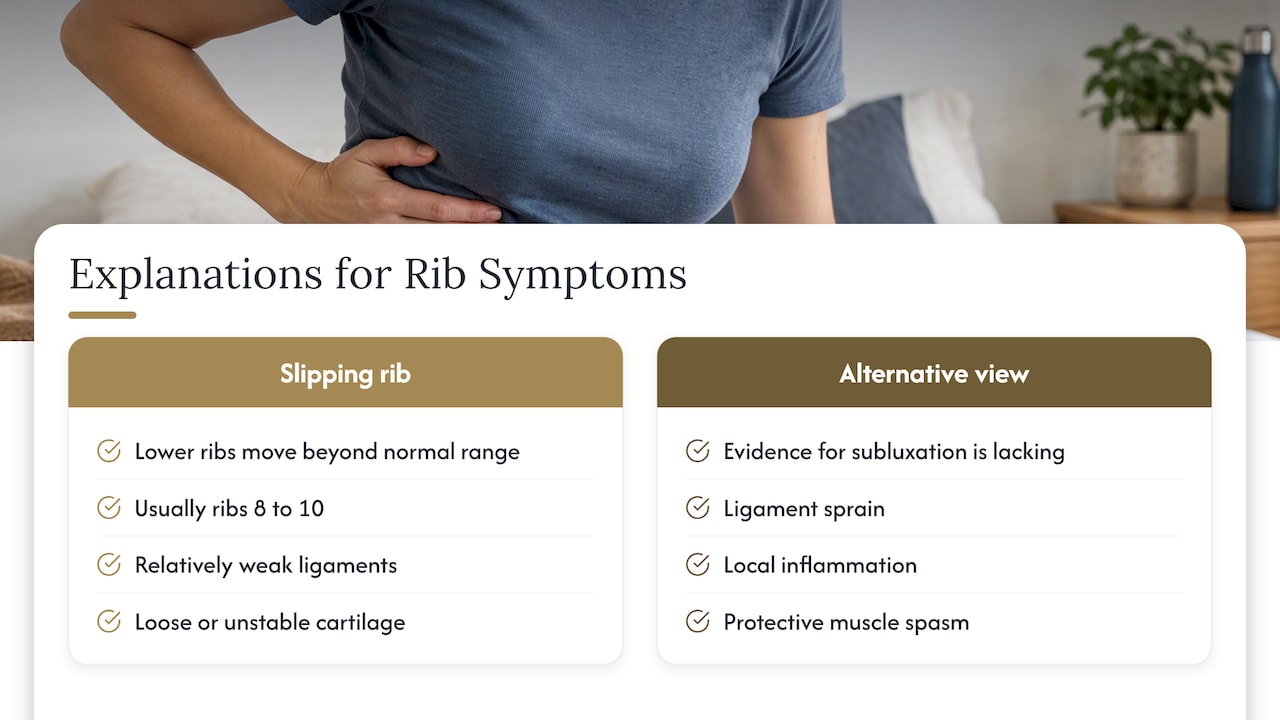
The best-described medical version is slipping rib syndrome. MedlinePlus explains that it involves movement of the lower ribs beyond the normal range, usually ribs 8 to 10, because the ligaments holding them are relatively weak. Symptoms include pain in the lower chest or upper abdomen, popping, clicking or slipping sensations, tenderness, and pain that worsens with coughing, laughing, lifting, twisting or bending. The Cleveland Clinic describes the same picture: the cartilage connecting the lower ribs becomes loose or unstable, so the ribs can slip in and out of place.
Not every clinician agrees on the wording. A Canadian physiotherapy education group argues that scientific evidence for rib subluxation is lacking and suggests that the “rib out” sensation may reflect a ligament sprain, local inflammation and protective muscle spasm. We think that is a useful way to understand it. Whatever you call it, the practical question is the same: what is irritated, and what restores comfortable movement?
Rib-related pain tends to behave mechanically. It changes with position and movement, you can often press on a tender spot and reproduce it, and it may feel sharper when you breathe deeply, twist or lie on one side. A catching or clicking sensation along the lower rib margin points toward the slipping rib pattern.
A few features make us pay closer attention:
That last one is common in our searches. Pain under the right rib cage can come from muscle strain, bruised or broken ribs, but also from organs such as the liver, kidneys, lungs or heart. That is why a careful assessment matters before anyone labels it a slipped rib.
The mid-back can also be a source of pain that wraps around to the ribs. Irritated spinal joints, for example, can produce pain that feels rib-related; if you want background on that possibility, read about facet syndrome symptoms and treatment. A hands-on assessment helps sort out which structure is responsible.
A good assessment starts with your story: what you were doing, where the pain sits, what makes it better or worse, and what else you have noticed. Then comes a physical exam of the ribs, spine, breathing pattern and surrounding muscles.
One test described in the medical literature is the hooking maneuver, where the examiner hooks fingers under the lower rib margin and gently pulls forward to see whether it reproduces your symptoms. In cases that stay unclear, a dynamic ultrasound can show rib movement in real time while you perform the movement that causes your pain. The same review notes that the condition is often underdiagnosed or misdiagnosed because it resembles other musculoskeletal and visceral problems.
The most important part of any chest-wall assessment is ruling out what should not be missed. Clinical guidance says the process should exclude life-threatening causes such as ischemic heart disease and pulmonary embolus, along with non-musculoskeletal causes such as reflux. If your presentation does not fit a musculoskeletal pattern, we refer you on rather than treat.
Go to an emergency department or call 911 for chest pain with shortness of breath, pressure or tightness spreading to the arm or jaw, sweating, fainting, or coughing blood. Do not wait to see whether it settles and do not book a chiropractor first.
Alberta’s health information service says that severe abdominal pain that starts suddenly needs medical assessment, as does new and different mild pain that worsens over hours or days. It also notes that pain below the ribs after an injury can signal liver or spleen damage. If you took a hard hit to your side in hockey, a fall on ice or a collision, get checked by a physician first.
That also matters for fractures. Broken ribs take about 12 weeks to heal, and they need a different plan than a sprained or irritated rib joint. A sprain-type problem often feels better sooner than that, although timing varies from person to person.
Conservative care is the usual starting point. MedlinePlus lists rest, avoiding aggravating activities, heat or ice, and over-the-counter anti-inflammatories such as ibuprofen or naproxen, and it suggests consulting a physical therapist. Check with your pharmacist or doctor before using anti-inflammatories if you have stomach, kidney or heart conditions or take other medications.
In practice, we tell patients to think in terms of reducing load, not stopping everything:
Reduce the triggers. Heavy lifting, twisting, pushing and pulling are the movements most often advised against while symptoms are sharp. Keep walking and moving gently so the area does not stiffen.
Use heat or ice, whichever feels better. Heat often suits muscle spasm. Ice may suit a sharper, more irritated flare. Fifteen to twenty minutes at a time with a cloth barrier is a sensible rule.
Breathe fully, but gently. Pain makes people breathe shallowly, which can tighten the ribcage further. Slow, comfortable breaths into the lower ribs help, within what your pain allows.
Watch your sleep position. A pillow under the painful side or between your arm and ribs can reduce the tug on the area overnight.
We would steer you away from trying to force a rib back with aggressive twisting or popping videos. If the problem is an irritated joint or a spasming muscle, forcing the area can aggravate it.
When home care is not enough, the next level is professional treatment aimed at calming irritated tissue and restoring normal movement. A medical review of slipping rib syndrome lists physical therapy, massage, topical anti-inflammatories, chiropractic manipulation and electronic stimulation among the symptom-control options after the initial rest, ice and oral anti-inflammatories. Physiotherapists may also use rib mobilization with movement to ease protective muscle spasm and inflammation.
At Shephard Health in Calgary, treatment is built from your assessment rather than from a template. Depending on what we find, a plan might combine several of these:
Chiropractic adjustment of the mid-back and ribs where appropriate, discussed below.
Active Release Technique for tight muscles and soft tissue around the ribcage, shoulder blade and spine, where restricted tissue may be contributing to your pain.
Graston Technique, an instrument-assisted soft tissue approach that can be used on the tight tissue along the ribs and back.
Laser therapy, a non-invasive option that we use to support pain and inflammation management.
Massage therapy for muscle spasm and tension that builds up around a sore rib.
Kinesio taping and rehab exercise to support the area while you return to activity.
Not every patient needs every option, and we do not promise a particular timeline. We reassess at each visit and adjust. If you want to see how we approach this complaint specifically, our pages on chiropractic care for rib pain and rib pain treatment in Calgary go into more detail.
Yes, in the right situation. Canadian chiropractic guidance says that thoracic or rib manipulation can form part of a monitored plan for non-specific musculoskeletal thoracic or chest-wall presentations. The same guidance says forceful manual procedures should be avoided when a fracture, serious pathology or another contraindication is suspected. That is exactly how we think about it: assess first, treat only when the picture fits, and monitor your response.
If you want to read our own take, we explain what rib adjustments involve in more depth.
An adjustment may be a quick, controlled thrust, or it may be a gentler technique with no thrust at all. Both are options, and your comfort and your findings guide the choice. A pop you may hear is gas moving within a joint; it is not a bone being put back. You always have the right to ask us to use a gentler approach or to stop.
HealthLink BC states that spinal manipulation is safe when done by a trained health professional; some people feel tired or sore afterward, and serious problems are very rare. A 2017 review summarized by the US National Center for Complementary and Integrative Health found that mild to moderate effects such as increased pain, discomfort or headache often occur, typically resolving within 24 hours.
There is one caution we want you to hear plainly. Professional chiropractic literature notes that forceful or poorly applied thoracic manipulation can cause rib fractures, costovertebral sprains or costochondral separations, particularly in older adults, and that preventing complications depends on recognizing red flags and using clinical judgment about whether high-velocity techniques are appropriate. Tell your practitioner about osteoporosis, prior fractures, cancer history, recent trauma or blood-thinning medication before any adjustment.
Most people do not need anything beyond the steps above. For the minority whose pain persists, there are medical options. MedlinePlus notes that severe pain may be treated with a corticosteroid injection, and that persistent pain may lead to surgery to remove cartilage and lower ribs. The Cleveland Clinic adds that if conservative treatment does not work, a provider may suggest an intercostal nerve block, with surgery considered if symptoms do not improve over the long term.
These are decisions for a physician, ideally one familiar with chest-wall pain. If you have followed a well-designed conservative plan and your pain is unchanged, we will tell you so and help you take the next step, including a referral.
Recovery depends on what is actually irritated, how long it has been going on, and how much your daily life or sport keeps reloading it. A mild strain-type problem can settle faster than a long-standing slipping rib pattern. We will not give a single number, because honest timelines depend on your assessment.
A reasonable progression looks like this. First comes settling the pain with relative rest and symptom control. Next is restoring comfortable movement in the ribs, thoracic spine and shoulders. Then you rebuild strength and endurance in the trunk and shoulder girdle, and return gradually to lifting, twisting and sport. If you are working through a soft tissue injury more broadly, our guide to soft tissue damage recovery timelines explains how we think about each phase.
Prevention is mostly about load and mechanics: warming up before rotational sports, building trunk strength gradually, and addressing posture habits during desk work. Athletes who throw, swing or row often notice rib pain at the start of a season when training volume jumps quickly.
We see rib pain often in people who are active: golfers, rowers, hockey players, lifters and parents who are constantly twisting and carrying. The label matters less to us than the question underneath it: which tissue is irritated, and what is keeping it irritated?
That is why we do not start with a single technique. We assess your biomechanics, rule out what should be handled elsewhere, and build a plan around your goals. For many rib complaints that means combining joint work, soft tissue treatment and rehab, because pain that is only quieted but not explained tends to return.
We also believe in being straightforward. If your symptoms suggest a fracture, a heart or lung problem, or an abdominal cause, you need a physician, not an adjustment. If your presentation fits a musculoskeletal pattern, a well-monitored, individualized plan is a reasonable and non-invasive place to start, and we are glad to guide you through it.
Deane
If you are dealing with a rib that will not settle, we can assess it, explain what we find in plain language, and build a plan for your situation. We offer same-day appointments, and we bill many insurance providers directly, so you can ask us about your coverage when you call.

You can learn more about our chiropractic care in Calgary or visit Shephard Health to book.
Usually with conservative care first: rest from aggravating movements, heat or ice, and over-the-counter anti-inflammatories if they are safe for you. Physical therapy, massage and chiropractic care can follow. Injections or surgery are reserved for pain that persists despite those steps.
There is no single answer. A strained or irritated rib joint often improves over days to weeks, while a fracture takes about 12 weeks to heal. Pain that is not improving after a few weeks of sensible care should be reviewed by a professional.
Treatment commonly includes manual techniques such as rib mobilization, posture and breathing work, and a gradual strengthening program for the trunk and shoulders. The aim is to reduce spasm, restore movement and prepare you for lifting and twisting again.
It can be a muscle strain or irritated rib joint, but it can also come from the liver, kidneys, lungs or heart. Sudden severe pain, or new pain that keeps worsening, needs medical assessment rather than home treatment.
Slipping rib syndrome, MedlinePlus
Slipping Rib Syndrome: Symptoms & Treatment Options, Cleveland Clinic
A Comprehensive Review of Slipping Rib Syndrome, PubMed Central
Musculoskeletal chest wall pain, RACGP
Thoracic and Chest Wall Pain, Canadian Chiropractic Guidelines
Spinal Manipulation, HealthLink BC
Spinal Manipulation: What You Need To Know, NCCIH
Contraindications, Canadian Chiropractic Association
Abdominal Pain, Age 12 and Older, MyHealth.Alberta.ca
Pain under right rib cage: 12 common causes, Northwell Health
Rib Fracture Management in Older Adults: A Scoping Review
Slipping Rib Syndrome, Physiopedia
Facet Syndrome: Symptoms, Causes, and Treatment Options
Same Day Appointments Available
We Direct Bill!