

If your neck locked up overnight, start with brief ice for the first day or two, switch to heat, and begin gentle range-of-motion as soon as you can tolerate it. A short course of acetaminophen or an NSAID can ease pain while you move. Most cases improve within days to a couple of weeks, but fever, recent trauma, or spreading numbness or weakness means you need prompt medical evaluation.
TL;DR:
- Use ice for 10 to 20 minutes at a time during the first 48 to 72 hours, protect skin with cloth, then switch to heat.
- If you use a soft collar, limit it to two to four days; avoid combining NSAIDs, and use the lowest effective dose for the shortest time.
- Seek urgent care for fever, major trauma, spreading numbness or weakness, breathing or swallowing trouble, or visible neck infection; these symptoms need immediate evaluation.
- Imaging is not routinely recommended during the first four to six weeks without warning signs because it rarely changes treatment.
- Symptoms that persist beyond two to three weeks usually call for supervised rehabilitation, while strengthening and posture work should wait until acute pain settles.
Pain or stiffness holding you back? Start with a $67 new patient visit
A chiropractor assesses what is going on, treats on day one when it is safe, and gives you a plan. See chiropractic care in Calgary. Book online.
Acute torticollis, often called wry neck, happens when a neck muscle spasms suddenly and pulls your head into a tilted position with limited rotation to one side. It is almost always a muscular problem, not a structural one, and it tends to arrive without warning.
You will usually notice:
Most cases trace back to an awkward sleep position, a minor strain during exercise, or a sudden jerking movement. These triggers point to a simple muscular cause rather than anything more serious, which is reassuring, but it is still worth knowing the difference between ordinary wry neck and the rarer presentations tied to infection or nerve involvement, which we cover further down.
The first few days are about calming the spasm and protecting movement, not shutting your neck down completely. A short, structured routine works better than guessing.
Many uncomplicated cases of acute torticollis begin improving quickly with simple home care and often resolve within a short period, which is why early, consistent self-care matters more than any single remedy.
When home care is not enough, or you want faster relief, a clinician has several evidence-aligned tools beyond what you can do on your own.
Combining manual therapy with structured exercise tends to produce better short-term gains in mobility and pain than either approach alone for acute mechanical neck problems. As the irritated stage settles, treatment usually shifts toward targeted exercises and posture correction, which you can start exploring in our neck pain exercises guide.
Pro Tip: Prioritize thoracic and scapular strengthening early. Supporting the muscles around your shoulder blades takes pressure off your neck and tends to produce more durable results than focusing on the neck alone.

Most wry neck resolves with simple care, but certain signs mean you should not wait it out at home.
Any of these calls for immediate medical attention rather than routine conservative care, according to guidance from Harvard Health on neck pain red flags. Without red flags, imaging such as X-rays or MRI is not routinely recommended in the first four to six weeks, since it rarely changes management for acute muscular torticollis. If none of these signs apply, a follow-up with a clinician in the near term is a reasonable next step.
Expect steady, if sometimes slow, improvement rather than an overnight fix.
Patient guidance generally recommends avoiding bed rest and instead encouraging activity within comfort limits, with supervised stretching and strengthening introduced as pain eases, according to MedlinePlus.
When wry neck does not settle on its own, a focused clinical visit can speed things along and rule out anything more complex. We start every visit with a biomechanical exam, a screen for red flags, and movement testing to understand exactly what is driving your symptoms before building a plan around them.
Depending on what we find, treatment may include:
Our full range of soft-tissue approaches is outlined in our guide to treatments for soft tissue injuries. We offer appointment availability and facilitate insurance billing where applicable, so bring your insurance information and a note of when your symptoms started and what has helped so far.
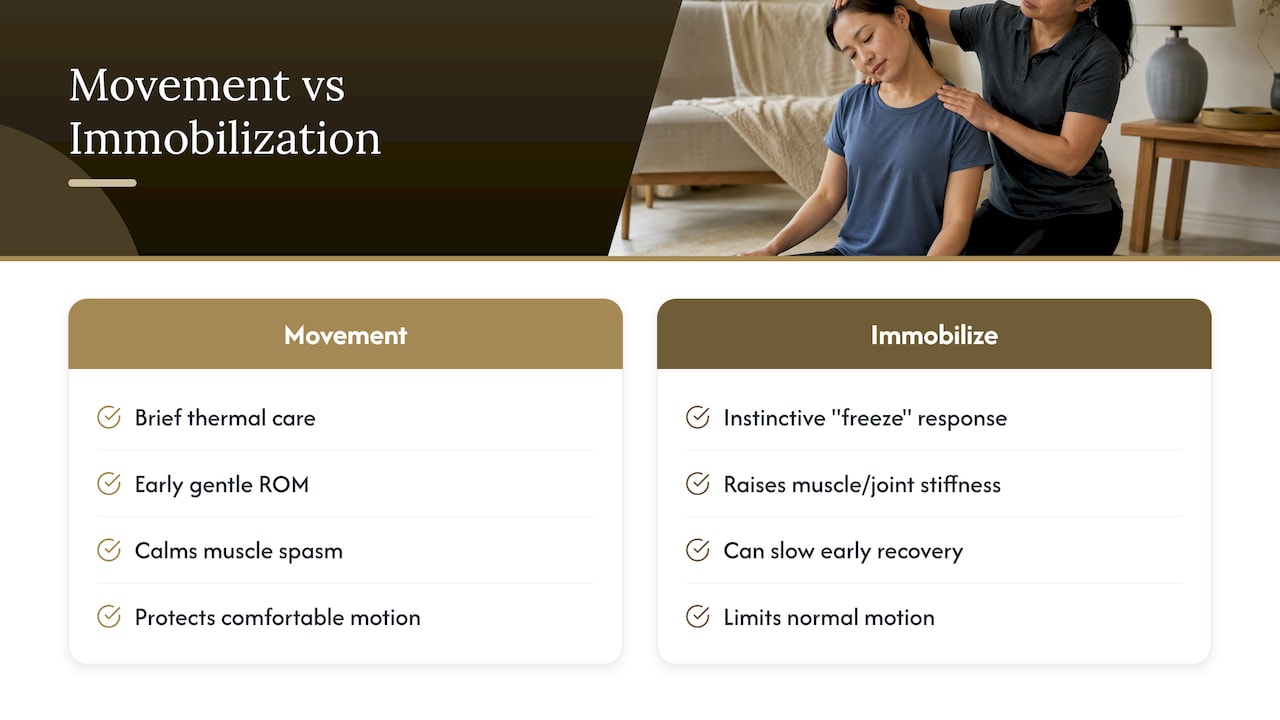
The instinct with sudden neck pain is to freeze and protect it, but that instinct works against you. Brief thermal care paired with early, gentle range-of-motion controls pain without letting the joint and surrounding muscle stiffen further, which is what actually slows recovery in the first week.
Our sequencing is deliberate: calm the spasm first, protect comfortable movement throughout, then layer in progressive strengthening once the acute pain has eased. If something does not fit that pattern, loop in your primary care provider and plan a follow-up rather than guessing.
— Deane
If your neck is still locked up after a few days of home care, an in-person assessment gets you a plan built around your actual symptoms rather than general advice. We offer:

Booking starts with a same-day appointment where we assess your movement, screen for anything that needs urgent attention, and build an individualized plan from there. We bill most insurance plans directly so there is less paperwork between you and relief. Visit our services page to book your first visit.
This article is general information, not a substitute for advice from a qualified doctor. Consult a qualified healthcare professional about your own circumstances before acting on anything here.
Brief ice for the first 48 to 72 hours followed by heat, combined with gentle range-of-motion movement several times a day, tends to bring the fastest relief, a pattern described by MyHealth Alberta. Short-term use of acetaminophen or an NSAID can ease pain enough to keep moving, which supports faster recovery than staying still.
Acute torticollis is a sudden muscle spasm in the neck that pulls your head into a tilted position with limited rotation to one side. It usually follows an awkward sleep position, minor strain, or a sudden movement, and most cases are muscular rather than structural.
Torticollis in cattle is a veterinary condition managed by a veterinarian and falls outside human treatment guidance. If you are looking for care for a sudden neck tilt in a person, the self-care and clinical steps above apply instead.
Massage therapy can reduce muscle guarding and improve blood flow to the spasmed area, which often eases pain and helps restore movement. It works well alongside gentle range-of-motion exercise rather than as a stand-alone fix, as explained in our guide on how massage therapy relieves neck pain.
Same Day Appointments Available
We Direct Bill!