

Nerve-gliding and tendon-gliding exercises, paired with gentle wrist and finger stretches, can ease mild to moderate carpal tunnel symptoms, especially when you add nighttime neutral wrist splinting and a few changes to how you work. Exercises are a support tool, not the main treatment: splinting and activity changes usually carry more weight. If you notice constant night pain, dropping objects, or visible muscle wasting at the base of your thumb, treat that as your cue to get assessed rather than push through more stretching.
TL;DR:
- Exercises should be combined with splinting and activity modifications, as they are supportive rather than standalone cures for carpal tunnel syndrome.
- Nighttime wrist splinting provides the most consistent relief within 6 to 12 weeks, while exercises can improve symptoms when added properly.
- Red flags such as ongoing night pain, muscle wasting, or worsening numbness require immediate professional assessment rather than continued self-treatment.
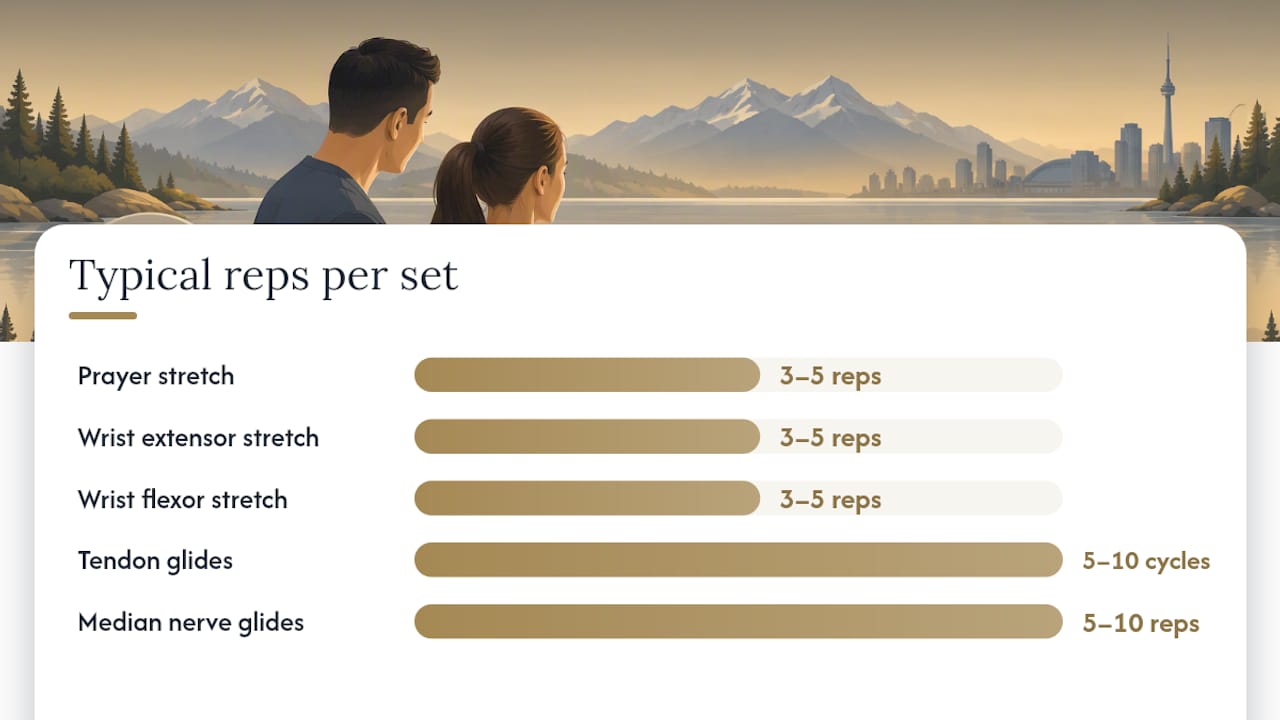
- Starting with moderate routines of 5 to 15 repetitions twice daily is recommended, with progression and reassessment at 4 to 12 weeks if symptoms persist.
- Ergonomic adjustments like keeping wrists neutral and taking micro-breaks during repetitive tasks enhance the effectiveness of exercise routines.
If you want a starting point before working through the detailed instructions below, this is the short list clinicians and hand therapists commonly recommend for mild to moderate median nerve irritation. Each targets a different part of the problem: nerve mobility, tendon glide through the carpal tunnel, or general wrist and finger range of motion.
None of these exercises is a stand-alone fix. A systematic review of gliding exercises found favorable effects when tendon and nerve gliding were added to conventional treatment, not used by themselves, and trial quality varied enough that the evidence supports “helpful addition” rather than “proven cure.” Think of this list as the toolkit you bring into a broader plan that includes splinting and, if needed, a clinician’s guidance. The next section walks through exactly how to do each one.
Good form matters more than speed here. Move slowly, stay within a comfortable range, and stop short of pain.
A brief increase in tingling during nerve glides is common and should ease within about an hour; if it lingers longer or gets sharper, stop and scale back. Skipping the elbow and shoulder alignment cues is the most common mistake, since sloppy posture can load the nerve instead of gliding it.
Pro Tip: If a stretch increases numbness rather than easing it afterward, reduce the range of motion before you reduce the reps.
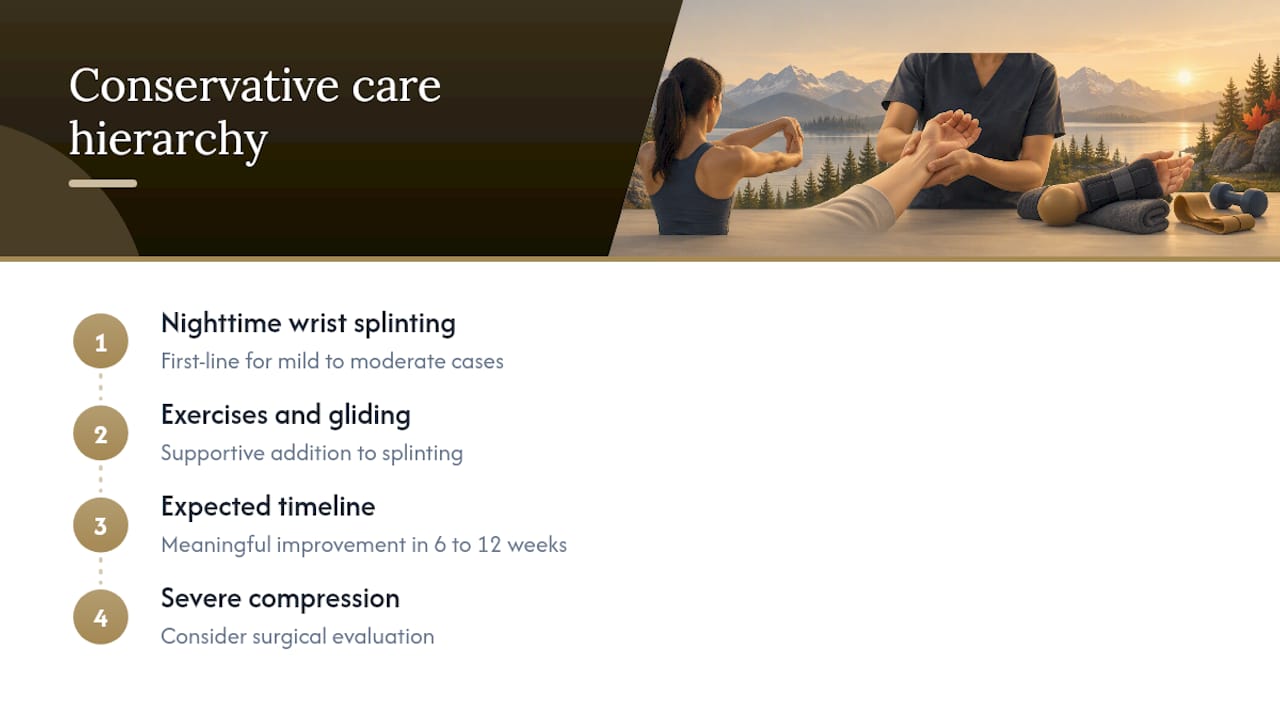
Guideline-level reviews treat exercises as a supporting measure rather than the main event. A review of conservative care approaches found no high-quality evidence to recommend exercise as a stand-alone primary treatment, placing splinting and activity modification ahead of it as the core conservative options.
Nighttime neutral wrist splinting is considered the most effective first-line conservative treatment for mild to moderate carpal tunnel syndrome, according to randomized trial evidence, with meaningful improvement often appearing after 6 to 12 weeks of consistent nightly wear. Exercises fit around that foundation. When gliding work is added to conventional care, the systematic review noted earlier found it can improve symptom severity and function, though study quality varied enough that this should be read as a helpful addition, not a replacement for splinting or, in more severe nerve compression, surgical evaluation.
Exercises are safe for most mild to moderate cases, but certain signs mean it is time to get checked rather than keep stretching.
These patterns can point to more advanced nerve compression that exercise alone will not resolve, and a clinician may run hands-on tests or refer you for nerve conduction studies. A short-lived increase in tingling during or right after nerve glides is normal and should fade within roughly an hour; if it does not, ease off and reassess your technique before your next session.
A simple structure keeps you consistent without overdoing it.
Reassess at 4 to 12 weeks, the same window in which splinting typically shows benefit. Limited improvement by then is a reasonable point to bring in a clinician and consider adding splinting more consistently or other conservative therapies.
Exercises work better when the tasks that irritate your wrist during the day are also addressed. Early carpal tunnel symptoms often start at night and later show up during repetitive daytime tasks, which is why clinical overviews treat activity modification as a standard part of conservative care.
Small adjustments like these reduce the ongoing pressure that your exercises are trying to relieve, and workstation habits picked up while working from home are often where the biggest gains hide.
Exercise prescription is paired with hands-on assessment rather than handed out as a generic sheet. Clinicians check for red flags, adjust exercise dosage to your tolerance, and add modalities when soft-tissue tightness or joint restriction is adding to nerve pressure. Assessment availability can reduce wait times for program adjustments.
Start gently, be consistent, and give the combination of exercises, splinting, and ergonomic changes the full 6 to 12 weeks it typically needs before judging results. If numbness or weakness is trending the wrong way at any point, that is not a sign to try harder. It is a sign to get a professional opinion before symptoms progress further.
— Deane
If home exercises and splinting have not moved the needle after several weeks, or you noticed any of the red flags above, a clinical assessment gives you a clearer picture than guesswork. 
A visit typically includes a biomechanical exam of your wrist, hand, and forearm, a tailored exercise plan matched to your specific pattern of nerve irritation, and hands-on therapies when soft-tissue restriction is part of the picture.
You can review the full range of services, including Active Release Technique and other soft-tissue approaches, on the Shephard Health services page and book an assessment when you are ready for a second opinion.
These are the sources referenced throughout this article for readers who want to look deeper into the evidence.
This article is general information, not a substitute for advice from a qualified doctor. Consult a qualified healthcare professional about your own circumstances before acting on anything here.
There is no single best exercise, but median nerve glides and tendon gliding sequences have the most supporting evidence when combined with other conservative care, according to a systematic review of gliding exercises. Pairing these with nighttime neutral wrist splinting tends to produce better results than exercises done alone.
Exercises are unlikely to help once you have significant hand weakness, visible thenar muscle wasting, or constant numbness that no longer responds to rest or splinting. At that stage, clinical guidance points toward medical assessment and possibly surgical evaluation rather than continued self-managed stretching.
Nighttime neutral wrist splinting is considered the most effective first-line conservative treatment, with trial evidence showing improvement often within 6 to 12 weeks of consistent use. Adding nerve and tendon gliding exercises alongside splinting and ergonomic changes gives you the best combination of conservative options.
Avoid sleeping with your wrists bent or flexed, sustained heavy gripping tasks, and pushing through exercises that cause tingling lasting longer than about an hour. If any movement worsens numbness or triggers new weakness, stop and get it checked rather than continuing the same routine.
Same Day Appointments Available
We Direct Bill!