

Cervical radiculopathy is a pinched or irritated nerve root in the neck, and most people recover with nonsurgical care: education, pain control, movement and targeted exercise, often combined with hands-on therapy. This guide walks you through the options in the order most people meet them, what recovery usually looks like, and which symptoms mean you should be assessed sooner rather than later.
A nerve root leaves your spinal cord through a small opening between two neck vertebrae. When a disc bulge, a bony change or swelling presses on or irritates that root, the nerve sends signals along its path. That is why the problem often shows up away from the neck: pain, tingling, numbness or weakness in the shoulder, arm, forearm or hand.
Many people describe a sharp, burning or electric arm pain that is worse than the neck ache itself. Certain positions, such as looking up, turning toward the sore side or reaching overhead, can bring it on. Others notice it most at night.
The pattern matters because different nerve roots supply different areas of the arm and hand. During an assessment, a clinician tests reflexes, strength, sensation and neck movements to work out which root is involved and how irritable it is. If you want a shorter overview of the same condition, our guide to pinched nerve neck treatment covers the early steps.
The standard first-line approach is patient education, pain control and physical therapy. In practice that means understanding what is happening, calming the nerve down and keeping the area moving.
The reassuring part is the natural course. NICE Clinical Knowledge Summaries reports that about 88% of people improve within four weeks with non-operative management, while noting that most improve regardless of treatment. Cleveland Clinic similarly states that over 85% of cases resolve within 8 to 12 weeks without specific treatment. Those numbers are why the early goal is comfort and function while the nerve settles, and why a plan built around you matters.
Common options include over-the-counter anti-inflammatory medicines, and in some cases a doctor may prescribe a short course of oral corticosteroids. Cleveland Clinic also notes that a soft collar is generally not recommended for more than one to two weeks because longer use can lead to neck muscle atrophy. Medication decisions belong with your family doctor or pharmacist, who know your history and other prescriptions.
The NHS Fife patient guide advises staying as active as possible, avoiding prolonged rest, pacing your activity and initially avoiding heavy lifting, excessive reaching or neck positions that trigger arm symptoms. Gentle exercise is fine as long as it does not worsen your symptoms. A useful rule: mild, settling discomfort during an exercise is one thing, but arm symptoms that spread or linger afterward tell you to scale back.
Physical rehabilitation is where most people see their plan take shape. An NHS musculoskeletal service explains that keeping the neck and arm moving and doing specific exercises can help manage symptoms and ease stiffness and inflammation, and that posture awareness and modifying aggravating activities also help.
For cervical radiculopathy specifically, the Canadian Chiropractic Guidelines list manual options such as neural mobilization, cervical or thoracic mobilization or manipulation, distraction and soft-tissue techniques as adjuncts to exercise. The word adjunct is worth noticing: hands-on work is meant to open a window of comfort so that exercise and movement can do their job.
At Shephard Health in Calgary, a plan may draw on several of these, depending on your assessment:
Not every person needs every technique. Treatment frequency, duration and volume should be guided by evidence, your needs and your response to reassessment, according to the Canadian Chiropractic Guidelines, rather than by a fixed pathway. We build in that reassessment at each stage.
A good program also trains the movements that aggravate you. Physical therapy guidance describes instruction for overhead reaching, pushing, pulling and prolonged sitting so that your neck is not under undue stress during those tasks. If you want the exercise side in detail, see our clinic-tested cervical radiculopathy exercises.
Some patients benefit from adding a technology-based therapy when the nerve is irritable or progress has stalled. We describe these as options within a broader plan, chosen after assessment.
Decompression uses controlled traction to create space around the spinal structures. Our spinal decompression service is designed for disc-related and nerve-related pain, and it works best when it is paired with active rehabilitation. Our article on what spinal decompression therapy is explains the process step by step.
The Canadian Chiropractic Guidelines describe low-level laser therapy as a short-term symptom-relieving option for selected cervical radicular presentations. That is how we use it: as part of a plan for the patients who fit, not as a stand-alone for everyone. You can read how it works in the science behind cold laser therapy or book a laser therapy assessment.
Shockwave is most often used for stubborn soft-tissue problems in the shoulder and upper back that accompany a neck nerve problem. If tight, painful tissue is limiting your exercise, shockwave therapy may be worth discussing at your visit.
Self-care is not a side note. It is often the difference between a flare that settles and one that keeps returning.
The answer to which is better is usually whichever feels better to you. MyHealth Alberta advises using heat or ice for 10 to 20 minutes at a time, several times a day, with a thin cloth between the pack and your skin. It also recommends short movement breaks and avoiding activities that make symptoms worse.

Many people keep working, with adjustments. Raise your screen to eye level, support your forearms, and break up long sitting with a minute of gentle movement every half hour. Our ergonomic desk setup guide shows how, and a simple routine of neck tension relief exercises can fit into a workday in five to fifteen minutes.
For physical jobs, the Government of Canada notes that reconfiguring workstations, lightening loads, slowing the pace of work and using handling equipment can reduce back-pain risk. The same thinking applies to your neck: change the task before the task changes you. MyHealth Alberta also suggests asking your doctor when to resume activities that worsen symptoms.
A home-exercise program helps you continue strengthening the neck, shoulder, arm and upper back after formal therapy ends. We give every patient a version they can realistically follow.
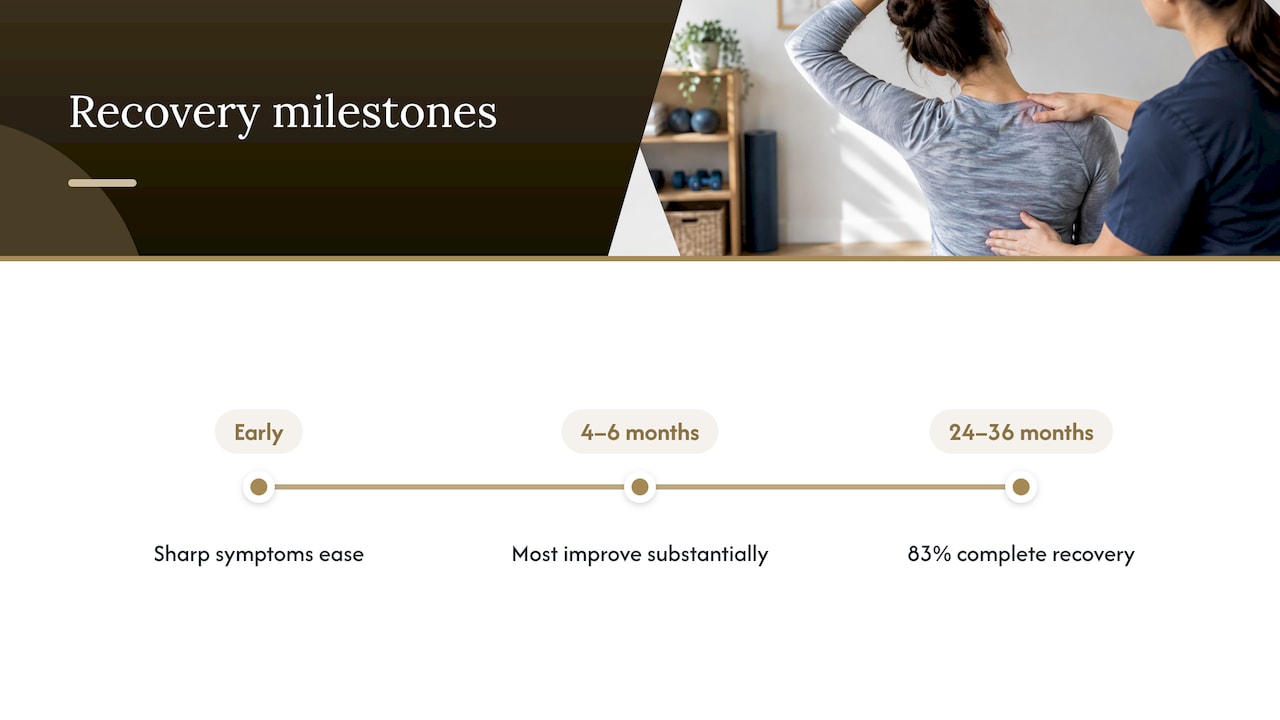
A systematic review of symptomatic cervical disc herniation with radiculopathy found that most patients improve substantially within 4 to 6 months, with complete recovery in about 83% of people taking between 24 and 36 months. In plain terms: the sharpest symptoms often ease early, while the last traces of numbness or mild aching can linger far longer without meaning anything is going wrong.
Several things influence the pace. MyHealth Alberta recommends quitting smoking because smoking can slow disc healing. The same review found preliminary evidence that workers’ compensation claims were linked with a poorer prognosis, although the authors said the evidence was not strong enough for firm conclusions. If your situation involves a work injury or a motor vehicle accident, tell us early so we can plan around your recovery goals and paperwork.
Most people never need either. Injections and surgery are considered when symptoms are severe, persistent or progressive despite good conservative care. A review in the BC Medical Journal reports that surgery does not improve long-term outcomes compared with nonoperative measures, though it can provide more rapid and substantial initial relief. The same source notes that epidural or selective root injections with corticosteroids give short-term improvement of radicular symptoms without decreasing the rate of open surgery.
Because procedures near the spine carry serious potential risks, the decision should be made with a physician or spine specialist after imaging and a full neurological exam. We will refer you promptly when your findings call for it.
The Canadian Chiropractic Guidelines advise earlier reassessment for new or worsening weakness, numbness, hand clumsiness, gait or balance change, or severe or progressive pain, and referral for marked, functionally important or progressive objective deficits. If you notice any of these, contact a clinician or your doctor right away. If you ever have sudden severe weakness or trouble walking, go to an emergency department.
We see cervical radiculopathy as a problem of the whole system, not just a sore neck. The nerve is irritated for a reason: a stiff segment, a tight muscle group, a posture held for eight hours, a sport that loads the shoulder. Treating only the pain leaves that reason in place.
That is why our approach begins with a comprehensive biomechanical assessment and an individualized plan. We combine hands-on care such as chiropractic adjustments, Active Release Technique and Graston Technique with rehabilitation exercise, and where it suits you, non-invasive technologies like spinal decompression, laser therapy and shockwave therapy. Our multidisciplinary team reassesses you as you progress, so the plan changes when you do.
We have experience with active adults, high-performance athletes and families, and we offer same-day appointments and direct insurance billing where applicable, because waiting in pain rarely helps anyone. Your goals, whether that is lifting again, returning to your sport or sleeping through the night, set the direction of care.
Deane
If arm pain, tingling or neck stiffness is holding you back, a clear assessment is the best first step. At Shephard Health we examine your neck, nerves and movement patterns, explain what we find in plain language, and outline a plan built around your goals. Same-day appointments and direct insurance billing are available where applicable.

Explore our chiropractic care in Calgary or visit Shephard Health to book.
There is no single best option. Education, pain control, physical therapy and exercise are the standard first steps, and the Canadian Chiropractic Guidelines stress that care should reflect your presentation, neurological status, irritability and goals. A thorough assessment decides the combination that suits you.
Use whichever eases your pain more. MyHealth Alberta suggests 10 to 20 minutes at a time with a thin cloth against the skin, several times a day. If neither helps or your symptoms are getting worse, have it assessed.
Often yes, with adjustments. Changing your workstation, pacing heavy or overhead tasks and taking short movement breaks all help. Ask your doctor or clinician when to return to activities that aggravate symptoms, especially if your job is physical.
Most people improve substantially within four to six months, and many notice relief much sooner. Complete recovery can take longer, and factors such as smoking can slow healing. Your clinician can give you a realistic timeline after examining you.
Same Day Appointments Available
We Direct Bill!