

A cervicogenic headache starts in the neck, so the most effective care usually targets the neck. Current guidance points to a combination of education, targeted exercise and hands-on care, built around your own pattern of symptoms. This guide explains how the condition is recognized, which treatments have the best support, how exercises fit in, which warning signs mean you should skip the clinic and seek emergency care, and what recovery tends to look like.
A cervicogenic headache is a secondary headache attributed to a disorder or lesion in the neck. That separates it from migraine and tension-type headache, which are primary headaches. The difficulty is that neck pain or tenderness can also show up with tension-type headache or migraine, so neck pain alone does not prove the neck is the source.
The source is usually in the upper neck. Harvard Health explains that problems in the upper cervical spine can send pain signals along the C1, C2 and C3 nerves, with causes that include a herniated disc, arthritis, or an injury such as whiplash. A clinical review from Health Plexus adds that the C2-3 joint is implicated in most cases, with other upper neck joints involved less often.
People typically describe a one-sided headache that begins at the base of the skull or neck and travels forward toward the forehead, temple or around the eye. Moving the neck, holding a posture for a long time, or pressing on tight neck muscles often brings it on. If this sounds familiar, you may also want to read our short guide on how to tell a tension headache from a migraine, since the three can overlap.
There is no single scan or blood test. Diagnosis is clinical: your clinician needs evidence that a neck disorder can cause headache and evidence that it is in fact causing yours. The Canadian Chiropractic Guidelines note that imaging alone is insufficient. The Health Plexus review also reports that, without red flag symptoms, imaging is not recommended for this type of headache.
The international classification of headache disorders asks for at least two signs of causation. These include a link in timing with the neck problem, improvement alongside the neck, reduced neck movement with headache made worse by provocative movements, or relief after a diagnostic nerve block. The same source lists features that tend to point toward the neck: side-locked pain, headache provoked by pressure on neck muscles or by head movement, and pain that radiates from back to front. It also stresses that these features are not unique to cervicogenic headache.
In practice, an assessment usually includes:
The same guidelines advise that a headache diary, such as the Canadian Migraine Tracker, helps with diagnosis, and that sorting it out may take several visits. Start a diary before your first appointment: note the date, side, what you were doing, and what eased it.
The gold standard for confirming a cervical source is a controlled diagnostic block of a cervical joint or nerve, which is done by a physician. The National Headache Foundation also notes that blocks can help confirm the diagnosis. These are generally reserved for cases that do not respond to conservative care.
Most headaches with neck pain are not dangerous, but a few patterns are. The Canadian Chiropractic Guidelines list situations that need immediate emergency assessment:
If any of these apply, call 911 or go to the nearest emergency department. Do not wait for a clinic visit. For a headache that keeps coming back and does not respond to medication, see your family doctor as well, because untreated headaches that persist deserve a proper work-up.
Across guidelines, one theme repeats: combine approaches. The Health Plexus review states that first-line care is multimodal conservative management, meaning manual physical therapy, exercise and patient education. It cites three randomized trials suggesting manual therapy gives some short-term relief for up to three months.
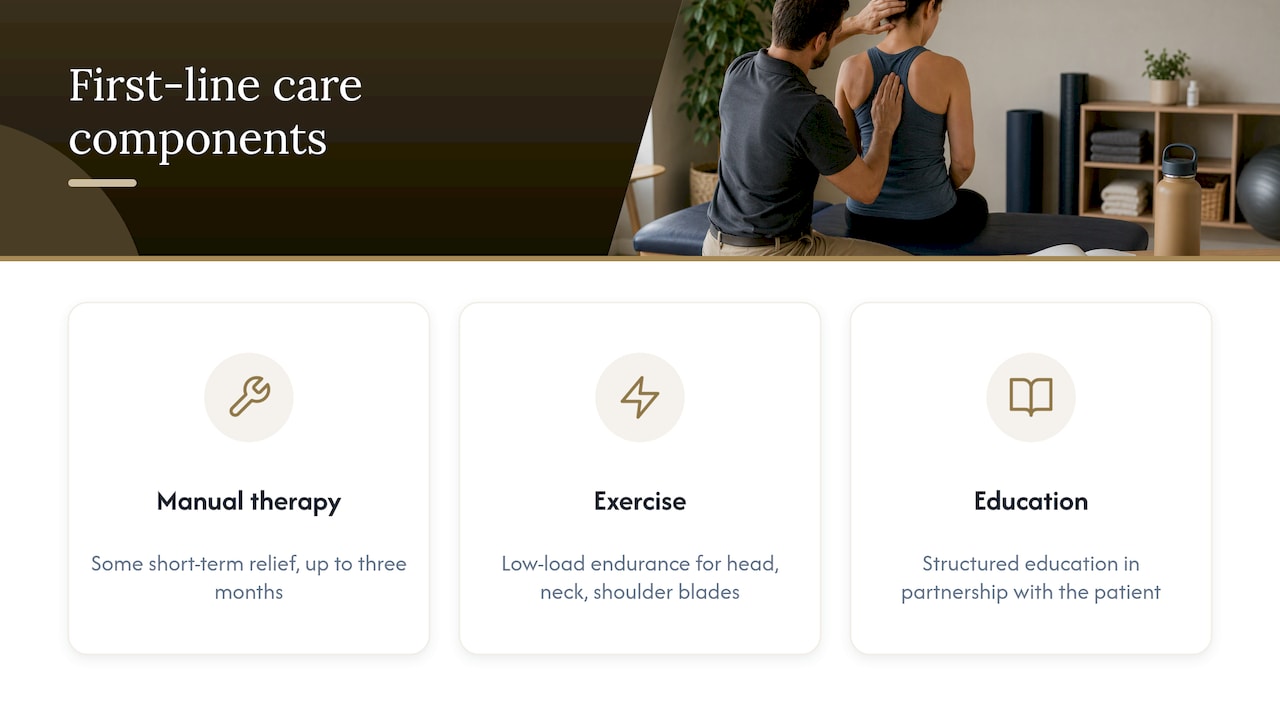
A 2026 network meta-analysis of 41 randomized trials with 1,922 participants found that multimodal non-drug approaches had better short-term results than single treatments or medication alone for cervicogenic headache.
For adults with persistent headache and neck pain, the Canadian OPTIMa guideline says clinicians should first rule out serious structural problems and migraine, then classify the headache as tension-type or cervicogenic. They should provide structured education and care in partnership with the patient. For cervicogenic headache lasting more than three months, they should consider low-load endurance exercises for the head, neck and shoulder blade region, and cervical and thoracic manual therapy.
The American Migraine Foundation says treatment should target the cause of the pain in the neck and that physical therapy with an ongoing exercise routine often produces the best outcomes. Medications and nerve blocks are part of the picture for some people, which is why care is individualized.
Many readers arrive here looking for exercises, so here is what the evidence supports and how to approach it. The Canadian Chiropractic Guidelines recommend individualized, low-load endurance exercise for the craniocervical and cervicoscapular regions, with the type, amount and progression matched to your capacity, goals and response. The earlier Canadian chiropractic guideline recommended deep neck flexor exercises, done twice daily over six weeks.
What that looks like in practice:
Three rules keep home exercise safe. Stay within pain-free ranges. Stop if the headache gets worse, or if you feel dizziness, numbness or tingling. And progress slowly: low load and many calm repetitions matter more than force.
Posture habits matter between sessions too. Sitting, standing and driving with the head stacked over the shoulders reduces sustained strain, and a short daily posture plan can help you turn the habit into a routine. Breaking up long screen sessions every 30 minutes or so is a simple addition. Applying ice or heat for 10 to 15 minutes a few times a day is another common self-care step that people find comforting.
If your arm symptoms accompany neck pain, our article on exercises for cervical radiculopathy covers a related set of movements, and our guide to pinched nerve neck treatment explains when a nerve is involved.
Manual therapy is a core element of first-line care. The Canadian Chiropractic Guidelines state that a time-limited trial of cervical or thoracic mobilization, manipulation with or without mobilization, or soft-tissue care can be an adjunct to education and active care for persistent cervicogenic headache, after safety screening and informed consent. It should continue only while the benefit is meaningful and acceptable to you.
The National Headache Foundation describes a stepwise progression that starts with conservative care: physical therapy, manual therapy, neck stabilization, postural retraining, trigger point release, massage and chiropractic management. Interventional options such as nerve blocks come next if needed, and surgery only if those fail.
At our clinic, the hands-on part of a plan may draw on chiropractic care, Active Release Technique for tight, restricted soft tissue, Graston Technique, and massage therapy, chosen after an assessment rather than by default. Our article on treatments for soft tissue injuries explains how these fit together. If you want to know about safety before a first adjustment, we reviewed the research in our chiropractic adjustment safety checklist, and what to expect on your first chiropractic visit walks through the appointment.
Some people also ask about related headaches. If your jaw clicks or aches, TMJ headaches can mimic or contribute to neck-related headache, and an assessment helps sort out which is which.
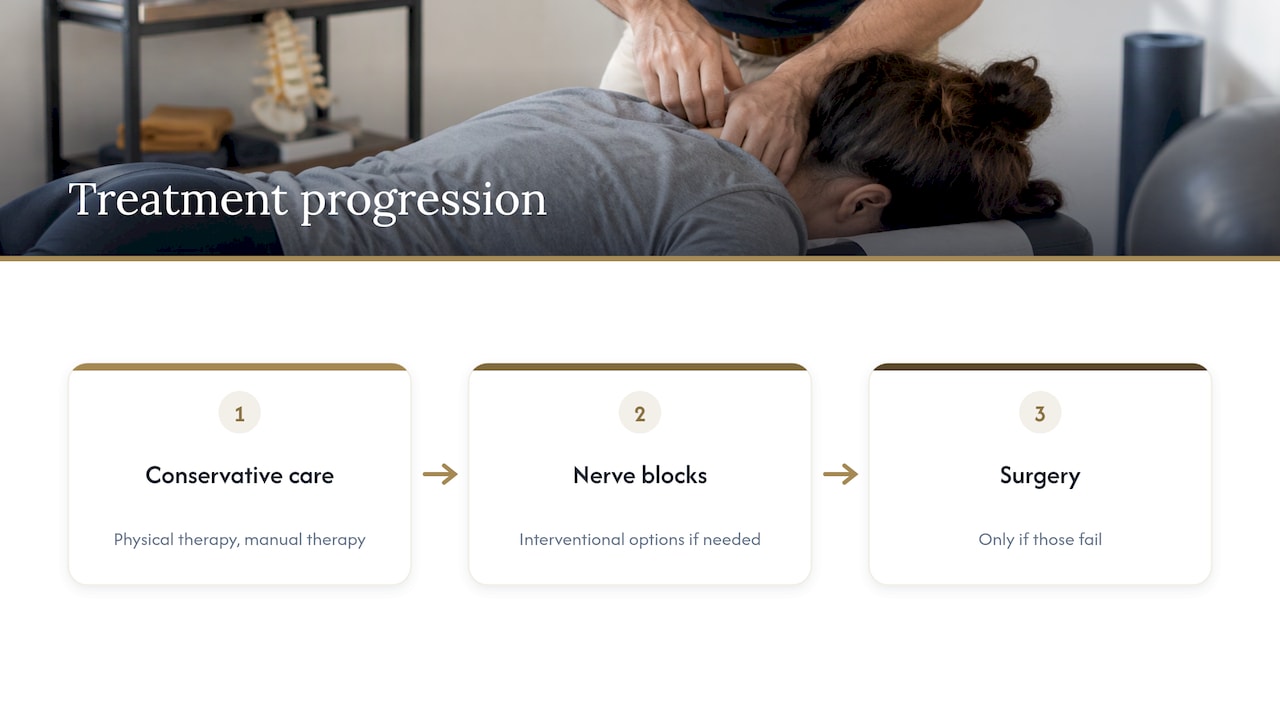
Some people need more than exercise and manual therapy, and that is a normal part of the pathway. A 2024 review in Pain Practice describes conservative treatment as pain education and self-care, analgesic medication, physical therapy, TENS, or a combination, and notes that injections with local anesthetic, with or without corticosteroid, can give short-term relief.
The National Headache Foundation lists occipital nerve blocks, cervical medial branch blocks, radiofrequency ablation and botox injections as the interventional step. These are prescribed and performed by physicians. If your headaches persist despite several weeks of well-delivered conservative care, ask your family doctor about a referral. A good clinician reassesses you at every visit and refers on when it is the right move.
People want a number, but the honest answer is that it varies. The Canadian Chiropractic Guidelines say the course is individual and can fluctuate with the neck disorder, and that clinicians should use your observed course and repeated outcome measures rather than a universal timeline. Factors linked with a less favourable course include depression, anxiety, poor sleep, stress, medication overuse and low confidence in managing headaches yourself.
That last point is practical. Sleep, stress management and understanding your triggers are part of treatment, not extras. Prairie Spine notes that the long-term outlook depends on the underlying cause, and that the condition can be well managed once diagnosed with the right plan. Your own markers are the best guide: fewer headache days, lower intensity, shorter episodes, and more neck movement without provocation.
A reasonable approach is to set a review point with your clinician after your first few visits, compare your headache diary with your starting point, and adjust. If nothing has shifted, that is information, not failure, and it guides the next step.
We see cervicogenic headache as a problem that rewards a careful look at the whole neck, not a quick fix. Our approach starts with a comprehensive biomechanical assessment: how your neck, upper back and shoulders move, where movement is restricted, and which tissues reproduce your headache.
From there we build an individualized, evidence-based plan. For many patients that means hands-on care to restore motion, paired with exercises you can do at home so that progress carries between visits. Our multidisciplinary team can combine chiropractic care, soft tissue techniques and rehabilitation, and we use non-invasive options where your assessment supports them.
We also believe you should be part of every decision. We explain what we find, set goals with you, and measure how you respond, so that you can see whether the plan is working.
Deane
If you have headaches that start in your neck, a proper assessment is the most useful first step. At Shephard Health we assess how your neck moves, screen for warning signs, and build a plan around your goals, whether you are an athlete, a desk worker, or recovering from a motor vehicle accident or sports injury.

We offer same-day appointments and direct insurance billing where applicable. You can learn more about our chiropractic care in Calgary or see the full list of services at our clinic, or start from shephardhealth.com.
Red flags include a sudden, severe headache that peaks within minutes, stroke signs such as facial droop or speech change, fever with intense headache and neck stiffness, and a painful red eye with vision changes. Any of these needs emergency assessment. Call 911 or go to an emergency department right away.
There is no universal timeline. The course is individual and can fluctuate with the neck problem, so progress is tracked by your own results over repeated visits. Many people manage the condition well once the source is identified and treated.
Causes range from muscle tension and poor posture to joint or disc problems in the upper neck, arthritis, or a past whiplash injury. Migraine and tension-type headache can also cause neck pain, so an assessment is needed to tell them apart. A sudden severe headache is different and needs emergency care.
Guidelines recommend individualized low-load exercise for the deep neck and shoulder blade muscles for persistent cervicogenic headache with neck pain. Exercises work best alongside education and, where appropriate, manual therapy. Keep them in pain-free ranges and have a clinician check your technique.
Cervicogenic and Tension-Type Headaches, Canadian Chiropractic Guidelines
11.2.1 Cervicogenic headache, ICHD-3
Living Concussion Guidelines, Post-Traumatic Headache Following Concussion
Clinical review of cervicogenic headache, Health Plexus
Cervicogenic Headache: Causes, Diagnosis and Treatment, National Headache Foundation
A headache that starts in your neck, Harvard Health
Non-pharmacological management of persistent headaches, OPTIMa
The Comparative Efficacy of Treatments for Cervicogenic Headache, network meta-analysis
Cervicogenic headache and occipital neuralgia, Pain Practice
What Is Cervicogenic Headache? How Do You Treat It?, American Migraine Foundation
Daily posture plan
Same Day Appointments Available
We Direct Bill!