

Chiropractic care can meaningfully reduce headache frequency and severity, but the strength of that evidence depends heavily on which type of headache you have. Cervicogenic headaches respond most consistently to spinal manipulation, migraine often improves with a multimodal approach, and tension-type headache benefits mainly when manual therapy is combined with exercise and posture work. Before starting any treatment plan, track your headache pattern for a week or two and get a proper assessment to rule out red flags that need medical attention first.
TL;DR:
- Spinal manipulation is most effective for cervicogenic headaches, which often worsen with neck positions, while migraine relief may require a longer, multimodal approach.
- Manual therapies combined with exercises and posture work tend to produce better outcomes, especially for tension headaches, but evidence for that type remains limited.
- Proper assessment and long-term commitment to home exercises are crucial for success, with adherence playing a significant role in treatment effectiveness.
- Serious adverse effects from chiropractic care are rare but require thorough screening to identify contraindications such as vascular risks or neurological deficits.
- Expect a personalized treatment plan with clear progress measures and avoid clinics promising quick cures without proper assessment.
Neck pain or headaches? Start with a $67 new patient visit
A chiropractor assesses your neck, upper back and posture, and treats on day one when it is safe. See neck pain and headache care in Calgary. Book online.
Chiropractic treatment for headaches rarely relies on one technique alone. Clinicians typically build a plan around several tools, chosen based on what your assessment reveals about your neck, posture, and muscle tension patterns.
The working theory is that cervical joint dysfunction and chronically tight neck muscles can irritate nerve pathways that refer pain into the head, a phenomenon covered in more detail in how neck pain and headaches connect. Manual therapy may also influence how the nervous system processes pain signals, though this mechanism is less well understood than the mechanical one. Programs that combine several of these techniques tend to outperform any single technique used alone.
Pro Tip: Keep a simple headache diary for two weeks before your first visit. Note the day, time, duration, and what you were doing beforehand. This single habit gives your chiropractor far more useful information than a vague description of “frequent headaches.”
Not all headaches are created equal, and knowing which one you have changes what to expect from treatment.
Seek immediate medical evaluation for a sudden “thunderclap” headache, headache with fever or stiff neck, new headache after a head injury, or any headache paired with vision loss, confusion, or weakness on one side.
Clinical practice guidelines give the clearest signal available. Canadian chiropractic guidance recommends spinal manipulation for cervicogenic headaches and supports its use for migraine in some protocols, but recommends it for tension-type headache mainly as one part of a broader, multimodal plan rather than a standalone fix.
A 2020 pilot study found that adult women receiving multimodal chiropractic care for migraine reduced their migraine days by 2.9 over 14 weeks, compared to a 1.0-day reduction with usual care alone. Adherence was strong, with most participants attending the majority of scheduled sessions.
That is a meaningful signal, but it comes from one pilot study, not a large-scale trial. Broader randomized trials on spinal manipulation for cervicogenic headache and migraine show mixed results. Some report real benefit, but sample sizes are often small and placebo effects run high, meaning perceived improvement doesn’t always translate to objective, replicable outcomes. Recent systematic reviews echo that caution, describing certainty for many SMT-for-headache outcomes as low. None of this erases the benefit some patients experience. It just means the honest answer is “often helps, not guaranteed,” which is a more useful expectation than a promised cure.
Your first visit typically follows a predictable structure, and knowing it ahead of time takes the mystery out of the process.
Spinal manipulation carries a real but generally low risk profile when performed by a trained clinician who screens you properly first.
A thorough intake conversation, not a rushed one, is usually the biggest predictor of whether a clinic takes safety seriously.
The right clinician for headache treatment isn’t necessarily the closest one. A few questions at booking can save you months of guesswork.
Pro Tip: Be wary of any clinic that promises to “cure” your headaches in a set number of visits before ever examining you. Evidence-based care means a plan built around your assessment, not a sales script.
At Shephardhealth, headache assessment starts with a full history and cervical exam, screening for red flags before any hands-on work begins. From there, care typically blends spinal manipulation or mobilization with soft-tissue techniques like Active Release Technique, guided exercise, and adjunct modalities such as laser therapy or spinal decompression when appropriate. Every plan is personalized rather than templated. Same-day appointments and direct insurance billing remove two of the biggest barriers patients face when trying to start consistent, evidence-informed care for recurring head pain.
Shephardhealth offers a practical, evidence-informed alternative to guessing your way through over-the-counter remedies. Rather than treating headaches as an isolated symptom, care here starts with a full musculoskeletal assessment, the same standard used in the guideline research covered above, and builds a plan around your specific headache pattern.

Booking is straightforward: same-day appointments are typically available, and the clinic bills most major insurance providers directly, so you’re not stuck fronting costs and filing paperwork later. Bring a list of current medications and, if you’ve started one, your headache diary. That single document often shortens the assessment phase considerably. If you’re ready to find out what’s actually driving your headaches, learn what to expect on your first visit and book an assessment with Shephardhealth today.
The honest gap in headache research isn’t whether chiropractic care works. It’s that most studies are too small to say exactly how well it works for any given person. A pilot study showing a 2.9-day reduction in migraine days is genuinely encouraging, but pilot studies exist to justify bigger trials, not to serve as final proof. I think the profession undersells this nuance because “chiropractic cures headaches” is a better marketing line than “chiropractic care, done consistently and combined with exercise, moves the needle for a meaningful share of patients.”
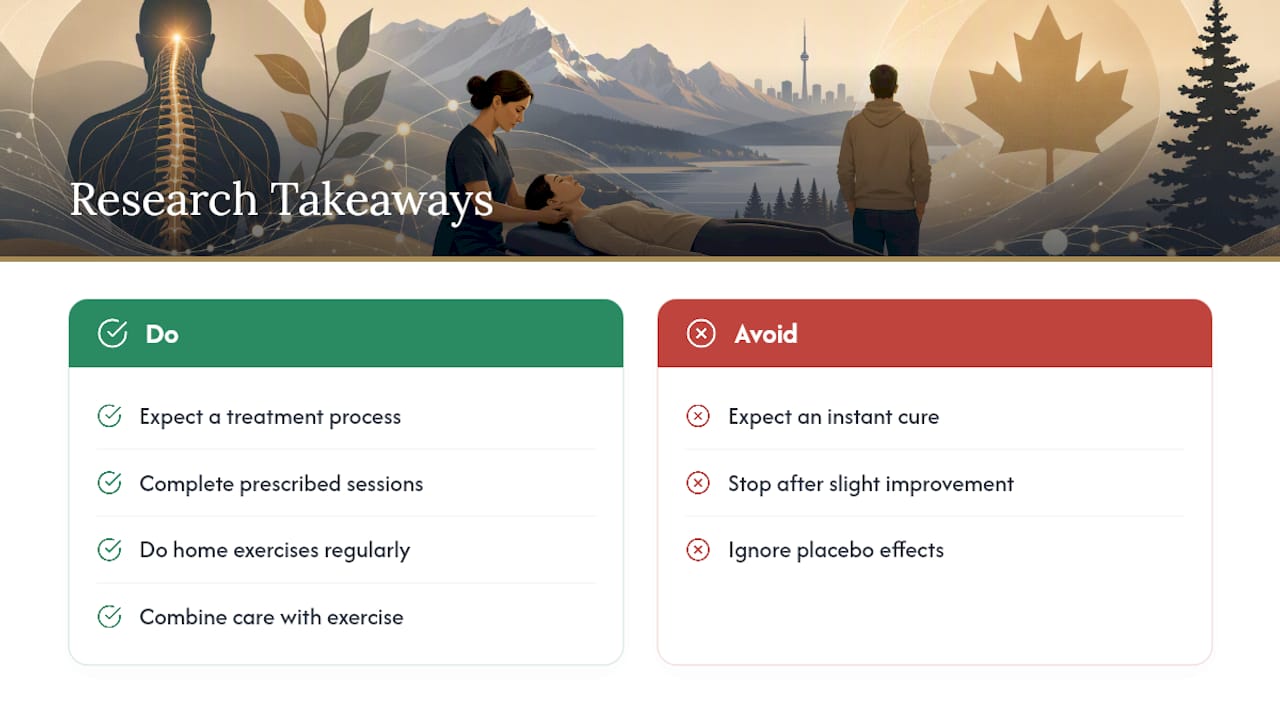
What gets overlooked even more is adherence. The migraine pilot study’s strongest number might not be the day reduction at all. It’s that most participants stuck with the program. Multimodal care fails most often not because the techniques are wrong, but because patients do six sessions, feel a little better, and stop. The home exercise piece, the boring part nobody wants to talk about, is doing more long-term work than the adjustment itself in a lot of cases.
I’d also push back gently on how confidently some clinics frame migraine treatment. The Chaibi trials are honest about placebo effects running high in this research area, and any clinician who skips past that nuance to promise you a cure is oversimplifying a genuinely useful, but genuinely limited, body of evidence. The patients who do best tend to be the ones who went in expecting a process, not a fix.
— Deane
This article is general information, not a substitute for advice from a qualified doctor. Consult a qualified healthcare professional about your own circumstances before acting on anything here.
Same Day Appointments Available
We Direct Bill!