

Chiropractic care is a reasonable first-line option for many people with a symptomatic herniated disc, provided there are no progressive neurological red flags. Prospective outcome data show most patients treated with spinal manipulation report meaningful improvement within months, but the strongest results come from combining manipulation with supported self-management and exercise, not manipulation alone. If you notice new leg weakness, numbness around the groin or inner thighs, or loss of bladder control, skip the chiropractor and go directly to emergency care.
TL;DR:
- Most herniated discs shrink or resolve naturally within weeks to months without surgery, regardless of herniation size on MRI.
- Chiropractic techniques like HVLA manipulation and flexion-distraction are effective for symptom relief but do not repair the herniation itself.
- Combining spinal manipulation with structured self-management and exercise yields better long-term outcomes than manipulation alone.
- Patients with progressive neurological symptoms such as worsening weakness or bladder dysfunction should avoid chiropractic care and seek emergency attention.
- Chiropractic care is safest when used as part of a multimodal approach and tailored to individual presentation, with clear communication and appropriate referrals.
Back or leg pain that is not settling? Start with a $67 new patient visit
A chiropractor assesses your spine and nerves, treats on day one when it is safe, and tells you honestly if you need other care. See sciatica and back treatment in Calgary. Book online.
A herniated disc starts with the anatomy of your spine’s shock absorbers. Each disc has a soft, gel-like center called the nucleus pulposus, wrapped in a tougher fibrous ring called the annulus fibrosus. When the annulus weakens or tears, usually from repetitive loading, age-related wear, or a single awkward lift, the nucleus can push outward or through the ring. That bulge or extrusion is what shows up on an MRI report as a herniated, protruding, or extruded disc.
Not all herniations hurt the same way, and the distinction matters for how you and your chiropractor think about treatment. Some people feel a deep, aching discogenic pain localized to the low back or neck, caused by irritation of the disc’s own nerve endings. Others develop radicular pain, also called radiculopathy, where the herniated material presses on or chemically irritates a nearby spinal nerve root. That’s the mechanism behind classic sciatica: pain that travels down one leg in a specific band, often paired with numbness, tingling, or measurable weakness in a particular muscle group.
Here’s what surprises most people who just got a scary-sounding MRI report:
This is why chiropractic treatment for a herniated disc focuses on calming the nerve irritation and restoring function during that natural healing window, rather than promising to reverse the herniation itself.
The clinical goals of chiropractic care for a herniated disc are specific: reduce pain enough that you can move, calm irritated nerve tissue, restore joint mobility in the segments above and below the herniation, and get you participating in rehab exercises as soon as it is safe. Nothing about that goal list requires “fixing” the disc structurally. Current evidence does not support the idea that manipulation repairs disc material, and clinicians who present it that way are overstating what the research on manipulation and disc pathology actually shows.
The technique choice depends on your presentation, comorbidities, and how irritable your nerve is that week. Common tools include:
Pro Tip: If your first visit involves nothing but a forceful thrust to your lower back before any neurological exam, that’s a signal to ask more questions. A clinician following guideline-based care checks your reflexes, strength, and sensation before choosing a technique, and adjusts the plan if HVLA seems too aggressive for your presentation.
None of these techniques work in isolation. Chiropractic therapy for a bulging disc or full herniation is designed to buy you enough symptom relief to tolerate movement, because movement, not passive treatment, is what drives the long-term recovery.
How effective is chiropractic for a herniated disc? The honest answer is: effective for many people, but most effective as one piece of a bigger plan rather than a standalone fix.
A prospective cohort study following patients with MRI-confirmed lumbar disc herniations treated with HVLA spinal manipulation found that roughly 90.5% reported clinically meaningful improvement at three months, and 88% still reported improvement at one year, with no serious adverse events recorded in that group.
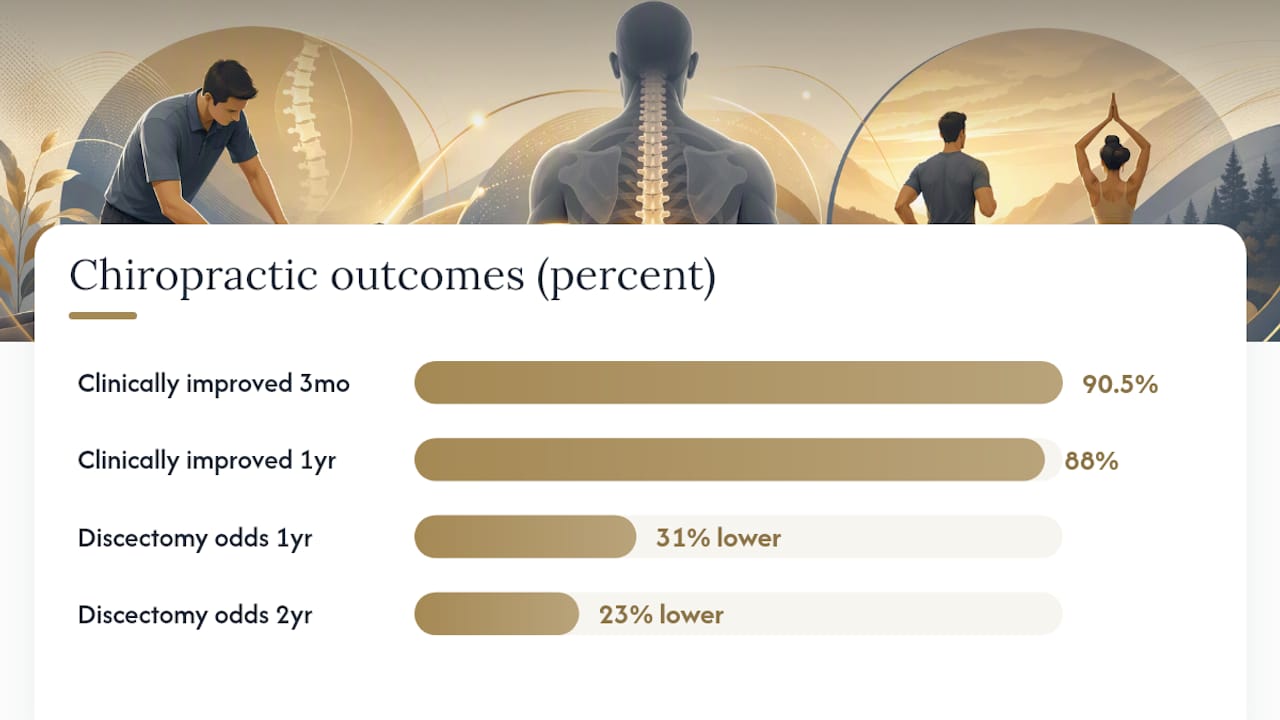
That’s a strong signal, but it comes from an observational cohort, not a trial comparing manipulation against a control group, and outcome studies like this tend to enroll patients who were already reasonable candidates for conservative care.
Randomized data adds an important nuance. A trial comparing guideline-based medical care against clinician-supported biopsychosocial self-management, both alone and combined with spinal manipulation, found that supported self-management and the combination of self-management plus manipulation reduced disability more over one year than medical care alone. Spinal manipulation by itself, without that structured self-management layer, did not produce a significant difference in pain intensity. That distinction should reshape how you think about a course of adjustments: the manipulation matters less on its own than it does as the thing that makes structured self-management and exercise tolerable.
Observational data on harder outcomes tells a similar multimodal story. A retrospective cohort study using matched patient records found that adults with lumbar disc herniation and radiculopathy who received chiropractic spinal manipulation had:
Those are associations from matched observational data, not proof that manipulation prevents surgery. Patients who seek out and stick with conservative care may differ in ways the matching couldn’t fully capture. Still, an association of that size across a large medical records dataset is not nothing, and it lines up with what a 2024 systematic review of clinical practice guidelines found: guidelines across multiple jurisdictions increasingly recommend spinal manipulative therapy for low back pain and select radiculopathy presentations, almost always as part of a multimodal package rather than a solo treatment.
Case reports round out the picture at the individual level. One documented case tracked a patient with an L3/L4 disc extrusion who underwent ten weeks of conservative care combining manipulation, adjunct therapy, and home exercise, with follow-up MRI at six months showing the extrusion had resolved. Case reports can’t establish cause and effect the way trials can, but they document that spontaneous or care-assisted disc resorption is a real, imaged phenomenon, not a theoretical one.
Chiropractic care carries a strong safety record for garden-variety disc herniations, and the cohort data above reported no serious adverse events. But “generally safe” is not the same as “safe for everyone, always,” and knowing the difference protects you.
Certain symptoms mean you need emergency medical evaluation before any chiropractic visit, not after:
Together, those symptoms can signal cauda equina syndrome, a surgical emergency where the bundle of nerve roots at the base of the spinal cord is compressed. This is not a “wait and see how the week goes” situation.
A separate set of relative contraindications doesn’t rule out chiropractic care entirely, but it changes which techniques a clinician should reach for:
In these situations, a clinician who knows what they’re doing shifts toward low-force mobilization, instrument-assisted soft-tissue work, and closely guided exercise instead of HVLA thrusting. That’s exactly the adaptation described in a case report of a patient managing a lumbar disc herniation alongside stage IV liver cancer, where the clinician avoided high-velocity thrusts entirely and still achieved a marked reduction in pain and improvement in function through mobilization and tailored exercise.
Pro Tip: Bring your imaging report and a written symptom log to your first visit, noting which movements make things better or worse. That single piece of preparation often changes which technique a chiropractor chooses on day one.
Your first visit should look like an investigation, not a script. A thorough chiropractic assessment for suspected disc herniation typically covers your symptom history, a focused neurological exam checking reflexes, strength, and sensation in a dermatomal pattern, and a review of any MRI or X-ray imaging you’ve already had. Many clinics also record a baseline pain and function score so progress can be tracked objectively rather than by feel alone.
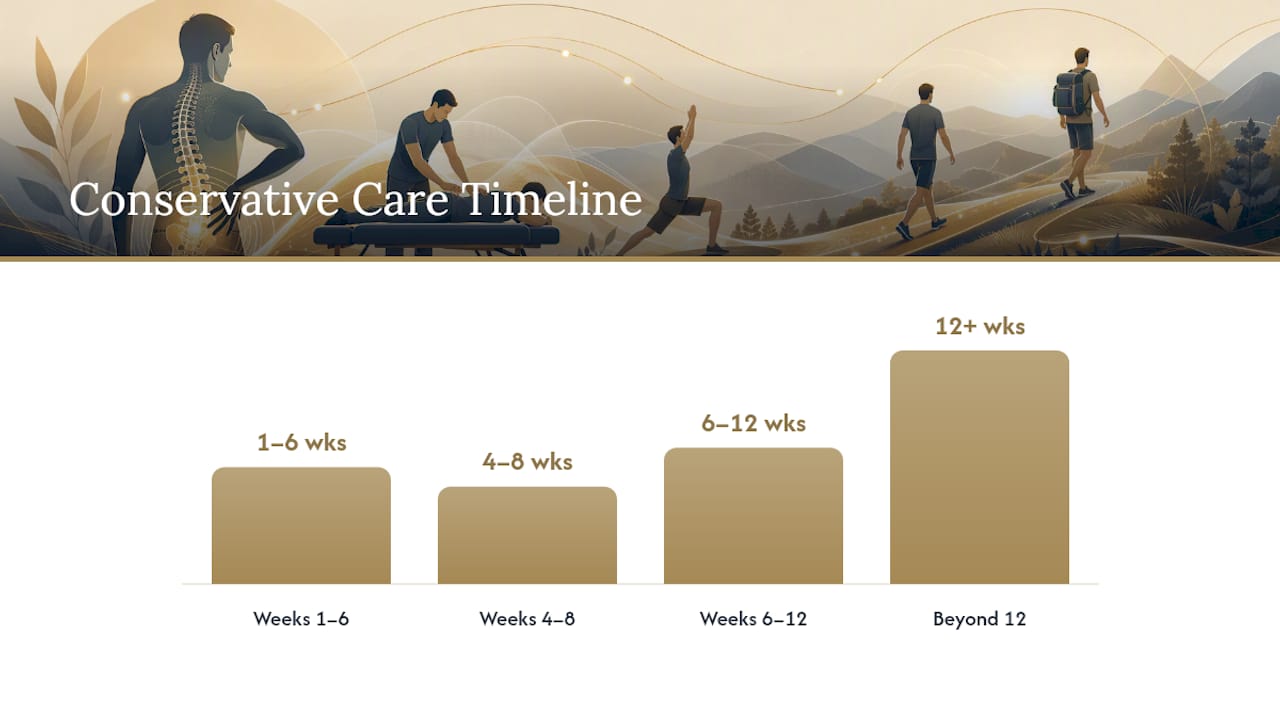
A realistic conservative care timeline generally unfolds in stages:
Long-term success tends to hinge less on the number of adjustments you receive and more on whether in-clinic care makes it possible for you to consistently do your home exercise program. Manual therapy that reduces guarding and pain is often the thing that unlocks adherence to rehab, not a substitute for it.
Chiropractic care and physiotherapy overlap more than most patients expect. Both disciplines lean heavily on graded exercise, patient education, and restoring normal movement patterns. The differences show up mostly in the manual techniques applied. Physiotherapists tend to emphasize therapeutic exercise progressions and movement retraining, while chiropractors add joint-specific manipulation and mobilization to the mix. In practice, the two approaches are frequently complementary rather than competing, and some patients benefit from both at different stages of recovery.
When conservative care of any kind stalls, or when radicular pain is severe enough to interfere with sleep and daily function, the next conversation usually involves injections:
Surgery sits at the far end of the escalation ladder, reserved for a narrower set of circumstances: progressive or severe neurological deficits, cauda equina syndrome, or persistent, function-limiting radicular pain that has not responded to an adequate trial of conservative management. It’s worth saying plainly: surgery is not a failure state for conservative care to avoid at all costs, and it’s not the default either. It’s a tool that fits specific clinical pictures, and a good chiropractor knows when your presentation has crossed into that territory and refers accordingly.
Not every chiropractor practices the same way, and for a condition involving nerve roots, that variation matters. A few practical filters help you separate evidence-based practice from guesswork.
Start with credentials and referral behavior. A licensed chiropractor should be comfortable reviewing your MRI or X-ray findings in plain language, and should refer you out for medical imaging, injections, or a surgical consult without hesitation if your presentation calls for it. Reluctance to refer is a bigger warning sign than any single technique choice.
Bring a short list of questions to your first visit:
Pro Tip: Be skeptical of any clinician who promises to “fix” your disc herniation in a set number of visits. Recovery timelines vary by individual, and language like that oversells what manual therapy can reliably deliver.
Shephardhealth builds herniated disc care around the same conservative-first logic the research supports: start with a thorough assessment, choose techniques that match your specific presentation, and track function over time rather than guessing. A visit typically includes a focused neurological exam, a review of any imaging you bring, and a discussion of realistic expectations before any hands-on treatment begins.
Depending on what that assessment shows, a plan may combine manual therapy, spinal decompression, laser therapy, shockwave therapy, or Active Release Technique with progressive rehab exercise, always adjusted for comorbidities like osteoporosis or prior spinal surgery. The goal mirrors what the outcome studies point to: reduce nerve irritation enough that you can move, then build capacity through exercise so the improvement holds.
The biggest disconnect in this field isn’t between chiropractic care and medicine. It’s between how chiropractic care for a herniated disc gets marketed and what the actual outcome data supports.
Where conventional advice falls short is treating “get adjusted” as the whole plan. The randomized trial data is fairly blunt about this: manipulation alone often does not move the needle much on pain intensity, while manipulation paired with structured self-management and exercise does. That’s not a knock against chiropractic care. It’s a case for using it correctly.
If you take one thing from this article, prioritize finding a clinician who treats manual therapy as the bridge to rehab, not the destination. Ask about exercise progression before you ask about adjustment frequency. The disc’s natural healing timeline is doing more of the work than any single technique, and the best chiropractic care simply gets out of that process’s way while keeping you functional.
— Deane
If sciatica or persistent back pain has you searching for options beyond rest and painkillers, an in-person assessment is the fastest way to know what you’re actually dealing with. Some clinics offer same-day appointments and bill most major insurance providers directly, so you’re not stuck fronting costs before you’ve even started treatment.

Bring any recent MRI or X-ray reports, a list of current medications, and a rough log of which movements ease or worsen your symptoms. That information helps your chiropractor build a plan targeted at your specific herniation pattern from the first visit, rather than a generic protocol. You can review the clinic’s dedicated herniated disc treatment page for a closer look at the nonoperative options available, or read what to expect on your first chiropractic visit if you want a walkthrough before you book. When you’re ready, scheduling that initial assessment is the next concrete step toward a plan built around your imaging, your symptoms, and your goals.
This article draws on peer-reviewed outcome studies, cohort research, and clinical case reports rather than general wellness advice. The prospective cohort study on HVLA manipulation supplied the three-month and one-year improvement figures. The BMJ Open retrospective cohort study provided the discectomy odds ratios. The randomized trial on self-management versus medical care informed the multimodal framing throughout. A case report on non-surgical disc resolution and a case report involving a medically complex patient illustrated individualized care in practice, alongside a 2024 review of clinical practice guidelines and a molecular scientist’s analysis of manipulation and disc pathology.
Same Day Appointments Available
We Direct Bill!