

Most patients start acute care at 2 to 3 visits per week for 2 to 4 weeks, then reassess. If pain and function have measurably improved, care tapers to once weekly, then every other week, moving toward monthly or less for anyone who chooses ongoing maintenance. The rule that governs every phase is the same: reassess around every six visits or every 2 to 4 weeks, and let objective progress, not the calendar, decide what comes next.
TL;DR:
- Most patients start with two to three visits per week for two to four weeks during the acute phase, with reassessment around every six visits or two to four weeks.
- As pain and function improve, visit frequency tapers to once weekly, then to every other week, and eventually to monthly or less for ongoing maintenance.
- The schedule should depend on functional progress and individualized response, not fixed timelines, with exceptions for severe cases like disc pathology or post-surgical recovery.
- Evidence shows maintenance visits averaging around two visits per month may reduce recurrent low back pain days, but this applies only to certain patients with persistent or recurring issues.
- Overuse beyond clear functional gains can be harmful, so tapering and objective reassessment are essential to prevent dependence and unnecessary visits.
Pain or stiffness holding you back? Start with a $67 new patient visit
A chiropractor assesses what is going on, treats on day one when it is safe, and gives you a plan. See chiropractic care in Calgary. Book online.
Chiropractic visit frequency isn’t one number. It’s a curve that starts higher and tapers as your body responds, and the shape of that curve depends heavily on why you walked through the door in the first place. A disc-related low back flare behaves differently than a stiff neck from a bad week at a desk, and your schedule should reflect that difference rather than follow a one-size template.
Here’s what the taper typically looks like in practice, based on how clinical guidelines frame frequency and duration for common musculoskeletal complaints:
Those numbers describe the median patient, not every patient. A herniated disc with radiating leg pain, a post-surgical spine, or a third recurrence of the same injury in two years often needs a different cadence, sometimes more frequent visits early on, sometimes a slower taper stretched over additional weeks. Observational data on ongoing chiropractic care report average visit frequency around 2.3 visits per month, or roughly one every two weeks, across a broad population that includes both active-care and maintenance patients. That average is useful context, but it does not prescribe an ideal frequency for any specific individual.
Pro Tip: Ask your clinician to write your reassessment date on your treatment plan the same day you start care. A visible checkpoint keeps both of you accountable to progress, not habit.
The taper itself is rarely linear. A patient recovering from acute sciatica might go from three visits a week to two, then to one, then skip a week entirely before a final check-in, rather than dropping frequency by a fixed amount every stage. What matters is the direction: visits should generally decrease as function returns, and any plan that holds steady at high frequency for months without a clear functional reason deserves a second look. You can read more about what shapes that first plan in what to expect on your first chiropractic visit.
Exceptions are common enough that they’re worth naming outright. Severe cases involving significant disc pathology, repeated episodes of the same injury within a short window, or rehabilitation following spinal surgery often follow a modified schedule built around imaging findings, surgical timelines, or a slower expected healing curve. If your case fits one of these categories, expect your clinician to explain, in plain terms, why your schedule departs from the typical ranges above.
Frequency isn’t arbitrary. It’s tied to what your body needs to accomplish at each stage of recovery, and the phase you’re in should dictate the schedule, not the other way around.
The acute phase targets pain relief and calming irritated tissue. The primary goal here is short-term: reduce inflammation, ease muscle spasm, and restore enough mobility that daily tasks stop hurting. This is why frequency runs highest in this window. Tissue in an inflamed or guarded state responds better to closer-spaced input than to isolated sessions weeks apart.
The corrective or recovery phase shifts the goal from symptom control to restoring biomechanics and strength. This is where clinicians start layering in specific functional targets: full pain-free range of motion in the neck, the ability to squat without compensation, or return to a specific sport movement without symptom recurrence. Visits space out here because the tissue is stable enough to tolerate longer gaps, and the work increasingly involves home exercise and active rehabilitation rather than passive treatment alone. Clinicians pair manual therapy with targeted rehab exercises during this phase, and frequency decisions often hinge on measurable changes in functional tests, a timed sit-to-stand, a sport-specific drill, a work-related lifting task, rather than pain scores alone.
The maintenance or wellness phase exists to prevent recurrence, not to treat an active complaint. Not every patient needs this phase, and it’s worth being honest about that. For patients who do choose it, whether due to a physically demanding job, a history of recurring flare-ups, or a personal preference for proactive care, the goal is preserving function at the longest interval that still works.
What actually triggers a move from one phase to the next? Clinicians generally look for:
That last point matters more than it sounds. A single pain-free visit doesn’t mean you’re ready to taper. Clinicians look for a trend, not a snapshot, before shifting your schedule. If you’re still deciding whether to start care at all, this decision guide walks through the signs worth acting on.
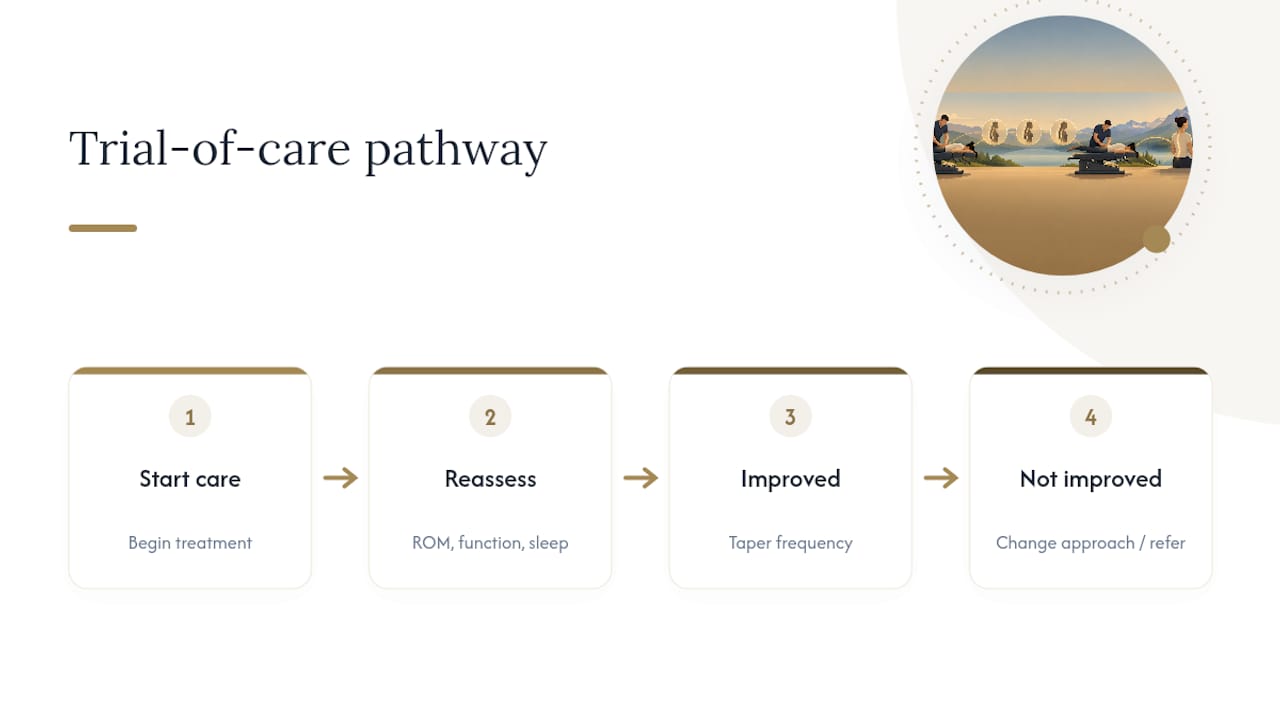
Most evidence-aligned practices structure care around a trial-of-care model: a defined block of treatment, commonly 6 to 12 sessions over 2 to 4 weeks, followed by a formal reassessment before any decision to continue, adjust, or discharge. This isn’t bureaucratic overhead. It’s the mechanism that prevents care from drifting into an open-ended routine with no clear stopping point.
During that reassessment, clinicians typically look at:
Clinical guidance frames maximal therapeutic benefit as something that typically arrives within a few weeks to a few months of active care. The timing varies widely depending on condition severity. What guideline language doesn’t support is indefinite frequent visits with no discharge or maintenance conversation ever happening.
Practitioner factors play a role too. Observational analyses suggest more experienced clinicians tend to average fewer visits per month than less experienced ones, which points to something worth asking about directly: how does this clinician typically structure a plan, and what does their average trajectory look like for a case like yours?
Red flags worth acting on include a plan with no defined reassessment date, care that continues at the same frequency for months without documented functional gains, or vague reassurance that you’ll “need to keep coming” without a specific functional target attached to that recommendation. If you notice any of these, the next step is straightforward: ask for a written reassessment point, request a copy of your functional test results, or seek a second opinion. Worsening neurological signs, such as new numbness, weakness, or loss of bladder or bowel control, warrant immediate referral for imaging or medical evaluation, not another adjustment.
Pro Tip: If your clinician can’t point to a specific functional test or outcome score that improved since your last reassessment, ask what would need to change before your frequency decreases. A good plan has an answer ready.
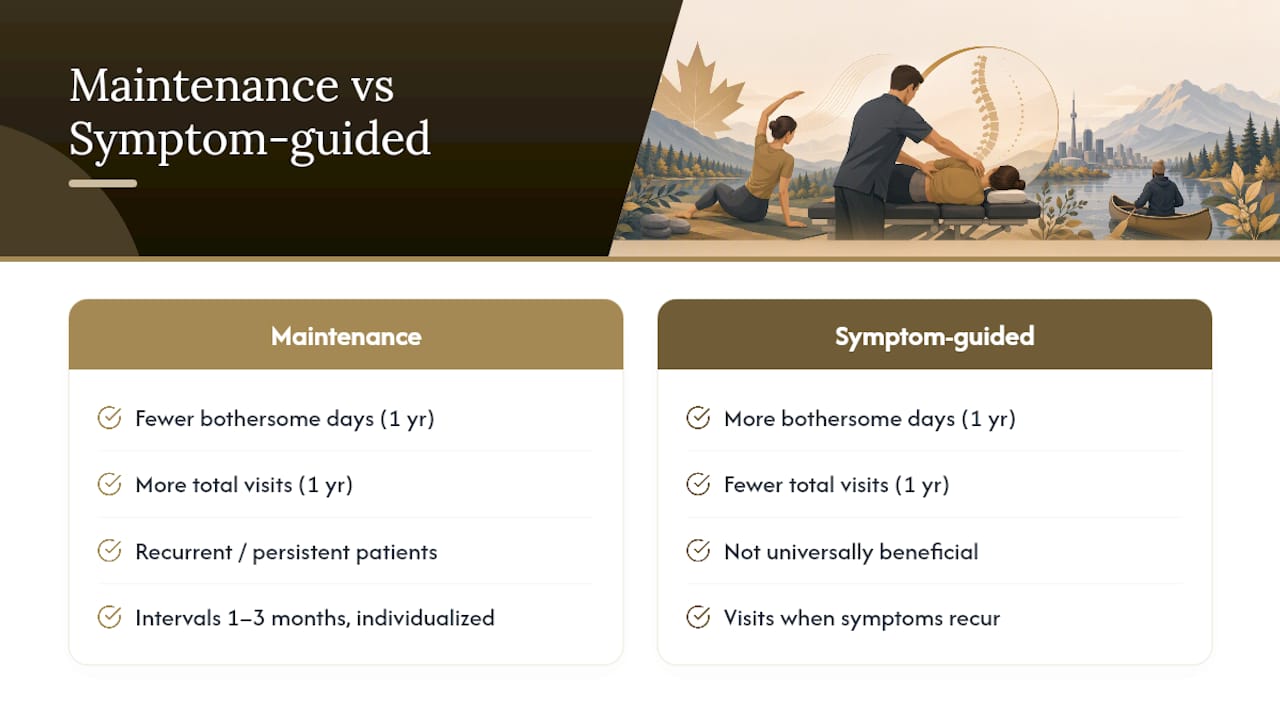
The strongest controlled evidence on maintenance care comes from the Nordic Maintenance Care Program, a randomized pragmatic trial that compared scheduled maintenance visits against symptom-guided care for patients with recurrent or persistent non-specific low back pain.
The maintenance care group experienced fewer days with bothersome low back pain over a full year compared to the symptom-guided group, though maintenance patients averaged more total visits over that period.
That trade-off is the honest takeaway: scheduled maintenance care reduced bothersome pain days for a specific patient population over a full year, but it required more visits to get there. The benefit wasn’t universal. It applied to patients selected for recurrent or persistent symptoms, not to everyone who walks into a clinic. That distinction should shape how you think about whether maintenance care makes sense for your own situation, rather than treating it as a default recommendation for anyone who finishes active care.
Practical delivery of maintenance care in that research typically followed intervals of 1 to 3 months, individualized to each patient rather than fixed at a single universal interval. The general approach: find the longest gap between visits that still preserves function, then attempt to stretch that interval further over time while watching for recurrence.
On the observational side, broader data on ongoing chiropractic care report an average frequency near 2.3 visits per month, blending active-care and maintenance patients across varied conditions. That number is a population average, not a prescription, and it should not be taken as evidence that twice-monthly visits are optimal for any specific individual.
It’s worth being clear-eyed about the limits of this evidence base too. Systematic reviews of manual therapy for acute low back pain generally show a short course of several visits outperforms a single treatment, but there’s no large-scale trial that pins down an exact ideal visit count applicable to every patient and condition. Guidelines fill that gap with structured judgment: trial-of-care blocks, defined reassessment points, and functional benchmarks, rather than a fixed formula. That’s why individualization keeps showing up as the answer, not because it’s a hedge, but because the actual research supports variability by condition, patient history, and response to early treatment.
Chiropractic care carries a favorable safety profile for most patients, but that doesn’t mean unlimited frequency is automatically safe or useful. Authoritative safety guidance on spinal manipulation describes common side effects as mild and temporary, typically soreness, stiffness, or fatigue lasting a day or so after treatment. Serious adverse events are rare, though the same guidance stresses informed consent and an open discussion of alternatives before starting care, particularly for patients with specific risk factors like severe osteoporosis or certain vascular conditions.
The more practical concern with high frequency isn’t acute injury risk. It’s the possibility of care continuing well past the point of diagnostic or functional value, a pattern sometimes described as dependence. Guideline language explicitly cautions against indefinite frequent visits without documented improvement, and recommends tapering, generally not exceeding two visits per week after the first six weeks of care, unless a specific clinical reason justifies staying at a higher frequency.
A few safeguards keep your plan honest:
Reading more on the benefits of regular adjustments can help you understand where genuine ongoing value tends to show up, so you can separate that from care that’s simply continuing out of habit.
Bring these questions and tracking habits to your next visit, whether you’re starting care for the first time or midway through an existing plan.
Watch for red-flag patterns as you go. Vague, indefinite care recommendations with no functional target attached are worth questioning. So is a plan built entirely around how you feel that day, rather than trends across several visits. And if you ever feel pressure to continue at a fixed frequency despite reporting no progress over multiple reassessments, that’s a fair moment to ask for a second opinion.
Individualized planning starts with a full biomechanical assessment, not a generic protocol applied to every patient who walks in. At Shephardhealth, that assessment shapes a specific plan built around your presenting condition, whether that means chiropractic adjustment alone or a combination approach using spinal decompression, Active Release Technique, laser therapy, or shockwave therapy depending on the tissue involved.
A short trial-of-care with a defined reassessment point is standard practice, not an afterthought. The goal is documenting functional gain at each checkpoint, whether that’s improved range of motion, reduced pain interference, or return to a specific task, so frequency decisions are based on evidence from your own case rather than a fixed calendar. Same-day appointments and direct insurance billing remove friction from starting that process, which matters when acute pain doesn’t wait for a convenient scheduling window.
If you’re dealing with acute pain, recovering from an injury, or simply unsure how often you should be scheduling visits, the clearest path forward is a proper assessment, not another generic guess. Shephardhealth builds every plan around your specific biomechanical findings and functional goals, using a short trial-of-care with a defined reassessment point so you always know why your frequency looks the way it does.

A typical first visit includes a thorough assessment, a working diagnosis, and a clear starting frequency, usually higher in the first 2 to 4 weeks, with a reassessment built in before anything continues past that point. Depending on what your case needs, your plan might combine chiropractic adjustment with supporting therapies like Active Release Technique for soft-tissue restrictions, shockwave therapy for tendon-related pain, or spinal decompression for disc-related complaints. Same-day appointments and direct insurance billing mean you don’t have to wait weeks to get started or navigate paperwork on your own.
Browse the full range of services on the Shephardhealth services page, or if you’re still weighing whether now is the right time, this decision guide on when to see a chiropractor can help you sort that out before you book.
Most advice on chiropractic frequency defaults to a comfortable middle ground, something like “twice a week for a few weeks,” without explaining why that number applies to your specific case or when it should change. That vagueness isn’t neutral. It quietly shifts the burden of monitoring progress onto the patient, who usually has no framework for knowing whether six visits in, they’re actually improving or just accustomed to showing up.
The trial-of-care model flips that responsibility back onto measurable evidence. A reassessment scheduled for week two or three forces an honest conversation: did your range of motion improve, did your functional test scores move, are you sleeping better and moving through your day with less interference? If the answer is yes, tapering follows naturally. If the answer is no, that’s not a reason to double down on the same frequency. It’s a signal to ask why, and possibly to look at a different approach or a referral.
What people underestimate about maintenance care specifically is how conditional the evidence actually is. The Nordic Maintenance Care trial is genuinely compelling for the patient population it studied, but it’s often cited as blanket justification for monthly visits for anyone who finishes active care, which stretches the finding well past what it actually supports. Maintenance care earning its place depends on your history of recurrence, your job demands, and whether you and your clinician have defined what you’re actually trying to prevent. Absent that conversation, monthly visits become a habit dressed up as prevention.
The uncomfortable truth is that frequency conversations often go unspoken because neither patient nor provider wants to have them. Patients don’t want to seem ungrateful for care that feels helpful in the moment, and providers, particularly ones building long-term patient relationships, aren’t always incentivized to initiate a taper. Evidence-aligned care requires deliberately building that conversation into the plan from day one, not waiting for a patient to ask.
— Deane
This article is general information, not a substitute for advice from a qualified doctor. Consult a qualified healthcare professional about your own circumstances before acting on anything here.
The frequency ranges and reassessment rules in this article draw on established clinical guidance and peer-reviewed research rather than general practice convention:
For chiropractic marketing and practice-related resources, see Chiropractor SEO services.
It depends on your care phase: acute cases often start at 2 to 3 visits per week, while recovery and maintenance phases stretch to weekly, biweekly, or monthly intervals as function improves. Guideline models recommend reassessing around every six visits or 2 to 4 weeks to confirm the current spacing still makes sense.
Most patients tolerate chiropractic care well, with mild, short-lived side effects like soreness being the most common issue, according to NCCIH’s safety overview. The bigger concern with excessive frequency is care continuing without documented functional improvement, which is why guidelines recommend tapering and generally advise against exceeding two visits per week after the first six weeks unless clinically indicated.
Yes, back-to-back adjustments are sometimes used during the acute phase of an injury when higher frequency helps manage pain and restore early mobility. This pattern is typically short-term, tapering within 2 to 4 weeks as your clinician reassesses your response and functional progress.
Three visits per week falls within typical acute-phase recommendations for new injuries or significant flare-ups, particularly in the first 2 to 4 weeks of care. It becomes a concern only if that frequency continues for months without measurable functional gains, since clinical guidance expects tapering as symptoms and function improve.
Pricing for chiropractic adjustments and related services at Shephardhealth is available directly through the services page, since costs can vary by treatment plan and insurance coverage. Direct insurance billing is available, which can reduce out-of-pocket costs depending on your plan.
Same Day Appointments Available
We Direct Bill!