

Class 4 laser therapy is a high-powered photobiomodulation treatment that uses infrared light to reduce pain, lower inflammation, and accelerate tissue healing through deep light penetration. Formally classified under FDA laser safety standards, Class IV devices deliver power outputs exceeding 500 mW, which separates them from lower-class therapeutic lasers in both depth of reach and clinical effect. The underlying mechanism, photobiomodulation, is the recognized industry term for this treatment. If you are dealing with a stubborn injury, chronic joint pain, or a musculoskeletal condition that has not responded to standard care, understanding how this therapy works can help you make a confident, informed decision.
Wondering if it can help you? Start with a $67 new patient visit
A chiropractor assesses your injury and tells you whether laser therapy fits your plan. See laser therapy in Calgary. Book online.
Photobiomodulation is the biological process at the core of this treatment. Light from the laser is absorbed by mitochondria, which then produce more adenosine triphosphate (ATP). ATP is the energy currency your cells use to repair themselves. More ATP means faster cellular repair, less inflammation, and reduced pain signals reaching your nervous system.

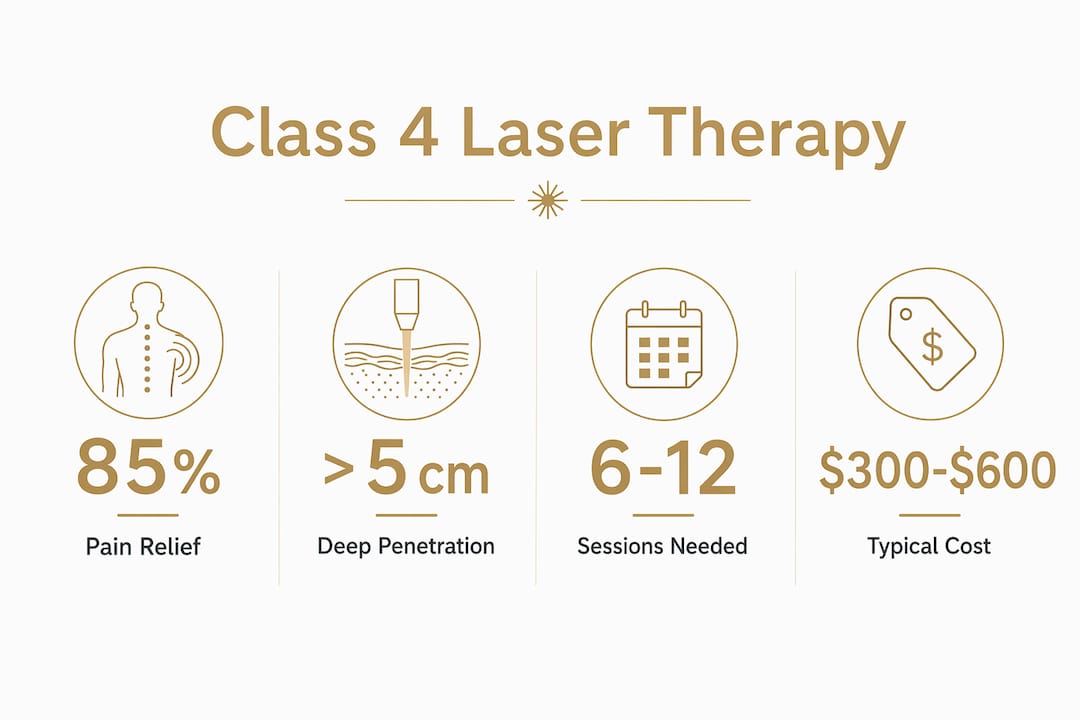
Class 4 devices operate at infrared wavelengths that allow light to penetrate beyond 5 cm into tissue. That depth matters because tendons, ligaments, and deep muscles sit well below the skin surface. Lower-class devices simply cannot deliver enough energy at that depth to produce a meaningful clinical effect. Class 4 lasers reach deeper tissue layers and deliver greater energy doses in shorter sessions, which is why they have broader clinical applications than their lower-powered counterparts.
The therapy produces three distinct biological effects:
That third effect is what separates true high-intensity laser therapy (HILT) from devices that simply deliver continuous high power. Not every Class 4 device produces photoacoustic effects. The distinction depends on whether the device generates high-peak, short-pulse output rather than a steady beam.
Pro Tip: Ask your provider to confirm the peak power and pulse duration of their device. Transparent reporting of these parameters is the clearest sign that a clinic understands the difference between high-power and high-intensity laser therapy.
The research base for high-intensity laser therapy has grown substantially. A 2026 systematic review covering 629 participants found significant pain and disability improvements for patients with tendinopathy. The results were not immediate. Benefits increased over time and peaked at approximately 16 weeks of treatment. That timeline is worth understanding before you start: this is a therapy that rewards consistency.
The same review reported a mean difference of -2.54 for shoulder-related pain scores and -0.91 for elbow pain scores. Those numbers reflect real, measurable reductions in pain that patients reported across multiple sessions. The shoulder findings are particularly strong, which aligns with clinical experience treating rotator cuff tendinopathy and subacromial conditions.
“High-intensity laser therapy shows significant pain and disability improvements for tendinopathy, with benefits increasing over time and peaking around 16 weeks, especially notable for shoulder-related conditions.” — Systematic review, 2026, 629 participants
Compared to low-level laser therapy, Class IV devices consistently show superior outcomes for deep musculoskeletal conditions. The reason is straightforward: greater energy doses in shorter times reach structures that lower-powered devices cannot access. For surface-level conditions, the difference is smaller. For deep joint and tendon injuries, it is clinically significant.
| Condition | Evidence level | Notable finding |
|---|---|---|
| Shoulder tendinopathy | Systematic review (2026) | Peak benefit at 16 weeks, MD -2.54 |
| Elbow tendinopathy | Systematic review (2026) | Measurable improvement, MD -0.91 |
| Deep musculoskeletal disorders | Comparative studies | Class 4 outperforms low-level laser therapy |
| General tendinopathy | Multiple trials | Cumulative benefit with repeated sessions |
The evidence supports Class 4 laser therapy as a legitimate, research-backed option for musculoskeletal pain. It is not a replacement for a full rehabilitation plan, but it is a meaningful addition to one. Shephardhealth integrates this therapy within personalized treatment plans rather than offering it as a standalone fix, which reflects how the research actually recommends using it.
Knowing what a session feels like removes a lot of uncertainty. Here is what a standard course of treatment looks like:
Certain contraindications apply. Providers do not treat directly over active malignancies, during pregnancy, over tattoos (which can absorb heat unevenly), or near metal implants without careful parameter adjustment. These are not reasons to avoid the therapy entirely. They are reasons to have a thorough intake conversation before your first session.
Pro Tip: Do not expect dramatic pain relief after a single session. The cumulative benefit of laser therapy builds over weeks. Patients who commit to the full recommended course consistently report better outcomes than those who stop after two or three sessions.
The science behind photobiomodulation explains why this gradual progression happens at the cellular level. Tissue repair is a biological process with its own timeline. The laser accelerates it; it does not bypass it.
Understanding where this therapy fits among your options helps you have a productive conversation with your provider. Here is a direct comparison across the most common alternatives:
| Treatment | Depth of effect | Invasiveness | Typical sessions | Insurance coverage |
|---|---|---|---|---|
| Class 4 laser therapy | Deep (5+ cm) | Non-invasive | 6–12 | Rarely covered |
| Low-level laser therapy | Superficial | Non-invasive | 10–20 | Rarely covered |
| Corticosteroid injections | Targeted | Invasive | 1–3 | Often covered |
| Physical therapy | Variable | Non-invasive | 12–24 | Often covered |
| Shockwave therapy | Moderate | Non-invasive | 3–6 | Varies |
The advantages of Class 4 laser therapy are real. It is non-invasive, has minimal side effects, and produces measurable results for conditions like tendinopathy and deep joint pain. The limitations are equally real. Most insurance carriers do not cover therapeutic laser treatments, making it an out-of-pocket expense for most patients in Calgary. Costs vary by clinic and session count.
Key considerations when evaluating this therapy against alternatives:
Discuss the full picture with your provider before committing to any single approach. A provider who recommends only one tool for every patient is not giving you a personalized plan.
Class 4 laser therapy delivers measurable pain relief and tissue healing for deep musculoskeletal conditions through photobiomodulation, with clinical benefits peaking around 16 weeks of consistent treatment.
| Point | Details |
|---|---|
| Deep tissue penetration | Class 4 devices reach beyond 5 cm, accessing tendons, ligaments, and deep muscles. |
| Cumulative results | Benefits build over multiple sessions, with peak outcomes reported at approximately 16 weeks. |
| Three biological effects | Photochemical, photothermal, and photoacoustic effects each contribute to healing and pain reduction. |
| Out-of-pocket cost | Most insurance plans do not cover therapeutic laser treatments; discuss pricing with your provider upfront. |
| Operator training matters | Device technique and parameter selection directly affect safety and clinical outcomes. |
I have seen patients arrive at the clinic convinced that any non-invasive therapy is a soft option. They have usually tried injections, rested for months, and are skeptical that light can do what medication could not. What changes their mind is not a single dramatic session. It is the third or fourth visit, when they realize their morning stiffness has dropped by half and they slept through the night without waking from shoulder pain.
The terminology in this field creates real confusion, and I think that confusion costs patients. “Class 4” describes a power classification, not a treatment type. “High-intensity laser therapy” and “high-power laser therapy” are not the same thing, even though clinics use both terms interchangeably. The photoacoustic effect that drives tissue regeneration requires a specific pulse profile. Not every device marketed as Class 4 produces it. Patients deserve to know that distinction before they pay for a course of treatment.
Operator training is the factor I see underestimated most often. Consistent hand speed, correct angle, and appropriate parameter selection are what separate a therapeutic session from one that just feels warm. A well-trained provider using a mid-range device will consistently outperform an undertrained provider using premium equipment. When you evaluate a clinic, ask about their training credentials, not just their device brand.
The research direction I find most promising is the combination of laser therapy with soft tissue injury treatments like Active Release Technique. The laser creates a better healing environment at the cellular level. Manual therapy then addresses the mechanical restrictions that developed around the injured tissue. Used together, they address the problem from two directions simultaneously.
— Deane
Shephardhealth offers laser therapy as part of a personalized, evidence-based approach to musculoskeletal pain and injury recovery. Every treatment plan starts with a thorough assessment of your condition, your goals, and the tissue depth involved. Laser therapy is integrated alongside other advanced non-invasive treatments, including shockwave therapy and Active Release Technique, so your care addresses the full picture rather than a single symptom. If you are ready to understand your options and build a plan that fits your specific injury, explore soft tissue treatments or review the laser therapy service page to see how Shephardhealth approaches your recovery.
Class 4 laser therapy treats musculoskeletal conditions including tendinopathy, joint pain, soft tissue injuries, and deep muscle inflammation. It is most effective for conditions involving structures deeper than 5 cm below the skin surface.
Most treatment plans involve 6–12 sessions, with clinical research showing that benefits peak at approximately 16 weeks of consistent treatment. Some patients notice improvement earlier, but full results require completing the recommended course.
Class 4 laser therapy is safe when performed by a trained provider who screens for contraindications. Patients who are pregnant, have active malignancies, or have certain implants near the treatment area require special consideration before proceeding.
Most insurance carriers do not cover therapeutic laser treatments, making it an out-of-pocket expense for most patients. Shephardhealth recommends confirming your coverage directly with your insurer and discussing session pricing before starting a treatment plan.
Class 4 devices deliver power outputs exceeding 500 mW and penetrate beyond 5 cm, while low-level laser therapy devices operate at much lower power and reach only superficial tissue layers. For deep musculoskeletal conditions, Class 4 devices consistently produce stronger clinical outcomes.
Same Day Appointments Available
We Direct Bill!