

Choosing between compression socks and sleeves comes down to one clinical distinction: coverage. Compression socks cover your foot, ankle, and calf, delivering graduated pressure that promotes venous return from the ground up. Sleeves cover only the calf, leaving your foot and ankle without support. For musculoskeletal injury recovery, that gap matters more than most patients realize.
Here is a quick framework to guide your decision:
Injured or not recovering as expected? Start with a $67 new patient visit
A chiropractor assesses the injury, treats it on day one when it is safe, and builds a recovery plan with you. See sports injuries care in Calgary. Book online.
The functional gap between these two garments is wider than it looks. Compression socks apply continuous graduated pressure from the toes through the calf, supporting lymphatic drainage and preventing fluid pooling in the foot. Sleeves, by contrast, compress only the calf muscle. When worn post-activity, a sleeve can actually push fluid downward with nowhere to go, worsening foot swelling rather than relieving it.
| Feature | Compression Socks | Calf Sleeves |
|---|---|---|
| Coverage area | Foot, ankle, and calf | Calf only |
| Graduated pressure | Yes, from toe upward | Partial, calf only |
| Best use case | Recovery, edema management, prolonged wear | Active training, sport-specific calf support |
| Ease of application | More involved; heel and toe alignment required | Slides on quickly |
| Ankle and arch support | Yes | No |
| Recovery effectiveness | Superior for post-injury and post-activity | Limited; not recommended post-workout |
| Typical price ranges vary depending on the product grade and retailer. |
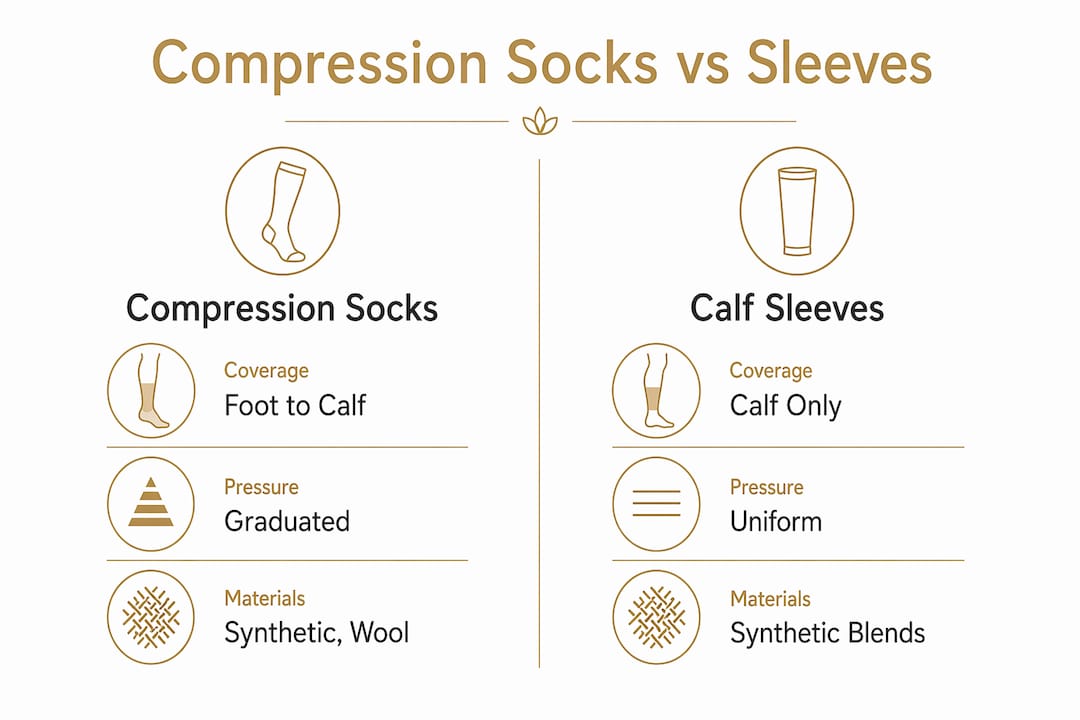
Materials vary meaningfully between the two. Compression socks come in synthetic blends for high-intensity use, merino wool for cold-weather endurance, and cotton blends for daily wear. Sleeves are almost always nylon-spandex blends engineered to grip the calf and stay in place during movement. Calgary winters make merino-blend socks a practical choice for outdoor rehabilitation activities.
Socks require three measurements: calf circumference, ankle circumference, and foot length. A poor fit at the foot reduces effectiveness and can cause pressure points. Sleeves are sized by calf circumference and length alone, making them simpler to match but less comprehensive. Certified fitting ensures you land in the correct compression level, typically 20–30 mmHg for rehabilitation, without the risk of a garment that acts as a tourniquet at the ankle.
Compression garments are not appropriate for everyone. Patients with peripheral arterial disease, active skin infections, or severe peripheral neuropathy should consult their clinician before use. Sleeves carry a specific caution: if sized too tight near the ankle, they can restrict blood flow and worsen circulation in post-injury tissue. Your chiropractor or physiotherapist should confirm that compression is appropriate for your current recovery stage before you purchase either garment.
Both garments lose elasticity over time. With frequent use, expect to replace them every four to six months. Wash compression socks after every wear due to foot contact and moisture. Sleeves can tolerate slightly less frequent washing if they stay dry, though regular laundering preserves elasticity. Hand-washing in cool water and air-drying extends the life of both. Never machine-dry compression garments; heat degrades the elastic fibers that create therapeutic pressure.
Pro Tip: For foot and ankle pain recovery, wear compression socks during rest and lower-intensity movement, then switch to a sleeve during higher-intensity training sessions when full-foot coverage becomes impractical. This combination, recommended by sports medicine experts, optimizes circulation year-round across both recovery and performance phases.
Several Calgary providers offer compression socks, sleeves, and certified fitting services. The options below vary in specialization, so your best fit depends on whether you need integrated rehabilitation, insurance billing, or straightforward retail access.
| Provider | Garments Offered | Professional Fitting | Insurance / Billing | Location | Google Reviews |
|---|---|---|---|---|---|
| Shephard Health Chiropractic Clinic | Socks and sleeves as part of rehab | Yes, with chiropractic integration | Direct billing available | Calgary | 4.9★ (543) |
| Wellnecity | Compression socks and garments | Yes, Certified Fitters | Alberta Aids to Daily Living; private insurance | Calgary | 5★ (98) |
| August Home Medical Supplies & Compression Socks | Compression stockings and home medical products | Yes, fitting assistance | Shipping and contact support | Two Calgary locations | 4.9★ (89) |
| Calmedi Medical Supplies, Rehab & Mobility | Compression stockings, braces, mobility aids | Available | Insurance-eligible; free local pickup | Calgary | 4★ (67) |
| Medi HealthCare | Compression stockings, orthopedic supports | Available | Not publicly listed | Calgary | 4.1★ (10) |
| Wellnest Collective Medical Supplies | Medical supplies | Not publicly listed | Not publicly listed | Calgary | 5★ (80) |
Shephard Health Chiropractic Clinic is the strongest choice for patients who want compression garment guidance embedded within a full rehabilitation plan. Rather than purchasing a garment and guessing at the right compression level, you receive a clinical assessment that accounts for your specific injury, recovery stage, and activity demands. That context changes which garment you need, what compression level is appropriate, and how long you should wear it each day. For patients managing soft tissue injuries or post-injury edema, that clinical layer is what separates a garment that helps from one that sits in a drawer.
Wellnecity is the right call if your priority is insurance navigation. Their Certified Fitters work directly with Alberta Aids to Daily Living and a range of private carriers, which can meaningfully reduce your out-of-pocket cost on medical-grade garments.
August Home Medical Supplies suits patients who want retail access with fitting support across two Calgary locations, particularly useful if proximity and convenience are your main criteria.
Calmedi Medical Supplies covers a broader rehab equipment range alongside compression stockings, with insurance eligibility and free local pickup making it a practical option for patients sourcing multiple rehab aids at once.
Medi HealthCare offers compression stockings alongside orthopedic supports and daily living aids, with transparent product pricing listed on their site.
Wellnest Collective Medical Supplies has limited publicly available detail on fitting services or specializations; contact them directly to confirm what they carry.
Compression socks outperform sleeves for musculoskeletal recovery because full-foot graduated pressure prevents fluid pooling and supports venous return in ways a calf-only sleeve cannot replicate.
| Point | Details |
|---|---|
| Socks for recovery, sleeves for training | Wear compression socks during rest and recovery phases; use sleeves for active training when foot coverage is impractical. |
| Foot coverage is clinically significant | Sleeves leave the foot and ankle uncompressed, which can worsen swelling post-activity rather than relieve it. |
| Certified fitting at 20–30 mmHg | Professional fitting prevents under- or over-compression and ensures the garment delivers therapeutic benefit. |
| Replace every four to six months | Elasticity degrades with frequent use; rotating pairs extends garment life and maintains consistent compression. |
| Shephardhealth integrates compression into rehab | Shephard Health Chiropractic Clinic provides clinical guidance on compression garment selection as part of a personalized rehabilitation plan. |
Compression socks and sleeves are tools, not treatments. The providers listed above can fit you with the right garment, and that matters. But if you are recovering from a musculoskeletal injury, the garment is only one piece of a plan that should also include hands-on clinical care.

Shephardhealth takes a different approach. Rather than starting with the garment, the clinic starts with your injury. Chiropractors assess your specific condition, whether that is a calf strain, ankle sprain, or chronic lower-leg pain, and build a rehabilitation plan that may include compression therapy alongside Active Release Technique, shockwave therapy, laser therapy, or Kinesio Taping. Direct insurance billing and same-day appointments mean you spend less time coordinating and more time recovering. If you are ready to move beyond guessing which garment to buy, learn about the unexpected benefits of chiropractic care and book your first assessment at Shephardhealth.
Same Day Appointments Available
We Direct Bill!