

Custom orthotics are designed from an assessment of how your feet and legs actually move, which is why they are the most direct way to address overpronation when it is linked to pain in your feet, shins, knees or back. The research supports foot orthoses for reducing pain in several foot conditions and in running injuries, and the quality of the result depends on the assessment behind the device. At Shephard Health in Calgary, we offer custom foot orthotics as part of a broader biomechanical approach to musculoskeletal pain.
Pronation is the natural inward roll of your foot after your heel strikes the ground. It helps absorb shock and lets your foot adapt to the surface. Overpronation means the roll goes too far or lasts too long, so the arch flattens and the heel tilts inward (clinicians call this rearfoot eversion).
That motion does not stay in the foot. When the foot collapses inward, the lower leg tends to rotate inward with it. A Pedorthic Association of Canada case study of a triathlete describes exactly this chain: flat feet, excessive subtalar eversion (movement at the joint below the ankle), and overpronation during midstance, producing excessive inward rotation of the shin bone and strain on the tibialis anterior, the muscle running along the front of the shin.
This is why overpronation shows up in many different complaints: arch and heel pain, shin pain, knee pain, and sometimes lower back discomfort. It is also very common to have some degree of overpronation with no symptoms at all. The goal is never to “fix” a foot shape for its own sake; it is to reduce the load that is causing your pain.
You cannot reliably diagnose overpronation by looking at the wear pattern on your shoes or by standing on a wet piece of paper. Professional standards for custom orthotics ask for much more.
The C. Ped © Standards of Clinical Practice (updated October 2023) say an assessment may include:
The College of Physicians and Surgeons of British Columbia guideline on custom orthotics (revised April 2026) adds that functional orthotics are prescribed to control or improve foot function to a specific degree, determined by a thorough biomechanical evaluation, and that a prescription should be based on stance and gait analysis plus casts or 3-D images of the feet.
The practical point for you: the device is only as good as the information that goes into it. When you book an orthotic assessment, expect questions about your activity, your pain and your shoes, expect to be examined standing and lying down, and expect to be watched in motion. If you are not, the orthotic is being designed without the evidence it needs.
It helps to be precise about what orthotics are shown to do. They are not a cure for a foot shape. They are a tool for reducing pain and abnormal load, and the evidence is encouraging in that role.
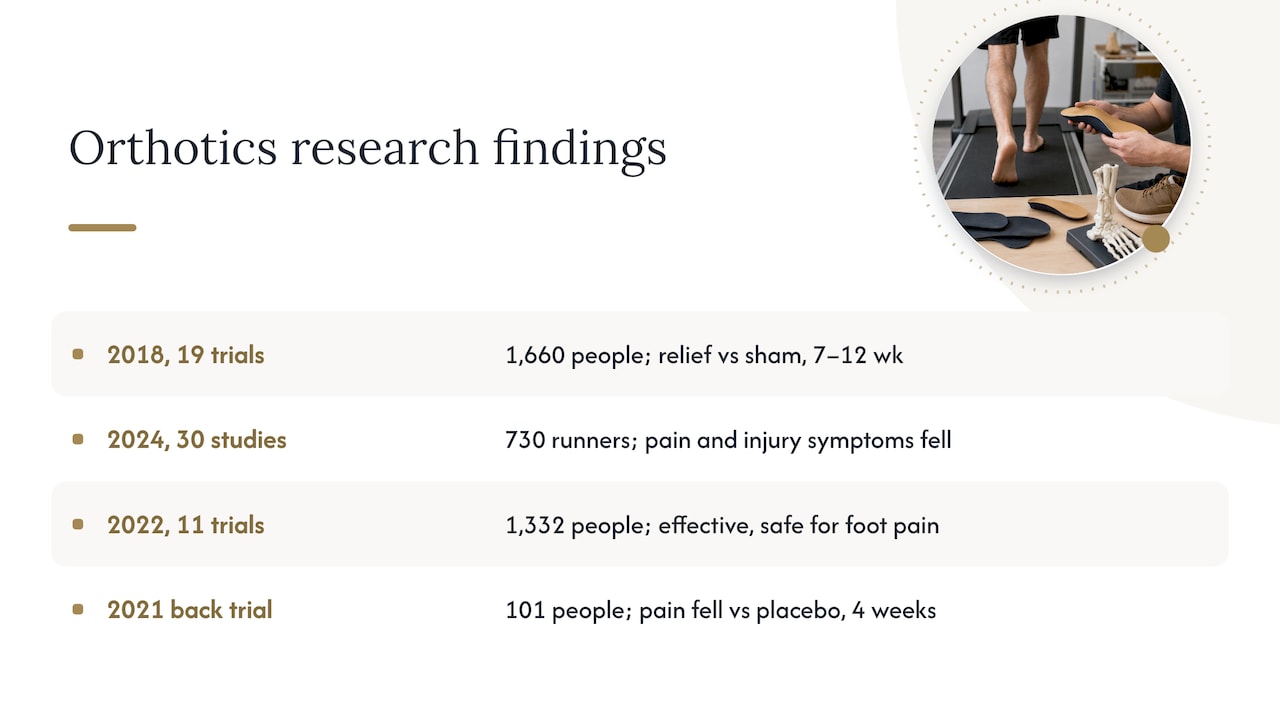
Pain relief. A 2018 systematic review and meta-analysis in BJSM pooled 19 trials with 1,660 participants. It found moderate-quality evidence that foot orthoses reduce pain more than sham orthoses in the medium term, at 7 to 12 weeks.
Running injuries. A 2024 scoping review of 30 studies covering 730 symptomatic runners found that wearing foot orthoses while running was related to an immediate and long-term decrease in pain and overuse-injury symptoms. It also found reduced foot and ankle eversion, the inward tilt that defines overpronation, and a shift toward more lateral pressure at the heel and forefoot.
Specific foot conditions. A Cochrane review from 2022 of 11 trials with 1,332 participants found custom-made foot orthoses effective for painful high-arched feet (pes cavus), rearfoot pain in rheumatoid arthritis, foot pain in juvenile idiopathic arthritis and painful hallux valgus (bunions). The reviewers also reported custom orthoses as a safe intervention in all the studies.
Back pain. A 2021 randomized controlled trial of 101 people with chronic non-specific low back pain and a pronated foot posture found a significant decrease in back pain after four weeks in the group wearing custom-made orthoses compared with the placebo group (p < 0.001 on both the disability and pain scales). The authors concluded that controlling excessive pronation may contribute to improving chronic low back pain.
Orthotics inside a full plan. The 2024 scoping review also suggests that adding foot orthoses to a comprehensive treatment plan may give better results than standalone first-line treatments. That matches how we think about it: the orthotic supports the mechanics while hands-on care, strengthening and activity changes address the tissue that is already irritated.
If you are also looking at recovery options beyond footwear, a comparison of PEMF and EMS for rehab covers how two common recovery technologies are weighed against pain outcomes.
Most people searching this topic start with the question of insoles versus orthotics. The difference is in how the device is specified.
An insole sold off the shelf is made to a general shape for a general foot. A custom orthotic is made for one person, from measurements and an assessment, to control the specific motion that is causing that person’s symptoms. The Pedorthic Association of Canada states that determining the need for and design of custom-made orthotics requires a thorough clinical assessment, biomechanical examination and gait analysis.
The Ontario Podiatric Medical Association points out that the word “orthotic” has been diluted to cover almost any insole, and that when properly prescribed, orthotics can be a very effective therapeutic modality for lower-limb and postural problems. That is a useful lens when you shop: ask what assessment sits behind the device, because that is what makes it an orthotic rather than a cushion.
Custom orthotics tend to make the most sense when:
Because an orthotic is built from your assessment, we can match the rigidity, shape and any added posting (a small wedge that adjusts foot position) to your activity, whether that is walking at work, distance running or court sports.
Repetition is what turns a mild mechanical quirk into an injury. A runner may take well over a thousand steps per kilometre, so a small excess of inward rotation can load the same shin, tendon or knee structure again and again.
The Pedorthic Association of Canada case study mentioned above is a good example. The triathlete had medial tibial stress syndrome (the shin pain commonly called shin splints). She was treated with custom orthotics made from a 3-D cast, a semi-rigid functional orthotic for structure and cushioning, and a right medial rearfoot post to support the position of the subtalar joint and reduce rotational force through the shin during running. Her findings were not symmetrical, and neither was her device: it was designed around the side that needed it.
For active people, the key points are:
Match the orthotic to the sport. A device for a daily walker is not the same as one for a hockey player or a trail runner. Tell your clinician which shoes you wear for which activity so the design fits them.
Treat the tissue and the mechanics together. If you already have pain, the irritated tissue still needs care. We can combine orthotics with hands-on soft tissue work such as Active Release Technique or Graston Technique, and with shockwave therapy where it fits your condition. Our guides on orthotics for running and runner’s knee go deeper on those cases.
Keep your feet and hips strong. Orthotics work best alongside a rehabilitation plan that builds strength and control through the foot, hip and core. That is why our physical rehabilitation sits next to our orthotic services rather than apart from them.
An orthotic that is well designed can still feel strange for the first days, because it changes how your foot meets the ground. The College of Physicians and Surgeons of British Columbia guideline says patients should receive guidance on tolerance, time frames and footwear, and that follow-up should be offered within a reasonable period, such as three to four weeks.
The C. Ped © standards go further, describing best practice as follow-up at three weeks, six months and one year after dispensing custom products. Those checkpoints let your clinician adjust the device as your body adapts and as your training changes.
A sensible break-in routine looks like this:
Bring the shoes you actually use. Orthotics need room, and a shoe with a removable insole or enough depth makes a real difference to how the device performs. Our article on how long orthotics last explains when shells and covers typically need replacing.
The British Columbia guideline also notes that treatment success cannot be guaranteed, but that your clinician should explain the outcomes you can reasonably expect. Ask that question at your first visit: what should be better, and by when?
Custom orthotics are a clinical product, and the price reflects the assessment, the device and the follow-up. For a sense of scale, a 2021 Ontario fee guide listed custom-made prescription orthotics at $460 to $690 per pair, and case fees including biomechanical assessment, casting, the device, dispensing and a follow-up review at $502 to $690. Prices differ by province and clinic and have moved since 2021, so use this as context only. For Calgary, our guide to what custom orthotics cost in Calgary explains what the fee covers.
Many extended health plans reimburse orthotics, and each plan sets its own conditions. One public example, the PSHCP bulletin published in 2025, lists custom orthotics as an eligible benefit and requires a valid diagnosis, the dispensing date and a true custom-made device based on a 3-dimensional foot cast from a biomechanical exam or gait analysis. Your own plan will have its own wording, so check its requirements before your visit. We offer direct insurance billing where applicable, which means we can often handle the claim paperwork for you.
Most people who come to us about overpronation do not arrive asking about a foot posture. They arrive with a sore shin, a heel that hurts on the first steps in the morning, or a knee that complains after a run. The foot is often part of the answer, but only part.
That is why we begin with a comprehensive biomechanical assessment rather than a product. We look at how you stand, how you move and what you do, and we build an individualized plan around what we find. For many patients, a custom orthotic is the piece that changes the load through the foot and lower leg, and the research on foot orthoses and pain gives us good reason to offer them with confidence.
We also like pairing the orthotic with active rehabilitation. Strong feet, hips and calves help you get the most from the device, and our team can add hands-on therapies when tissue needs attention. Our aim is simple: less pain, better function, and fewer repeat injuries, so you can get back to what you enjoy.
Deane
If overpronation is behind your foot, shin, knee or back pain, the next step is an assessment of how you move. At Shephard Health, we assess your biomechanics, build an individualized plan, and provide custom foot orthotics alongside chiropractic care and physical rehabilitation. We offer same-day appointments and direct insurance billing where applicable. You can see everything we offer on our services page.

If your pain is in the heel, our page on foot and ankle pain treatment shows how we approach it, and our overview of treatments for plantar fasciitis covers the options in more detail.
Orthotics are designed to control how far the foot rolls inward while you are wearing them. The 2024 scoping review of symptomatic runners found foot orthoses were related to reduced foot and ankle eversion and to lower pain and symptoms from overuse injuries. The goal is less pain and better loading, not a permanently changed foot shape.
It depends on the clinic, the province and what the fee includes, such as assessment, casting, follow-up and any adjustments. A 2021 Ontario fee guide listed custom-made orthotics at $460 to $690 per pair. For Calgary, see our cost guide, and check your extended health plan, since many reimburse a portion.
An insole is made to a general shape, while a custom orthotic is made for your feet after a biomechanical assessment and measurements. The rigidity, shape and posting are chosen to match your motion, your symptoms and your activity. That assessment is what separates a prescribed device from a generic one.
Most people build up wear gradually over the first couple of weeks, starting with a few hours a day. Follow-up around three weeks after you receive them is recommended in Canadian clinical standards, so adjustments can be made if anything rubs or feels off.
The 2022 Cochrane review of custom-made foot orthoses reported them as a safe intervention in all the included studies. If you notice new pain, numbness or skin irritation while wearing them, tell your clinician so the device can be adjusted.
Same Day Appointments Available
We Direct Bill!