

Kinesiology tape is defined as a thin, elastic cotton adhesive tape designed to relieve pain and support muscles without restricting movement. Millions of athletes and patients use it worldwide, and the question of whether kinesiology tape works has a clear, evidence-based answer: it provides modest short-term relief for pain and function, but little proof supports lasting benefits. A 2026 analysis covering 128 reviews, 29 conditions, and over 15,000 participants confirmed this finding. That scale of research makes the conclusion hard to dismiss. Understanding what the tape actually does, and where it fits in a recovery plan, helps you use it wisely rather than rely on it blindly.
Kinesiology tape works through several proposed mechanisms, though none are fully proven in isolation. The most widely cited theory is that the tape lifts the skin slightly, creating space between the skin and the tissue beneath. This is thought to improve lymphatic drainage and local circulation, which may reduce swelling and ease discomfort after injury.
The second mechanism is sensory feedback. Kinesiology tape acts as a proprioceptive tool rather than purely mechanical support. The tape’s contact with the skin sends continuous signals to the nervous system, increasing body awareness in the taped area. This heightened awareness helps patients avoid compensatory movement patterns that often worsen injuries over time.
A third proposed effect involves muscle motor recruitment. The tape provides a sensory stimulus that increases afferent neural input, which can improve the timing and activation of nearby muscles. For shoulder conditions like rotator cuff tendinopathy, this neural input may help stabilize the joint during movement.
The key limitation is variability. These mechanisms do not produce the same effect in every person or every condition. Individual differences in skin elasticity, pain sensitivity, and injury type all influence how much benefit you actually feel.
Pro Tip: Apply the tape to clean, dry skin and smooth it flat with your palm after application. The heat from your hand activates the adhesive and improves skin contact, which directly affects how well the sensory feedback mechanism works.
The evidence on kinesiology tape is more nuanced than the colorful strips on professional athletes suggest. Current clinical evidence rates the certainty of benefit as low, with minimal clinically important differences over placebo in most conditions. That does not mean the tape does nothing. It means the effect is real but modest, and it fades.

For shoulder conditions specifically, the picture is slightly more encouraging. Multiple randomized controlled trials and systematic reviews show that kinesiology tape can improve short-term pain and function in rotator cuff tendinopathy and subacromial impingement when applied correctly alongside exercise. The operative phrase is “alongside exercise.” Tape alone does not replicate the benefit of a structured rehabilitation program.
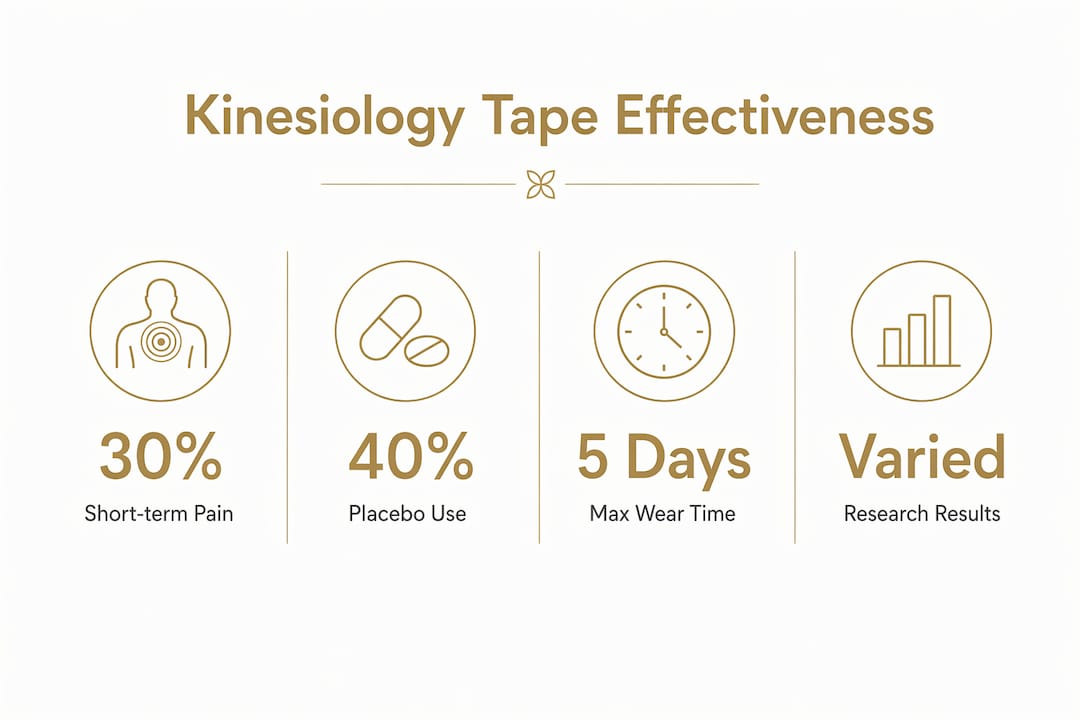
One finding that surprises many people: 40% of athletic trainers report using tape partly as a placebo. That number reflects a clinical reality, not a criticism. Placebo effects can be genuinely valuable in rehabilitation if they help patients move with more confidence and less fear, which accelerates recovery.
The table below summarizes what the research shows across different time frames.
| Outcome | Short-term (0–4 weeks) | Medium to long-term (4+ weeks) |
|---|---|---|
| Pain reduction | Modest, statistically significant | Minimal to none over placebo |
| Functional improvement | Moderate for specific conditions | Uncertain, inconsistent evidence |
| Shoulder conditions | Positive effect with exercise | Limited without ongoing rehab |
| Placebo comparison | Small advantage | No consistent advantage |
| Skin irritation risk | Low in most adults | Higher in older adults with prolonged use |
The skin irritation risk deserves attention. Kinesiology tape can be worn up to 5 days, including during bathing or swimming, but older adults face a higher risk of skin irritation with extended wear. If you notice redness, itching, or blistering, remove the tape immediately and allow the skin to recover before reapplying.
Technique is not a minor detail. Improper application yields no benefit at all, and in some cases creates discomfort that discourages continued use. The stretch percentage applied during taping, the shape of the tape strip, and the direction of application all determine whether the tape achieves its intended effect.
For shoulder conditions, technique varies by the specific problem being addressed. Subacromial decompression taping uses higher stretch tension to create more lift under the acromion. Scapular stabilization taping uses lower tension to guide the shoulder blade into better alignment without forcing it. A Y-strip configuration is commonly used for rotator cuff support because it wraps around the muscle belly and provides feedback along the full length of the tissue.
These distinctions matter because applying a scapular stabilization technique to a subacromial impingement problem will not produce the right mechanical or sensory effect. Correct application can require several strips and specialized knowledge, which is why professional guidance consistently produces better outcomes than self-application from a YouTube tutorial.
For athletes in Calgary managing shoulder or joint injuries, working with a clinician who understands both the injury mechanics and the taping technique is the most reliable path to getting real benefit from the tape.
Pro Tip: Ask your clinician to mark the anchor points on your skin with a washable marker the first time. This lets you replicate the placement accurately if you need to reapply between appointments.
Kinesiology tape works best as an adjunct, not a standalone treatment. Treating it as a primary therapy sets unrealistic expectations and delays more effective interventions. The following scenarios represent the clearest evidence-based use cases.
During active rehabilitation. Tape used alongside exercise-based rehabilitation produces better outcomes than tape alone. The tape supports movement quality while the exercise rebuilds strength and tissue resilience.
For rotator cuff tendinopathy and AC joint sprains. These shoulder conditions show the most consistent short-term benefit from kinesiology taping when the correct technique is applied. The tape reduces pain enough to allow therapeutic exercise to proceed.
As a proprioceptive aid post-injury. After an ankle sprain, shoulder dislocation, or similar joint injury, the tape helps retrain movement patterns by providing continuous sensory input. This reduces the risk of compensation injuries in adjacent joints.
For wear periods up to 5 days. The tape is water-resistant and designed for multi-day wear. Remove it if skin irritation develops, and give your skin at least 24 hours of rest before reapplying.
When managing pain during sport. For athletes competing through minor injuries, the tape can provide enough pain modulation and confidence to perform safely. This is where the proprioceptive and placebo effects combine most usefully.
Kinesiology tape is not appropriate as a substitute for imaging, diagnosis, or structured treatment of serious injuries. If your pain is worsening, spreading, or accompanied by numbness, tape will not address the underlying cause. A clinical assessment is the right first step.
For older patients or those with sensitive skin, the skin irritation risk increases with longer wear times. Use hypoallergenic tape formulations and check the skin daily during the first application to establish your tolerance.
Kinesiology tape provides real but modest short-term pain relief and functional support, and its best results come from correct application paired with structured rehabilitation.
| Point | Details |
|---|---|
| Short-term benefit is real | Research confirms modest pain relief and function improvement, especially in the first four weeks. |
| Technique determines outcome | Stretch percentage, strip shape, and direction must match the specific condition for the tape to work. |
| Tape is an adjunct, not a cure | Combine kinesiology tape with exercise-based rehab for meaningful, lasting recovery results. |
| Placebo effect has clinical value | Increased confidence and reduced fear of movement can accelerate rehabilitation even when tape’s direct effect is small. |
| Skin care matters | Wear tape for up to five days maximum, and monitor for irritation, especially in older adults. |
After working with patients across a wide range of musculoskeletal conditions, I have seen kinesiology tape deliver genuine value and genuine disappointment, often in the same week. The difference almost always comes down to expectation management, not the tape itself.
The patients who benefit most are those who understand the tape as a support tool, not a fix. A runner with IT band irritation who tapes correctly and continues their strength program recovers faster than one who tapes and skips the gym. The tape buys them comfort during the process. That is worth something real.
What concerns me is the growing number of people who apply tape from a social media tutorial, feel no improvement, and conclude that nothing works. They have usually applied the wrong technique for their condition, at the wrong tension, in the wrong direction. The tape did not fail them. The application did.
The placebo dimension is also worth taking seriously rather than dismissing. If a patient moves with more confidence because the tape makes them feel supported, their movement quality improves, their compensation patterns reduce, and their recovery accelerates. That is a real clinical outcome, regardless of the mechanism. Dismissing it as “just placebo” misses the point of what rehabilitation is trying to achieve.
My recommendation: use kinesiology tape as one layer of a broader plan. Pair it with Active Release Technique or manual therapy to address the underlying tissue dysfunction, and let the tape support your movement quality between sessions. That combination consistently outperforms either approach alone.
— Deane

Shephardhealth integrates professional kinesiology taping with evidence-based therapies including Active Release Technique and chiropractic care to address the root cause of your pain, not just the symptoms. Tape applied by a trained clinician at Shephardhealth is matched to your specific condition, using the correct strip configuration and tension for your injury. That precision is what separates clinical taping from a self-application kit. If you are managing a shoulder injury, a sports-related strain, or a recurring musculoskeletal problem in Calgary, Shephardhealth offers same-day appointments and direct insurance billing. Learn more about kinesio taping for sports injuries and how it fits into a complete recovery plan.
Kinesiology tape provides modest, short-term pain relief supported by clinical research, but evidence for lasting benefit beyond four weeks is weak. It works best when combined with active rehabilitation rather than used alone.
Kinesiology tape can be worn for up to five days, including during bathing or swimming. Remove it sooner if you notice skin redness, itching, or irritation, and allow at least 24 hours before reapplying.
Kinesiology tape and rigid athletic tape serve different purposes. Kinesiology tape allows full range of motion and works through sensory feedback, while rigid athletic tape restricts movement to protect unstable joints. For shoulder pain involving rotator cuff or impingement issues, kinesiology tape is generally the preferred option during active rehabilitation.
Self-application is possible for simple areas, but correct technique for shoulder conditions requires specific strip shapes, tension levels, and placement that most people cannot replicate accurately without training. Professional application consistently produces better outcomes.
Kinesiology tape can benefit older adults managing musculoskeletal pain, but skin sensitivity increases with age. Hypoallergenic tape formulations reduce irritation risk, and daily skin checks during the first application help establish safe wear tolerance.
Same Day Appointments Available
We Direct Bill!