

Chiropractic care can be a reasonable part of a multimodal conservative plan for frozen shoulder, helping many patients reduce pain and regain movement. High-quality trials show that manual therapy combined with exercise improves outcomes, though steroid injections often provide stronger short-term relief. Your response will depend on your stage of the condition, so ongoing reassessment matters as much as the treatment itself.
TL;DR:
- Recovery can take several months to two years; early care targets pain, while later stages focus on restoring motion through progressive exercise.
- Steroid injections improved pain 26% more than manual therapy and exercise at seven weeks; by six to twelve months, the difference was not meaningful.
- A trial of four to six weeks should combine manual therapy with progressive exercise and regular reassessment, with referral if progress stalls.
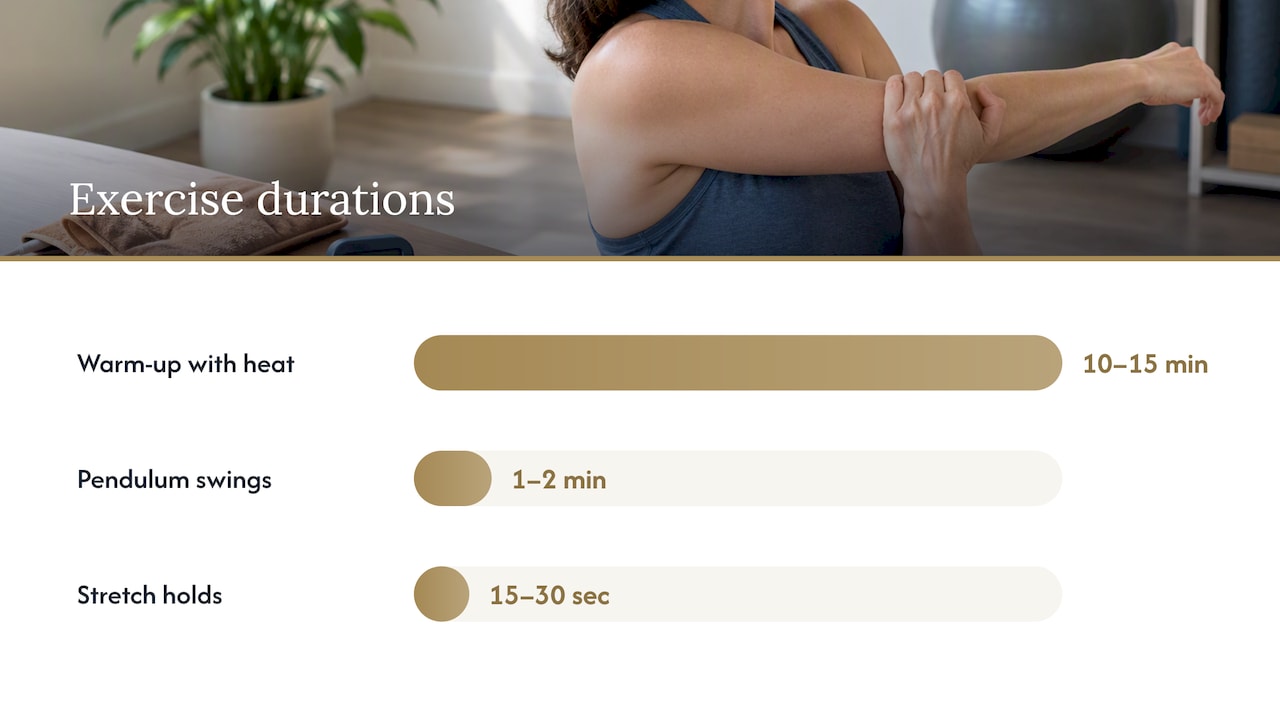
- Use warm heat for 10 to 15 minutes before stretching, stop at tension rather than sharp pain, and add resistance exercises only as motion improves.
- Fever, unexplained weight loss or weakness, visible deformity, or major trauma warrants prompt medical evaluation rather than continued routine care.
Frozen shoulder, known clinically as adhesive capsulitis, happens when the capsule surrounding the shoulder joint thickens and tightens, restricting movement in nearly every direction. The hallmark is a loss of both active and passive range of motion, something that distinguishes it from simpler rotator cuff problems. Pain tends to be worse at night and often disrupts sleep, especially when you lie on the affected side.
We see this condition most often in adults between 40 and 60, and it affects women somewhat more than men. A few patterns show up consistently in the people we assess:
Severity varies widely. Some patients notice mild catching with certain movements, while others cannot lift their arm past shoulder height at all.
Frozen shoulder is classified as primary (idiopathic, with no clear trigger) or secondary (following injury, surgery, or a period of immobilization such as a cast or sling). Both types involve the same underlying capsular tightening, but secondary cases often have a more identifiable starting point.
Several factors raise your likelihood of developing it:
Systemic disease and inactivity often compound each other, which is part of why we always ask about broader health history during an initial assessment.
Frozen shoulder typically moves through three phases. The freezing stage brings gradually worsening pain and a progressive loss of motion, often lasting two to nine months. The frozen stage follows, where pain tends to settle but stiffness remains pronounced, sometimes for four to twelve months. Finally, the thawing stage brings a slow, often uneven return of motion that can take several months to two years.
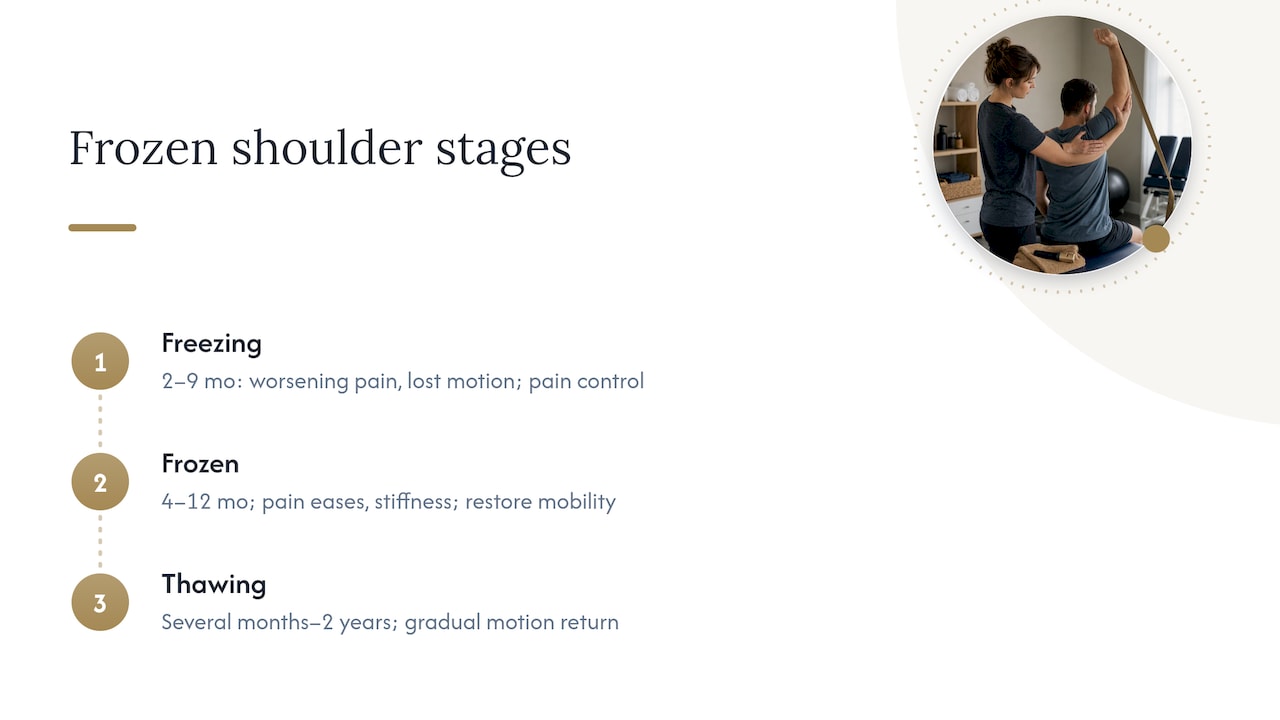
Treatment goals shift with each stage: early care focuses on pain control, while the frozen and thawing stages shift attention toward restoring mobility through structured exercise. Our stage-by-stage recovery guide walks through what to prioritize at each point in the process.
Diagnosis starts with a hands-on exam and a detailed history. We look at both active and passive range of motion, since the global restriction seen in frozen shoulder (rather than pain limited to one direction) helps separate it from rotator cuff tears or impingement. Functional tests like the Apley scratch test and resisted abduction give us a clearer picture of where movement is restricted and why.
Imaging such as ultrasound or MRI is not usually needed to diagnose frozen shoulder, but we use it when the presentation is unclear or symptoms don’t match the expected pattern.
Certain findings call for referral rather than continued conservative care:
These are signs of something other than straightforward adhesive capsulitis, and red-flag screening is a standard part of any thorough musculoskeletal workup.
Chiropractic management for frozen shoulder usually blends hands-on techniques with active, patient-led rehabilitation rather than relying on passive treatment alone. Common approaches include thoracic and cervical spine mobilization or manipulation, direct shoulder joint mobilization, and soft-tissue work to address the muscles compensating around a stiff joint.
We also draw on tools like Active Release Technique and Graston Technique for soft-tissue restrictions, along with shockwave therapy for persistent stiffness that hasn’t responded to earlier care. These are used to support, not replace, an active exercise program, since Canadian chiropractic guidelines recommend supervised exercise as central to care, with manipulation considered an adjunct when cervicothoracic dysfunction is part of the picture.
A typical course of care includes:
A retrospective case series of 50 patients treated with a chiropractic technique focused on cervical and thoracic spine work reported that 16 patients achieved complete resolution and 25 more showed 75 to 90 percent improvement, with a median care duration of 28 days. This is encouraging, but it comes from a case series rather than a controlled trial, so it points toward a promising approach rather than a confirmed one.
Pro Tip: Track your range of motion weekly with a simple phone photo or video. Small, measurable gains help you and your clinician decide whether to continue the current plan or adjust it.
Guideline-aligned practice means reassessing at every visit and referring you for further investigation if progress stalls, which is something we build into every frozen shoulder plan.
Movement is the foundation of recovery, but how you move matters as much as how often. A short warm-up prepares stiff tissue for stretching and reduces the chance of flare-ups.
Throughout, stretch to the point of tension, never sharp pain. Pushing through pain tends to trigger more stiffness rather than less.
Pro Tip: Consistency beats intensity. A few minutes of stretching several times daily tends to outperform one long session.
Supervised progression helps you know when you’re ready to add load, and following Osteoporosis Exercise Guidelines: Safe Moves That Work can help ensure your exercise progression is both safe and effective once you’re past the acute stiffness.
Conservative care isn’t the only path, and understanding the alternatives helps you make sense of where chiropractic treatment fits. A Cochrane review found that manual therapy plus exercise probably improves pain and function, but trial evidence shows a 26 percent greater short-term improvement in pain with steroid injection compared with manual therapy and exercise at seven weeks. By six to twelve months, the difference between the two approaches is not considered clinically meaningful.
Other options include:
In practice, many patients do best with a combined approach: an injection for early pain relief paired with supervised exercise to rebuild motion.
Recovery timelines vary, and that’s one of the hardest parts of frozen shoulder to accept. The overall course can run anywhere from several months to as long as two years, though most people improve meaningfully with consistent conservative care. Short-term gains at six to twelve weeks often show up as reduced night pain and small increases in range of motion, while fuller functional recovery tends to unfold over months.
Sticking with your home program and attending reassessment visits makes a measurable difference in how steady that progress stays.
If a planned trial of conservative care doesn’t produce the expected improvement, that’s a signal to consider imaging or referral rather than continuing the same plan indefinitely. New systemic symptoms such as fever or unexplained weight loss, marked unexplained weakness, or a shoulder problem that followed significant trauma all warrant prompt medical evaluation.
Best practice means reassessing your progress at every visit and arranging co-management or referral when your shoulder isn’t responding as expected.
Every frozen shoulder case starts with a thorough assessment to understand your stage, your range of motion, and what’s driving your symptoms. From there, we build an individualized plan that blends manual therapy with supervised, progressive exercise, because passive treatment alone rarely gets patients where they want to be. We reassess regularly and adjust the plan as your shoulder responds.
— Deane
If frozen shoulder is limiting your sleep, your work, or your ability to reach for the things you need, we offer a direct path forward. Our chiropractic care combines hands-on assessment with therapies like Active Release Technique, Graston Technique, shockwave therapy, and laser therapy, all tailored to where your shoulder is in its recovery.

Your first visit includes a full assessment and a plan built around your specific stage and goals, not a generic protocol. We offer appointments and direct billing to many insurance providers, so getting started doesn’t mean waiting weeks or sorting out paperwork on your own. Visit our services page to see the full range of therapies we offer, or book your first visit today to get a clear plan for your shoulder.
This article is general information, not a substitute for advice from a qualified doctor. Consult a qualified healthcare professional about your own circumstances before acting on anything here.
The most reliable conservative approach combines warming the shoulder before stretching with a consistent home exercise program, supported by manual therapy when needed. Harvard Health recommends 10 to 15 minutes of warmth before stretching, progressing to strengthening once motion improves.
Discomfort during manual therapy or mobilization varies by stage, with more sensitivity during the freezing phase and generally less during the frozen stage. Clinicians typically work within your tolerance and stretch to tension rather than pain to avoid flare-ups.
Chiropractic care, including spinal mobilization and shoulder-focused techniques, can support pain reduction and mobility gains as part of a broader exercise-led plan. A case series of 50 patients reported substantial improvement using a chiropractic technique, though stronger trial evidence is still needed to confirm these results broadly.
Hormonal shifts around menopause are not a confirmed direct cause, but frozen shoulder is more common in women in the age range when menopause typically occurs, alongside other risk factors like thyroid dysfunction. If you’re in this age group and experiencing shoulder stiffness, it’s worth having your thyroid and metabolic health checked alongside your shoulder assessment.
Same Day Appointments Available
We Direct Bill!