

Yes, the Graston Technique can help reduce scar-related stiffness and improve short-term mobility, but only when a trained clinician applies it and pairs it with progressive exercise. The research behind it is genuinely encouraging for short-term gains in range of motion and pain, though it stops short of proving lasting change on its own. If scar tissue is limiting how you move, the right next step is a professional assessment, not a self-treatment plan.
TL;DR:
- Short-term improvements in range of motion and pain are supported by research, but lasting scar tissue changes require ongoing exercise and strengthening.
- Effective Graston therapy depends on expert application using specialized instruments that map and treat fibrotic tissue, not self-treatment or quick fixes.
- Treatment protocols generally involve 8 to 12 minutes per session, with 1 to 3 weekly visits over 4 to 6 weeks, combined with targeted exercises.
- Risks are low when performed by trained clinicians, but contraindications include active infection, open wounds, or blood clotting issues.
- The true benefit of Graston lies in pairing mechanical stimulation with consistent movement and load-bearing exercises, not solely in the instrument work.
Tight, sore or stuck? Start with a $67 new patient visit
A chiropractor assesses the soft tissue and nerve involved and treats it the same day when it is safe. See Active Release Technique in Calgary. Book online.
Graston Technique falls under a broader category called instrument-assisted soft tissue mobilization, or IASTM. Instead of using hands alone, your clinician works with a set of beveled stainless-steel instruments designed to find and treat areas of soft tissue fibrosis, the dense, disorganized collagen that forms scar tissue after injury or surgery. Graston Technique’s official training standard requires clinicians to complete accredited coursework before they can use the instruments clinically.
The edges of these tools create a controlled combination of shear and compression as they glide across scarred tissue. That mechanical pressure does something your fingers usually cannot: it transmits a distinct vibratory feedback, sometimes described as a “speed bump,” when it passes over a fibrotic band that might be missed by palpation alone. Clinicians use this sensation to map out exactly where adhesions are hiding, then focus repeated strokes there.
What happens underneath the skin is where scar tissue treatment gets interesting. The mechanical stimulation is thought to encourage fibroblast activity and support better collagen alignment, along with a localized increase in blood flow to the treated area, according to clinical commentary on the technique’s goals and application.
During a session, you can expect:
Pro Tip: If a spot feels unusually “gritty” or bumpy under the instrument, mention it. That texture change is often exactly what your clinician is hunting for, and it helps them adjust pressure and stroke direction in real time.
The strongest data point on Graston technique scar tissue outcomes comes from a 2019 randomized controlled trial that measured recovery after exercise-induced muscle damage. The IASTM trial also found significantly lower levels of TGF-β1, a protein tied to fibrotic tissue formation, in the treated group between 48 and 96 hours post-injury.
That combination matters because it links a functional outcome (strength recovery) to a plausible biological mechanism (reduced fibrotic signaling), rather than relying on patient-reported comfort alone.
Systematic reviews take a more measured tone. A review of IASTM efficacy found consistent short-term improvements in joint range of motion and pain, but noted that many trials are small, and protocols vary enough across studies that pooling results reliably is difficult. Much of the existing literature also leans heavily toward tendon injuries, leaving muscle and ligament applications comparatively under-studied.
Here’s the honest summary of best methods for scar tissue backed by current evidence:
Does Graston work for scars in a permanent sense? The fairer claim is that it creates a window of improved mobility, one that becomes lasting change only when you use it.
A session usually opens with a brief warm-up and a lubricant applied to reduce skin friction, followed by scanning to locate fibrotic areas before any real treatment strokes begin.
From there, clinical protocol guidance for IASTM for scar tissue generally follows a consistent pattern:
That protocol range is a starting framework, not a rigid formula. Milestone expectations differ, too: short-term ROM gains often show up within the same week, while true tissue remodeling, the kind that changes how a scar behaves months later, depends on the strengthening work done between sessions.
Pro Tip: Ask your clinician what specific exercises you’ll be doing immediately after each Graston session. The instrument work opens a motion window; what you do with that window in the next 24 hours often determines how much of the gain sticks.
The most common immediate reaction to Graston therapy is mild soreness and small red or purple marks called petechiae, tiny areas of pinpoint bleeding under the skin. This is a normal vascular response to the increased local blood flow the instruments are designed to trigger, and it typically fades within a few days.
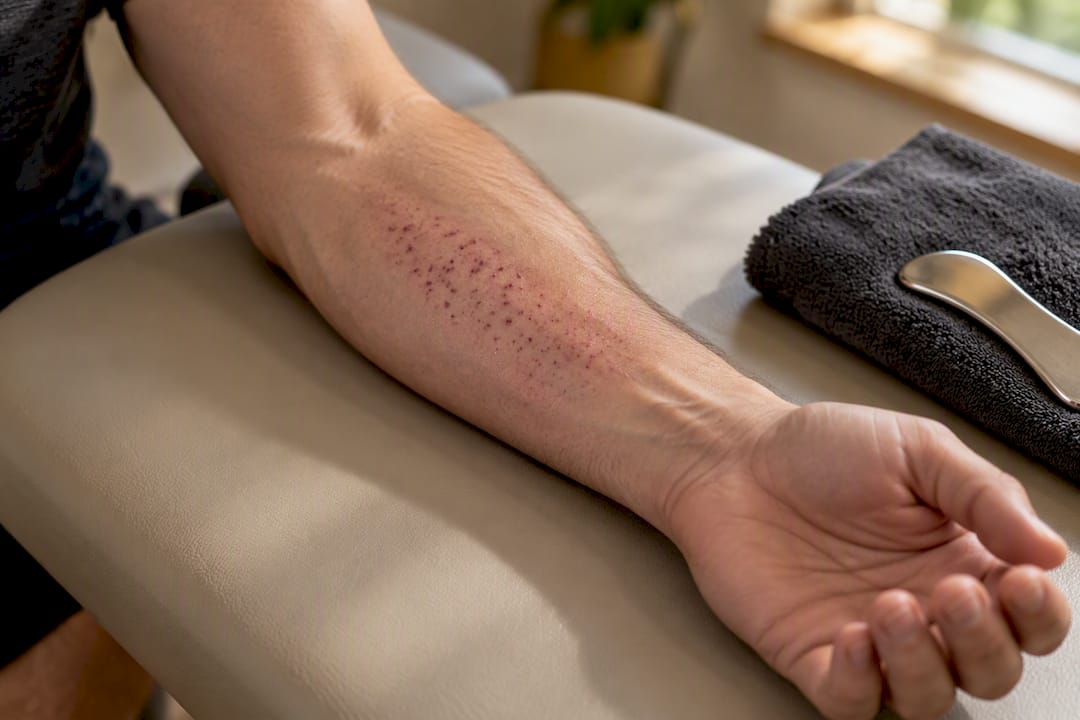
Beyond the skin reaction, patients tend to notice two separate timelines. Range of motion and pain relief often shift within the first session or two. The deeper gains, the kind tied to actual tissue remodeling, build over weeks as you work through prescribed exercises between visits.
Aftercare guidance is usually simple:
Graston tends to fit best if you’re dealing with chronic adhesions, a persistent restriction in range of motion, and a green light from your provider for progressive loading exercises afterward. Post-surgical scars, old sports injuries, and long-standing soft tissue restrictions are common candidates.
Certain conditions rule it out entirely, and your clinician should screen for these before ever picking up an instrument:
Risk with Graston is generally low when clinicians screen carefully, dose conservatively, and pair treatment with a real rehabilitation exercise plan rather than treating the instrument work as a standalone fix.
At Shephard Health, Graston Technique is never used as an isolated fix. It fits into a broader assessment process built around your specific movement limitations and goals.
The typical care pathway looks like this:
Pro Tip: When you book an assessment, ask directly how many sessions are typically recommended for a case like yours and what specific outcome, degrees of motion, pain score, functional task, will be tracked to measure progress. Reviewing how Graston applies to soft tissue injuries more broadly can also help you understand where it fits alongside other rehab tools.
Graston has earned its place in soft tissue rehab, but a lot of marketing around scar tissue treatment overpromises what any single manual technique can do. The 2019 RCT is a solid piece of evidence, and it’s telling that the effect size on strength recovery was large enough to reach statistical significance in a controlled setting. That’s not nothing. But treating Graston as a scar tissue treatment that works independently of exercise misreads what the research actually supports.
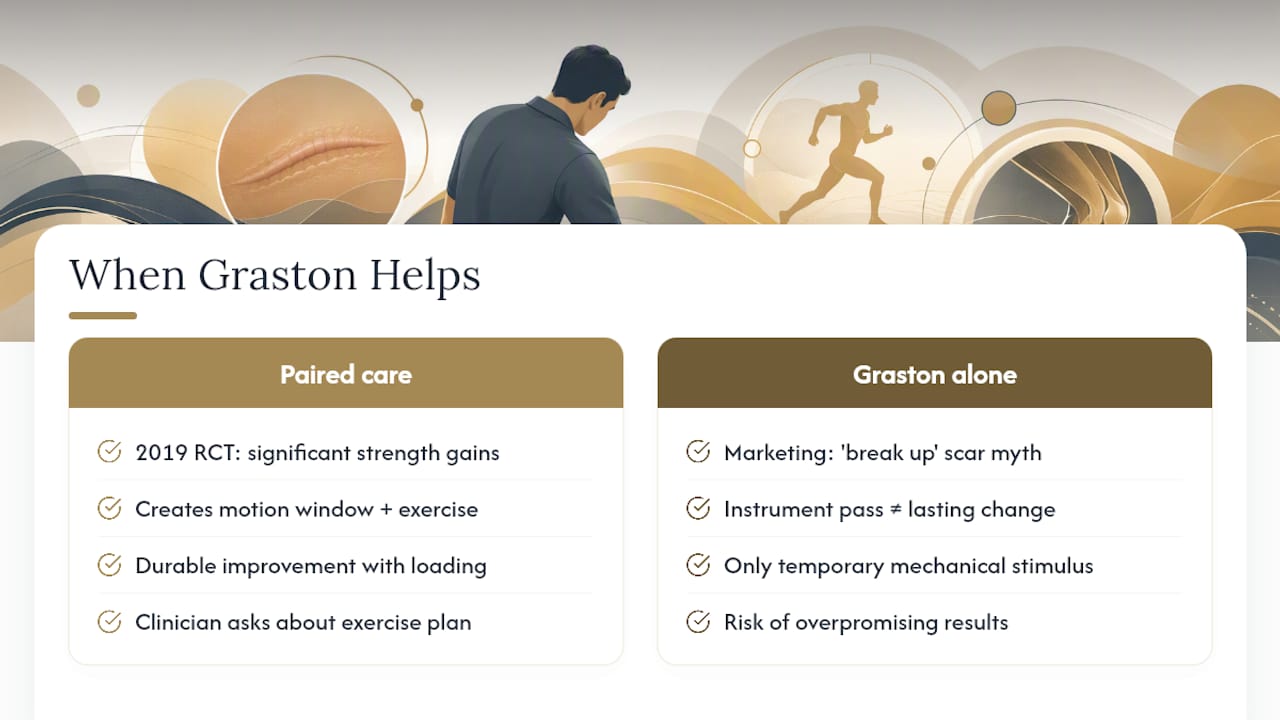
The conventional pitch you’ll hear online treats scar tissue like something that just needs to be “broken up” once, then it’s resolved. That framing is misleading. Fibrotic tissue responds to mechanical stimulation and blood flow changes, but durable improvement comes from what you do with the motion window Graston creates, not the instrument pass itself.
If you take one thing from the evidence, prioritize the pairing over the tool. A clinician who treats Graston as one piece of a loading and strengthening plan will likely get you further than one who leans on it as a quick fix. Ask about the exercise plan before you ask about the instrument.
— Deane
Shephard Health is the practical alternative to guessing your way through foam rollers and generic stretching routines. We offer Graston Technique as part of an individualized rehabilitation plan, not a standalone gimmick, backed by a full biomechanical assessment and a progressive exercise program built for your specific restriction.
Appointments may be available on short notice, and some clinics bill insurance plans directly, so patients may avoid fronting costs and filing paperwork. If persistent scar-related stiffness or a functional limit has been holding you back, whether from an old surgery, a sports injury, or a stubborn adhesion that never quite resolved, book an assessment and find out whether Graston, paired with the right exercise plan, is the right move for your situation.
Graston doesn’t physically break scar tissue apart the way the term implies. It applies controlled mechanical pressure that appears to support fibroblast activity and better collagen alignment, based on clinical commentary on the technique, which can loosen the functional restriction the scar causes.
No single technique is universally the strongest fix for every scar tissue case. Graston, combined with a progressive exercise program, has research support for short-term mobility gains, while other manual approaches like Active Release Technique work through a different mechanism and may suit certain restrictions better. A clinical assessment is the only reliable way to match the method to your specific scar.
The main immediate effects are transient soreness and petechiae, small skin marks from increased local blood flow, which usually resolve within a few days. Serious risks are rare when a trained clinician screens for contraindications like open wounds, active infection, or unmanaged clotting disorders beforehand.
Self-treatment with generic IASTM tools is not the same as clinical Graston therapy, which depends on trained scanning and precise stroke direction to target fibrotic bands safely. Attempting it without that training raises the risk of bruising or aggravating tissue that hasn’t been properly assessed, so a supervised session is the safer starting point.
Same Day Appointments Available
We Direct Bill!