

Mild bruising, redness, or small red dots called petechiae are a normal and usually temporary response to Graston Technique treatment. If bruising is heavy, spreads well beyond the treated area, or comes with fever or signs of infection, that’s not typical, and you should contact your clinician or seek medical care. Your first move after any Graston session is simple: tell your provider how your skin looks and feels, and ice the area if it’s sore.
TL;DR:
- Bruising and petechiae are common but usually minor and temporary side effects that typically fade within a week, depending on tissue density and individual response.
- Increased bruising risk is linked to factors like blood thinners, bleeding disorders, uncontrolled high blood pressure, or recent surgeries, which should be disclosed before treatment.
- Clinicians control bruising by gradually increasing pressure, adjusting stroke angles, and stopping or easing up when petechiae appear during a session.
- Most side effects resolve naturally within two weeks, but spreading redness, worsening pain, or persistent discoloration beyond 72 hours require medical consultation.
- Proper screening, customized pressure adjustment, and integrating Graston with other therapies help minimize bruising while maximizing treatment benefits.
Tight, sore or stuck? Start with a $67 new patient visit
A chiropractor assesses the soft tissue and nerve involved and treats it the same day when it is safe. See Active Release Technique in Calgary. Book online.
Graston Technique falls under a broader category called instrument-assisted soft tissue mobilization, or IASTM. Your clinician uses stainless steel tools to apply shear and compression forces across muscle, fascia, and scar tissue. That mechanical pressure increases local blood flow, which is the point. It’s also exactly why some skin reactions show up afterward.
When an instrument passes over tissue with enough force, it can rupture small capillaries near the skin’s surface. That’s the physical root of Graston technique bruising. It’s worth separating out what you might actually see, because these terms get used interchangeably even though they describe different things:
Whether any of these show up depends on more than just how hard your clinician presses. Tissue quality matters. Someone with dense scar tissue or chronically tight fascia often needs more mechanical input to create a therapeutic effect, and that same density makes small vessels more likely to break. Skin sensitivity varies person to person, too. Two patients receiving the exact same treatment on the exact same muscle group can walk away with very different marks. One peer-reviewed review of IASTM studies found that petechiae wasn’t consistently tied to how much pressure or time was used in healthy subjects. Tissue and instrument factors played a bigger role than dose alone.
That single finding reframes how you should think about a bruise. It’s not automatically a sign your clinician pressed too hard. Sometimes it’s just your tissue’s particular way of responding.
Most patients see something modest: light redness that fades in a few hours, or a scattering of petechiae confined to the exact area treated. True bruising, in the sense of visible purple or blue-green discoloration, happens less often and tends to stay small when it does appear.
The timeline that matters most: some reactions show up immediately, right on the table, while others take 24 to 72 hours to fully develop. Most resolve within a few days to a couple of weeks, with lighter marks clearing faster and deeper ecchymosis taking longer. Depth of treatment, tissue density, and your own vascular fragility all influence where you land in that window.
What “normal” looks like: Confined to the treated area. Doesn’t grow after the first day or two. Fades in color the way a typical bruise does (purple to green to yellow). Doesn’t come with worsening pain, warmth, or swelling.
A bruise that spreads well outside the treated zone, deepens instead of fading after several days, or takes longer than two weeks to resolve isn’t the expected pattern. That’s the point where you loop your clinician back in rather than waiting it out. Spine-Health’s patient guidance on Graston aftercare echoes this same expectation: soreness, bruising, or small red dots can occur, but they’re framed as short-term side effects, not a sign that something has gone wrong with the treatment itself.
Some patients bruise more easily than others because of what’s happening inside their blood vessels, not because of anything the clinician does differently. Knowing your own risk factors before your first session lets you and your provider make a smarter call about how aggressive the technique should be, or whether it should wait.
Tell your clinician about any of the following before treatment starts:
These aren’t arbitrary caution flags. Clinical guidance on Graston indications and contraindications lists open wounds, uncontrolled hypertension, cancer (case-dependent), unhealed fractures, certain kidney disorders, and anticoagulant use among the conditions that should change or rule out treatment. A clinician trained in the technique will also rule out active infection and deep vein thrombosis risk before ever picking up an instrument. If you’re managing a health condition where soft tissue work carries its own considerations, such as pregnancy-related pelvic pain, it’s worth reading up on physiotherapy approaches to pelvic girdle pain alongside whatever your Graston provider recommends.
You don’t have to just hope your provider gets the pressure right. Trained clinicians follow a deliberate, adjustable process, and knowing what that process looks like helps you spot good practice when you see it.
Official Graston Technique guidance reinforces that last point directly: the Graston Technique FAQ states that the appearance of petechiae is a signal for the clinician to reduce pressure, and that the technique does not need to be painful to be effective.
Pro Tip: Before your first session, write down every medication and supplement you take, even ones that seem unrelated, and hand the list to your clinician. Blood thinners and certain herbal supplements are easy to forget in the moment, but they change how your provider should dose the treatment.
Good aftercare is straightforward, and it starts the moment you leave the table. If the treated area feels sore, ice it for 15 to 20 minutes, which helps calm the local inflammatory response without interfering with healing.
A few habits make recovery smoother:
When those normal signs cross a line: Spreading redness beyond the original treatment area, rapidly increasing pain instead of gradual improvement, fever, or any sign of infection (warmth, pus, red streaking) all warrant a call to your clinician or a medical visit. A bruise that’s still growing after 48 to 72 hours, rather than settling into its color-change phase, also deserves a second look. Most Graston side effects resolve on their own within the 3 to 14 day window covered earlier; anything that clearly breaks that pattern is worth flagging rather than waiting out.
The evidence base for Graston Technique bruising is smaller than most patients assume. Peer-reviewed literature on IASTM does report transient erythema as a common finding, but the studies summarizing post-intervention effects also note that petechiae appears inconsistently, and doesn’t reliably track with how much pressure or time a clinician uses in healthy subjects. That’s a meaningfully different picture from “more pressure equals more bruising.”
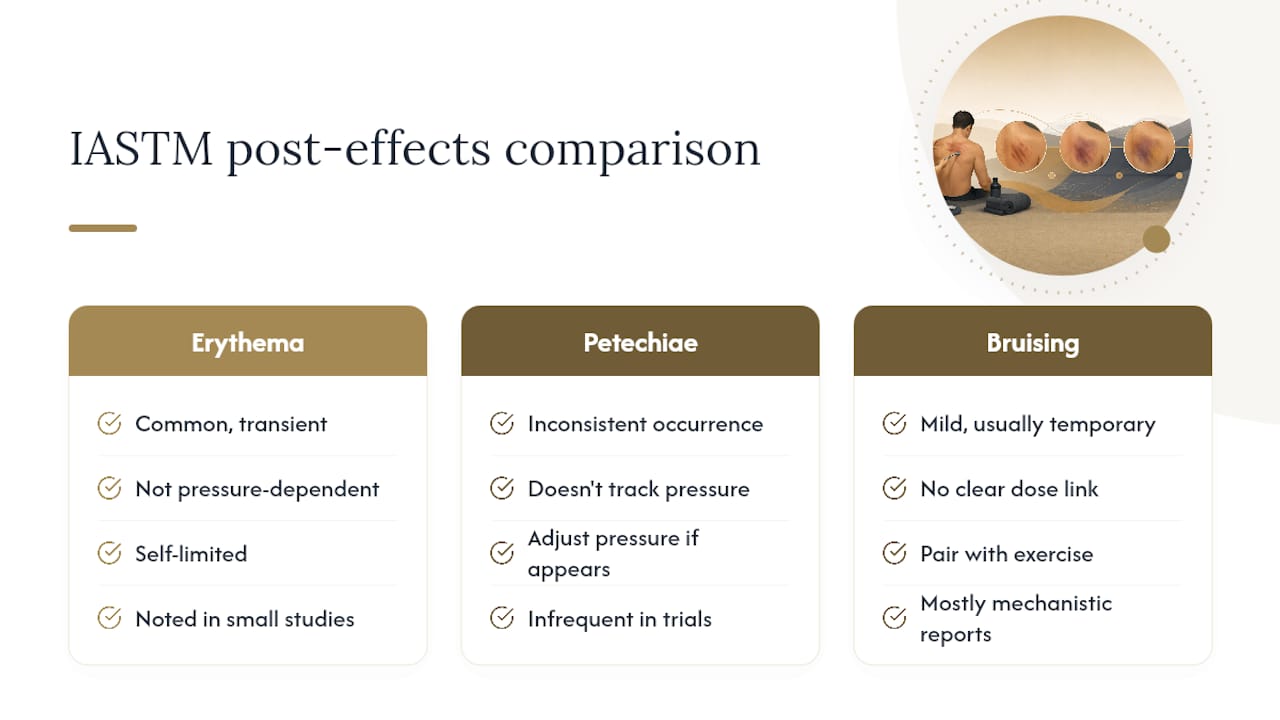
Case reports and mechanistic studies covering IASTM describe its use in conditions ranging from knee arthrofibrosis to lumbar spine cases, generally noting transient local side effects without evidence of lasting harm. The honest caveat is that much of this research is small in scale or mechanistic rather than large randomized trials, so the strongest practical guidance still comes from clinician consensus and the manufacturer’s own FAQ rather than a deep well of high-quality studies.
That FAQ is direct about what to expect: mild bruising, redness, and soreness are common and usually temporary, and clinicians should adjust pressure the moment petechiae shows up. The consistent thread across both the research and the official guidance is that Graston works best paired with progressive exercise and ongoing clinical judgment, not as a standalone intervention applied at maximum intensity every session.
Most of the anxiety around Graston bruising comes from a reasonable but incomplete assumption: that a bigger mark means a rougher session. In practice, tissue response varies so much between patients that the same pressure can leave one person unmarked and another with visible petechiae. That’s not a flaw in the technique. It’s a reason screening matters as much as technique itself.
That screening happens before the instrument ever touches the skin. Clinicians ask about medications, supplements, and any bleeding history up front, and adjust pressure and stroke length based on how tissue responds during the session, not a fixed protocol applied to everyone equally. Graston Technique is paired with progressive exercise rather than treated as a one-off fix, and skin response is documented session to session so patterns get caught early. If something feels off during treatment, say so immediately. Monitoring works both ways.
— Deane
If you’ve read this far because you’re weighing whether Graston Technique bruising is a risk worth taking, the honest answer is that it’s manageable with the right screening and a clinician willing to adjust as they go. Screening is built into every new Graston consultation. Before any instrument touches the skin, bleeding risk factors, medications, and any prior tissue sensitivity are reviewed, and a conservative starting dose is set based on what is found.

We also treat Graston as one piece of a broader plan rather than an isolated session. Combined with progressive exercise and, when relevant, complementary approaches like Active Release Technique or massage therapy, the goal is steady tissue improvement without unnecessary side effects along the way. If you’re dealing with a stubborn soft tissue injury and want a same-day assessment before committing to treatment, book a consultation through our Graston Technique service page and we’ll walk through your risk factors together before any instrument touches your skin.
This article is general information, not a substitute for advice from a qualified doctor. Consult a qualified healthcare professional about your own circumstances before acting on anything here.
Graston Technique is designed to apply mechanical pressure that can help remodel dense or restricted soft tissue, including areas affected by scar formation, though it works best as part of a broader plan that includes progressive exercise rather than as a standalone fix. Evidence for its exact mechanism is still limited, and results vary by individual tissue response.
Yes. Applying too much pressure, too long a stroke, or too many passes over sensitive tissue raises the chance of bruising, petechiae, and unnecessary soreness. Trained clinicians titrate pressure and stop or adjust the moment petechiae appears, per official Graston guidance.
Frequency depends on your specific injury, tissue response, and treatment plan, which is why an individualized assessment matters more than a fixed schedule. Many patients start with once or twice weekly sessions and adjust based on how their skin and tissue respond between visits.
Common contraindications include open wounds, uncontrolled hypertension, active cancer, unhealed fractures, bleeding disorders, and anticoagulant use, according to clinical guidance on Graston indications and contraindications. Pregnancy and certain kidney disorders also require modified treatment approaches, so always disclose your full medical history before your first session.
Most bruising and petechiae resolve within 3 to 14 days, depending on how deep the treatment went and your individual tissue response. If discoloration is still spreading or worsening after 48 to 72 hours, that falls outside the typical pattern and is worth a call to your clinician.
Same Day Appointments Available
We Direct Bill!