

If your heel hurts when you run, the most likely cause is plantar fasciitis, an irritation of the thick band of tissue along the sole of your foot. MyHealth Alberta names it the most common cause of heel pain, and running is one of the activities that brings it on. Other causes exist, and they need different handling, so the first job is to work out where exactly it hurts and when. A hands-on assessment that looks at how your foot, ankle, calf and hips share the load is the fastest way to get that answer, and it is what we do at Shephard Health in Calgary.
Every stride sends your body weight through the foot. The plantar fascia is a band of tissue that runs from the heel bone to the base of the toes and acts like a tension cable for the arch. When the load it carries repeatedly exceeds what it can tolerate, it becomes irritated and painful. That is true whether the cause is a sudden jump in weekly mileage, a new pair of shoes, a switch to hills or speed work, or tight calves that pull more strain through the foot.
A review in a peer-reviewed journal, Heel Pain in the Athlete, lists plantar fasciitis, plantar fascia rupture and calcaneal stress fracture (a small crack in the heel bone) among the common sources of pain under the heel in athletes. They can feel similar at first, which is why the pattern of your pain matters so much.
HealthLink BC notes that plantar fasciitis in athletes is often associated with overtraining. That is useful news in one sense: training load is something you can change.
The location and timing of your pain are the best clues. Here is how the main causes tend to show up.
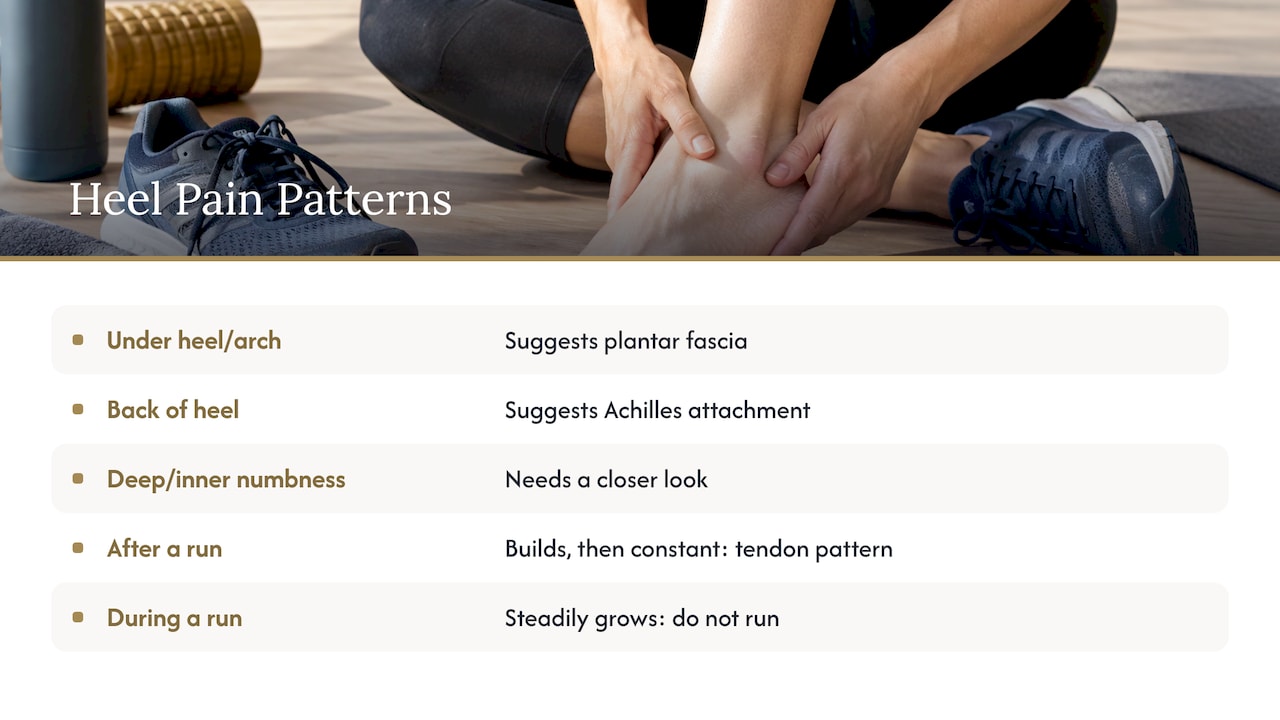
This is pain on the underside of the heel, sometimes spreading into the arch. According to the Heel Pain in the Athlete review, the pain is typically worse on the first steps in the morning or after rest, may ease as you walk, and can flare again after a long day on your feet or a hard training session. Many runners describe it as feeling like a stone bruise, even though nothing looks bruised.
You may see it called plantar fasciopathy. The newer term reflects that the tissue is often worn and degenerated rather than only inflamed. For you the practical meaning is the same: the tissue needs less load for a while, then a planned rebuild.
If the tender spot is at the back of the heel, where the Achilles tendon attaches, think tendon rather than fascia. HealthLink BC describes tenderness at the lower back of the heel, reduced ability to flex the foot upward, and pain that is often worse after exercise and can eventually become constant. It is sometimes linked with a bone spur rubbing at the attachment. If this sounds like you, our page on Achilles tendinopathy exercises is a good next read.
A stress fracture is a small crack in the heel bone from repeated impact. It tends to make the whole heel sore, often worse with impact and not easing as you warm up. Because it needs proper assessment and rest from impact, do not run through heel pain that keeps building or hurts when you squeeze the sides of the heel. Get it checked.
The name sounds like a catch-all, but it is a specific diagnosis. Radiopaedia identifies jogger’s foot as another name for medial plantar nerve entrapment, a relatively rare nerve compression linked particularly with running. It can cause pain in the inner arch or heel together with numbness along the inner sole and the underside of the first and second toes. If numbness or tingling is part of your picture, that is a reason to be assessed rather than to guess.
Think through these questions before you decide what to do. They are not a diagnosis, but they help you describe your symptoms accurately when you book.
Where is the pain? Under the heel or into the arch suggests the plantar fascia. At the back of the heel suggests the Achilles attachment. Deep inside the whole heel, or on the inner side with numbness, suggests something else that needs a closer look.
When is it worst? First steps after sleeping or sitting is typical for the plantar fascia. Pain that builds after a run and becomes constant fits the tendon pattern. Pain that grows steadily during a run and does not ease with rest should not be run on.
What changed? Think back four to six weeks. New shoes, a new surface, a race build, extra hills, a heavier training block or a long stretch of standing at work can all raise the load on the heel.
We ask the same questions in the clinic, then add a biomechanical assessment, looking at how you stand, move and run, to see why the load landed on your heel and not somewhere else.
Most running heel pain is not an emergency, but a few signs change the plan. Following MyHealth Alberta’s guidance:
Get medical attention right away, or call a nurse advice line, if heel pain comes with fever, redness or warmth, or numbness or tingling in the heel.
Contact a clinician if you cannot put weight on the sore foot, or if the pain has lasted more than two weeks.
The two-week mark is a good rule for runners. If you have already reduced your mileage and the pain is no better, more rest alone is unlikely to be the answer. An assessment can tell you which tissue is involved and what to change. In Calgary, we offer same-day appointments, so you do not have to wait for the pain to get worse.
The basics are simple and are consistent across Canadian health guidance.
MyHealth Alberta advises reducing activity to a level that avoids pain and, where possible, avoiding running or walking on hard surfaces while the heel settles. For a runner that usually means shorter, flatter, softer runs, or a pause, depending on how irritated the heel is. HealthLink BC adds that substituting an activity that places less stress on your feet is a common approach. Cycling and swimming may be possible before walking or running.
The same MyHealth Alberta page suggests wrapped ice on the heel, calf stretches and towel-assisted foot stretches if your doctor says they are fine for you, and supportive, cushioned shoes. A heel cup or insert may help. For pain at the back of the heel, HealthLink BC recommends reducing or stopping the aggravating activity, ice massage, light stretching and, if you choose, pain medicine such as acetaminophen or an NSAID, and a soft but firm, flat surface if you run. Check with your doctor or pharmacist before taking any medication, especially if you have stomach, kidney or heart conditions or take other medicines.
After a long day, a soothing foot balm for tired legs can be a pleasant part of your evening routine while the heel settles.
Gentle rolling of the arch and calf is common, but it should never be sharp or leave the heel more sore the next morning. If massaging makes the pain worse, stop. Numbness, tingling, warmth or redness are not signs to massage through. See the red flags above.
Supportive, cushioned shoes are part of the standard advice, and a runner’s shoes wear out. If your heel pain began soon after a shoe change, or your current pair is well past its life, that is a clue worth following up. Some runners also benefit from an insert or a custom orthotic when foot mechanics add to the load on the plantar fascia. Our guide to orthotics for running explains when they help and how to choose. We make custom foot orthotics at the clinic, and they are listed among our services, alongside Kinesio Taping, which some runners use for short-term support.
When rest, load changes and stretching have not cleared the problem, a clinic can add targeted treatments to a rehab plan. At Shephard Health, treatment plans are built around your assessment and your goals, and may combine several of the following.
Active Release Technique (A.R.T.). A hands-on soft tissue method that works on muscles, tendons and fascia while you move. Runners with tight calves or restricted ankles often fit this approach. Learn more about Active Release Technique.
Graston Technique. An instrument-assisted soft tissue treatment used on areas of restriction in the calf, Achilles and foot. See Graston Technique.
Shockwave therapy. A non-invasive treatment applied to the painful area. We describe how it is used for heel pain on our page about shockwave therapy for plantar fasciitis in Calgary, and you can also read about the overall shockwave therapy service.
Laser therapy. Another non-invasive option in our clinic, described on our laser therapy page.
Chiropractic care and rehabilitation. Joint work for the foot, ankle and lower back, paired with a strengthening and mobility program, so that the heel is not asked to absorb forces that other areas should share. See chiropractic care in Calgary. For a broader view of how we approach plantar fasciitis, read our plantar fasciitis treatment page or the overview of 3 treatments for plantar fasciitis.
Not every runner needs every tool. The point of the assessment is to choose the few that suit your heel, your running and your timeline.
Be realistic. HealthLink BC says plantar fasciitis pain may take several months to go away completely. Many runners feel meaningfully better sooner, but the tissue has typically taken weeks or months of repeated stress to become irritated, and it does not recover overnight.
If symptoms continue after several months of treatment, HealthLink BC advises discussing further options with a doctor. That conversation is a normal part of care for heel pain that has not settled, and it can happen alongside your rehab.
The practical message: start early, stay consistent, and treat a flare-up in week three as information, not failure.
The most common reason heel pain comes back is a return that is too fast. HealthLink BC advises waiting until pain and tenderness have gone, then increasing activity gradually. Returning to running usually takes at least several weeks.
A sensible progression looks like this.
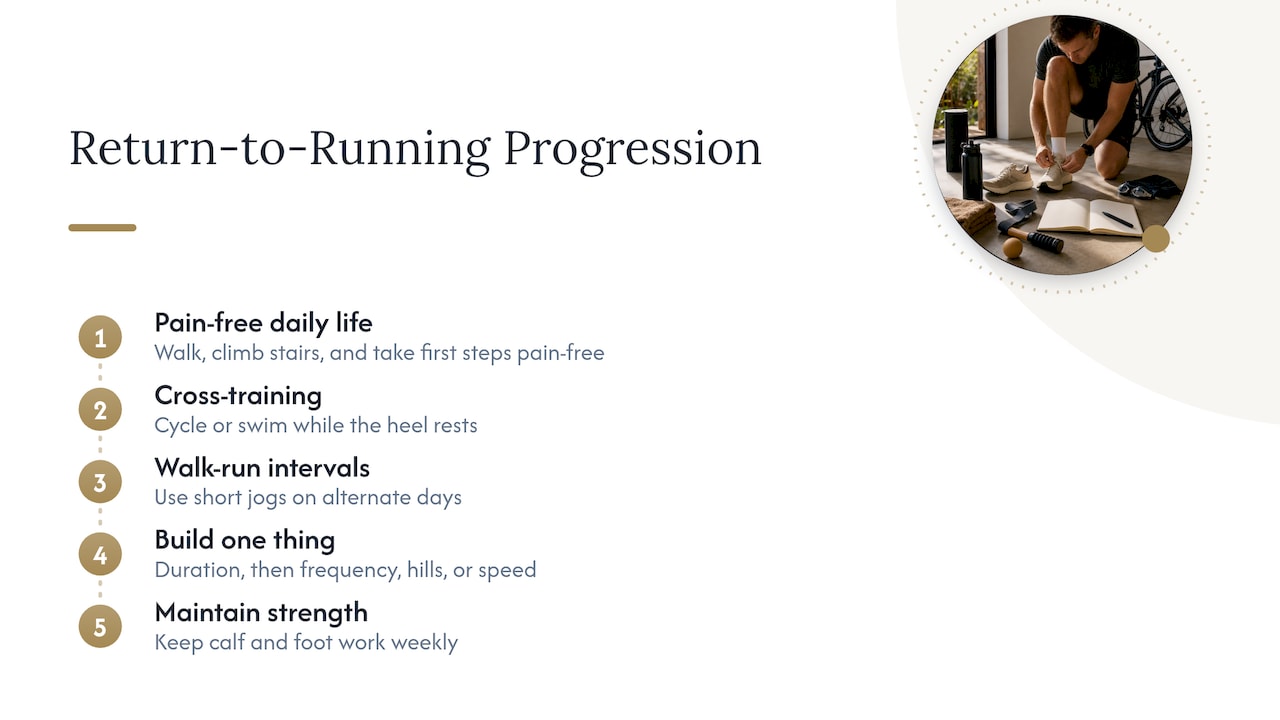
Step one: pain-free daily life. You can walk, climb stairs and take your first steps in the morning without heel pain.
Step two: cross-training. Cycling or swimming keeps your fitness going while the heel gets a break from impact.
Step three: walk-run intervals. Start on a flat, softer surface with short jogging segments between walking, on alternate days. If the heel is sore the next morning, you did too much: step back one level.
Step four: build one thing at a time. Increase duration first, then frequency, then add hills or speed. Changing two at once is how the heel gets overloaded again.
Step five: keep the strength work. Calf and foot strength is what lets the heel handle your training in the long term, so keep it in your weekly plan after you are running normally.
If you want a model for how a structured return works, our guide to the five return-to-running tests after an ankle sprain shows the kind of checkpoints we use before a runner goes back to the road. For soft tissue injuries in general, our PEACE and LOVE recovery timelines explain what to expect week by week.
Runners often come to us after weeks of waiting it out. They have cut mileage, bought new shoes, rolled a ball under the foot, and the heel still hurts on the first step out of bed. The heel is usually where the pain shows up, not where the problem starts.
That is why we begin with a full biomechanical assessment rather than a quick look at the sore spot. We look at how your foot, ankle, calf, hip and lower back share the load when you run, and we build a plan around you and your goals. Depending on what we find, that plan may include hands-on work such as Active Release Technique or Graston Technique, shockwave or laser therapy, custom orthotics, chiropractic care and a rehab program you can keep doing on your own.
We also know that runners hate losing training time. We offer same-day appointments, and we bill many insurers directly where applicable, so getting assessed early is easier than waiting for the pain to force a long break.
Deane
If your heel pain has lasted more than two weeks, keeps returning after runs, or sits in a spot you cannot explain, the next step is an assessment at Shephard Health in Calgary. We examine your feet and running mechanics, explain what is driving the pain, and set out a treatment plan that fits your training. You can see our full list of chiropractic, rehabilitation and orthotic services or visit shephardhealth.com to book.

Direct insurance billing is available where applicable, and same-day appointments make it easier to be seen before a small problem becomes a long one.
That pattern is typical of plantar fasciitis. Pain tends to be worst on the first steps after rest, may ease as you walk, and can return after a long day or hard training. If it has lasted more than two weeks, have it assessed.
Only at a level that does not provoke the pain. Official Alberta guidance is to reduce activity to a pain-free level and avoid hard surfaces while it settles. If you cannot put weight on the foot, or the pain builds during a run, stop and book an assessment.
It is another name for medial plantar nerve entrapment, a relatively rare nerve compression associated with running. It can cause arch or heel pain with numbness on the inner sole and the first two toes. It is a specific diagnosis, not a general term for running heel pain, so numbness or tingling is a reason to be assessed.
It depends on the cause and how irritated the tissue is. HealthLink BC advises waiting until pain and tenderness have gone, then building up gradually, and notes that returning to running usually takes at least several weeks. Cross-training with cycling or swimming may be possible sooner.
See a clinician if it has lasted more than two weeks, and seek urgent care if you have fever, redness, warmth, numbness or tingling. Earlier assessment usually means a simpler plan and less time out of running.
MyHealth Alberta: Heel Pain, Care Instructions
HealthLink BC: Insertional Achilles tendinopathy
HealthLink BC: Plantar Fasciitis, Resuming Your Training
Heel Pain in the Athlete (peer-reviewed article)
Radiopaedia: Medial plantar nerve entrapment
Same Day Appointments Available
We Direct Bill!