

Kinesio taping for knee conditions works by stimulating the skin’s mechanoreceptors to modulate pain signals, improve lymphatic drainage, and send neuromuscular cues that help your muscles activate more effectively. It does not mechanically realign your joint. What it does is give your nervous system better information so your body can move with less pain and more control. Used alongside exercise-based rehabilitation, it can meaningfully accelerate recovery from patellofemoral pain, knee osteoarthritis, and sports injuries.
Key benefits of kinesio taping for the knee include:
Think of kinesio tape as a neurosensory tool, not a brace. Its role is to support your rehabilitation, not replace the strength work that creates lasting recovery.
The tape lifts the skin microscopically as you move, creating space between the skin and underlying tissue. That mechanical effect stimulates cutaneous mechanoreceptors, which send signals that compete with pain signals traveling to the brain. This is the same gate-control principle that explains why rubbing a sore spot instinctively helps.
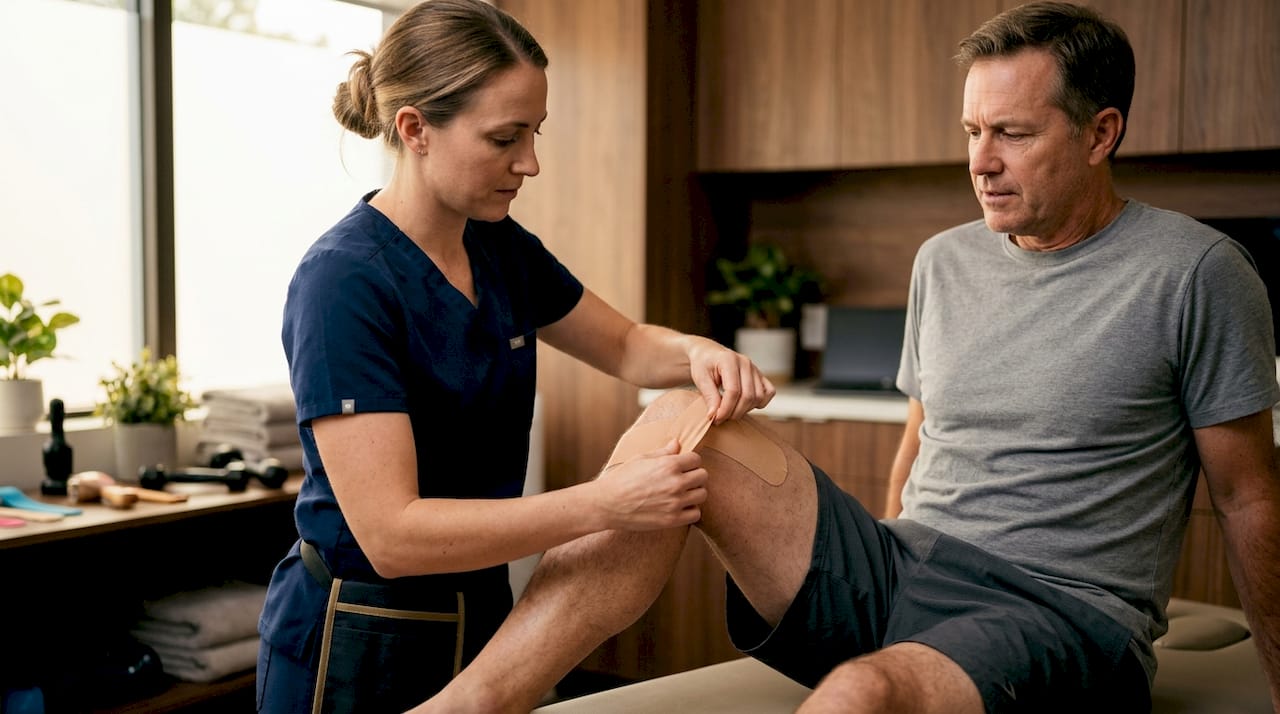
Beyond pain modulation, the improved space under the tape supports lymphatic flow, which reduces localized swelling and inflammation. For athletes dealing with post-training knee puffiness or early-stage osteoarthritis, this drainage effect can make a noticeable difference within the first day of wear. The tape also provides directional cues that influence how your muscles fire. Applied from a muscle’s insertion toward its origin, it can facilitate contraction; applied origin to insertion, it tends to inhibit an overactive muscle.
Pro Tip: Apply tape with your knee bent at roughly 30–45 degrees. This position optimizes the tape’s elasticity during activity and prevents premature peeling at the edges.
The three most commonly used patterns for knee pain are the I-strip, the Y-strip, and the fan technique. Each targets a different problem.
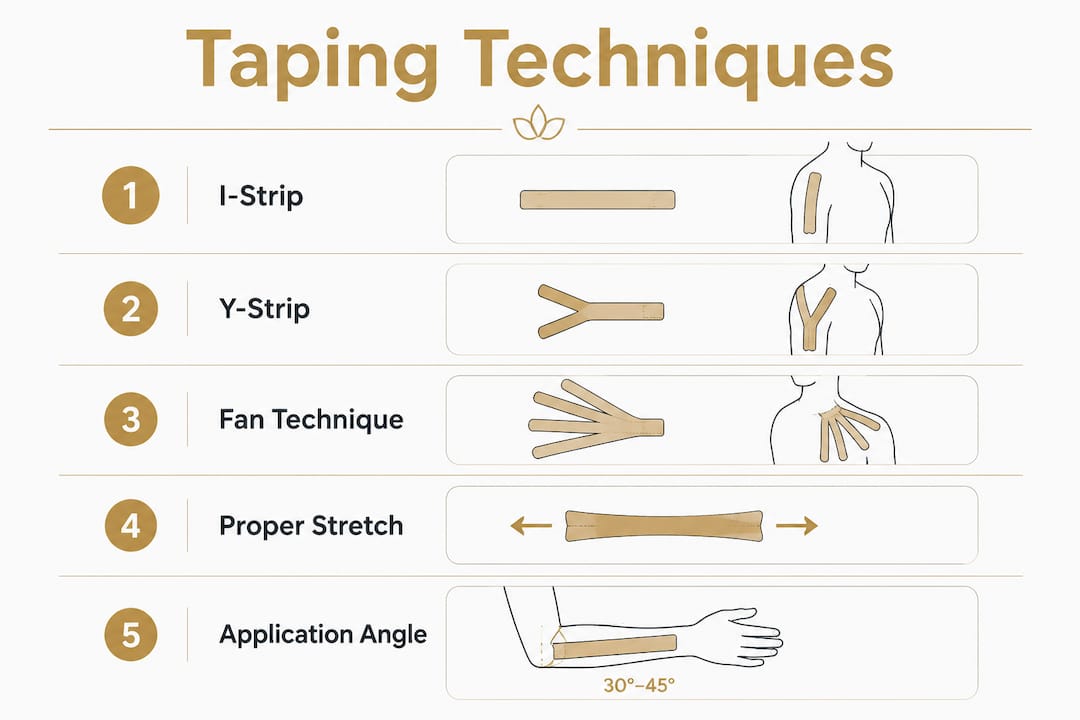
The I-strip runs directly over the patellar tendon or along the collateral ligaments to address pain and edema. The Y-strip splits around the patella to provide directional cues for patellar tracking, making it the go-to choice for patellofemoral pain syndrome. The fan technique uses multiple strips fanning out from a single anchor to maximize lymphatic drainage over a swollen area.
Here is a step-by-step approach for a basic Y-strip patellar application:
The stretch you apply to the tape body matters. Too little and you lose the neurosensory lift effect. Too much and you risk skin irritation, blistering, and actually negating the lymphatic drainage benefit. Anchor points always get zero tension, no exceptions.
Pro Tip: Never apply kinesio tape to freshly shaved skin or right after a shower. Wait at least 30 minutes so the skin is fully dry and the pores have closed. This dramatically improves adhesion.
Six clinics across Alberta stand out for their integration of kinesio taping into knee rehabilitation programs. Each takes a different approach, so your best fit depends on what your knee actually needs.
| Clinic | Services Offered | Specializations | Direct Insurance Billing | Best For | Rating |
|---|---|---|---|---|---|
| MVMT Physio & Chiro | Physiotherapy, Chiropractic, Massage, Acupuncture | Musculoskeletal rehab, Pain relief | Yes | Integrated multimodal pain management | 4.9★ |
| Shephard Health Chiropractic Clinic | Chiropractic, Kinesio Taping, Shockwave, ART, Laser, Graston | Sports injuries, Musculoskeletal conditions | Yes | Advanced chiropractic combined with kinesio taping for active patients | 4.9★ (542 reviews) |
| Impact Physio & Sports Clinic | Physiotherapy, Shockwave, Pelvic Floor, Acupuncture, Massage | Sports injury, Orthopedic rehab | Yes | Prompt sports injury management | 4.9★ (484 reviews) |
| Stride Sports & Physiotherapy | Physio, Chiro, Kinesio Taping, Joint Mobilization, ACL/Knee Rehab, Shockwave, Custom Orthotics | Sports injuries, Chronic pain, Complex MSK rehab | Yes | Wide-ranging sports and musculoskeletal rehabilitation | 4.9★ (478 reviews) |
| Human Integrated Performance | Physiotherapy, Chiropractic, Massage, Psychology, IMS, Exercise Rehab | Injury rehab, Sports performance, Mental health | Yes | Holistic recovery integrating physical and psychological care | 5★ (187 reviews) |
| Biomech Orthotics and Rehab Clinic | Chiropractic, Kinesiotape, Laser Therapy, Custom Orthotics | Neuromusculoskeletal injuries, Gait analysis | — | Personalized pain relief with custom orthotic solutions | 4.9★ (27 reviews) |
Stride Sports and Physiotherapy carries one of the broadest service menus in Alberta, with dedicated ACL and knee rehabilitation programs alongside kinesio taping, joint mobilization, and shockwave therapy. That depth suits athletes managing complex or recurring knee injuries.
Human Integrated Performance stands apart by pairing physical rehabilitation with psychology services, including trauma-focused counseling and mindfulness-based cognitive therapy. For athletes whose recovery is complicated by fear of re-injury or performance anxiety, that combination is genuinely rare.
Shephard Health Chiropractic Clinic integrates kinesio taping with shockwave therapy, Active Release Technique, and Graston Technique within a single treatment plan. For active patients who need evidence-based chiropractic care alongside taping, that combination addresses both the structural and neuromuscular sides of knee pain.
MVMT Physio & Chiro and Impact Physio & Sports Clinic both offer direct billing and broad physiotherapy services, making them practical choices for patients who want straightforward access to multimodal care. Biomech Orthotics and Rehab Clinic is the right call when gait analysis and custom orthotics are part of the picture.
Kinesio tape on the knee is typically worn for up to three days per application. A randomized controlled trial of 141 patients with knee osteoarthritis found that wearing tape for three consecutive days produced significant improvements in pain, joint stiffness, and physical function compared to sham tape or no intervention.
Precut kinesiology tape for knee applications is available at pharmacies across Alberta, with pricing around $7.99 per unit. When kinesio taping is applied as part of a physiotherapy or chiropractic session at a clinic with direct insurance billing, the session cost is often covered under your extended health benefits.
Post-taping care tips:
Kinesio tape is not appropriate for patients with open wounds, active skin infections, deep vein thrombosis, or known tape allergies. If you have fragile or sensitive skin, ask your clinician about hypoallergenic tape options before your first application. Tape is also not a substitute for strength training. Over-reliance on it can create compensatory movement patterns that slow your recovery.
Kinesio tape, rigid braces, and compression sleeves each serve a different purpose, and understanding the difference helps you choose the right tool for your situation.
A rigid or hinged knee brace provides mechanical stability by physically limiting joint movement. It is the right choice after ligament reconstruction or when instability is the primary concern. Kinesio tape does not restrict movement at all. Its effect is neurosensory, not structural.
Compression sleeves reduce swelling through consistent circumferential pressure and provide mild proprioceptive feedback. They are easy to put on and take off, and they work well for general support during activity. Kinesio tape, by contrast, can be applied in directional patterns that target specific muscles or patellar tracking issues, making it more precise for conditions like patellofemoral pain syndrome. You can also wear it continuously for days, including during sleep, which a sleeve is not designed for. For injury healing and recovery, the best approach often layers these tools strategically rather than treating them as mutually exclusive.
The evidence is consistent on one point: kinesio taping relieves pain, particularly for patellofemoral pain syndrome and knee osteoarthritis, when used as part of a broader treatment plan.
A meta-analysis of randomized controlled trials found that kinesio tape produces meaningful pain reduction in the short and long term compared to control groups, while showing no significant effect on overall knee function scores. This reinforces the clinical understanding that tape helps manage pain but does not rebuild strength or correct biomechanical issues alone.
A separate randomized controlled trial comparing kinesio taping plus exercise, sham taping plus exercise, and exercise alone found that the kinesio taping group achieved greater pain reductions and functional gains at 12 weeks. The authors concluded that tape offers small to moderate incremental benefits as an adjunct, not a replacement, for structured exercise therapy. Research also confirms that tailored taping customized to control a patient’s specific patellar tilt, glide, or spin produces larger immediate pain reductions than generic application.
The clinics that get the best outcomes treat kinesio taping as one layer in a coordinated plan, not a standalone fix. At Shephard Health, taping is combined with sports injury treatments such as shockwave therapy and Active Release Technique, addressing both the pain cycle and the tissue-level dysfunction driving it. That kind of integration reflects what the evidence supports: tape reduces pain enough to let patients engage fully in rehabilitation exercise, which is where the real recovery happens.
Stride Sports and Physiotherapy pairs taping with therapeutic exercise prescription and joint mobilization, which addresses both the neuromuscular and mechanical contributors to knee pain. Human Integrated Performance adds psychological support for athletes whose recovery is complicated by anxiety or fear-avoidance patterns, a dimension most clinics overlook entirely. The common thread across the strongest providers is individualized assessment. A clinician who evaluates your specific patellar tracking pattern before applying tape will consistently produce better outcomes than a generic protocol, as sports physiotherapy research consistently supports.

If you are an active person or athlete dealing with knee pain in Alberta, Shephardhealth offers something the general physiotherapy model often does not: a single clinic where kinesio taping, shockwave therapy, Active Release Technique, and chiropractic care are coordinated within one treatment plan from day one. You are not referred between providers or waiting for separate appointments to align. The clinic offers same-day appointments and direct insurance billing, which removes two of the most common barriers to starting care promptly. For patients who want chiropractic benefits alongside evidence-based taping and soft tissue work, Shephardhealth is a practical, well-equipped starting point. Book directly through shephardhealth.com to discuss your knee goals with a clinician who can assess your specific needs.
Kinesio taping relieves knee pain most effectively when tailored to the individual and combined with structured exercise rehabilitation, not used as a standalone treatment.
| Point | Details |
|---|---|
| Pain relief is well-supported | A 2025 meta-analysis found kinesio taping produces meaningful pain reduction in the short and long term compared to control groups. |
| Tape is a neurosensory tool | Kinesio tape stimulates skin receptors and supports lymphatic drainage; it does not mechanically stabilize the joint. |
| Tailored application outperforms generic | Customizing tape direction to control patellar tilt, glide, or spin produces larger immediate pain reductions than standard application. |
| Wear duration and safety | Three consecutive days of wear improves pain, stiffness, and function in knee osteoarthritis; remove tape if skin irritation develops. |
| Shephardhealth for active patients | Shephardhealth integrates kinesio taping with shockwave therapy, ART, and chiropractic care under one roof with direct insurance billing. |
Same Day Appointments Available
We Direct Bill!