

Yes. Chiropractic care can reduce knee osteoarthritis pain and improve function in the short term, especially when it’s part of a multimodal plan that pairs manual therapy with exercise. A large cohort analysis from the Osteoarthritis Initiative found chiropractic use was significantly associated with reduced pain scores over time. That doesn’t mean it’s right for everyone or every stage of knee OA.
Quick fact: In one panel study of nearly 3,800 knee OA patients, chiropractic use correlated with a statistically significant reduction in pain over time (β = −0.41, p = 0.005), according to research published in Frontiers in Medicine.
Knee or hip pain? Start with a $67 new patient visit
A chiropractor assesses the joint, the muscles around it and how you move, and treats it the same day when it is safe. See knee pain care in Calgary. Book online.
Chiropractic care, delivered as part of a multimodal plan with exercise and education, produces modest short-term pain relief and functional improvement for most people with knee osteoarthritis.
| Point | Details |
|---|---|
| Evidence supports short-term benefit | Cohort and trial data show measurable pain reduction, though long-term evidence remains limited. |
| Trial length matters | Commit to 4 to 10 visits with reassessment around session 4 to 6, not an open-ended package. |
| Watch for red flags | Fever, unexplained swelling, or severe instability need medical review before chiropractic care starts. |
| Pair manual therapy with exercise | Home strengthening and balance work are what maintain gains after in-clinic sessions taper off. |
| Shephardhealth offers guideline-aligned care | Personalized plans combine manual therapy, modalities like laser and shockwave, and measurable goals with same-day booking. |
This article is general information, not a substitute for advice from a qualified doctor. Consult a qualified healthcare professional about your own circumstances before acting on anything here.
A chiropractor treating your knee rarely stops at the knee. Your knee sits between two joints that move constantly, your hip and your ankle, and problems in either one change how force travels through your knee with every step. That’s why a proper evaluation looks at your spine, hip mechanics, and foot function alongside the joint that actually hurts.
This kinetic chain assessment matters because a stiff hip or a collapsed arch can quietly overload the inside of your knee for years before pain shows up. Manual therapy, joint mobilization, soft-tissue work, and targeted adjustments, works partly through pain modulation. It calms the nervous system’s pain response and partly by restoring range of motion in joints that have been compensating.
Here’s what matters: chiropractic care won’t regenerate cartilage or reverse the structural changes visible on an X-ray. The randomized trial testing lumbosacral manipulation combined with hamstring muscle energy technique found meaningful improvements in pain and function scores, not structural repair. The realistic goal is better function, less pain, and a knee that keeps up with your life.
Pro Tip: Ask your chiropractor to assess your hip rotation and ankle dorsiflexion at your first visit. If those are restricted, treating the knee alone will likely give you incomplete results.
The evidence for manual therapy in knee osteoarthritis is genuinely encouraging for short-term outcomes, and appropriately cautious about the long term. A randomized controlled trial using a standardized manual therapy knee protocol found participants aged 47 to 70 reported significantly lower pain (1.9 versus 3.1 on a pain scale) after a two-week intervention, with no adverse events. A separate systematic review and meta-analysis covering 25 studies and over 2,300 participants concluded manual therapy outperformed usual care for short-term pain relief and appears generally safe, though the researchers flagged inconsistent study quality and uncertain long-term benefit.
The Canadian Chiropractic Guidelines for knee osteoarthritis reflect this same balance. They recommend a conservative care pathway built around red-flag screening, exercise-based programs, and manual therapy as an adjunct rather than the centerpiece, with clear criteria for when to refer out.
Chiropractic care tends to work best for a specific profile of knee OA patient, and recognizing where you fall matters before you book anything. Generally, good candidates have chronic, symptomatic knee OA without signs of active systemic inflammation or major ligament instability, are willing to do a home exercise program since passive treatment alone rarely holds gains, and have had knee pain evaluated to understand the cause rather than having a mystery symptom.
Certain signs mean you need medical review before starting chiropractic care, not after.
A good clinician will co-manage with your physician or refer you for imaging when your presentation falls outside straightforward mechanical knee OA.
Guideline-aligned care for knee osteoarthritis blends in-clinic work with a home program you actually do between visits. Neither half works well alone.
In the clinic, you can expect a combination tailored to your presentation:
At home, the program usually follows this progression:
A common structure is two visits per week for the trial period, tapering to a home-focused maintenance plan once function improves. A short patellofemoral exercise routine is a reasonable starting point if you want to see what home work looks like in practice.
You shouldn’t commit to months of care on faith. Track a handful of concrete measures from visit one so you and your chiropractor can make an objective call on progress.
Most guidance points to reassessing around 4 to 6 sessions into a 4 to 10 session trial, though some exercise-based components take longer to show their full effect. If you see no meaningful change by that point, or symptoms worsen, that’s your signal to escalate. Talk to your physician about imaging, intra-articular injections, or a surgical consult rather than continuing the same plan indefinitely.
Not every clinic approaches knee OA the same way, and the difference shows up fast if you know what to ask. Before booking, look for a few concrete signals of evidence-informed care.
On your first call, ask directly: What does your assessment involve? How many visits before you reassess? What outcomes will we track? What happens if I’m not improving?
Pro Tip: Be wary of any clinician who promises to “repair” or “reverse” your cartilage, or who tries to sell a large fixed-visit package upfront without a reassessment point built in. Guideline-aligned care is built around checkpoints, not blind faith.
Shephardhealth builds knee osteoarthritis treatment around the same multimodal logic the research supports: manual therapy paired with active rehab, not manual therapy alone. Assessments look at hip and ankle mechanics alongside the knee itself, and treatment plans draw on tools like shockwave therapy, cold laser, Active Release Technique, and structured home exercise, adjusted to what your reassessment data shows.
Bring a list of your current symptoms, any imaging reports you have, and your specific goals, walking a certain distance, getting back to golf, climbing stairs without pain, to your first visit. For a broader look at what ongoing chiropractic support offers beyond a single condition, see the unexpected benefits of chiropractic care.
Pro Tip: If you also use compression or recovery devices at home, check for contraindications first. This overview of compression boot contraindications is a useful general reference before adding any new recovery tool to your routine.
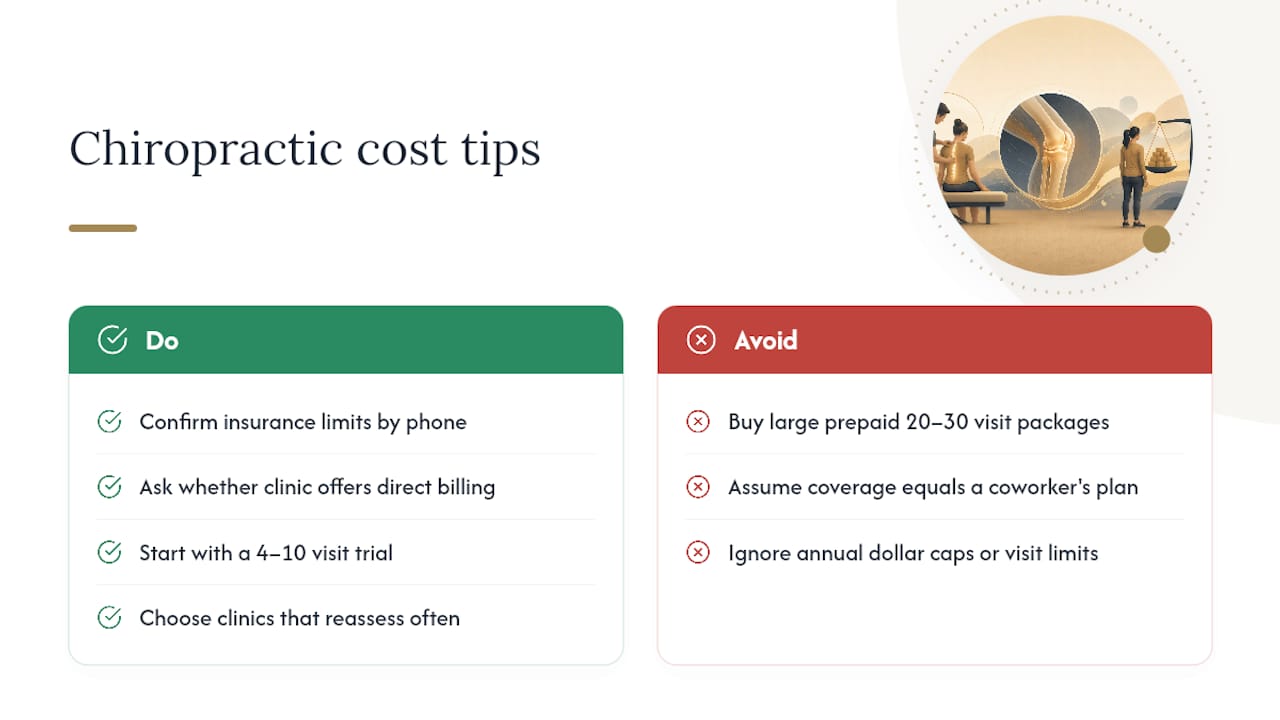
Chiropractic session fees vary by clinic and region, and most people pay per visit rather than a flat program rate. A trial of care, four to ten visits, represents a modest, defined investment before you decide whether to continue, which is one reason guideline-aligned clinics favor short trials over long upfront packages.
Insurance coverage for chiropractic care depends heavily on your specific plan. Many extended health benefits plans in Canada include chiropractic coverage, often with an annual dollar cap or a maximum number of visits per year, but details vary widely between insurers and employer plans. It’s worth calling your provider before your first visit to confirm your specific limits rather than assuming coverage matches a coworker’s plan.
Direct billing, where the clinic submits your claim straight to your insurer, removes a real logistical headache and is worth asking about when you’re comparing clinics. It doesn’t change what your plan covers, but it does mean you’re not fronting the full cost and waiting on reimbursement.
If a clinic quotes you a large prepaid package of 20 or 30 visits before any reassessment, treat that as a caution flag rather than a discount. Guideline-aligned care checks whether treatment is working every few sessions, and pricing structures should reflect that, not lock you into a long commitment before anyone knows if it’s helping.
Knee osteoarthritis is a chronic condition, and the initial trial of care is really just the starting point. What happens after your symptoms improve determines whether those gains stick around.

The exercise habits built during your home program, quad and hip strengthening, balance work, are what maintain function once formal treatment tapers off. Research on programs like GLA:D® backs this up: the education and exercise components are designed to build self-management skills you carry forward independently, not just a temporary fix that ends when sessions stop.
Most people who do well long-term settle into a maintenance rhythm rather than stopping care entirely. That might mean a chiropractic visit every few weeks instead of twice weekly, continued strength training two or three times a week, and periodic check-ins if symptoms start creeping back. Activity pacing matters here too: learning to modulate high-impact activities during flare periods without abandoning movement altogether tends to produce better outcomes than either pushing through pain or avoiding activity out of fear.
Weight management, when relevant, and staying ahead of new symptoms, rather than waiting for a bad flare, round out a realistic long-term plan. Knee osteoarthritis doesn’t reverse, but a well-managed case can stay stable and functional for years with the right ongoing habits.
The research on knee osteoarthritis chiropractic care is more encouraging than most people expect, and more limited than marketing sometimes suggests. Both things are true at once, and treating this as a binary, “chiropractic works” or “chiropractic doesn’t”, misses what the evidence actually shows.
What stands out across the trials and cohort data is how consistently manual therapy performs when it’s paired with exercise, and how much weaker the case gets when it’s offered in isolation. The clinics chasing quick wins with adjustment-only packages are selling a version of care the research doesn’t fully support. The ones building plans around measurable function, hip and ankle mechanics, and a defined reassessment point are working closer to what actually moves the needle.
If there’s one thing worth prioritizing, it’s this: pick a clinician who tracks your outcomes and changes course when the data says to, rather than one who keeps you on the same schedule indefinitely. Passive relief feels good in the moment. Active, measured progress is what actually protects your mobility over the next decade.
— Deane
If you’re weighing chiropractic care against physical therapy, medication, or waiting it out, Shephardhealth gives you a way to test guideline-aligned manual therapy without committing to a long, expensive program upfront. Every plan starts with an assessment that looks at your knee, hip, and ankle mechanics together, then sets measurable goals before your trial of care even begins.

That structure, short trial, clear metrics, reassessment built in, is exactly what the evidence supports and what a lot of fixed-package clinics skip. Shephardhealth also offers same-day appointments and direct insurance billing, so starting care doesn’t mean waiting weeks or paying out of pocket while your claim processes. If you want a clear picture of what happens at your first visit, read what to expect on your first chiropractic visit and book an assessment to get your baseline measurements started.
Same Day Appointments Available
We Direct Bill!