

Massage therapy reliably improves how athletes feel: it reduces delayed onset muscle soreness (DOMS), delivers small but measurable gains in flexibility, and lowers perceived fatigue, stress, and anxiety. Timing matters, too. Most benefit shows up when sessions land 24 to 72 hours post-exercise, and massage works best paired with active rehab rather than as a standalone recovery plan.
TL;DR:
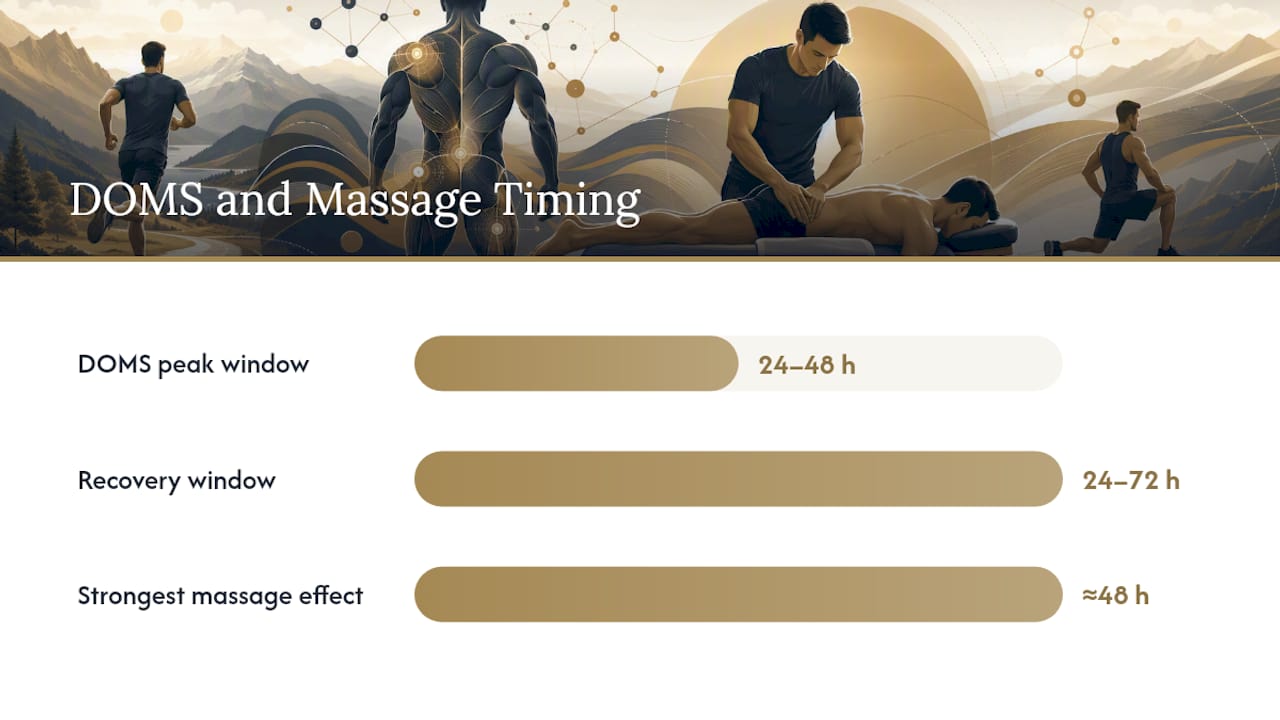
- Massage delivered 24 to 72 hours after exercise provides the strongest relief for delayed onset muscle soreness and can reduce muscle damage markers.
- Flexibility improvements from massage are consistent, especially for sports requiring a high range of motion, but it does not significantly enhance speed, strength, or endurance.
- Psychological benefits such as reduced anxiety and better sleep are linked to massage’s activation of the parasympathetic nervous system, supporting overall recovery.
- Techniques should be matched to the goal: light, brief pre-competition massage; targeted deep tissue or myofascial work for chronic tightness; and pairing massage with mobility drills to sustain gains.
- Massage is most effective as part of a broader recovery plan focused on active rehab and structural care, not as a substitute for exercise or injury management.
Want hands-on help? Start with a $67 new patient visit
A chiropractor assesses what is driving the tightness and treats it the same day when it is safe. See massage therapy in Calgary. Book online.
Athletes rarely ask “does massage work?” so much as “will this help me feel and move better before my next hard session?” The honest answer is yes, in specific and fairly predictable ways. The gains cluster into three categories: reduced soreness and fatigue, modest flexibility improvement, and psychological benefits such as better mood, lower anxiety, and improved sleep.
Delayed onset muscle soreness responds better to massage than almost any other benefit researchers have measured. Soreness typically peaks 24 to 48 hours after unfamiliar or eccentric-heavy loading, and massage delivered in that window tends to blunt the intensity athletes report. A Frontiers meta-analysis found the strongest effects on DOMS and some muscle performance markers appeared around 48 hours post-exercise, with certain trials also showing reduced creatine kinase, a blood marker tied to muscle damage. That’s a meaningful signal: it means the soreness relief isn’t purely psychological, even if the mechanism isn’t fully mapped.
Flexibility and range of motion improve consistently across the research, even when other outcomes don’t. A large systematic review and meta-analysis pooling 29 studies and over 1,000 participants found small but statistically significant flexibility improvements alongside DOMS reduction. Athletes in sports demanding a big range of motion, gymnastics, swimming, martial arts, tend to notice this more than a powerlifter chasing a one-rep max. Team-sport and strength athletes also report larger subjective gains from deep tissue work, and one study found bi-weekly sessions outperformed sporadic single visits for flexibility outcomes across different sports.
Psychological and nervous-system benefits deserve more attention than they typically get in performance-focused conversations. A small study covered in the Massage Therapy Journal found that athletes receiving twice-weekly, one-hour massages before competition reported reduced anxiety and higher self-confidence. The likely mechanism involves parasympathetic activation, essentially, massage helps shift the body out of sympathetic “fight or flight” mode and toward the rest-and-digest state where actual recovery happens. That shift also supports better sleep, which matters more for athletic output than most training plans acknowledge.
Soft-tissue and adhesion effects round out the physical benefits. Therapists working on athletes with chronic tightness, scar tissue from prior injury, or persistent trigger points often use targeted pressure to improve tissue mobility in ways a general relaxation massage won’t touch. This is where technique choice starts to matter as much as the fact of getting a massage at all.
Different goals call for different techniques:
Pro Tip: If you’re deciding which technique to book, match it to your complaint, not your sport. General tightness and stress call for sports massage; a specific, stubborn knot or old scar tissue calls for deep tissue or myofascial work.
Here’s the uncomfortable truth for athletes hoping massage will shave seconds off a sprint or add pounds to a lift: the evidence doesn’t back that up. The same meta-analysis of 29 studies and 1,012 participants that found flexibility and DOMS benefits also found no clear evidence that massage improves sprint, jump, strength, or endurance performance, despite high heterogeneity across study protocols. That’s not a minor caveat. It’s the central finding.
A separate comprehensive review synthesizing 114 articles reached a similar conclusion: massage generally doesn’t change motor abilities except flexibility, but it does reduce pain, perceived fatigue, stress, and anxiety, and it supports recovery indirectly rather than through any direct physiological performance boost. Read those two findings together and a clear picture emerges. Massage changes how athletes feel and, to a lesser extent, how far they can stretch. It does not appear to change how fast, strong, or explosive they are on demand.
What the data shows: Across a pooled sample of many athletes, researchers found statistically significant improvements in flexibility and DOMS, but no measurable gains in sprint speed, jump height, strength, or endurance.
Why does the research land here instead of confirming what feels intuitively true to a lot of athletes? A few structural problems explain the gap.
That last point isn’t a knock against massage. Perceived recovery and confidence matter enormously for athletes facing multi-day competitions, tournament formats, or back-to-back training blocks. The research on sports massage and recovery doesn’t dismiss this, it simply separates it from objective performance enhancement.
So where does that leave practical decision making? Schedule massage when the goal is reducing soreness, improving how a joint or muscle group moves, or managing pre-competition nerves. Don’t schedule it expecting a personal record the next day. Treat it as a recovery and readiness tool, not a performance-enhancing intervention, and the expectations will match what the evidence can actually deliver.
One more nuance worth flagging: some individual trials have found improvements in specific muscle performance markers, like peak torque and maximal isometric force, when massage was delivered around the 48-hour post-exercise mark, according to the Frontiers meta-analysis. These findings haven’t been consistent enough across the broader body of research to overturn the larger conclusion, but they suggest timing may matter more than technique choice for the handful of measurable physiological effects that do appear.
Getting the benefit without wasting a session comes down to timing, duration, and matching the technique to the moment in an athlete’s training cycle.
Pro Tip: Don’t book a deep tissue session the day before a big event just because it’s available. If you haven’t tried a technique before, test it during a low-stakes training week first, never for the first time right before competition.
A few contraindications are worth a quick mental checklist before booking. Skip or postpone massage over an acute injury with visible swelling, a suspected fracture, an open wound, or an area with signs of infection. Athletes with certain circulatory conditions or recent surgery should get clearance before scheduling deep or vigorous work. When in doubt, a five-minute conversation with your therapist or your chiropractor before the session solves most of these questions before they become a problem mid-treatment.
No single recovery method covers every need, and treating massage as the whole recovery strategy usually means neglecting something else that matters more for a given goal. Matching the tool to the specific problem gets better results than defaulting to whatever’s most convenient.
For DOMS and general soreness, massage sits near the top of the list alongside light active recovery. For inflammation control after acute, high-intensity efforts, cryotherapy and cold exposure tend to have a more specific, immediate physiological rationale. For circulatory support during multi-day events, compression garments offer a low-effort, low-cost option athletes can wear between sessions without needing a therapist’s schedule. For psychological reset and nervous-system recovery, massage’s parasympathetic effect gives it a real edge over passive modalities that don’t involve human contact or focused attention.
Cost and time matter here, too. Foam rolling costs nothing beyond the equipment and can happen daily. In-clinic massage costs more per session but delivers targeted work on adhesions and trigger points a foam roller physically can’t reach. Most athletes get the best return combining both: self-massage for daily upkeep, professional sessions for the deeper, more specific work.
Massage addresses soft tissue tightness, general soreness, and stress. It is not a substitute for medical evaluation when something more serious is happening. A handful of warning signs should send an athlete to a physiotherapist, chiropractor, or physician instead of, or in addition to, a massage table.
Post-surgical rehab, persistent tendinopathy, and suspected structural injuries, ligament tears, stress fractures, joint instability, call for integrated care rather than manual therapy alone. In these cases, massage often becomes one piece of a broader rehab pathway that might include Active Release Technique, the Graston Technique, shockwave therapy, or a structured, exercise-based rehab program built around the specific injury.
Shephard Health approaches athletic recovery the way the evidence suggests it should be approached: massage as one tool within a broader, assessment-driven plan rather than a stand-alone fix. The clinic offers chiropractic care, Active Release Technique, the Graston Technique, laser therapy, and shockwave therapy alongside manual and sports massage work, giving athletes access to multiple modalities depending on what an assessment actually reveals.
A typical path starts with an assessment to identify whether an athlete’s complaint is muscular, structural, or a combination of both. From there, a clinician builds a targeted plan: manual therapy or massage for soft tissue tightness and soreness, instrument-assisted techniques like Graston for adhesions and scar tissue, and a home exercise program to reinforce whatever gains happen in the clinic. That home program matters more than most athletes expect. Manual therapy loosens tissue temporarily; the exercises that follow are what make the change stick.
Relevant services worth knowing about if you’re weighing your options:
The biggest mistake active athletes make with recovery isn’t skipping massage, it’s expecting it to do a job it was never built for. Massage earns its place by making training more tolerable: less soreness, better sleep, calmer nerves before competition. It does not reliably make you faster or stronger, and treating it as the centerpiece of a recovery plan usually means neglecting the strength work, mobility drills, and structural care that actually move the needle on performance and injury resistance.
A simple hierarchy works for most coaches and athletes: active rehab first, targeted manual therapy second, passive modalities last. If a movement pattern is broken or a joint is unstable, no amount of massage fixes that on its own, exercise-based correction has to lead. Massage then supports that work by managing the soreness and nervous-system fatigue that come with consistent training. Passive tools like heat, ice, or compression fill in the remaining gaps. Get that order backward, leaning on massage or passive recovery while skipping the corrective exercise, and athletes tend to plateau or reinjure the same tissue repeatedly.
— Deane
If you’ve read this far, you already know massage won’t fix a structural problem or replace targeted rehab, but it earns its place as part of a smarter recovery plan when it’s paired with the right clinical support. Athletes benefit from a combination of manual therapy, Active Release Technique, and instrument-assisted work like the Graston Technique, built around what an actual assessment shows rather than a one-size-fits-all treatment plan.

A first appointment typically starts with a conversation about your training load, current complaints, and history, followed by a physical assessment to pinpoint what’s tight, restricted, or structurally off. From there, your clinician builds a plan that might include massage, ART, or targeted treatment for soft tissue injuries, along with a home program to keep the gains between visits. If you’re dealing with recurring soreness, tightness that won’t resolve on its own, or you simply want a plan built around your specific sport, book an assessment and find out what’s actually driving the issue before it turns into something bigger.
For athletes who want to dig into the primary research behind these recommendations, the systematic review and meta-analysis on sports massage covers performance and recovery outcomes across 29 studies. The broader review of massage effects synthesizes 114 articles on motor performance and psychological benefits. The Frontiers meta-analysis focuses specifically on DOMS and muscle performance markers. Practitioner-level guidance on technique selection and season planning comes from the Massage Therapy Journal.
Yes. Massage reliably reduces DOMS, improves flexibility slightly, and lowers stress and anxiety, though it doesn’t produce direct gains in sprint speed, jump height, strength, or endurance.
For general soreness and maintenance, sessions vary in length depending on the muscle groups treated and soreness levels; deeper or more targeted work on chronic problem areas may require longer sessions.
The clearest benefits are reduced DOMS, small improvements in flexibility and range of motion, and lower perceived stress and fatigue, with some studies also noting reduced creatine kinase levels after treatment.
Massage supports the conditions that allow good performance, better sleep, lower anxiety, less soreness, rather than directly improving raw athletic output like strength or speed.
Massage targets soreness and nervous-system recovery particularly well, while tools like cryotherapy and compression are often better suited to acute inflammation control and circulatory support during multi-day events.
Same Day Appointments Available
We Direct Bill!