

Orthotics for running are shoe inserts that support and guide the way your foot loads the ground with each stride. Runners most often consider them when a recurring injury has not settled with training changes, strengthening and rehabilitation. Research on symptomatic runners links foot orthoses to less pain, and a large review links them to a lower risk of lower limb injury. The best fit comes from an assessment of how you move, not from a guess at the shelf.
This guide explains what the evidence shows, how orthotics compare with barefoot and minimalist shoes, and how to choose, fit and break in a pair. It also covers the warning signs that mean you should have your feet and gait checked.
A foot orthotic sits inside your shoe and changes how forces pass through your foot, ankle, shin and knee. Some are prefabricated inserts sold in stores. Others are custom devices made from an assessment of your foot structure and the way you run and walk.
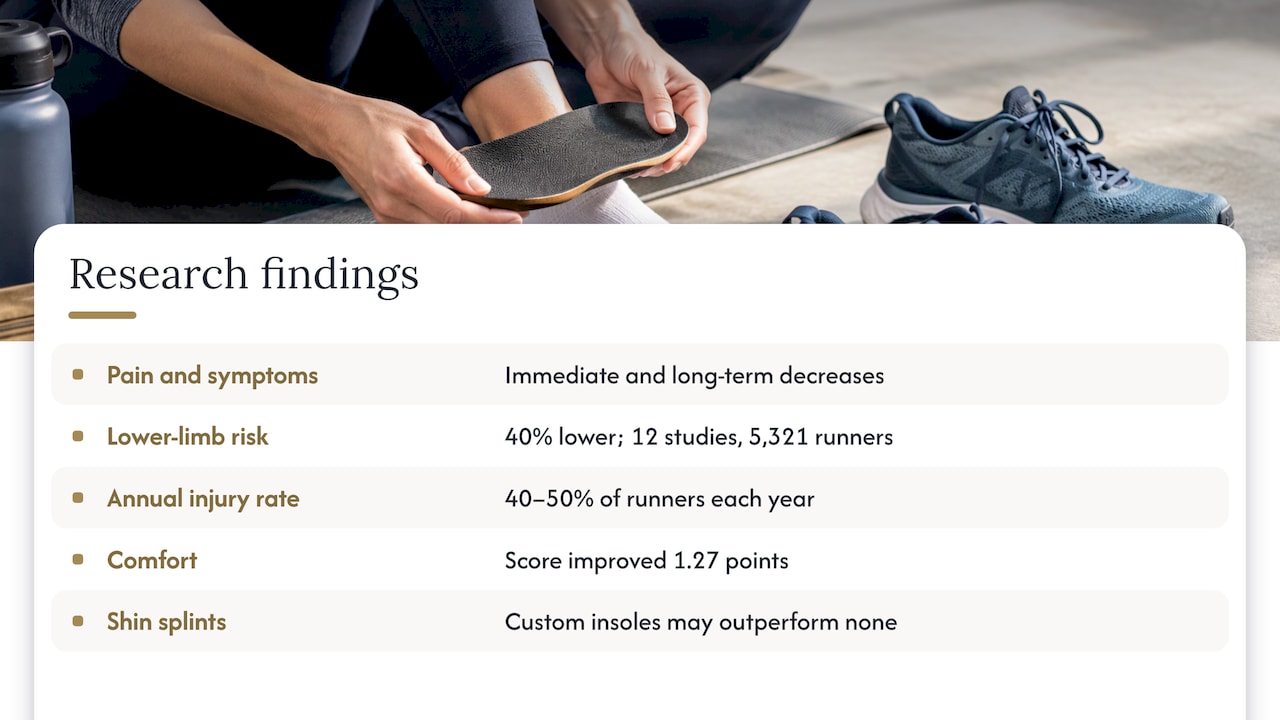
A 2024 scoping review of 30 studies covering 730 symptomatic runners found that foot orthoses decrease eversion at the foot and ankle, shift plantar pressure toward the outside of the heel and forefoot, and may change motor control strategies. In plain terms, they can alter how much your foot rolls inward and where load lands. The same review noted that the effect depends on added design features, such as a rearfoot medial wedge. That is why two orthotics that look similar can behave differently under your foot.
This also explains why a generic insert works for some runners and not others. The shape that suits a flexible, flat foot is not the shape that suits a stiff, high-arched one. Our guide to the benefits of custom foot orthotics goes deeper on how custom devices are built around the individual.
The evidence is not a single finding. It is a set of studies that point in a similar direction, each with its own scope.
Pain and symptoms. The 2024 scoping review above found that wearing foot orthoses while running is related to immediate and long-term decreases in pain and symptoms of overuse running injuries.
Injury risk. A 2022 systematic review and meta-analysis of 12 studies and 5,321 runners found that foot orthoses reduced lower limb injury risk by 40% (risk ratio 0.6, moderate-quality evidence). Running injuries are common. A 2010 review reported that they occur in 40% to 50% of runners each year, so a measure that lowers that risk matters.
Comfort. In a 2023 randomized trial of 94 runners, orthotics improved comfort scores by 1.27 points. Comfort is not a minor result. A runner who is comfortable in the shoe can keep training consistently, and consistency is what builds fitness.
Shin splints. A Cochrane review found that custom-made biomechanical insoles may be more effective than no insoles for reducing shin splints in military recruits, based on one trial of 146 participants.
Stress fractures. The 2010 review suggests that weak evidence points to orthotics possibly lessening stress-fracture risk. That is a reason to raise bone-related pain early with a clinician, not to wait.
The practical reading: orthotics are one well-supported tool for runners with overuse pain, and their value rises when they are matched to the runner. Studies average across many feet, and your result depends on how well the device suits yours.
Canadian Running Magazine advises that orthotics are considered when a runner has tried conservative options such as modified training, strengthening and physiotherapy, but still struggles with a recurring injury. That matches how we see the decision in practice. Orthotics usually come into the conversation in situations like these:
You have heel or arch pain that returns every time your mileage climbs. You have shin pain that appears at the same distance each run. You have forefoot pain under the ball of the foot, which we cover in our guide to orthotics for metatarsalgia. You have had one or more ankle sprains and your foot no longer feels stable on uneven ground. Or you have noticed that your shoes wear unevenly, on one side or on one foot more than the other.
None of these signs is a diagnosis. They are reasons to have your feet, hips and running pattern looked at together. Pain in the foot is often tied to what the calf, hip or ankle is doing, so a good assessment looks above and below the painful spot.
If you are coming back from a sprain, our phased return-to-running roadmap after an ankle sprain shows how the stages fit together, and orthotics can be one part of that plan when your clinician finds they suit you.
Runners often ask whether to wear orthotics or switch to barefoot shoes. The two ideas start from different places. Orthotics guide and support the foot. Barefoot and minimalist shoes ask the foot and lower leg to do more of the work themselves. Both can have a place in a runner’s life, and neither should be started in a hurry.
A 2021 update summarizing a 26-week study of 61 runners found no significant difference in injury incidence between conventional shoes (37%) and minimalist shoes (52%), but higher running-related pain in the minimalist group. The authors suggest most runners limit minimalist shoe use to about 35% of their training time.
Body weight changes the picture. The same study estimated that 68% of runners weighing 188 lb in minimalist shoes would likely be injured within 26 weeks, against 22% in conventional shoes. If you are a heavier runner, that gap is worth taking seriously before you change footwear.
A 2017 article in Lower Extremity Review described a 2012 study in which 10 experienced runners who moved to minimalist footwear developed eight metatarsal stress fractures, a calcaneal stress fracture and a plantar fascia rupture. The time they spent transitioning varied widely and may have played a role.
A 2023 study reported by ABC News followed 76 runners through a 20-week transition, and 70% made the change successfully. The protocol raised time in minimal shoes by no more than 20% of total running volume per week and included calf and foot strengthening. The study team also suggests using pain during and in the 24 hours after a run as a guide, and consulting a sports and exercise health professional if pain appears.
Caela Fenton of Canadian Running Magazine notes that barefoot running is tolerated by only a small portion of the population at higher mileage. She recommends mixing footwear: a few pairs of shoes to train in, barefoot strides on a soft surface, and time barefoot at home, because the small muscles of the foot can go quiet when they spend too much time in shoes.
That last point fits well with orthotic use. Many runners who wear orthotics for training also do foot-strengthening work and short barefoot drills. The device supports the foot while it is under repeated load, and the exercises build the foot’s own capacity. You do not need to pick a side.
| Question | Orthotics | Barefoot or minimalist shoes |
|---|---|---|
| Main idea | Support and guide foot motion | Let the foot and lower leg do more of the work |
| Typical starting point | Recurring injury or pain, after conservative steps | Interest in foot strength or a lighter shoe |
| How to start | Assessment, fitting, gradual break-in | Gradual increase, no more than 20% of weekly volume per the study protocol |
| Extra consideration | Fit to your foot and your shoe | Body weight and injury history |
| Pairs well with | Foot and calf strengthening | Foot and calf strengthening, assessment |
Choosing well is mostly a matter of asking the right questions in the right order. Here is the sequence we recommend.
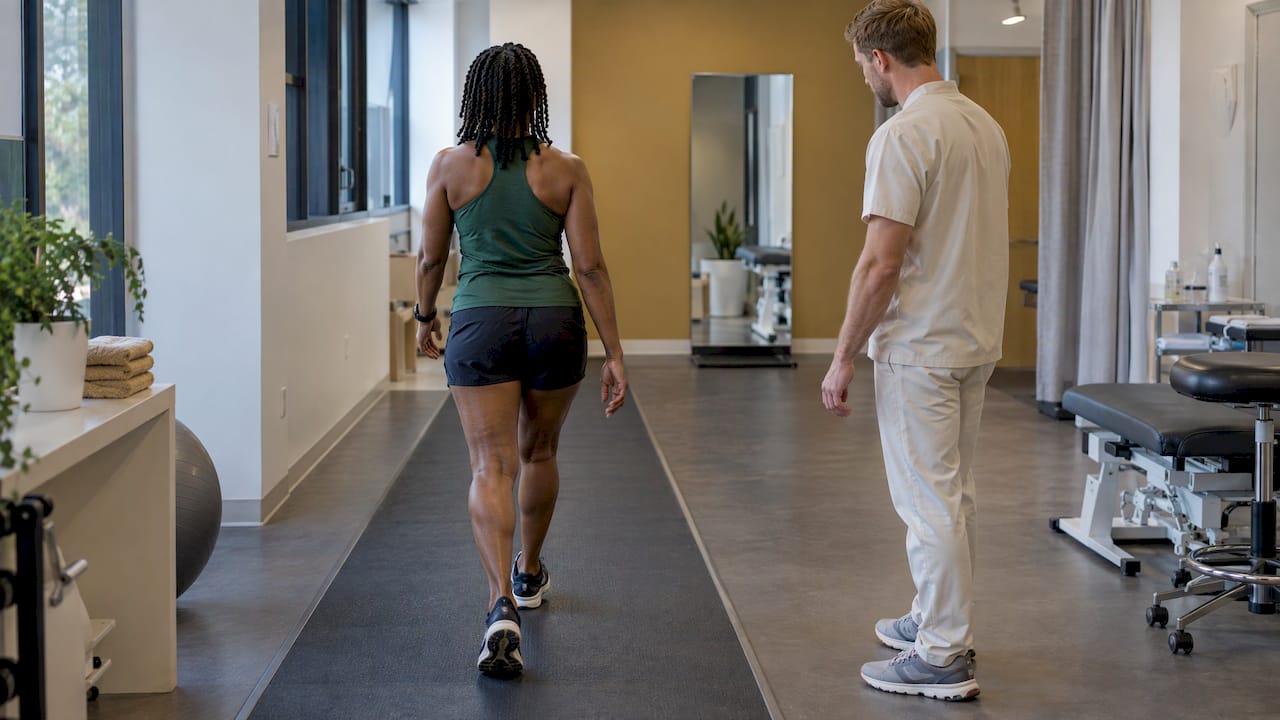
The most useful first step is a biomechanical assessment: how your foot is built, how your ankle, knee and hip move, how you stand, walk and run, and where your pain sits. An assessment can show whether the foot is the main driver of your problem or whether hip weakness, calf tightness or training load is more important. It also tells you whether an insert is likely to help.
Off-the-shelf inserts are a reasonable starting point for some runners. Custom orthotics are made from your own measurements and your clinician’s findings, so the shape, firmness and added features such as a medial wedge can be set for your foot. The 2024 review noted that such design features influence effectiveness, which is an argument for matching the device to the person. Our custom foot orthotics service is built around that kind of individual match.
Orthotics work inside a shoe, so the shoe must have room. Bring the shoes you actually run in to your appointment, along with a pair or two that you have worn out. Wear patterns tell a clinician a lot. Check that the insole in your shoe can be removed and that the heel stays secure with the device in place. Plan for a fitting check after you start, because a device that fits the foot but crowds the shoe will not be comfortable.
Tell your clinician how far you run, on what surfaces, and whether you race, train for trails, or mostly run on pavement. A runner logging a few easy kilometres a week and a runner training for a marathon do not load their feet in the same way. Mention other sports and work too. If you stand all day at work, you may want a device that also suits your everyday shoes.
Orthotics work best as part of a plan. That plan may include manual therapy for tight or irritated tissue, strengthening, a change in training load and a timeline for return to full running. If you want to know how treatments fit together, our guide to soft tissue damage recovery timelines lays out the stages.
A new pair of orthotics changes how your foot loads the ground, and your body needs time to adapt. Most clinicians suggest wearing a new pair for short periods at first, building up over days, before using them for a long run. Your clinician will give you a schedule that suits your device and your feet. Follow that schedule rather than a general rule, and apply the same logic the transition research uses for minimalist shoes: change one thing at a time, and build up gradually.
A sensible pattern looks like this. Wear them for walking and daily activity first. Move to a short, easy run. Then extend the distance over the following weeks, with your regular training load held steady rather than increased at the same moment. If you change shoes, mileage and orthotics all at once, you will not know which change caused any new soreness.
Expect to notice the device. A mild awareness of the arch or heel is common early on. Mild, short-lived soreness that settles can be part of adjustment, but that is a judgment for your clinician, so mention it at your follow-up.
Stay safe by knowing what is not normal. Contact a clinician if you notice any of the following when you use orthotics or increase your running:
Pain that is sharp, localized to one spot on a bone, or that worsens with each run. Pain that continues into the 24 hours after a run, which the barefoot transition researchers use as a guide. Numbness, tingling or burning in the foot. Swelling, bruising or a change in color. Blisters or hot spots that keep appearing in the same place. New knee, hip or lower back pain that begins after you start using the device. Pain that wakes you at night.
Bone pain that is specific and keeps worsening needs prompt assessment, because stress injuries can progress when you keep running on them. If you have had an ankle sprain and feel unstable, our guide on when to see a clinician for an ankle sprain explains what to look for. If you have diabetes, poor circulation or reduced foot sensation, speak with your doctor or foot-care professional before using any new insert.
We see orthotics as one part of a larger running plan, and we believe they earn their place when they are matched to the runner in front of us.
Our approach starts with a comprehensive biomechanical assessment. We look at how your foot, ankle, knee and hip work together, and we want to know your goals: a first 5K, a half marathon, or getting back to the sport you love without pain. From there we build an individualized, evidence-based plan. For many runners, custom foot orthotics sit beside manual therapy, strengthening and a graded return to training.
We treat athletes and active families, and we know that a runner who is comfortable and confident in their shoes keeps training. That is what we aim for: less pain, better function and fewer repeat problems. If you also want to build your foot’s own strength, we welcome that, and we plan it alongside your orthotics rather than in place of them.
Deane
If you run in Calgary and your feet, shins or knees keep slowing you down, we can assess your running mechanics and tell you whether custom orthotics make sense for you. Our custom foot orthotics service sits within a clinic that also offers chiropractic care, physical rehabilitation, Active Release Technique, shockwave therapy, laser therapy and massage therapy, so your plan can cover every part of the problem. We offer same-day appointments and direct insurance billing where applicable.

You can see everything we offer on our services page or start from Shephard Health to book your visit.
Some runners do well with a prefabricated insert, especially for mild, short-term discomfort. Custom orthotics are made from your own assessment, so the shape and added features can be set for your foot, which matters because research shows design features influence the effect. An assessment is the quickest way to find out which suits you.
Research suggests they can. A 2022 meta-analysis found foot orthoses reduced lower limb injury risk by 40%, and a 2024 review linked them to less pain in symptomatic runners. Results vary from person to person, so the device should be matched to your foot and your running.
They do different jobs, and many runners use both ideas together. Orthotics support and guide the foot. Minimalist shoes ask the foot to work harder and need a slow transition, with weekly increases of no more than 20% of running volume in the study protocol. A clinician can help you plan the mix.
That depends on the device and on you, so follow the schedule your clinician gives you. In general, start with short periods of wear and build up before long runs. Keep other changes, such as new shoes or higher mileage, separate from the break-in.
See a clinician if pain is sharp, sits on one spot on a bone, lasts into the next day or keeps worsening. Numbness, swelling or pain that wakes you at night are also reasons to book. Early assessment usually makes the plan simpler.
Same Day Appointments Available
We Direct Bill!