

The exercises that help posterior tibial tendonitis are gentle calf, hamstring and shin stretches, followed by slow, controlled strengthening: seated heel raises, band inversion and, later, single-leg calf raises. The order matters as much as the exercises. Load the tendon too fast and the inner ankle pain comes back, so your plan should rise only as your symptoms allow. At Shephard Health in Calgary, we start with a biomechanical assessment so your exercises, arch support and treatment match what your foot and ankle are actually doing.
This guide walks you through each exercise, how to progress, how peroneal tendon rehab differs, and what to do when the tendon flares.
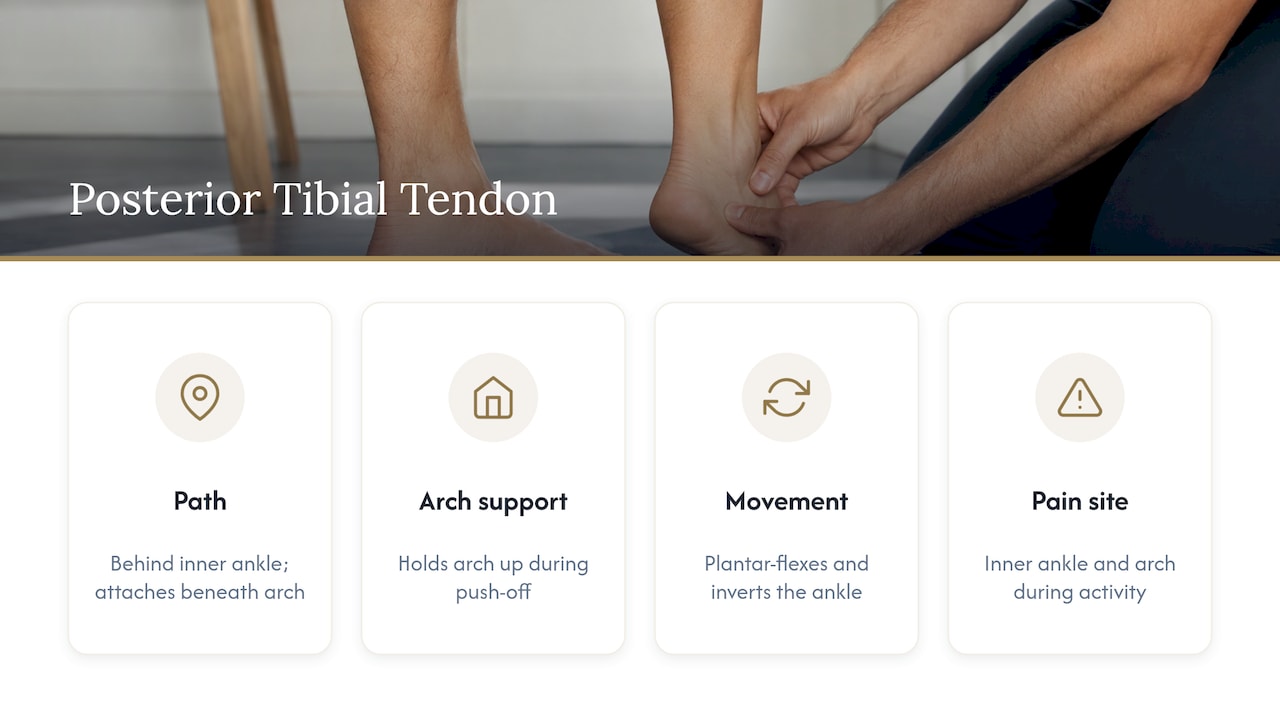
The posterior tibial tendon runs behind the inner ankle bone and attaches under the arch. It helps hold the arch up when you push off, which is why pain shows up along the inside of the ankle and the arch during walking, running and jumping. Hospital for Special Surgery lists pain over the tendon in the inner hindfoot and midfoot as the first common symptom.
According to the American Academy of Family Physicians’ 2022 review, this tendon plantar-flexes (points) and inverts (turns inward) the ankle. That is why its rehab centers on controlled inversion and on supporting the arch.
Good tendon rehab is dull and repetitive, and that is a feature. A few rules keep it working:
If you cannot tell whether a symptom is a normal training response or a setback, that is a good moment for an assessment rather than guesswork.
Tight calves and hamstrings pull the foot into more pronation and put extra demand on the tendon. Alberta Health Services recommends four stretches for posterior tibial tendinitis. Hold each for 15 to 30 seconds and repeat 2 to 4 times.
Stand facing a wall with your hands at eye level and the affected leg a step behind. Keep that back leg straight with the heel on the floor. Bend the front knee and bring your hip and chest toward the wall until you feel the calf stretch.
Where it goes wrong: lifting the back heel or letting the foot roll in. Keep the foot pointing straight ahead.
Use the same stance with both heels on the floor. Bend both knees and lean toward the wall. This version reaches the deeper calf muscle that sits lower toward the heel.
Lie on your back and hold the stretch for 15 to 30 seconds, ideally up to a minute, repeating 2 to 4 times. Alberta Health Services also describes sliding the leg up a doorway wall for at least a minute, building toward 6 minutes.
Sit with both feet flat. Bend the affected leg behind you so the top of the foot rests flat on the floor with the toes pointed away. Hold 15 to 30 seconds and repeat 2 to 4 times. Because this position loads the front of the ankle, ease into it.
Once stretching is comfortable, begin low-load strengthening. The NHS leaflet on tibialis posterior tendinopathy lays out a simple starting sequence, each done three times a day:
| Exercise | Dose in the leaflet | How to do it |
|---|---|---|
| Seated heel raises | 10 reps × 5 sets | Sit with feet flat, lift heels slowly, lower slowly |
| Towel pick-up | 30 seconds × 5 sets | Scrunch a towel with your toes to wake up the arch muscles |
| Self-resisted eversion | 30 seconds × 5 sets | Push the outside of the foot against your other foot |
| Standing calf raises | 10 reps × 5 sets | Rise onto both toes, lower under control |
The leaflet then progresses to single-leg calf raises once you can complete 30 repetitions in one go.
That volume is a lot for some people on day one. If five sets feel like too much, start with fewer and build up, because the rule is that symptoms must not increase.
For posterior tibial tendinopathy, the AFP review recommends eccentric exercises over concentric ones. An eccentric exercise is one where the muscle lengthens under load, like lowering slowly. Here is the band version it describes:
The lowering phase is the work. Count three seconds down. If the band is so heavy that the foot snaps back, use a lighter band.
This is also the point where technique drifts. People often rotate the whole leg instead of the ankle, which skips the tendon entirely. A clinician watching your form for a single session can correct that quickly.
From here, you rebuild what the tendon does in daily life: holding your arch on one leg while you push off.
After that, return to walking volume, then running or sport in small increments. Rather than adding speed and distance together, add one at a time.
A flare is a short-term increase in pain after doing too much. It does not mean you have undone your progress. Here is a sensible response:
The AFP review lists ice, NSAIDs (non-steroidal anti-inflammatory drugs) and activity reduction as initial treatment. If you take NSAIDs, follow the label and check with your doctor or pharmacist if you have stomach, kidney or heart conditions or take blood thinners.
Some readers also look at red light therapy for tendon healing while they sort out the research. In our Calgary clinic, laser therapy is one of the non-invasive options we offer alongside exercise.
For most people with mild symptoms, walking at a comfortable pace is reasonable, especially with supportive footwear. The East Lancashire NHS service notes that a prescribed insole supporting the arch can make walking less painful and let the tendon settle. If walking brings on a limp or pain that lingers into the next day, reduce the distance and have the foot assessed.
Gentle massage along the inner calf can ease tightness that feeds into the tendon. Use light to moderate pressure, stay on the muscle rather than pressing hard on the tender tendon behind the ankle bone, and stop if it hurts. In clinic, we use massage therapy, Active Release Technique and Graston Technique on the soft tissues around the lower leg, and the choice depends on what we find in your assessment.
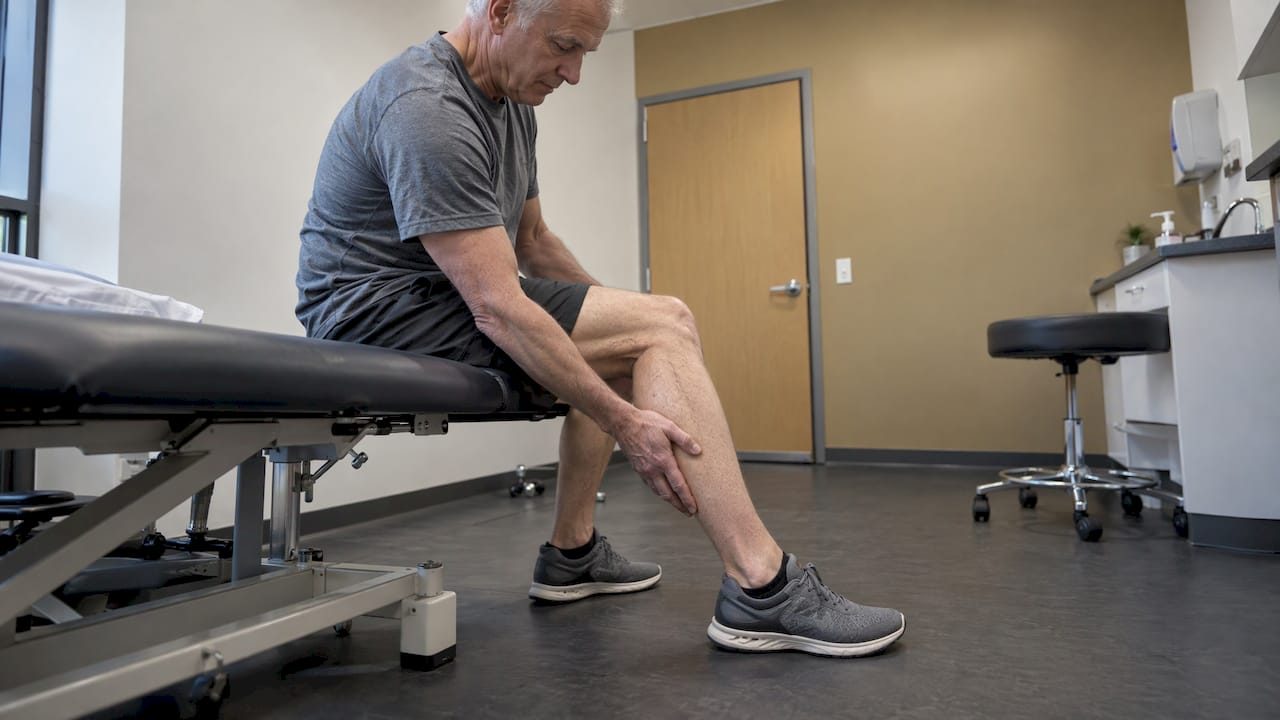
The peroneal tendons run along the outside of the ankle. The AFP review describes them as the primary ankle evertors, meaning they turn the foot outward and assist pointing the foot down. So the mirror image of the posterior tibial plan applies.
For a full phased plan, see our guide to peroneal tendonitis treatment. Since inner and outer ankle pain can look alike at first, an assessment that tells them apart saves weeks of doing the wrong exercises.
Timelines vary with how long the tendon has been irritated, your activity level and how well the arch is supported. Many people see symptoms ease over weeks, and long-standing cases take months. We do not promise a number, because a tendon that has been overloaded for a year behaves differently from one that flared after a new running block. For a general framework on how soft tissue heals, our soft tissue recovery timelines article explains the stages.
See a clinician if you notice any of these:
An untreated tendon problem can progress, so earlier assessment is usually simpler than later.
Exercise is the foundation, but a plan fits better when it is built around your own foot. At Shephard Health, we assess your biomechanics, then build an individualized plan that can combine hands-on soft tissue work, Active Release Technique, shockwave therapy, laser therapy, Kinesio taping and custom foot orthotics with your exercise progression. We offer same-day appointments and direct insurance billing where applicable.
If you are an athlete or an active adult in Calgary dealing with inner or outer ankle pain, you can book through our physical rehabilitation services.

Most tendon rehab fails for one of two reasons: the person does too much too soon, or does the right exercise with the wrong form. We built our approach around both problems.
When someone arrives with inside-ankle pain, we look at the whole chain: how the foot lands, how the arch collapses under load, how tight the calf is, and what the person needs to get back to. Exercises are prescribed from that picture, not from a handout. Then we watch the movement, because a band inversion done with the hip instead of the ankle is not the same exercise.
Our non-invasive tools, such as shockwave, laser, Active Release Technique and Graston Technique, are designed to work alongside the loading program. Taping and custom orthotics give the arch support while the tendon is rebuilt. That combination, plus same-day appointments when pain is fresh, is how we like to help active people keep moving.
Deane
Start with calf, hamstring and seated shin stretches, then add seated heel raises, band inversion and standing calf raises. Eccentric inversion with a band, where you lower the foot slowly, is the strengthening method the AFP review recommends. Progress only while your symptoms do not increase.
The stretches are the same, and Alberta Health Services lists identical ones for both conditions. The strengthening differs: peroneal rehab emphasizes eversion, while posterior tibial rehab emphasizes inversion and arch support.
The NHS leaflet gives its starter exercises as multiple sets three times a day, with progression only when symptoms stay stable. Stretches from Alberta Health Services are held 15 to 30 seconds and repeated 2 to 4 times. Your clinician can adjust the dose to your level.
Most people reduce impact while the tendon settles, then return in small steps once exercises are comfortable. Swapping in cycling or swimming keeps fitness up. If pain persists, an assessment can tell you what your tendon can handle.
Same Day Appointments Available
We Direct Bill!