

Most runners with a mild (Grade 1) sprain can start light running within one to two weeks, moderate (Grade 2) sprains typically need two to six weeks, and severe (Grade 3) or high ankle sprains often take several weeks to a few months. The real decision rule is not the calendar. You return when you pass objective checks for pain, strength, balance, and function, following the PAASS consensus framework rather than a fixed date on your training plan.
TL;DR:
- Runners with mild sprains often return to light jogging within one to two weeks if they pass functional tests, while moderate injuries need two to six weeks, and severe sprains may take several months.
- Progression depends on pain levels, swelling, weight-bearing ability, and clinician clearance, not just time spent healing.
- Rehab exercises focus on mobility, strength, and proprioception, with each stage crucial for preventing re-injury and ensuring full stability before returning to running.
- Return-to-sport requires passing specific objective tests, including hop symmetry above 90% and stable balance, rather than relying solely on elapsed time.
- Using external support like braces during the return-to-running phase reduces recurrence risk when combined with proper rehab and testing.
Foot, ankle or calf pain? Start with a $67 new patient visit
A chiropractor assesses the foot, ankle and lower leg, treats on day one when it is safe, and builds a recovery plan. See foot and ankle care in Calgary. Book online.
Recovery moves through four overlapping phases, and skipping ahead is the single biggest reason runners end up back at square one. Each phase has its own goal, its own timeline, and its own gate you need to clear before moving forward.
Phase 1: Protect and mobilize (days 1 to 7 for Grade 1, up to 2 weeks for Grade 2 to 3). The goal here isn’t rest. It’s controlled movement. Guidance from MedlinePlus recommends starting with rest, ice, compression, and elevation, but shifting to weight-bearing as soon as pain allows, often within 48 hours for mild sprains. Prolonged immobilization actually delays recovery and raises your risk of chronic instability later, according to research summarized in a BJSM systematic review overview.
Phase 2: Restore range of motion and strength (roughly week 1 through week 4, depending on severity). You’re working to get your ankle bending, flexing, and bearing load the way it did before the injury. This phase blends daily mobility drills with progressive resistance work.
Phase 3: Rebuild proprioception and dynamic control (overlaps with Phase 2, extending through week 3 to 8). Your ankle needs to relearn how to react to uneven ground, sudden direction changes, and single-leg loading, the exact demands running places on it with every stride.
Phase 4: Graded return to running (begins once you clear functional testing, detailed further down). This is where walk/run intervals, volume increases, and surface variety come into play.
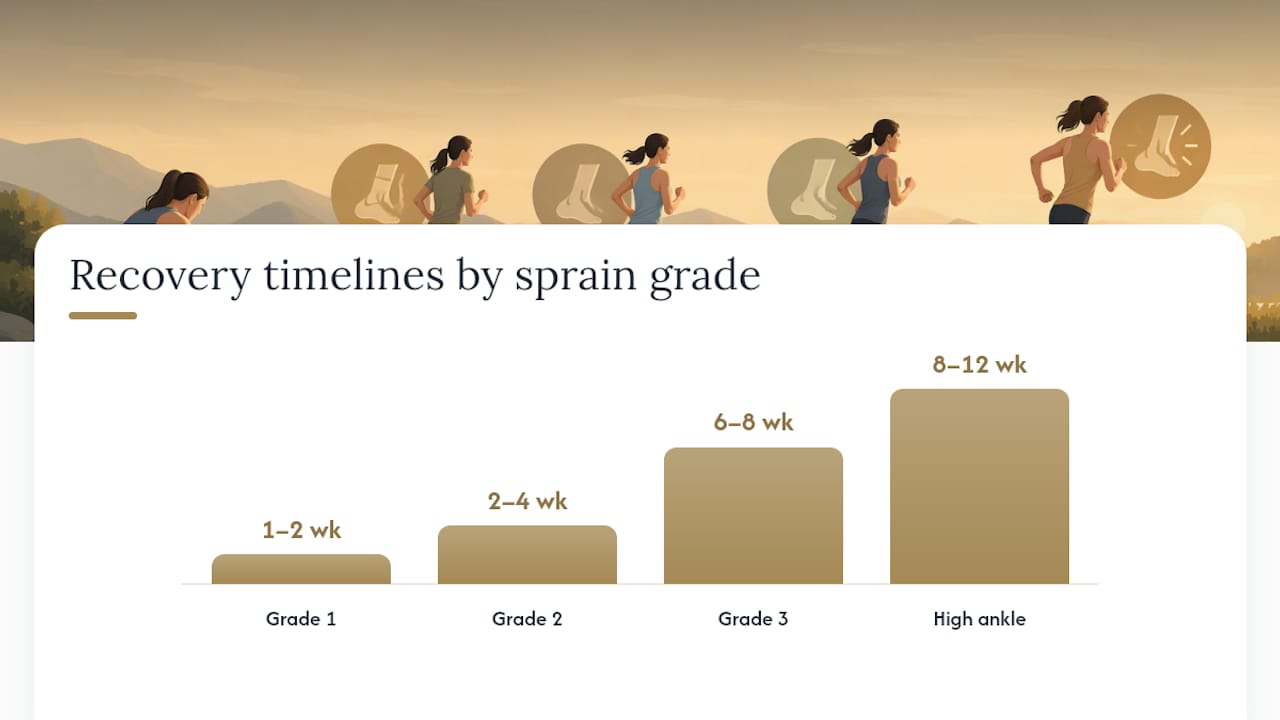
Timelines shift based on sprain grade. The American Academy of Family Physicians notes that Grade 1 sprains often resolve in one to two weeks, Grade 2 sprains in two to four weeks, and Grade 3 sprains in six to eight weeks, with high ankle (syndesmotic) sprains sometimes stretching to eight to twelve weeks.
Progression between phases depends on more than the clock:
If you’re unsure whether your injury falls into the sprain category at all versus a muscle strain, the distinction changes your expected timeline, worth confirming early so you’re not measuring your recovery against the wrong benchmark.
Three exercise categories drive recovery: mobility, strength, and proprioception. Skipping any one of them is why so many runners feel “fine” walking but still roll their ankle the first time they cut sideways on a trail.
Mobility work comes first. The ankle alphabet, tracing letters in the air with your foot, restores basic range of motion with minimal load. Weight-bearing dorsiflexion drills, where you kneel and drive your knee over your toes while keeping your heel down, rebuild the flexibility you need for a normal running stride. Calf and soleus stretches, held for 30 seconds each, prevent the tightness that often follows a sprain. Stop any mobility drill the moment you feel sharp or pinching pain. Soreness is fine; pain that changes your movement pattern is not.
Strength training follows once basic mobility returns. Here’s a practical progression:
Proprioception work is the piece runners skip, and it’s the piece that prevents re-injury. Start with single-leg balance on firm ground for 30 seconds, then progress to an unstable surface like a foam pad or wobble board. From there, add dynamic elements: reaching in different directions while balanced on one leg, then small hops and landings. This sequence retrains the nerve pathways between your ankle and brain that a sprain disrupts, which is part of why exercise-based rehab reduces re-injury risk more reliably than rest alone.
Pro Tip: Progress any exercise only when you’ve had two consecutive sessions with pain at 3/10 or under and no new swelling the next morning. Rushing this rule is the most common setback runners create for themselves.
A reasonable weekly frequency is daily mobility work, strength training every other day, and proprioception drills 4 to 5 times a week, adjusting based on how your ankle responds.
The PAASS framework, developed through international consensus among sports medicine clinicians, argues that no single test tells you whether you’re ready. Instead, you need to clear five domains: Pain, Ankle impairments, Athlete perception, Sensorimotor control, and Sport/functional performance, an approach detailed in the PAASS consensus paper. Relying on time alone, “it’s been three weeks, so I should be fine,” is exactly the mistake this framework was built to correct.
Here’s how that translates into tests you can actually perform or ask a clinician to run:
An LSI of 90% or higher on hop testing is commonly used as a benchmark for return-to-sport readiness, though recent research on hop test performance cautions that LSI alone doesn’t reliably predict who will re-injure. Movement quality matters just as much as the number. A hop that technically clears 90% but looks stiff, hesitant, or asymmetrical in landing mechanics deserves a second look before you clear it.
The safest decision flow moves in order: pass low-load tests (pain, range of motion, basic strength) before attempting dynamic control tests (balance, reach), then move to hop testing, then supervised running trials, and only then full training. Rehabilitation algorithms built for return-to-sport in professional athletes follow this exact low-load to high-load sequencing specifically because jumping straight to hop tests skips the chance to catch compensations early.
Before your first run, confirm you can walk pain-free for 30 minutes, complete single-leg balance for 30 seconds without wobbling excessively, and perform 15 single-leg calf raises without pain. If any of those fail, you’re not ready for running intervals yet, regardless of how many days have passed.
For a mild Grade 1 sprain, a faster two to three week ramp often works:
This slower ramp matches the extended tissue-healing window Grade 2 injuries need, and it gives your proprioception training more time to catch up with your cardiovascular fitness, which usually returns faster than joint stability does.
Watch for pain during or after a run that exceeds 3/10, or that lingers past 48 hours. Increased morning swelling compared to the day before, a returning limp, or a drop in your hop test performance are all signals to step back one week in the protocol rather than pushing through.
Pro Tip: Run on a treadmill or track for your first two sessions back. Predictable, even surfaces remove one variable while your ankle relearns impact loading, so you’re testing your ankle’s readiness, not the terrain’s unpredictability.

Strong evidence supports external support during the return-to-sport window. A BJSM overview of systematic reviews found strong evidence for bracing and taping to reduce recurrence, alongside moderate evidence for neuromuscular training. Combining both gives you better odds than either alone.
Most sprains recover with structured rehab alone, but certain signs mean you need professional assessment before continuing. Get evaluated promptly if you notice any of the following.
Clinicians often apply the Ottawa ankle rules to decide whether an X-ray is warranted, and imaging becomes more likely if a high ankle sprain or persistent mechanical instability is suspected. A physical therapist typically manages straightforward rehab progression, while orthopedic referral comes into play for suspected fractures, syndesmotic injury, or instability that isn’t resolving with conservative care. Expect a clinical visit to include a hands-on assessment, functional testing, and an individualized rehab plan rather than a generic handout.
Shephard Health builds ankle sprain rehab plans around the same evidence base covered here, translated into a structured, clinician-guided sequence rather than a one-size-fits-all handout. A typical 6 to 8 week clinician-backed pathway moves through five stages:
Clinicians may layer in adjuncts like Active Release Technique or kinesio taping when soft tissue restriction or support needs call for them, though these are supplementary tools rather than mandatory steps. Progress gets documented against objective tests at each visit, so clearance to run is based on data, not a guess about how many weeks have passed.
The conventional advice, “give it six weeks and you’ll be fine,” persists because it’s simple, not because it’s accurate. Two runners with what looks like the same Grade 2 sprain can have wildly different single-leg hop symmetry at four weeks. One might be ready; the other might be one bad landing away from a repeat injury. Time is a rough proxy for tissue healing, but it tells you nothing about whether your nervous system has relearned how to stabilize your ankle under load, which is usually the actual cause of re-injury.
Where I think most runners go wrong is treating proprioception work as optional, something to add “if there’s time” after strength training. The research doesn’t support that ordering. Balance and reactive control work is what closes the gap between “my ankle doesn’t hurt anymore” and “my ankle can handle an unexpected root on a trail run.” If you take one thing from this article, let it be this: don’t schedule your first run by the calendar. Schedule it by your hop test symmetry and how your ankle feels on unstable ground, not how many weeks have passed since you rolled it.
— Deane
This article is general information, not a substitute for advice from a qualified doctor. Consult a qualified healthcare professional about your own circumstances before acting on anything here.
For deeper detail on the standards behind this article, the PAASS consensus framework outlines the return-to-sport assessment domains, AAFP’s patient guidance covers expected recovery timelines by grade, and the BJSM systematic review overview summarizes the evidence behind bracing and exercise-based prevention.
It depends on severity rather than a fixed number of days. Mild (Grade 1) sprains often allow light running within one to two weeks, while moderate sprains need two to six weeks and severe or high ankle sprains can take six to twelve weeks. The better question is whether you’ve passed functional tests like single-leg hop symmetry, not how many days have elapsed.
Two weeks is often enough for a mild Grade 1 sprain if you’re pain-free, have full range of motion, and pass balance and hop testing. For a Grade 2 or Grade 3 sprain, two weeks usually isn’t sufficient, since those injuries typically need two to eight weeks or longer before tissue healing and stability catch up.
A fracture is a different injury from a sprain and follows a longer, bone-healing timeline set by an orthopedic provider, often involving imaging and a structured non-weight-bearing period before rehab even begins. Return-to-run decisions after a fracture should come from your treating physician, not a general sprain timeline.
Running through acute pain or instability risks re-injury and can extend your recovery well beyond the original timeline. Wait until you can walk pain-free, complete single-leg balance and hop tests near your uninjured side’s performance, and have clearance based on the PAASS assessment domains rather than pushing through discomfort.
Same Day Appointments Available
We Direct Bill!