

Most shoulder instability is treated first with a structured rehabilitation program, not surgery. The goal is to rebuild the control of the muscles around the joint, so your shoulder stays stable when you reach, lift, throw or sleep. Expect about 12 weeks of consistent, progressive work before judging the result. Surgical opinions come into the picture if that work does not give you a stable, usable shoulder, or if you have had a dislocation with high-risk features. This guide explains how instability is assessed, what the exercise stages look like for multidirectional instability, how long recovery usually takes, and which signs mean you should get care sooner.
Your shoulder is the most mobile joint in your body. The ball of the upper arm sits on a shallow socket, so stability depends heavily on ligaments, the labrum and, above all, muscle control. Instability happens when that system cannot keep the ball centered while you move. It ranges from a full dislocation, where the joint comes out completely, to subluxation, where it slips partway, to a vague sense that the shoulder is loose or about to give way.
There are two broad patterns. Traumatic instability follows a specific event such as a fall or a tackle. Non-traumatic instability develops gradually, often in people with naturally flexible joints, and it can affect both shoulders. Multidirectional instability (MDI) is the form where the shoulder is loose in more than one direction, for example forward, backward and downward.
A 2025 scoping review of assessment and diagnosis of non-traumatic shoulder instability found that it often affects young individuals and shows up as a mix of problems: poor neuromuscular control, muscle imbalances and altered shoulder movement. The same authors note that its causes and presentation are multifactorial, and that clinical history is crucial for understanding a complex, long-standing problem. The review also suggests that orthopaedic special tests and routine imaging have limited value as a first step.
In practice, that means a good assessment relies on listening and watching. At your first visit, expect questions such as:
Then we look at how your shoulder blade moves, how your rotator cuff and deltoid fire, how your neck, upper back and trunk contribute, and where your control breaks down. If you want a sense of how a first appointment flows, our guide on what to expect on your first chiropractic visit walks through it.
A 2022 review of non-operative management of shoulder instability recommends a shoulder muscle rehabilitation program as the initial treatment for MDI. Strengthening and retraining the scapular muscles, the rotator cuff and the deltoid helps make up for a lack of passive stability and restores active control of the joint.
The key idea is that you cannot tighten a loose ligament with exercise, but you can teach the muscles to hold the joint in the right place before the joint reaches its end range. That is why good rehab for instability looks different from a generic shoulder strengthening plan. It starts with control, not load, and it progresses only when you can keep the movement clean.
A complete plan usually combines several parts:
Motor control work. Gentle, precise exercises that teach the shoulder blade and rotator cuff to switch on at the right time.
Strength and endurance. Progressive loading once control is reliable, so the shoulder tolerates daily demands and sport.
Movement and posture habits. Changes to how you sit, sleep, lift and train, so you stop repeatedly stressing the joint in its loosest position.
Work on neighbouring areas. Stiff upper back, tight chest or neck muscles and irritated nerves can all affect how your shoulder behaves.
Our related guides cover the building blocks in more detail: rotator cuff rehab exercises, serratus exercises for scapular control and shoulder impingement exercises. Many people with an unstable shoulder also have overlapping problems like these, so a plan often borrows from all three.
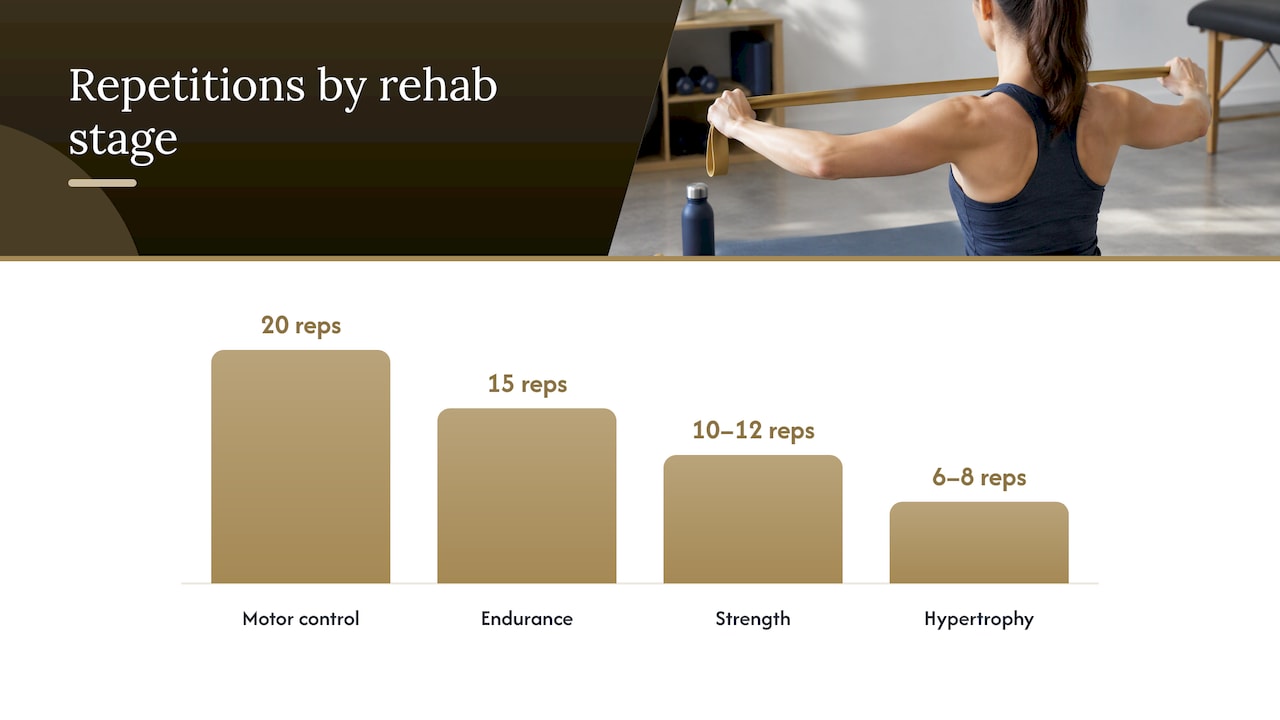
Readers often ask which exercises to do and how many. The 2022 review gives a useful framework, built on what clinicians call dosage stages. The published dosages for MDI rehab move through four steps:
| Stage | Typical dosage | Purpose |
|---|---|---|
| Motor control | 1 to 2 sets of 20 repetitions, 5 second holds, 2 to 3 times a day | Re-learn timing and position |
| Endurance | 2 sets of 15 repetitions, 2 to 3 second holds, once a day | Build staying power |
| Strength | 3 sets of 10 to 12 repetitions, every second day | Add load with weights |
| Hypertrophy (if needed for sport) | 3 sets of 6 to 8 repetitions, 3 times a week | Prepare for high demands |
The same review describes the Watson six-stage program. Stage 3 builds control of lifting from 0 to 45 degrees, Stage 4 works through the mid-range of 45 to 90 degrees, Stage 5 strengthens the deltoid, and Stage 6 returns you to real-life and sport-specific movements. You move on only when you can keep perfect control and stay pain-free at the current stage.
Examples of exercises named in the review include isometric internal and external rotation holds (5 sets of 5 to 10 second holds at 50 to 70 percent effort), shoulder blade setting drills, wall push-ups and pendulum swings. None of these look dramatic, and that is the point. They are meant to be done slowly and accurately.
Some practical rules we give patients:
The load is only part of the picture. Calm, controlled breathing and slow movement help many people notice their shoulder position. A gentle qigong routine for shoulder mobility can be a low-intensity way to practise slow, controlled arm movement on days when you are not doing your formal rehab, as long as it stays inside your pain-free range.
Because MDI varies so much from person to person, a printed exercise list rarely replaces a plan built around your own movement pattern. That is where hands-on assessment and supervised progression pay off.
The honest answer is weeks to months, not days. The Watson instability program is a 12-week program, and studies reported improved outcomes at 12 and 24 weeks. The authors describe significant functional improvement after about 6 weeks, scores of around 80 percent of a normal shoulder closer to 12 weeks, and the largest treatment effects at 24 weeks. That later point is when many overhead athletes can expect to restart full training.
In Alberta, the Alberta Health Services MSK Shoulder Assessment Clinical Pathway calls for at least 12 weeks of appropriate physical therapy for shoulder instability, whether at home or supervised, as long as it is active and strength-based. If you have not reached a pain-free shoulder with improved range of motion by 6 weeks, the pathway adds pain control such as an oral anti-inflammatory or a topical analgesic and continues therapy for another 6 weeks.
Signs that you are on track:
Progress is rarely a straight line. A flare after a long day of lifting or an extra hard workout does not mean you are back to square one, but it is a cue to drop back a step for a few days and tell your clinician.
If you do have a stabilization procedure, rehab is still the main event. The post-operative protocol from Queen’s University in Kingston has supervised physiotherapy starting 1 to 2 weeks after surgery and continuing for 3 to 6 months. It stresses that progression depends on the individual, and that revision surgery or larger repairs are often delayed. Follow your surgeon’s protocol exactly, since it will differ from the non-operative plan described above.
Rest is not the answer on its own. The NICE Clinical Knowledge Summary on instability disorders states that keeping the arm immobilized for more than a week does not lower the chance of another dislocation, and advises moving the shoulder as soon as pain allows, with early referral to physiotherapy that may help.
That said, some positions deserve caution while control is still being rebuilt. Without surgery, we typically ask people to temporarily modify:
After surgery, the limits are stricter and time-based. In the Queen’s protocol, the sling is worn at all times for at least 4 weeks except during physiotherapy, external rotation with the arm out at 90 degrees is avoided for 12 weeks, and pushing, pulling or heavy lifting is avoided for at least 6 weeks. Low-speed throwing, controlled racket sports and non-contact hockey may begin at about 3 months, while competitive throwing, racket sports and contact sports progress from about 6 months. Your surgeon’s instructions always take priority over general guidance.
If your shoulder issue involves a stiff or painful joint rather than looseness, our guide to frozen shoulder treatment explains why the approach is different. Our page on movements to avoid or modify during scapular recovery is also useful when shoulder blade control is part of your problem.
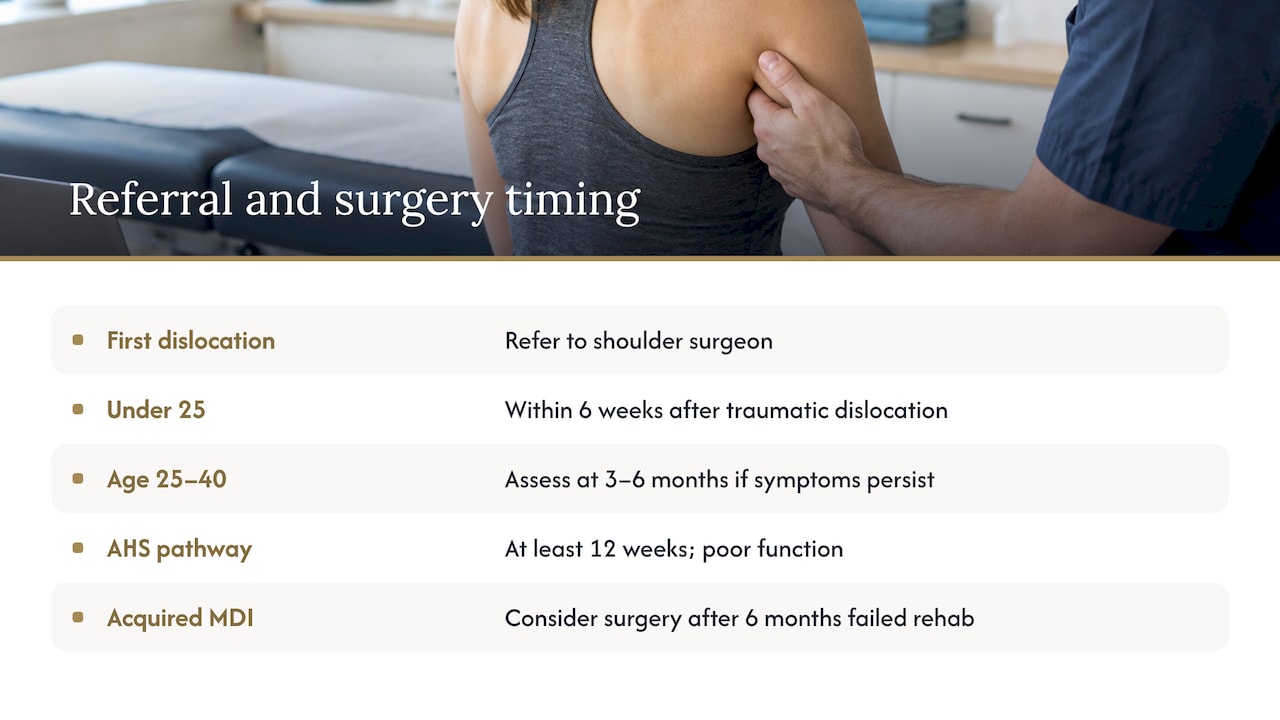
Rehab is the first step, but it is not the only one. NICE advises referral to a shoulder surgeon after a first-time dislocation, recurrent painful dislocations, symptoms that affect work or leisure, symptoms that do not improve with physiotherapy, or associated injuries such as a fracture. For a traumatic dislocation, NICE says people under 25 should be seen by a shoulder surgeon within 6 weeks to consider surgical repair, while people aged 25 to 40 should be assessed at 3 to 6 months if symptoms persist.
In Alberta, the AHS pathway says that when appropriate non-operative care has been tried for at least 12 weeks and a young, high-functioning patient, or one over 40, still has a poor functional outcome, referral through the Provincial Orthopaedic Referral Pathway is recommended. The pathway’s ideal timelines are about 6 weeks to assessment and another 6 weeks to a surgical consult.
For acquired MDI specifically, the 2022 review says surgery may be considered if 6 months of evidence-based rehabilitation fails. For anterior instability after a dislocation, the BSM Foundation notes that surgery may be recommended for people at high risk of recurrence, such as young males, contact or collision athletes, or those with significant bone injury. Common procedures include arthroscopic Bankart repair and the Latarjet procedure when there is substantial bone loss on the socket. It also emphasizes shared decision-making, weighing the benefits and risks of surgery with your surgeon.
The takeaway: a well-run rehab block is not a detour. It either solves the problem, or it gives your surgeon a clear picture of what non-operative care could not do.
A suspected dislocation is a medical emergency. NICE guidance is clear that neither the injured person nor bystanders should try to put the joint back. Go to an emergency department for assessment, imaging and reduction in a controlled setting.
The AHS pathway also says that if you cannot lift your arm forward to 90 degrees, you should be referred urgently for an orthopaedic surgical consult within 2 weeks. Numbness, a cold or pale hand, or sudden severe weakness after an injury also warrant prompt medical attention. A chiropractor or physiotherapist can help you decide where to go, but do not wait for a clinic appointment in these situations.
In our experience, the most common mistake with an unstable shoulder is treating it like a tight one. Stretching and forceful mobilizing of a joint that already moves too much rarely helps. What helps is a careful biomechanical assessment, then a plan that teaches your shoulder blade, rotator cuff and deltoid to share the work.
We build that plan around your goals, whether that is lifting, swimming, playing hockey or simply carrying your kids without worry. Our multidisciplinary approach lets us look beyond the shoulder itself, at the neck, mid-back and nerve mobility that influence how it behaves. Where it fits your presentation, we add supportive tools such as Active Release Technique, Graston Technique, laser therapy, shockwave therapy, massage and Kinesio taping to calm irritated tissue so you can keep training your control.
We believe in evidence-based, individualized care, and we will tell you clearly when a surgical opinion makes sense. Working toward that conversation with a solid rehab record is good for you and for your surgeon.
Deane
If your shoulder feels loose, catches, or slips during sport or daily tasks, a structured assessment is the best first step. At Shephard Health, our team in Calgary combines physical rehabilitation with hands-on and technology-supported options. Same-day appointments and direct insurance billing are available where applicable, so you do not need to wait for a long referral to start moving in the right direction.

You can explore the therapies we use to settle irritated tissue around the shoulder: Active Release Technique, Graston Technique, laser therapy, shockwave therapy and massage therapy. Our chiropractic care page explains how an assessment-led plan comes together. Book online through our site or contact the clinic to arrange your visit.
Many people improve with a structured rehabilitation program, and non-operative care is the usual first treatment for multidirectional instability. Rehab does not tighten stretched ligaments, but it can restore active muscle control so the shoulder functions well. If a proper program does not work, a surgical opinion is the next step.
Program design starts with motor control work such as shoulder blade setting, isometric rotation holds, wall push-ups and pendulum swings. It then builds toward endurance and strength with weights. The right exercises and dosage depend on your movement pattern, so have a clinician assess you before progressing.
Plan for at least 12 weeks of consistent work. Studies of a 12-week program reported improvements at 12 and 24 weeks, with the largest effects at 24 weeks. Overhead athletes often need the longer timeline before returning to full training.
You usually do not need to stop everything, but you should modify loaded, end-range and overhead movements until you can control them. Avoid contact sport if the shoulder has dislocated until you are cleared. A dislocation needs emergency care, not self-treatment.
Same Day Appointments Available
We Direct Bill!