

Back sleeping and side sleeping are the best options for most people with neck pain, and stomach sleeping is the one to retire for good. Tonight, measure the distance from your ear to the tip of your shoulder and match that to your pillow’s loft, usually 4 to 6 inches, so your neck stays level with your spine instead of tilting up or dipping down.
TL;DR:
- Sleeping on your back or side, with a pillow altura matching your ear-to-shoulder measurement, reduces neck pain risk, unlike stomach sleeping which strains neck joints.
- Testing pillow loft by measuring from ear to shoulder and adjusting fill ensures proper neck support, with contoured or adjustable pillows outperforming flat ones.
- Gradually shifting from stomach to back sleeping by adding support and using small changes is more effective than abrupt position changes.
- Short nightly stretches and heat therapy before bed can lessen morning stiffness, but persistent pain requires professional evaluation.
- When self-care fails after weeks, an assessment of posture, joint mobility, and muscle imbalances helps identify underlying issues needing targeted treatment.
Neck pain or headaches? Start with a $67 new patient visit
A chiropractor assesses your neck, upper back and posture, and treats on day one when it is safe. See neck pain and headache care in Calgary. Book online.
Your cervical spine has a natural curve, and it wants to stay in that curve all night, not get bent, twisted, or compressed for eight hours straight. Back sleeping and side sleeping let you support that curve because your head, neck, and spine can line up in a single, neutral row. Stomach sleeping does the opposite: it forces your head to rotate to one side for hours, which strains the joints and muscles on that side of your neck and often leaves you stiffer in the morning than you were the night before.
A 2025 systematic review looking at sleep posture and spinal pain found that supine sleeping and supportive side-lying were both linked to a lower prevalence of pain, while prone sleeping raised the risk. The review’s authors recommended ergonomic fixes, like proper bedding and posture education, over just telling people to “sleep better.”
Anatomy still plays a role here. A few things shift the calculation from person to person:
That’s why Sleep Foundation guidance treats back and side sleeping as strong defaults, not a one-size-fits-all prescription.
Most pillow shopping goes wrong because people buy based on a label like “orthopedic” or “cervical” instead of testing what actually holds their neck straight. The label means very little if the loft doesn’t match your body, so testing to personal fit matters.
Here’s the test that matters more than any marketing claim:
Contoured cervical pillows and adjustable-fill designs tend to outperform flat pillows at holding that curve, but plenty of people do just as well with a firm, medium-loft pillow paired with a rolled towel tucked under the neck for extra support. Feather pillows are the one to watch. They commonly lose their loft within about a year, so a pillow that felt supportive last spring might be doing nothing for you now.
If you’re side sleeping and one pillow never feels quite right, try a second, thinner pillow between your knees to level your hips and take pressure off the lower spine and neck. A mattress that’s too soft lets your hips and shoulders sink unevenly, which drags your neck out of alignment no matter how good your pillow is.
Pro Tip: Keep a rolled towel inside your pillowcase for a week as a trial run before buying a specialty pillow. It’s the cheapest way to find out whether more cervical support actually helps you.

Each sleep position has its own failure points, and most people are one small tweak away from fixing theirs.
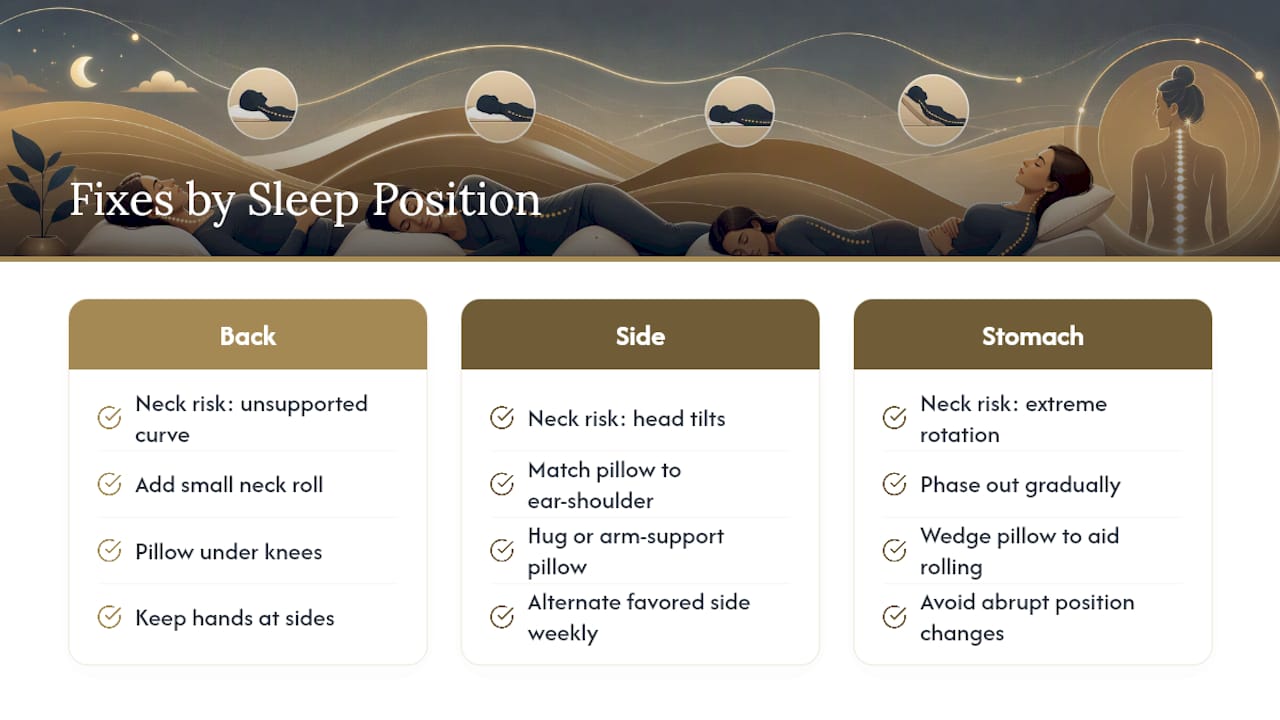
Back sleepers: Add a small neck roll or rolled towel under the curve of your neck, not under your whole head. Slide a pillow under your knees to reduce lower back arching, which indirectly eases neck tension too. Keep your hands at your sides or on your stomach. A small 2017 EMG study found that sleeping with a hand on the forehead spiked activity in the upper trapezius and scalene muscles, the same muscles that ache when neck pain flares.
Side sleepers: Match pillow height to your ear-to-shoulder measurement so your head doesn’t tilt down or get pushed up. Hug a pillow or rest your top arm on one in front of you instead of letting it flop across your body or under your head. Alternate which side you favor over the week. Physical therapists note that always sleeping on the same side can build muscle imbalances that show up as pain later.
Stomach sleepers: This is the position to phase out gradually rather than quit cold. Wedge a pillow along one side of your body to make rolling onto your back feel more natural, and give it a couple of weeks. Clinicians recommend small, gradual changes over forcing an abrupt switch, since forcing it usually means you just roll back over at 2 a.m.
Muscle tension doesn’t wait for you to wake up to start bothering you. It builds overnight, and a short routine before you turn off the lights can head off a lot of that stiffness.
Clinical guidance on neck pain supports short daily stretching sessions like this one for reducing stiffness and improving range of motion over time. If your muscles feel especially tight, a warm towel or heating pad for 15 to 20 minutes before bed can help them relax, though you should avoid heat directly on irritated or numb skin.
What you do earlier in the day matters too. Slouching over a phone or laptop for hours puts your neck in the same strained position you’re trying to correct at night, so cutting off screens earlier and checking your daytime posture pays off well before bedtime. A consistent bedtime routine also helps your whole body wind down, not just your neck.
A flare-up at 3 a.m. doesn’t call for a full workout, just a few smart moves.
Most neck pain from sleep position responds to the fixes above within a few weeks. Some cases don’t, and a handful come with warning signs that mean you shouldn’t wait that long.
If your pain persists or gets worse after a few weeks of consistent self-care, it’s time for an assessment rather than another pillow swap. Sleep-position changes often provide short-term relief, but lasting recovery frequently depends on identifying what’s driving the pain during the other sixteen hours of your day too. A clinician can evaluate joint mobility, muscle imbalance, and posture patterns that a pillow alone can’t fix, and can point you toward chiropractic care or targeted therapy if that’s what the evaluation points to.
Most sleep advice treats the pillow like the whole problem, and that’s the part I’d push back on. Sleep posture is one variable in a 24-hour equation. If you spend nine hours a day hunched over a keyboard and then buy a $150 cervical pillow expecting it to undo that, you’re going to be disappointed. The research backs a specific, testable claim: back and side sleeping, matched to your own ear-to-shoulder measurement, reduce strain. It doesn’t back the idea that any single product solves chronic neck pain on its own.
What I find useful about Shephard Health’s approach is the emphasis on individualized assessment before recommending a fix, whether that’s Active Release Technique, laser therapy, or straightforward chiropractic adjustment. Self-care and professional care aren’t competitors here. Try the pillow test tonight. If you’re still waking up stiff in three weeks, that’s information, not failure.
— Deane
Adjusting your pillow and swapping sleep positions solves a lot of cases, but not all of them. When neck pain sticks around despite doing everything right at bedtime, some clinics offer same-day assessments to figure out what’s actually going on, avoiding weeks-long waits.

Your first visit isn’t a generic script. It starts with an assessment of your posture, joint mobility, and muscle patterns, so the plan built for you actually matches your case instead of a template. You can see exactly what to expect on your first chiropractic visit before you ever book. Depending on what that assessment turns up, your plan might include chiropractic adjustment, Active Release Technique, or laser therapy for tissue that’s been irritated for a while, along with insight into how regular chiropractic care supports long-term neck health beyond just the sleep fixes covered here.
Some clinics bill insurance directly and offer same-day appointments, so you don’t have to sit on a growing problem while you wait for an opening. If your neck pain has outlasted a few weeks of pillow adjustments, book an assessment and find out what’s actually driving it.
This article is general information, not a substitute for advice from a qualified doctor. Consult a qualified healthcare professional about your own circumstances before acting on anything here.
Progressive arm or hand weakness, spreading numbness or tingling, changes in bowel or bladder function, unrelenting severe pain, or pain following recent trauma all warrant prompt medical evaluation rather than continued self-care.
No. Sleeping flat without support usually lets your head tilt out of a neutral position, especially for side sleepers. Most people need a pillow matched to their ear-to-shoulder measurement, not the absence of one.
The most reliable trick is rolling a small towel or dedicated neck roll and placing it under the curve of your neck, which fills the gap a flat pillow leaves and helps maintain your spine’s natural curve overnight.
A short routine of chin tucks, ear-to-shoulder stretches, and gentle rotation, done for 5 to 10 minutes, offers the quickest relief for muscle-related stiffness. Persistent or worsening pain calls for a professional assessment rather than repeated at-home fixes.
Same Day Appointments Available
We Direct Bill!