

Non-surgical spinal decompression is one option within a broader conservative plan for spinal stenosis, not a stand-alone cure. The best Canadian guidance favours a combination of education, manual therapy and exercise, and decompression can sit inside that plan when your assessment supports it. Surgery is usually reserved for people whose symptoms stay disabling despite good conservative care, or who have warning signs that need urgent attention.
This guide explains what stenosis is, what decompression therapy does and does not do, what the research says, who should be screened carefully, and how to decide your next step.
Spinal stenosis happens when the space inside the spine becomes too small, which puts pressure on the spinal cord and nerves. In the lower back, that often shows up as leg pain or cramping while standing or walking that eases when you bend forward or sit down.
That pattern is a useful clue. Many people with lumbar stenosis notice they can walk much farther pushing a grocery cart or leaning on a bike than they can walking upright. The Canadian Chiropractic Guidelines describe the presentation as buttock or leg pain, heaviness, cramping, numbness, tingling or weakness brought on by standing or walking and eased by sitting or bending forward.
Two points from the same guidance matter for you. First, imaging and symptoms do not always match: some people with a markedly narrowed canal on MRI have mild symptoms, and some with modest findings are quite limited. Second, a working diagnosis comes from your history, a hands-on examination and imaging when it is needed. A scan alone does not decide your plan.
Non-surgical spinal decompression uses a motorized table that applies controlled, gradual traction to the spine. The intent is to gently lengthen the spine and reduce pressure on irritated structures. You stay clothed, lie on the table, and are secured with a harness while the table cycles through traction and rest phases.
It differs from surgery in a fundamental way. Surgical decompression directly removes bone or disc tissue from compressed nerve roots, using open or minimally invasive techniques. Non-surgical care aims to reduce symptoms and improve movement without removing the narrowed anatomy. So the goals are different: with traction-based care we are working toward less pain, easier walking and better tolerance for daily activity, and we are building the strength and movement control that help you keep those gains.
You can read how we run this treatment on our spinal decompression page.
Honest answers matter here, because stenosis is a condition where marketing often outruns evidence.
A 2022 systematic review found moderate-quality evidence that multimodal care, combining manual therapy and exercise with or without education, improves short-term symptoms and function compared with medical care or group exercise. Evidence for other individual non-operative interventions was rated low or very low quality, which means it is limited, not that those options are disproven.
Canadian clinical practice guidelines for lumbar stenosis with neurogenic claudication point the same way. They suggest a multimodal, non-pharmacological approach that includes education, advice, lifestyle changes, manual therapy and home exercises.
What does that mean for decompression specifically? The strongest findings favour a package of care. We therefore treat traction as a tool that can reduce symptoms and open a window to move better, and we pair it with active rehabilitation. If someone offers you a stand-alone series of table sessions with nothing else, ask what the rest of the plan is.
Conservative care is the normal starting point. A Cochrane review notes that non-surgical interventions are almost always recommended first for lumbar stenosis, and the 2024 American Family Physician review likewise recommends non-operative treatment first when there are no findings requiring urgent surgical assessment.
Alberta Health Services lists activity changes, pain medicines, exercise and physiotherapy as non-surgical options. It adds that steroid injections may help some people but relieve symptoms only for a short time. The Canadian guideline panel went further and does not suggest epidural steroid injections for reducing pain or improving function in lumbar stenosis with neurogenic claudication. Discuss that with your family doctor if injections have been offered.
In practice, a good conservative plan for stenosis often has these parts, in this order of importance:
Education and pacing. Understanding which positions and distances provoke symptoms lets you stay active without flaring them. Short walking intervals with rests in a flexed position are a common starting point.
Manual therapy. Hands-on techniques for stiff joints and tight soft tissue around the spine and hips. Our chiropractors also use Active Release Technique and massage therapy where tight muscles add to your symptoms.
Exercise. Strength for the trunk and hips, hip mobility, and walking capacity. This is the part that keeps results going once treatment sessions taper.
Adjunct therapies. Spinal decompression, laser therapy or shockwave therapy can be added when your assessment suggests they fit your presentation.
One caution from the research deserves plain words. A review of non-operative care noted that passive single-method treatments, such as spinal manipulation on its own, are unlikely to give long-term benefit but may help when combined with a comprehensive approach. That is exactly why we build plans rather than sell single techniques.
There is no single universal checklist, and a thorough assessment is the only reliable way to know. Still, you can prepare for that conversation.
People who tend to be considered are those with a typical neurogenic claudication pattern, no red flags, and a willingness to take part in an exercise program alongside table treatment.
Some conditions call for extra caution or a different plan. A registered clinical trial of non-surgical decompression, for example, excluded people with known serious spinal pathology such as vertebral fracture, tumour or osteoporosis, as well as pregnancy and spinal fusion. Those are research eligibility rules, not a rule book for every clinic, but they show which situations clinicians approach carefully. Tell your clinician if any of these apply to you:
This is why our first visit is an assessment, not a treatment session. We review your history, examine how you move and decide together with you whether decompression is appropriate, whether another approach suits you better, or whether you should see your physician first. Our guide to what to expect at your first chiropractic visit walks through that visit.
Most stenosis is slow and manageable, but a few symptoms are different. The Canadian pathway advises emergency assessment for new bladder, bowel or sexual dysfunction, saddle numbness or rapidly worsening weakness. Progressive weakness, foot drop, repeated falls or a marked change in how you walk warrant prompt medical assessment.
If you have those first symptoms, go to an emergency department. Canadian primary care guidance describes cauda equina syndrome as requiring emergency referral within hours, while severe unremitting pain or significant trauma may need urgent referral within 24 to 48 hours.
Spinal stenosis often waxes and wanes or slowly improves, so surgery is usually elective. A review by Lurie and Tomkins-Lane explains it is generally considered when troublesome symptoms persist despite less-invasive treatment, and that the benefit is generally greater for leg symptoms than for predominantly back pain.
The Canadian pathway considers a specialist spine assessment appropriate for persistent disabling neurogenic claudication, progressive neurological findings, substantial diagnostic uncertainty, or limited progress with suitable conservative care. Alberta Health Services identifies decompressive laminectomy as the most common surgery for lumbar stenosis. It removes bone, thickened tissue or both to relieve pressure on the nerve roots. Fusion, when added for stability, is more complicated and carries more risk.
Imaging has a timing rule too. Choosing Wisely Canada says imaging for suspected uncomplicated stenosis is generally indicated only after at least six weeks of conservative management when symptoms are severe enough that surgery is being considered, unless red flags call for earlier imaging.
If you do go to surgery, rehabilitation matters. HealthLink BC notes that a rehabilitation program is very important after most back surgery, and that someone unable or unwilling to commit to physiotherapy may not be a good candidate. Building strength and movement habits now serves you either way.
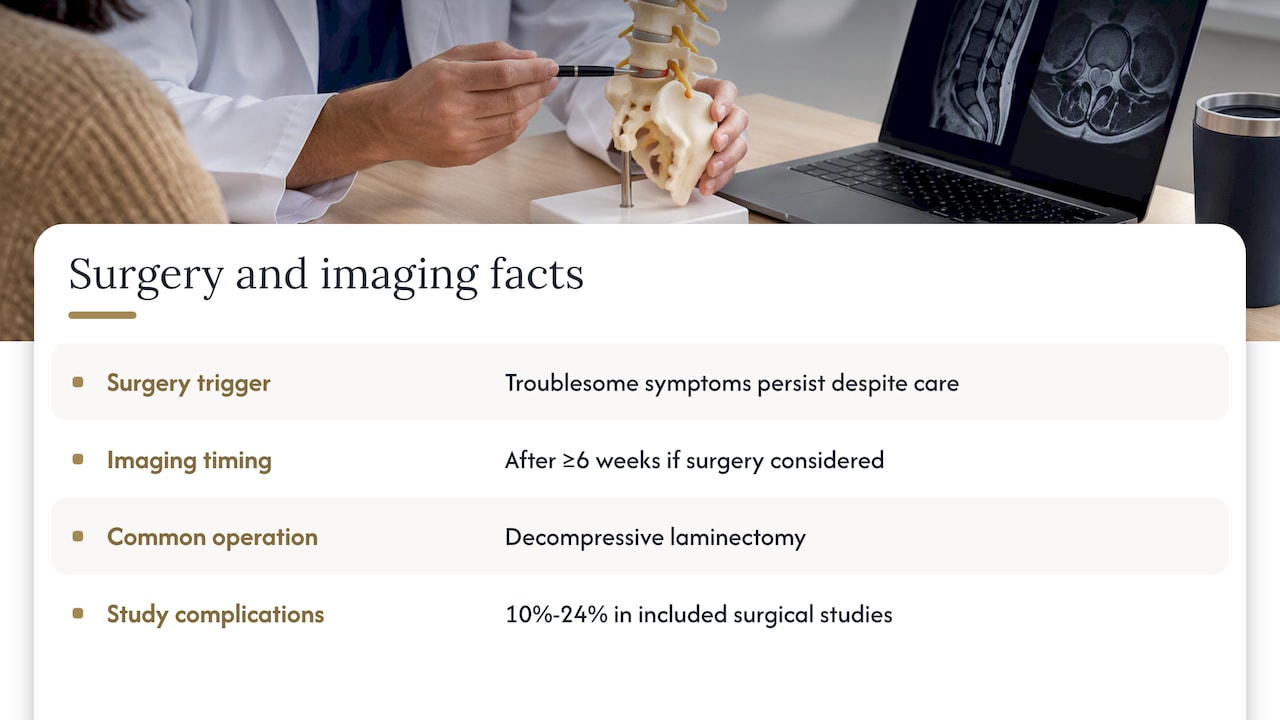
The Cochrane review also cautions that evidence directly comparing surgery with conservative care is low quality, and that complications in the included surgical studies ranged from 10% to 24%. That does not make surgery wrong for you. It makes a structured, time-limited conservative trial a sensible first step for most people.
When someone arrives with stenosis, the first thing we want to understand is what they have stopped doing: the walk to the corner store, the garden, the hockey game with their kids. That tells us what the plan has to restore.
Our approach is built on a full biomechanical assessment and an individual plan, delivered by a multidisciplinary team. Spinal decompression is one of the non-invasive tools we have for this, and we like it because it lets us calm symptoms in a controlled way and pairs naturally with active rehabilitation. The research favours combined care, and combined care is how we work: adjustments and soft tissue work, decompression where it suits, and exercise that you can keep doing at home.
We also think you deserve a clear map. If your assessment shows signs that need a physician or a spine specialist, we tell you plainly and help you get there. If it shows a good fit for conservative care, we start promptly, and we offer same-day appointments to help you do that.
Deane
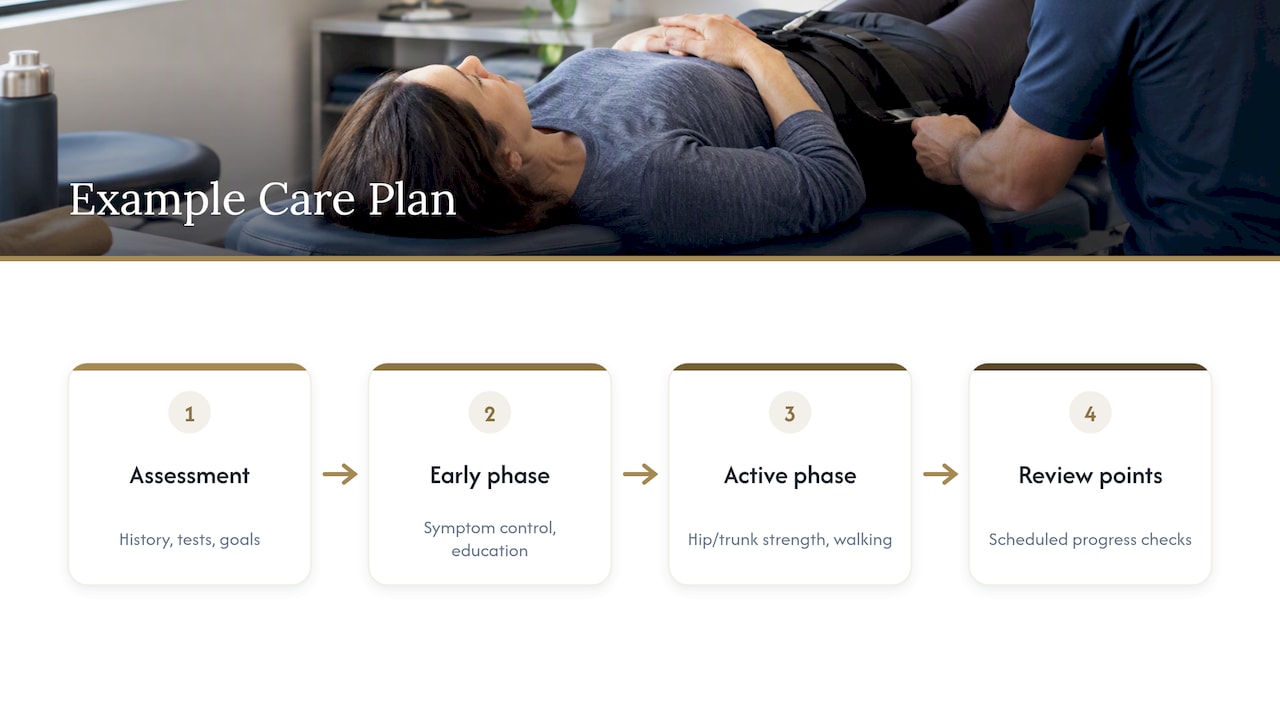
Every plan is individual, so treat this as an illustration of structure, not a prescription or a promise of results.
Assessment visit. History, walking and standing tolerance, neurological screening, movement testing, and a discussion of your goals. If you already have imaging, bring it.
Early phase. Symptom control and education. This may include manual therapy, soft tissue work and, if suitable, decompression sessions, with simple movements and walking strategies to practise between visits.
Active phase. Progressive strengthening of the hips and trunk and gradual increases in walking time. Sessions become less about the table and more about movement.
Review points. At set intervals we check whether you are getting better at the things that matter to you. If progress stalls despite suitable care, that is a reason to talk about a specialist opinion, in line with the Canadian pathway above.
If your symptoms include sciatica-type leg pain, our article on spinal decompression for sciatica and why active rehab matters goes deeper. For a broader view, see non-surgical back pain treatments that actually work, and if a disc is part of your picture, read about herniated disc treatment in Calgary.
If walking, standing or sleeping has become harder because of back and leg symptoms, an assessment is the practical next step. We will examine you, explain what we find in plain language, and tell you whether spinal decompression fits your plan.
We offer same-day appointments and direct insurance billing where applicable. Learn more about spinal decompression at Shephard Health or see our full chiropractic care in Calgary.
The best-supported conservative approach is multimodal care that combines manual therapy and exercise. A 2022 systematic review rated that evidence as moderate quality for short-term symptoms and function, while evidence for other single interventions was low or very low. We use decompression as one part of a wider plan, not as the whole plan.
For most people, yes, at least initially. Non-surgical care is almost always the first recommendation, and Alberta Health Services lists activity changes, exercise, physiotherapy and pain medicines among the options. Surgery is discussed when disabling symptoms persist despite good conservative care or when red-flag signs appear.
No. Conditions such as fractures, severe osteoporosis, tumours, pregnancy or previous fusion call for extra caution or a different plan, which is why an assessment comes first. Tell your clinician about your full medical history before any treatment.
Go immediately for new bladder or bowel problems, numbness in the saddle area, new sexual dysfunction or rapidly worsening leg weakness. Foot drop, repeated falls or a marked change in your walking also need prompt medical assessment.
Same Day Appointments Available
We Direct Bill!