

Tarsal tunnel syndrome (TTS) is a pinched tibial nerve on the inside of your ankle. It is usually treated step by step, starting with activity changes, ice, supportive footwear or orthotics, and guided rehabilitation, with injections or surgery kept for cases that do not settle. The earlier the cause is found, the better your options. At Shephard Health in Calgary we assess your foot, ankle and movement patterns together and build a rehabilitation plan around what is actually loading the nerve, with same-day appointments available and direct insurance billing where applicable.
The tarsal tunnel is a narrow passage along the inner ankle, bordered by bone and covered by a band of connective tissue. The tibial nerve runs through it on its way to the sole of the foot. When the space tightens, the nerve is squeezed.
Alberta Health Services describes the symptoms as burning foot pain, aching, numbness and tingling in the sole or arch. A professional reference also lists night pain, symptoms that do not ease with rest, and worsening with prolonged activity.
The same Alberta source lists the common risk factors: a past ankle injury, being on your feet a lot, being an athlete, rolling the ankle inward when you walk or run (pronation), a cyst or tissue mass, and inflammation or swelling in the area. If you run, play court or field sports, or work on your feet, you are in the group most likely to meet it.
The first stage is simple and worth doing properly. Alberta Health Services advises you to:
All four points come from the Alberta Health Services care instructions. Where home care goes wrong is in the details: icing too long, resting completely until the foot stiffens, or returning to full training the day the tingling fades. Because the nerve irritation usually comes from how the foot is loaded, calming it without changing the load tends to bring it back.
If swelling is part of your picture, reducing it can help the tunnel regain space. There is a general guide on compression therapy for swelling that covers the basics.
If pain does not improve with home care, contact your doctor or call 811, as Alberta Health Services recommends. You can also book an assessment with us so the cause is identified early.
TTS is a label for a result, not a cause. A flattened arch with excess pronation, a tight calf, a previous sprain, a cyst, or swelling from inflammation can all narrow the tunnel. This matters because treatment differs. Research on conservative care notes that orthoses are often used when a foot deformity is behind the problem, while anti-inflammatory approaches suit inflammatory causes.
A proper assessment looks at how you stand, walk and run, how your ankle and foot move, where the nerve is tender, and whether tapping along its path reproduces your symptoms. When symptoms are stubborn, your physician may order nerve conduction studies or MRI. A 2025 Washington State clinical resource says these tests can be considered when a case has not resolved within a few weeks, to check whether the posterior tibial nerve is compromised.
Our approach starts with a comprehensive biomechanical assessment, so your plan is built on your foot and your goals, not a generic protocol.
Support is where many people see the first change. The Merck Manual explains that strapping the foot in a neutral or slightly inverted position, raising the heel, or wearing a brace or orthotic that holds the foot inverted reduces tension on the nerve. A review in EFORT Open Reviews also lists kinesiology tape for arch support, a medial heel wedge to reduce nerve traction, and night splints among the rehabilitation options.
In practice, a shoe that fits well, an orthotic matched to how your foot actually moves, and taping while you build strength can take pressure off the nerve during daily life. We offer custom foot orthotics and Kinesio Taping for exactly this purpose. If your arch is part of the picture, our article on plantar fasciitis treatments covers related foot loading.
Guided rehab is the centre of non-surgical care. The 2022 systematic review in Orthopedic Reviews reported that all 28 patients who followed a 6-week physiotherapy program of stretching, strengthening and medial arch supports improved in pain and range of motion. The EFORT review adds calf stretching, nerve gliding and strengthening of the tibialis posterior (the muscle that supports your arch) to the list.
How to start safely:
This is where hands-on care and supervised exercise earn their place. Our physical rehabilitation and nerve flossing program is designed to restore ankle and foot movement while you strengthen the structures that keep the tunnel open.
Soft tissue tightness around the calf, inner ankle and arch can add to nerve pressure. At our Calgary clinic we use Active Release Technique, Graston Technique and massage therapy to address those tissues, and non-invasive options such as laser therapy and shockwave therapy as part of a treatment plan. Joint work through chiropractic care can help the foot and ankle move as they should.
If you want to know what to expect from a session of the more technical options, we explain the process in our shockwave therapy procedure guide and our overview of Active Release Technique.
For related nerve entrapments elsewhere in the body, see our pages on carpal tunnel and ulnar nerve entrapment.
Your physician guides this stage. Reviews describe pain-relief drugs such as acetaminophen and NSAIDs, nerve-pain medicines such as gabapentin and pregabalin, and corticosteroid injections into the tarsal tunnel to reduce swelling, as set out in the EFORT Open Reviews article.
A 2022 study of 218 patients who received ultrasound-guided injections found 77.5% did not need surgical release, and no injection complications were detected. The authors note injections should be done carefully because of the risk of tendon rupture and injection into a blood vessel, which is why a trained physician should perform them, preferably under ultrasound.
Surgery is considered when conservative treatment has failed and the cause of the entrapment is clear. The EFORT review describes releasing the band of tissue that roofs the tunnel, with reported success rates from 44% to 96%. Better results are seen in younger patients with a clear cause, a short history and early diagnosis.
The British Orthopaedic Foot & Ankle Society advises that non-operative measures that bring no benefit should not be prolonged, to avoid irreversible nerve changes, and reports better outcomes when surgery is done within 12 months of symptom onset. A 2024 scoping review of 32 studies found excellent or good results in 75.3% of cases.
The practical message: give a structured plan a fair trial of a few weeks, and review progress with your physician. If numbness spreads, weakness appears, or pain keeps worsening, ask your doctor about referral for further testing.
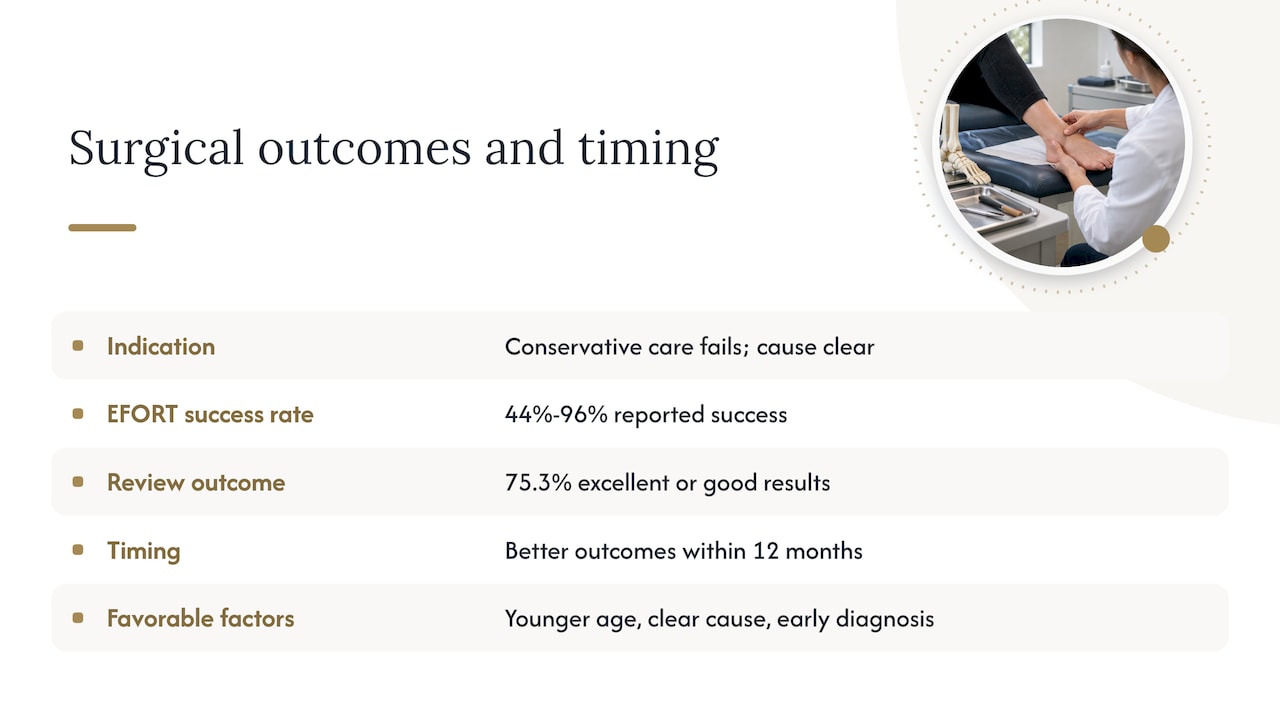
A reviewed set of options is only useful if it is matched to your foot. Rest, orthotics, stretching and injections each fit certain causes, and the same review notes that the success of conservative care is not clearly established for every patient, which is the reason to assess first and adjust as you respond. Tracking your response week by week lets you and your clinician change course early instead of drifting.
Most people who come to us with inner-ankle burning have already tried resting and a drugstore insole. What has usually been missed is the reason the nerve is under pressure: how the foot rolls in, how tight the calf has become, how the ankle moves.
That is why we begin with a biomechanical assessment and build an individual plan. Our team combines chiropractic care, rehabilitation exercise, soft tissue work such as Active Release Technique and Graston Technique, and non-invasive technologies like laser and shockwave therapy, so that your plan can cover the whole chain from foot to calf, not only the sore spot.
We have experience with athletes and with families, and we aim to get you back to what you do without pain. Same-day appointments help you start sooner, and direct billing to insurance, where applicable, keeps the process simple.
Deane
If burning, tingling or numbness in your foot is not settling, an early assessment gives you the clearest picture of your options. Our clinic offers physical rehabilitation, orthotics and hands-on therapy for tibial nerve irritation, with same-day appointments and direct insurance billing where applicable.

It depends on the cause and how long the nerve has been irritated. The 6-week physiotherapy program in the 2022 review is a useful reference for the time frame of a structured plan. If you see no change after several weeks, have your plan reviewed.
Usually with changes. Alberta Health Services advises reducing or pausing the activity that causes symptoms and taking breaks to rest and stretch. Lower-impact training that does not provoke burning or tingling is generally a sensible bridge while your rehab progresses.
Alberta Health Services recommends ice or a cold pack for 10 to 20 minutes at a time, with a thin cloth between the ice and your skin. Use it after activity or when the area feels inflamed.
Supportive footwear, arch supports and orthotics are part of first-line care in the Alberta Health Services guidance. They work best when matched to how your foot moves, which an assessment can show.
Same Day Appointments Available
We Direct Bill!